|
|
Happy Independence Day! The July TPA is truly packed with information. Read about how "Our Forests Need Your Help." Get to know GLTPA member Gene Brzoznowski, find out Where the Whip-Poor-Wills are and learn about Green Energy Impact on Wildlife Habitat. This issue also introduces Associated Contract Loggers and Truckers of Minnesota and GLTPA Board Member Guy Longhini.
Don't forget all your other favorites - they're in there too.
Logging EXPO is right around the corner - sign up to exhibit, attend, and check out the Earl St. John Golf Outing, it's a great time!
Have a safe & blessed July.
|
|
|
Visit our Website: www.gltpa.org |
|
|
|
|
From the President's Desk
Troy Brown
|
“Lobbying & PACs to Protect Our Industry”
The term lobby often has a negative connotation when associated with an attempt to influence political activity to secure political action in favor of personal interests. The most original and fascinating story about the origins of lobbying is connected to President Grant. The President would often stay at the Willard Hotel, where political activists would wait for him to appear in the lobby. When the President appeared, he was met by many visitors hoping to secure political favors from him. However, lobbying is most accurately credited to the English Parliament, where the same activity took place as members of Parliament were met in the lobby before and after chamber proceedings.
Lobbying is a necessary process in a democratic society. The practice is considered in a negative light when the term influence is used. However, when the word education is substituted for influence, this becomes a very important process to the system. We live in a vast and complex society with every interest group protecting what they believe in.
|
|
|
|
GLTPA Director Notes
Henry Schienebeck
|
Greetings,
First, a follow up to June’s greetings message regarding deforestation. Moving forward, GLTPA is asking its members for help. What is being asked is that members please call the office anytime you see land being deforested for another use. Doesn’t matter what the conversion is for only that it is taking place. All we need currently is an approximate number of acres and an approximate location. You can call the office at 715-304-2861 and anyone of the team will be happy to take the information.
Now for July,
What does a road or bridge know about the load it carries? Nothing and furthermore it doesn’t care. It is a road built out of dirt, gravel, blacktop, concrete, and for logging it can be snow, ice, and whatever other material we find to make it travelable.
All the road really cares about is axle weight and the bridge likes to know the distance over which the load is spread. Those two little bits of information determine how far the road will flex when the axles tires pass over it and the loads spread will determine how far the bridge will bend when the full load passes over it. Ever take a hacksaw blade and bend it just a little bit?
|
|
|
|
|
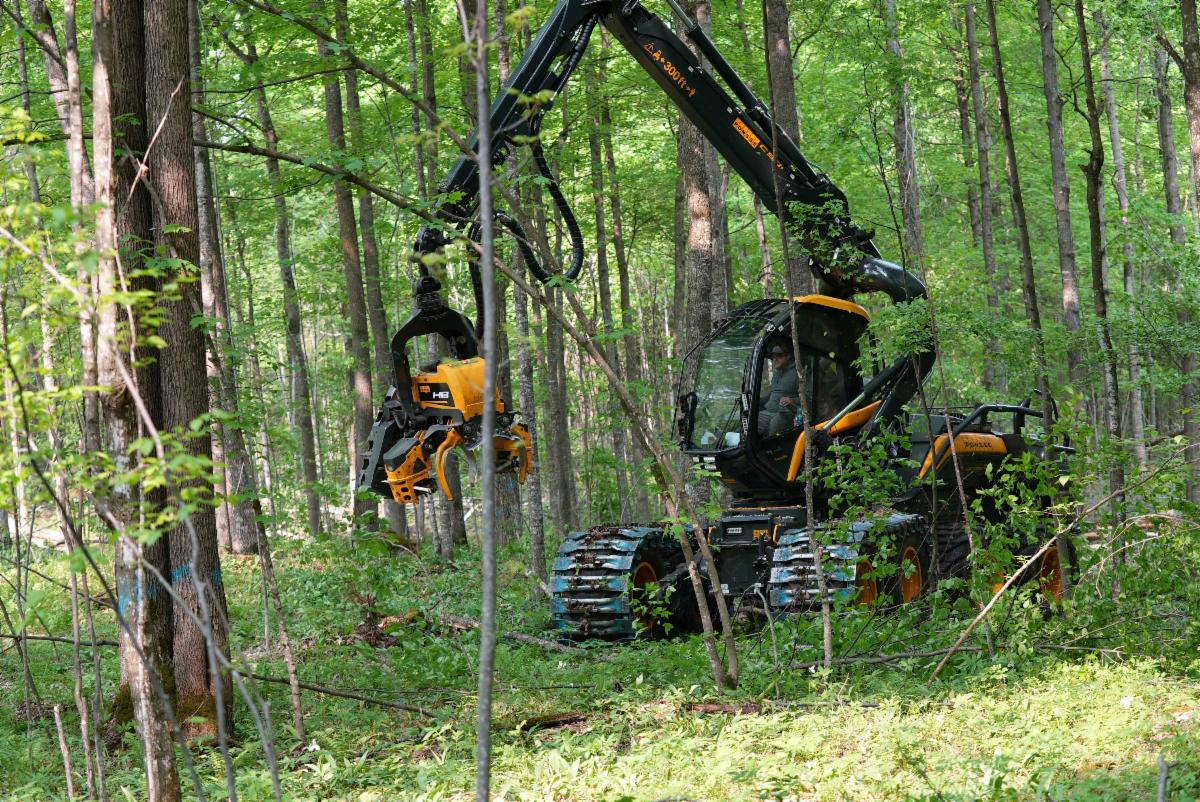
The newest member of the Scorpion family seamlessly complements the entire PONSSE harvester range. Developed according to the requests from our customers, PONSSE Scorpion Giant conveniently fulfils the gap between Scorpion King and Bear in the PONSSE harvester line-up comparison.
PONSSE Scorpion Giant can be equipped with the H8 harvester head. Smaller heads are available for customers who mainly require more lifting power. With the new C50+ crane offering more lifting power and more tractive force, PONSSE Scorpion Giant is right at home in working with larger trees, in snow, slopes, and soft grounds.
PONSSE FUTURE CABIN
PONSSE Scorpion Giant is a beast of a harvester with more modern and stylish features, and increased comfortability. The best properties are still there – just upgraded from the feedback of operators. The entirely new cabin is full of features that improve visibility, safety, ergonomics and usability. All of these increase the operator’s comfort, while the completely new air conditioning system, larger storage spaces and dozens of other small details add their finishing touches.
|
|
|
Green Energy Impact on Wildlife Habitat, Animal Numbers, Hunter Access, and Agricultural Production |
|
By: Larry C. Holcumb, Ph.D. certified Wildlife Biologist
In this article an attempt will be made to share information demonstrating the adverse impact of green energy, especially solar and wind. Specific examples given will largely be from Michigan but other great lake states face similar policy followed for energy production.
Development of Policy
First, we need to understand electricity production in a state like Michigan as it exists today: the amount produced (megawatts). Sources available as of late 2018 were largely coal, natural gas, and nuclear. Wind and solar produced only about 5 percent and hydro, biomass and petroleum, and other gas, small percentages. Since then nuclear has disappeared and solar and wind has slightly increased. A very informative document, "Electricity in Michigan: A Primer", produced by the Mackinac Center reviews the entire process of laws, rules, and policy for energy development now and for the future in Michigan. They report that if the electric production industry were to replace fossil fuels and nuclear with renewable energy there would be very large increases in acreage required. Wind requires about 70 acres per megawatt; solar about 43.5 acres. In comparison: nuclear, natural gas, and coal generation, just over 12 acres per megawatt. They recently reported that to supply Michigan's energy needs with wind energy would require 3470 square miles; with solar, about 920 square miles.
Michigan Act 116 provided some tax relief to landowners who agreed to protect their agricultural and open spaces from development. The current Michigan governor's policy, together with state department bureaucracies have collectively declared that the solar energy industry sites are solar farms because they are harvesting energy from the sun. Thus, many areas that were formerly protected from development by Act 116 agreements are free to become solar industrial sites in rural areas. A similar policy is being used to allow wind energy industrial development sites that are called wind farms.
|
|
Great Lakes Timber Professionals Association
PO Box 1278, 3243 Golf Course Road Rhinelander WI 54501
PHONE # 715-304-2861
|
|
|
|
|
|
|