|
We have been working hard to develop liming recommendations and evaluate other strategies that combat soil acidity issues. When it comes down to it, liming is your best option. However, in many cases rented ground may not be feasible to lime. The contracts are short and you are not guaranteed to reap the benefits from the input costs of adding lime to soil. If you are renting a parcel and not guaranteed to farm that acid land for two or more years, banding 50+ lbs P2O5/ac may be a more economical decision (Cho et al., 2020). Others have argued the phosphorus banding strategy for up to five years to be economical (Kaitibie et al., 2002).
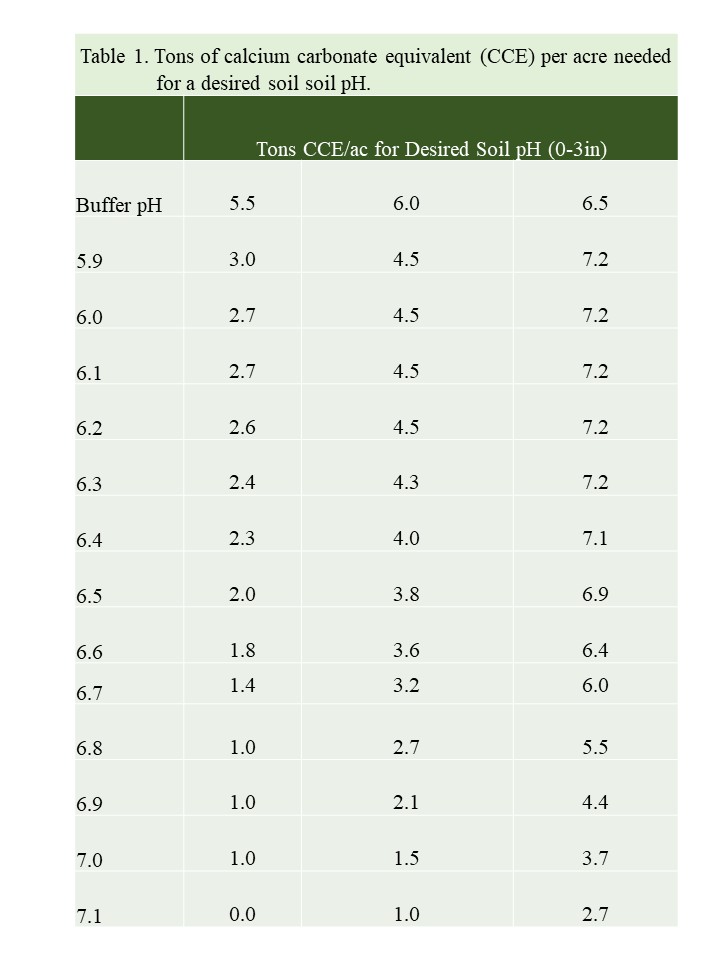
When it comes to liming, think of applying tons per acre and not pounds per acre. Our research shows that the Buffer pH soil tests does well predicting how a soil will respond to liming. Data from many other states agree with this. The table below (Table 1) shows how much lime/calcium carbonate equivalent (CCE) is needed to improve soil acidity.
To use this chart, look at your soil’s Buffer pH (left column), select a desire pH (Bold numbers at the table top), and look below in the appropriate column where the Buffer pH and Desired Soil pH intersect. For example, your soil test says the Buffer pH is 6.3 and you want a soil pH of 6.5. The recommendation is 7.2 tons CCE/ac. That is assuming a few things.
1: The liming material is fine and all the material passes through a 50 mesh screen.
2: The liming material calcium carbonate efficiency is 100%.
The two aforementioned variables impact how much product is truly needed for a desired soil pH. Particle size is important because finer materials have more surface area and readily react with the soil more than a coarser material. Beet lime is generally very fine and passes through the screen. Whereas, pelletized lime is coarser and needs to be accounted for. The purity of the lime or calcium carbonate equivalent (CCE) reference the neutralizing power a material has. Products like beet lime are likely closer to 70% CCE and pelletized lime may be around 95% or better. If you’re using these products, be sure to adjust accordingly.
Applying a liming amendment is your only option to improve soil acidity. If you’re renting land on a short-term basis, cultivar/crop selection or a high rate of banded phosphorus could be your best option to manage these troublesome acres. Either way, be sure to soil sample at the 0-3 inch depth in a suspected acidic area to make sure you are addressing the right problem. Pinpoint those acidic soils with precision agriculture to most efficiently manage those troublesome acres (Augustin and Buetow, 2002).
Augustin, C.L., and R. Buetow. 2023. Soil sampling depth in no-till acid soils. Comm.in Soil and Plant Anal. 55(1), 1-6. DOI: 10.1080/00103624.2023.2259421
Cho. W., B.W. Brorsen, D.B. Arnall. 2020. Banding of phosphorus as an alternative to lime for wheat in acid soil. Agrosyst. Geosci. Environ. 2020;3:e20071. doi:10.1002/agg2.20071.
Kaitibie, S., Epplin, F. M., Krenzer, E. G., & Zhang, H. (2002). Economics of lime and phosphorus application for dual-purpose winter wheat production in low-pH soils. Agronomy Journal, 94(5), 1139–1145. https://doi.org/10.2134/agronj2002.1139
|