In 1981, a relatively progressive Dartmouth College—newly open to women and focused on racial diversity—named businessman David McLaughlin as its next president. McLaughlin had few academic credentials but his conservative leanings and budgetary savvy as a corporate CEO were thought by supporters to be great assets. Fast forward four decades and note the similarities in last week's appointment of conservative former U.S. Sen. Ben Sasse as the next president of the University of Florida. The choice of Sasse—known for stances against gay marriage, the Affordable Care Act and abortion—immediately drew protests from students and faculty. College presidential historian Stephen J. Nelson, professor of educational leadership at Bridgewater State University and senior scholar with the Leadership Alliance at Brown University, writes in NEJHE: "If the past is prologue, Sasse and Florida are in for a rough ride."
|
|
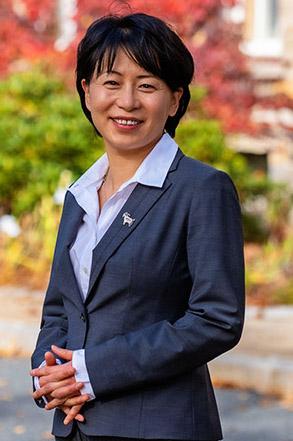
Worcester Polytechnic Institute (WPI) selected materials scientist “Grace” Jinliu Wang as its 17th president. She succeeds Laurie Leshin, who served as WPI president for eight years before joining NASA’s Jet Propulsion Laboratory as director in May. ... Northern Essex Community College hired Marjorie Campbell as the Tomfohrde Executive Director of Health Care Pathways to lead a one-year, grant-funded program providing healthcare employers with a talented and trained workforce pool while offering opportunities for their employees to continue their education and training. ... Burlington, Vt. Mayor Miro Weinberger chose Kimberly Carson, recently the Iowa Judicial Branch’s director of education and human capital development, to serve as the Vermont city’s next director for the Office of Racial Equity, Inclusion & Belonging. The job has been open since the department’s first director, Tyeastia Green, resigned in March. ... See more on these and other developments in NEJHE's Comings and Goings tally of new appointments in New England higher ed and beyond.
Pictured: Grace Wang
|
|
|
As NEJHE noted last month, the topic of cybersecurity and higher education is not going away any time soon. NEBHE journalism intern Viktoria Popovska checks in on the latest happenings. Among them: the launch of CyberTrust Massachusetts, a new nonprofit that will work with business and academia to grow the cybersecurity talent pipeline and increase career pathways for underrepresented groups ... the Boston office of the FBI's partnership with Moderna, the biotech company and vaccine maker, to highlight cybersecurity awareness among government, academic and private-sector organizations about cyberthreats ... a National Science Foundation-funded program providing selected students in cybersecurity-related fields at the University of Rhode Island with scholarships toward tuition and fees.
|
|
|
From time to time, NEJHE revives the presentation of facts and figures called Data Connection that we had published quarterly for nearly 20 years in the print editions of The New England Journal of Higher Education and its predecessor, Connection. This edition includes data on diversity, unions, absenteeism, book bans, school boards, legacy admissions and more.
|
|
|
Tidbits from the NEJHE Beat |
|
|
Brief items from the "NEJHE Beat"—that unique constellation of issues connected to higher education and also to social justice, economic and workforce development, regional cooperation, quality of life, academic research, workplaces and other topics that together say "NEJHE."
|
|
|
Blasts from the Past ... ICYMI from The New England Journal of Higher Education ... |
|
|
The Commission on the Future of Higher Education in Prison held its first meeting last Friday at the Hacker Reactor in MIT's Innovation Center. Convened by NEBHE and The Educational Justice Institute at MIT (TEJI)—and funded with a $250,000 grant from the Ascendium Group—the Commission will formally assemble more than 80 individuals throughout New England who represent key stakeholders, including postsecondary and corrections leaders, current and previously incarcerated individuals, employers, legislators and governors. The Commission will develop an action agenda, policy recommendations, strategies and next steps to align institutions, policymakers, prisons, and industry to increase the life and career readiness of formerly incarcerated people—and facilitate their successful transitions to work and sustained contributions to the wellbeing and competitiveness of the region and nation. Visit here for more on the New England Commission on the Future of Higher Education in Prison.
|
|
|
NEBHE published its 2022 Annual Report, providing an overview of the interstate compact's programs, including Tuition Break, Policy & Research, The New England Journal of Higher Education (NEJHE) and the State Authorization Reciprocity Agreement (SARA) as well as NEBHE initiatives on Open Educational Resources (OER), college transfer, the North Star Collective Faculty Fellowship aimed at uplifting BIPOC (Black, Indigenous and people of color) faculty on college campuses, and the future of postsecondary education for people in prison.
|
|
|
NEJHE NewsBlast is a summary of NEJHE content and other news around NEBHE prepared weekly by NEJHE Executive Editor John O. Harney and emailed every Wednesday to opinion leaders and practitioners. When responding to NEJHE content, please make sure that your remarks are relevant, courteous and engaging. Individuals are responsible for their comments, which do not represent the opinions of the New England Board of Higher Education. We urge commenters to briefly note their occupational or other interest in the topic at hand. Please refrain from offensive language, personal attacks and distasteful comments or they may be deleted. Comments may not appear immediately. Thank you for staying engaged.
|
|
NEJHE NewsBlast is sponsored by
|
|
For more information about partnering with NEBHE, click here
or send an email message to our events coordinator Marla Phippen.
|
|
© 2020 New England Board of Higher Education |
|
|
|
|
|
|
|