Weekly Digest Number 33 - August 17, 2021 |
|
Port of LA/Long Beach Railway Workers Sue for Decades of Racist Abuse |
|
Lawyers from the civil rights law firms Hadsell Stormer Renick & Dai LLP and Mirer Mazzocchi & Julien PLLC yesterday sued Pacific Harbor Line, Inc. (“PHL”), its parent company Anacostia Rail Holdings Company (“Anacostia”), and two of their managers for decades-long race discrimination, harassment, hostile work environment, and retaliation against Black workers.
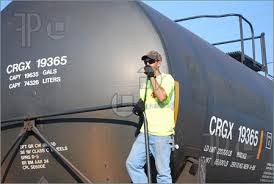
PHL is a short-line freight railroad corporation servicing the Ports of Los Angeles and Long Beach, which together form the largest container port in the United States. PHL’s work includes, among other things, moving cargo off the ships and onto trains, including a vast variety of goods such as baked goods, paper, lumbar, petroleum gas, corn syrup and other corn products, iron, and fireworks. Anacostia owns and manages six short-line freight railroads, including PHL, operating in seven states across the United States. This is the second lawsuit against one of Anacostia’s subsidiary short-line railroads for widespread racial discrimination and harassment; the first being against New York and Atlantic Railway.
The seven plaintiffs—six of whom are Black—are current and former railroad engineers with 18 to 7 years of tenure with PHL and Anacostia at the Ports of Long Beach and Los Angeles. Their work connects manufactured goods, industrial products and food that pass through the third-largest port in the world to communities all across the United States.
Throughout their employment with PHL and Anacostia, the Black plaintiffs and their colleagues have been subject to racial epithets such as “n***er”, “slave”, “monkey”, and “coon”; exposed to chalk-drawn graffiti on a bridge in the rail yard including threatening KKK imagery, images of black men hanging, and chalk-drawn slogans such as “the only good n***er is a dead n***er”; demeaned by denigrating racist stereotypes of black people as “lazy”; harassed with “slave jokes”; debased by negative racial stereotypes around watermelons and fried chicken; pelted with urine-filled bottles; and mocked for the color of their skin. This abuse intensified with the arrival of new management in 2009. PHL managers repeatedly turned a blind eye to this appalling conduct—when they were not participating in it directly.
|
|
(Editor's Note: The Class One carriers slash their workforce ... and then cry aloud that they cannot get people to work for them. It's not OUR fault, they say. Ports are congested as ships unload and containers cannot be forwarded to their destinations. Not OUR fault. Amtrak trains are delayed endlessly by the excessively long and heavy trains clogging up the mainline. Not OUR fault ... And on and on.) |
|
Labor Shortage for Railroads that Have Slashed Workforce by 33% |
|
“No way did I realize how difficult it was going to be to try and get people to come to work these days…” CEO of CSX.
There are few hiccups in the US economy right now. James Foote, the chief executive of CSX, one of the largest railroads in the US, put it this way:
“In January when I got on this [earnings] call, I said we were hiring because we anticipated growth. I fully expected that by now we would have about 500 new T&E [train and engine] employees on the property,” he said. “No way did I or anybody else in the last six months realize how difficult it was going to be to try and get people to come to work these days.”
“It’s an enormous challenge for us to go out and find people that want to be conductors on the railroad, just like it’s hard to find people that want to be baristas or anything else, it’s very, very difficult,” he said. So even though we brought on 200 new employees, we fell short of where we thought we would be by now….”
Railroads are grappling with a weird phenomenon that is a combination of “labor shortages” and 12.6 million people still claiming some form of unemployment compensation, amid stimulus-fueled demand.
This comes after railroads had spent six years shedding employees in order to tickle Wall Street analysts and pump up stock prices. The North American Class 1 freight railroads combined—BNSF, Union Pacific, Norfolk Southern, CSX, Canadian National, Kansas City Southern, and Canadian Pacific—have tried to streamline their operations, using fewer but longer trains and making other changes, including the strategy of “precision scheduled railroading,” implemented first by Canadian National, then by CSX.
The resulting deterioration in service triggered numerous complaints from shippers. But one of the big benefits was that the workforce could be slashed, which fattened the profit margins at the railroads. Wall Street analysts loved it, and it was good for railroad stocks. By now, precision scheduled railroading has become the new religion at all Class 1 railroads except at BNSF, which has not officially adopted it, at least not completely.
In the process, over the past six years, the Class 1 railroads have axed 33% of their workers through layoffs and attrition. According to the Surface of Transportation Board (STB), an independent federal agency that oversees freight railroads, the Class 1 railroads slashed their headcount from 174,000 workers in April 2015 to 116,000 workers in June 2021.
Before the railroads blame the 33% cut in the workforce on the pandemic, let’s point out that by February 2020, just before the pandemic, their headcount had already been cut by 46,000 workers, or by 26%, to 128,000. Only 12,000 workers were cut during the pandemic.
During the pandemic, some of the workers were put on furlough, to be recalled more easily. But it turns out that not all of them are eager to return to work on the conditions offered by the railroads, including relocation to new assignments.
These cuts in the workforce, and now the scrambling to hire people amid “labor shortages,” is contributing to issues in meeting heavy transportation demand: Union Pacific temporarily suspended traffic from Los Angeles into Chicago, and BNSF has started to meter traffic into Chicago, to allow them to catch up unloading the trains that are stuck in their Chicago rail yards. The resulting pot-banging by frustrated shippers has gotten the attention of the STB.
“The railroads cannot strip down to bare-bones operations,” STB chairman Martin Oberman told the Wall Street Journal. “It’d be like a professional football team only having one quarterback.”
|
|
What's in the Senate's Bipartisan Infrastructure Bill for Rail |
|
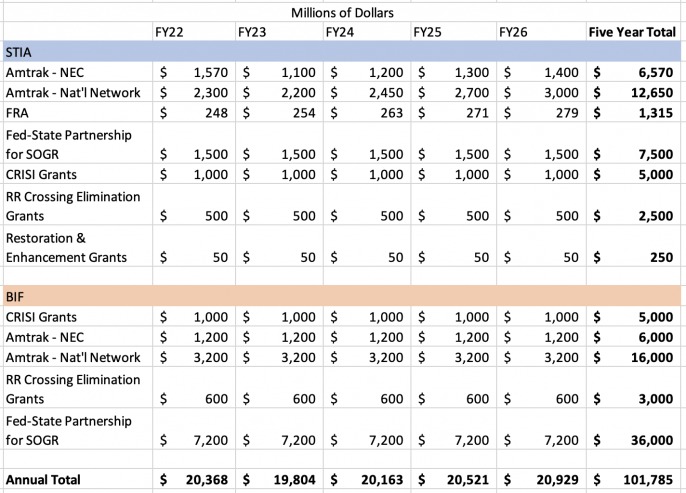
The Senate has combined the two investment bills to create a truly ambitious investment program in passenger rail in the U.S. Combining both the Bipartisan Infrastructure Framework and the Surface Transportation Investment Act of 2021, the bill outlines $102 billion in rail investment over the next five years – a potentially transformational figure. [Nb. It’s important to note that future appropriations aren’t guaranteed in the absence of a passenger rail trust fund. That means only $66 billion of the rail funds are guaranteed, with the remainder at the discretion of appropriators. There’s no assurance that the additional $36 billion in investment will ever fully materialize. This creates uncertainty around federal operating funds and total levels of capital investment, potentially hindering the ability of States and Amtrak to effectively execute multi-year capitalization plans.]
|
|
(Editor's Note: As this article so astutely points out, we cannot talk about passenger trains without talking about freight trains. And we cannot talk about freight unless we address the elephant in the room; that is, the rail industry in North America is vital national infrastructure that is in the hands of private investors, whose short-term financial interests are at loggerheads with the interests of the nation) |
|
Amtrak Joe vs. The Modern Robber Barons |
|
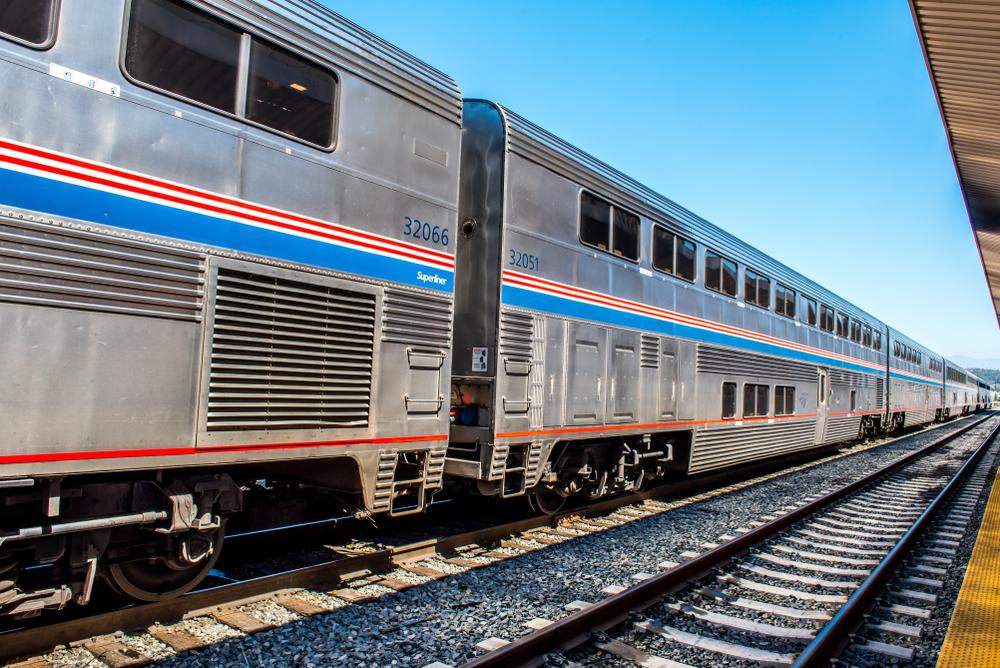
For a chief executive whose love of trains won him the nickname “Amtrak Joe,” this must be a pretty exciting moment. President Joe Biden’s bipartisan infrastructure bill, which designates an unprecedented $66 billion to expand rail service across the country, appears poised to pass the Senate (Editor's Note: It did, last week).
The bill promises to furnish a more convenient and environmentally friendly mode of travel between destinations that are far enough apart to make driving tedious but close enough together to make flying impossible or at best impractical. You may never use these new trains yourself, but those who do will create less traffic congestion, cleaner air, and a cooler planet. Removing more freight from pavement-pounding long-haul semi-trucks onto super fuel-efficient trains will make driving safer and more pleasant, and may yield huge reductions in carbon emissions.
But for any of this to happen on any meaningful scale, the Biden administration will need to do more than invest more public money in train travel. It will also need to reverse decades of deregulation, lax antitrust enforcement, and other policy blunders that left latter-day robber barons in control of nearly all the nation’s highly monopolized railroad infrastructure, just as they were in the worst days of the Gilded Age. This time, the financiers aren’t presiding over an expanding rail system; they’re selling it off and permanently liquidating its assets for short-term economic gain.
Unless Biden takes on the financiers, merely maintaining Amtrak service – let alone expanding it – will become ridiculously expensive. Here’s an example that shows why. Amtrak for decades ran two roundtrip trains a day along the Gulf Coast corridor between New Orleans and Mobile. In 2005, Hurricane Katrina badly damaged the tracks. The two giant corporate rail systems that own the line, Norfolk Southern and CSX, made the necessary repairs, and within a year resumed running their own freight trains. But Amtrak service never returned ... After five years of negotiations, you still can’t take the train to Gulfport, Biloxi, Pascagoula, or anywhere else along the Gulf Coast. CSX, which controls most of the track along the route, insists that restoring Amtrak service would interfere with the seven or eight daily freight trains it runs daily along the Gulf Coast. It’s an argument that rail corporations often deploy against passenger service.
|
|
WATCH: Here's Why Bigger, Heavier Trucks Are So Dangerous |
|
Now that the U.S. Senate has passed an infrastructure bill, it will move to the House for additional consideration.
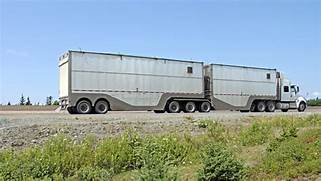
We’re now at a critical stage. You see, this is exactly the point at which the Bigger Truck Lobby will attempt to sneak last minute amendments into the legislation. Their goal? Open up our roads to more dangerous, more polluting trucks that put you and your family at great risk. This is where your Representative must hold the line. Email your Congressperson TODAY urging rejection of any changes in the infrastructure bill that would allow longer, heavier trucks on our highways.
|
|
(Editor's Note: After the last few months of impressive intermodal resurgence, the party has apparently come to a screeching halt. It is not because there are not containers to move by rail, but that the railroads and their PSR operating model have greatly restricted the Class One carriers' ability to handle the loads. Shippers have been forced to ship by truck due to a logjam of containers in many ports and rail hubs around the country. Just the latest example of how the nation's rail carriers are failing shippers, passengers, workers and the nation. NOTE: the U.S. freight rail network is moving less freight now that 15 years ago!) |
|
Carloads Up, Intermodal Volume Down for U.S. Railroads in Year's 31st Week |
|
U.S. railroads registered mixed traffic results in the week ending Aug. 7. Their carloads climbed 6.3% to 234,336 units but intermodal volume dipped 0.6% to 275,271 containers and trailers compared with the same week in 2020, according to Association of American Railroads (AAR) data.
U.S. roads’ total weekly traffic rose 2.4% year over year to 509,607 units. Six of the 10 carload commodity groups tracked by the AAR posted gains in the year's 31st week, including metallic ores and metals (up 7,424 carloads), coal (up 7,301 carloads) and and nonmetallic minerals (up 3,131 carloads). Grain, motor vehicles and parts, and and petroleum and petroleum products traffic declined.
Canadian railroads reported 72,235 carloads for the week, up 2.1%, and 68,578 intermodal units, down 1%, while Mexican railroads reported 19,407 carloads, down 11.6%, and 14,593 intermodal units, down 16.6%
|
|
(Editor's Note: It comes as no surprise that Amtrak - many of whose workers interface regularly with the public - would be the first Class One railroad to institute such a policy. Will the Class One freight carriers follow suit in the coming months?) |
|
Amtrak Requires Employees to be Vaccinated by November |
|
Amtrak is now requiring employees to be fully vaccinated by Nov. 1 and mandating that all new hires be vaccinated. Employees who do not submit proof of vaccination by Nov. 1 will be required to submit a negative COVID-19 test result weekly, Amtrak officials said in a press release. New hires will need to show proof of full vaccination starting Oct. 4 prior to beginning their employment.
The railroad offers all employees free vaccinations at public sites and hosts free vaccine clinics at various Amtrak locations, including one held last week with the state of Illinois and Walmart at Chicago Union Station. The return to work date for office employees is now set for Nov. 1, which is consistent with the railroad's vaccine mandate, Amtrak officials said.
|
|
(Editor's Note: This entire fiasco is reminiscent of the Conrail carve up in the late 1990's, when NS and CSX entered a bidding war that sent the price of Conrail stock skyrocketing, ending in a deal that split the railroad in half and a complete and total meltdown of the Norfolk Southern for over a year. Capitalism has very little memory of its past debacles ...) |
|
KCS Board Backs CN Merger Proposal, Cites Possible Shareholder Meeting Change |
|
Just two days after CP presented the higher bid, KCS’ board determined it doesn’t constitute a “superior proposal” to CN’s competing bid and could not reasonably be expected to lead to a superior proposal. The board came to that conclusion following a “careful and thorough review” in consultation with outside financial and legal advisors, KCS officials said in a press release.
“The KCS board reaffirms its recommendation to KCS shareholders to vote in favor of the pro-competitive, end-to-end merger with CN, which will create the premier railway for the 21st century and offer unparalleled opportunities and benefits for customers, employees, shareholders, the environment and the North American economy,” they said. “The board recommends shareholders vote for the pending merger with CN.”
|
|
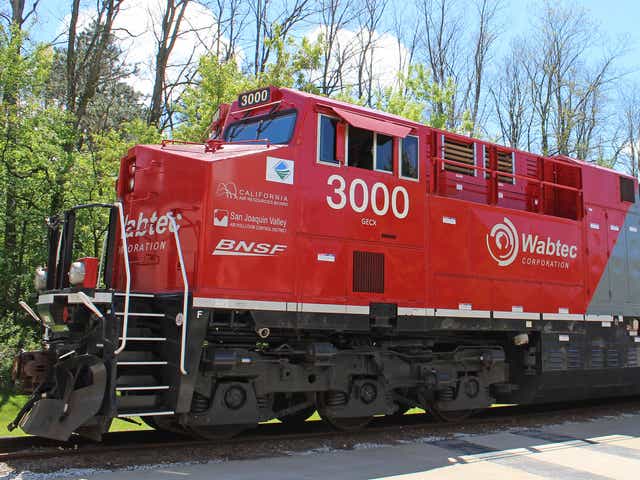
Wabtec Delivers Locomotive Overhaul No. 1,000 |
|
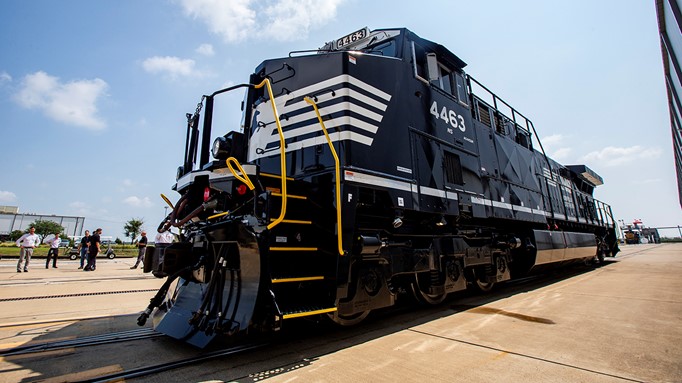
Wabtec’s modernization program covers replacing control systems to transforming DC-traction units into AC units. 4463’s transformation into an AC44C6M—a joint effort of Wabtec and NS engineering teams—involved a complete rebuild of the unit’s 7FDL primer-mover to EPA Tier 1 Plus emissions standards, upgrading the engine control system, and installing Trip Optimizer SmartHPT and LOCOTROL® eXpanded Architecture (XA) Distributed Power (DP)....
The rebuild into an AC44C6M yields “up to a 25% improvement in fuel efficiency; more than a 40% increase in reliability; up to a 55% increase in tractive effort; and up to a 20% reduction in maintenance, repair and overhaul expenses,” Wabtec reports. “The fuel efficiency benefits of these 1,000 locomotives have reduced carbon emissions by more than 1.4 million tons since 2015. That reduction is the equivalent of removing the emissions from 340,000 cars.”...
NS accounts for 500 of the 1,000 locomotives Wabtec has upgraded. Each rebuild in the NS fleet reduces more than 500 tons of carbon emissions per year, according to Wabtec.
|
|
(Editor's Note: RWU has endorsed the union's efforts to build green locomotives at the Erie plant, and has developed ties with Local #506 of the United Electrical (UE) over the last decade or so. The local's membership has built GE/Wabtec locos there for more than half a century. Perhaps the BLET and SMART-TD could jump aboard this train and lend the UE some support!) |
|
Can Green Locomotives Get Rail Industry Back on Track? Wabtec, Union Leaders in Erie Say Yes |
|
Developing low- and zero-emission locomotives can help address worries about climate change. And it can also be good for business.
Wabtec CEO Rafael Santana announced the establishment of a research institute in partnership with Carnegie Mellon University and Genesee & Wyoming Railroad during a House Transportation and Infrastructure Committee hearing in March. Santana told the committee the company was committed within the next nine years to developing the technology to accelerate the reduction of greenhouses gas emissions by using battery- and hydrogen-powered locomotives.
Meanwhile, union leadership at Local 506 of the United Electrical, Radio and Machine Workers of America in Erie has drafted legislation that would provide financial incentives to railroads that replace older, inefficient locomotives with newer, low-emissions models.
That legislation has been introduced by U.S. Rep. Jesús “Chuy” García, a Democrat who represents Chicago, in the form of an amendment to the Invest in America Act. The $760 billion legislation passed the U.S. House of Representatives about three weeks ago.
The three-pronged goal of the amendment is to "phase out older locomotives, decrease emissions from passenger and freight locomotives and to establish a grant program to facilitate the upgrading of existing locomotives and the purchase of new locomotives."
Scott Slawson, president of UE 506 at Wabtec, said Tier 4 emissions locomotives that the company make now generate dramatically less pollution than previous generations.
|
|
(Editor's Note: U.S. railroaders have a lot to learn from our Fellow Workers in European nations ...) |
|
In Germany, Railway Workers’ Strike Paralyzes Rail Traffic |
|
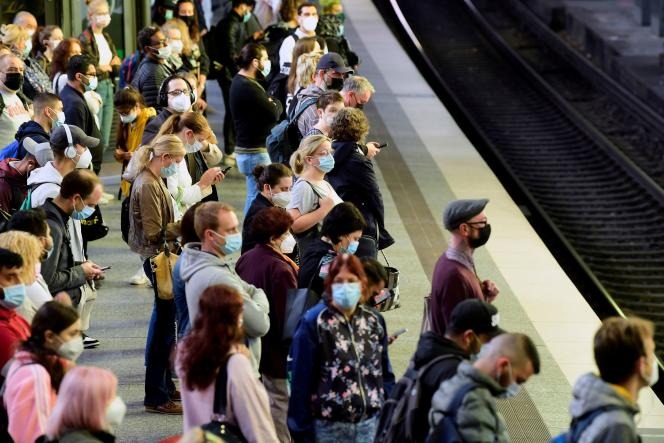
Three quarters of mainline trains remained at the depot on Wednesday. Regional traffic has been affected in different ways depending on the Länder, but everywhere the disorganization has caused serious delays. In cities like Berlin, Cologne or Nuremberg, suburban trains (S-Bahn) ran randomly. “I took six hours to reach the center”, told a resident of Spandau, on the outskirts of the capital. At the main station, thousands of holidaymakers found themselves without a train. Eleven of the sixteen Länder are still on school holidays and “With the uncertainty of the Covid-19 epidemic, like many people, we gave up on leave abroad and here we are stranded! “, lamented a Bavarian mother on her way to the Baltic coast with her two children.
The conflict could drag on for months
The GDL union has broken off talks with Deutsche Bahn, with which it is negotiating a new pay scale for train drivers. Voted 95% Monday, the strike promises to be hard and long. Walkouts are scheduled for 48 hours at first, but if discontent sets in, as in 2014-2015, the conflict could drag on for months. Claus Weselsky, CEO of GDL, set the tone on Tuesday: “To my knowledge, there is nothing that sets the limits of a strike. “ He could call for a second strike as early as next week.
|
|
(Editor's Note: With picket line support from the local labor movement including BLET and RWU members, the Keolis bus drivers have forced the company to back down on proposed health care cuts. This strike is of particular interest to railroad workers since the company has numerous local and regional contracts around the country to provide commuter rail services, including Boston's MBTA and Virginia's VRE. It is the largest operator of regional heavy rail in the U.S., and all told, operates in 15 countries with 60,000 employees) |
|
See NevadaLabor.com for references and history, including 2002 Hot August Strike 1.0
Agreement on Health Care Ends Transit Strike
|
|
Teamsters and contractor return to negotiation
RENO, Nev, (11:00 p.m. PDT 8-12-2021) - Teamsters Local 533 president Gary Watson tonight announced that the union has reached a tentative agreement with Keolis Transit on healthcare.
The parties will schedule future dates to bargain the rest of open contract articles as they work toward finalizing a new collective bargaining agreement.
"The Union looks forward to Keolis meeting us at the bargaining table with good intentions and bargaining in good faith moving forward. We are glad our members are getting back to work doing what they do best, servicing the transit passengers in the Reno, Sparks and Washoe County region," the longtime labor leader added.
Workers who had been on strike since noon on August 3 have until Saturday to return to work. Any workers who so desire may report for work Friday and allowed to service any available route.
Access NevadaLabor.com for complete background on all relevant issues and Teamsters/RTC history, including the 1999 near-strike and the 2002 walkout. The signed three-page health care agreement is available at the website.
|
|
|
|
|
|
|