Weekly Digest Week #40 - October 4th, 2022 |
|
Welcome to the RWU Rail & Labor News! This news bulletin is produced and emailed out each Tuesday morning. We hope you find each week's news and information useful. If so, please share with co-workers, friends, and colleagues. If you like, you can sign them up to get all the news from RWU HERE. Or forward them the link. Note: If you read over this news bulletin each week, you will be sure to never miss the important news of what is going on in the railroad world from a worker's perspective!
|
|
(Editor's Note: The whole debacle around the TA has propelled rail issues to the forefront, the likes of which has not been seen in decades. The press and the American people have discovered us, thanks in part to the diligent efforts of RWU. RWU encourages every rail worker to get out there and tell our story!) |
|
Railroad Executives Want to Eliminate Conductors — and Exhausted Rail Workers are Terrified |
|
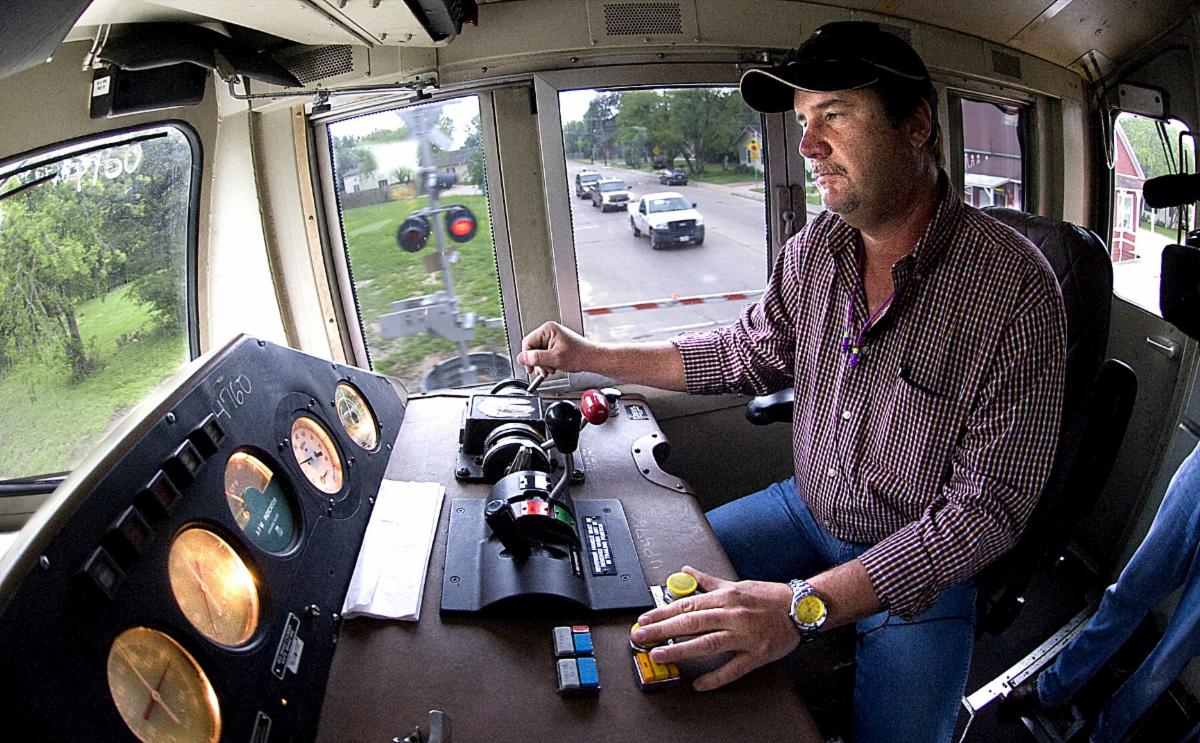
It was 11 p.m. on Jan. 3, 2022, when rail conductor Brian Raleigh got the call from Norfolk Southern that he would need to come into work.
Raleigh, who joined Norfolk Southern in 2004, drove to the railyard in Decatur, Illinois. He started setting up rail cars hauling soybeans, corn, chemicals and other commodities from the rural town. But he didn’t feel so good — just a cold, he figured.
Raleigh told the engineer for his train, Travis Pierce, he was feeling off. “No big deal,” Pierce thought at the time. “Hell, us as rail workers, we never feel good.”
The conductor took his temperature; it hit 99.9 degrees. Once the train started moving, Pierce remembered Raleigh was “sweating bullets,” and he regularly stepped outside the train in the 20-something-degree weather to cool off.
Raleigh decided to tell his dispatcher that “for everybody’s safety” he’d like to get off the train. They would find a new conductor to fill in for him in Harristown, about 10 miles from where they started.
Then Raleigh fell down. He tried to sit on a chair but passed out — hitting his head on the window. He vomited shortly after.
Pierce, the engineer, moved the train to the side at a nearby crossing. A dispatcher connected them to an ambulance, which showed up 15 or 20 minutes later, Pierce said.
“I never did ask him how long I was passed out,” Raleigh reflected months later. “I just remember him yelling at me, ‘Brian, Brian’ until I came to.”
|
|
(Editor's Note: Regardless of whether rails go on strike or not at the end of the day, our actions and resistance has inspired countless other workers to organize and fight back. We have the potential to lead a resurrection of organized labor in the U.S. in the months and years ahead.) |
|
New ‘Striketober’ Looms as US Walkouts Increase Amid Surge in Union Activity
Support for unions is on the rise as workers take action to raise pay and conditions amid booming company profits.
|
|
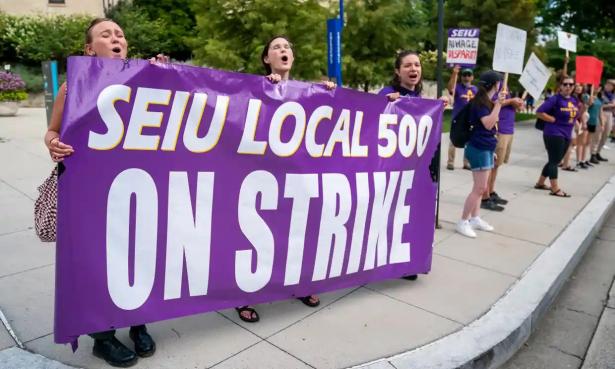
Thousands of workers around the US are going on strike or threatening to do so heading into October, amid a recent surge of labor action activity in America and just one month before crucial midterm elections.
Union election petitions increased 58% in the first three quarters of fiscal year 2022, compared with 2021. Public support for labor unions is at its highest point since 1965, according to the most recent Gallup poll, with a 71% approval of labor unions in the US.
According to the labor action tracker at Cornell University, strikes in 2022 so far have significantly outpaced strike activity in 2021, with 180 strikes involving 78,000 workers in the first six months of 2022, compared with 102 strikes involving 26,500 workers in the first six months of 2021. The tracker recorded 41 strikes that started between 15 August and 15 September 2022, involving 35,250 workers.
“Strikes appear to be increasing as we head into the fall,” said Johnnie Kallas, project director for the Cornell University ILR labor action tracker. “These strikes are being led by workers in the service sector. Starbucks workers have organized over 70 strikes so far this year in response to poor working conditions and employer retaliation. Over the past month, thousands of healthcare workers and educators have gone on strike to protest understaffing, low pay and poor conditions for patients and students.”
Last October was also dubbed “Striketober” by the US labor movement as a number of high-profile labor strikes and strike threats occurred throughout the month.
Some of the largest strikes in recent weeks in the US have included 15,000 nurses who went on a three-day strike in Minnesota, over 1,100 timber workers in Oregon and Washington, over 4,500 teachers and staff in Columbus, Ohio, more than 6,000 teachers and staff in Seattle, 2,000 mental healthcare workers in California, 1,200 casting plant workers at Stellantis in Indiana, and 700 nursing home workers in Pennsylvania.
|
|
(Editor's Note: RWU hosted this Canadian attorney at our Convention in June, and has sent letters of support for this cause to various Canadian officials in addition to the Surface Transportation Board in the U.S.) |
|
Whistleblower Questions CP Police Force Powers in US After KCS Merger
Attorney represents families whose relatives died in fatal 2019 incident
|
|
While much of the focus on the proposed merger between Canadian Pacific and Kansas City Southern has been on keeping cross-border gateways open to competing railroads, a Canadian attorney is asking whether there will be national security consequences if a corporate police force run by a foreign entity is operating on U.S. soil.
Tavengwa Runyowa, a Regina, Saskatchewan-based lawyer, plans to address that issue before the Surface Transportation Board’s three-day hearing later this week on the proposed merger.
Runyowa represents three families of CP employees who were killed during a February 2019 incident in which a CP train bound for Vancouver derailed near Field, British Columbia. The train consisted of 112 covered hopper cars and three locomotives. Of those, 99 cars and two locomotives derailed.
CP, like other Class I railroads, operates a police force to safeguard rail shipments and infrastructure. CP’s police force is a fully authorized federal force under the direction of CP.
Runyowa wants STB to consider how or whether a foreign-run corporate police force operating in the U.S. should abide by U.S. law — especially, he says, since he wants CP to be accountable for actions in Canada related to the February 2019 incident.
“If STB allows CP Railway to use the merger process to integrate the KCS police force into the new Canada-based CP-KCS Police, that will affirm the United States’ acceptance of non-American persons with no police powers in the United States, and who answer to persons outside of American soil, exercising full police powers in the country,” said Runyowa’s filing from last Thursday. “The externalization of extraordinary powers and informational access that law enforcement authority endows on those who exercise it could have disastrous national security, privacy, and other consequences on the United States.”
|
|
(Editor's Note: The classic case of "Vote until you get it right." The leadership simply repackaged the original TA with a few perks and lots of pledges that the company will bargain this and that. Isn't that what we just did for 2.5 years and met with nothing but resistance from the Class One's? Where did that get us?) |
|
Locomotive Machinists, Mechanics Reach New Deal with Railroads
Rank and file had rejected original deal with the Class I railroads
|
|
The International Association of Machinists and Aerospace Workers (IAM) District 19 has reached a new tentative agreement with the group representing the freight railroads in contract negotiations.
This agreement tweaks one that IAM rejected earlier this month. IAM represents locomotive machinists, track equipment mechanics and facility maintenance personnel at the freight railroads represented by the National Carriers Conference Committee (NCCC).
“Throughout this process of seeking a new contract, you have stood strong and demanded the fair treatment you deserve from the carriers,” IAM said in a Tuesday notice to members. “Your solidarity and strength have made national headlines and, most importantly, given your District 19 negotiating team the power we need at the negotiating table to make the carriers listen to your needs.”
According to IAM, highlights of the agreement include a cap on health care costs; codified language regarding travel costs for roadway mechanics; further bargaining over travel expenses and per diem; and plans to conduct a joint study on overtime, forced overtime policies and overtime meal options.
|
|
(Editor's Note: The nation's oldest and largest environmental group comes out publicly in support of railroad workers. RWU encourages all rail workers and rail unions to embrace these people and work together for expansion of freight and passenger rail in this country, along with better wages, benefits and working conditions for all railroad workers. Let's all extend the olive branch!) |
|
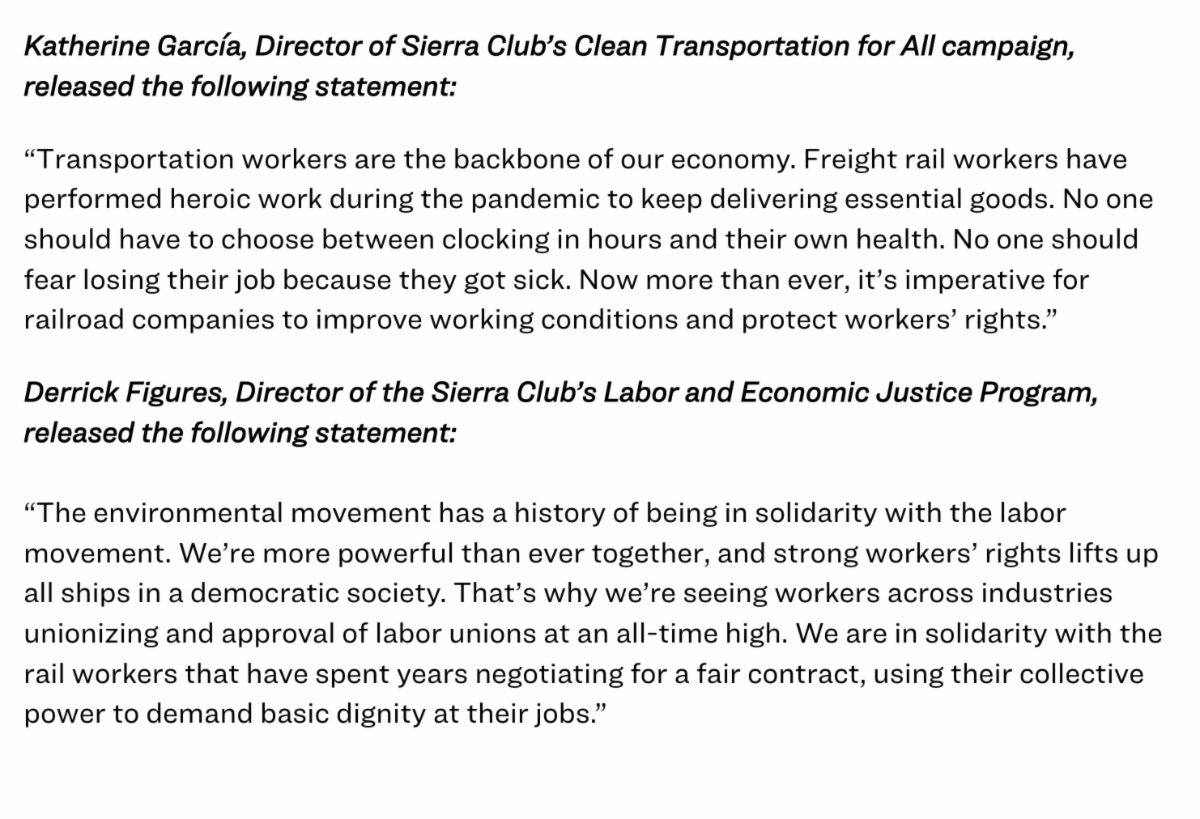
The National Sierra Club Issues Statement of Solidarity with the Nation's RR Workers
Sierra Club is in solidarity with the more than 100,000 rail workers negotiating for safer and better working conditions.
|
|
(Editor's Note: RWU has partnered with the group Solutionary Rail for eight years now. They are beating the bushes to build solidarity for the railroad workers struggle among individuals and organizations of the environmental movement.) |
|
Rail Advocacy Group Builds Solidarity with Rail Workers |
|
Friend --
As you know, a railroad strike was delayed - but not prevented - by the exceedingly inadequate tentative agreement negotiated on the eve of the strike. As railroad workers reject this agreement and wait out the next "cooling off" period, once again a strike is likely. We now have time to organize and further support railroad workers.
Now we need grassroots pressure on Congress and the Biden Administration to solve fundamental problems that created the conditions that are forcing the workers to exercise their right to strike. One ask is to pass H.R. 8649, the “Freight Rail Shipping Fair Market Act.
Click the buttons above for talking points and an easy tool that connects you with local newspapers and Congressional offices.
Need More Info?
An edited video of our webinar with railroad workers explaining why they are ready to strike is HERE. You can also add your name/organization to the Sign On Letter on this page.
Thank you for standing with these essential workers!
|
|
(Editor's Note: It is a new day, and the rail industry is oblivious to this fact. Workers are tired of poor treatment, overwork, dangerous exhausting conditions, and are standing up and resisting ... or simply making their departure from the industry.) |
|
To Avoid Next Crew Crisis, Railroads Need to Broaden Their Appeal to Younger Workers
Shippers, railroaders, and analysts all agree conductor jobs need to be more predictable
|
|
PITTSBURGH – In order to attract, hire, and retain conductors – and avoid crew shortages that snarl operations and hurt service – Class I railroads need to make the job more appealing to today’s workers.
That was the consensus of shippers, railroaders, and analysts who spoke at the North East Association of Rail Shippers conference last week.
Fixing the poisoned labor-management relationship would help, too, as evidenced by the last-minute tentative contract agreement that the Class I railroads and unions reached this month.
“We can all agree that the last couple weeks were an exercise in political brinkmanship and really was the latest manifestation of institutionalized animosity within our industry that has the potential to threaten its future,” says Eric Monger, vice president at KBX Rail, the logistics arm of Koch Industries, the conglomerate that ships 180,000 carloads per year and is the country’s largest exporter of containerized freight.
Railroads need to retain current train and engine employees while closing the yawning gap between traffic volume and the number of crews available to move tonnage, Monger says. They also need to motivate crews to work as productively and safely as possible, he adds.
This chart from KBX Rail shows how a gap has opened between carload volume (black line) and the number of Class I railroad train and engine employees (yellow line) since the beginning of the pandemic. (KBX Rail)
“I don’t think anyone at the railroads will deny that throwing money at our people problem was necessarily the answer. All of the attendance bonuses, the buybacks, and other incentives that carriers gave starting in the pandemic when we needed the employee base back seemed to fall flat in terms of generating meaningful outcomes. You heard last week in the news articles that what took us down to the wire in negotiations with SMART-TD and BLET wasn’t pay, it wasn’t insurance premiums. It was quality of life.”
|
|
(Editor's Note: The TA with the operating crafts is all smoke and mirrors. Dig a little deeper and you see that the "sick time" is not sick time at all as it is traditionally understood. The "scheduled days off" are not really that at all. The carriers continue to have the right to unilaterally implement/change harsh attendance policies. And "self-protecting pools" will decimate the workforce and further degrade the quality of work life for T&E. Make sure to read the comments below this article.) |
|
Tentative Rail Agreement Provides Medical Leave for Workers — But There’s a Catch |
|
The 2022 tentative national rail agreement includes some guaranteed time off for rail workers as well as the largest wage increase in nearly 50 years, according to a copy of the agreement shared with FreightWaves.
The most contentious point of rail workers’ negotiations with their employers was the question of time off. North American Class I railroads have revamped their operations in recent years, leaving them with better profit margins but fewer employees. As a result, rail conductors and engineers are more likely to be on call and unable to take time off for medical reasons.
The tentative agreement now guarantees one additional paid day off for workers. Unionized rail employees will be permitted three annual periods off for medical care visits, and cannot be penalized for that time off by their employers. Hospital admissions or surgeries cannot be penalized.
However, there’s a catch.
The medical care visits must take place on a Tuesday, Wednesday or Thursday and be scheduled at least 30 days in advance.
The time off allows for days off before or after the exam, according to the tentative agreement. It’s not clear if employees will be penalized for taking medical leave should the days off around the exam not take place on those three days of the week, or if the exam must occur with less than 30 days of notice.
|
|
(Editor's Note: RWU members are using this golden opportunity to amplify the perspective of working railroaders on their conditions of employment.) |
|
RWU Members Speak Out - Explain Rail Workers Perspective on the Current State of Affairs |
|
In recent months, RWU members have been diligently spreading the word of our struggle and the mess that is the U.S. Rail industry. A Media Outreach Committee of 10 members has taken on the task of speaking with various media outlets to explain our story and project our point of view before the American people. In addition, other workers independently are finding their voices and likewise blowing the whistle on Class One shenanigans and promoting what our struggle is all about. Below is a sampling of some of the article and video clips. At some point, RWU will issue a Special Bulletin with a comprehensive listing of positive media coverage of railroad workers this past year. |
|
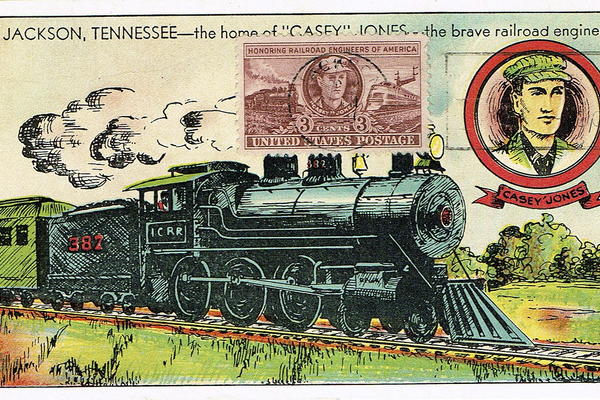
What Casey Jones Tells Us About the Past and Present of America's Railroad Workers |
|
With a potential railroad strike in the news, Americans are learning quite a bit about the poor working conditions on the freight railroads that keep this country running. Railroad workers threatening to strike have complained about poor pay, dangerous working conditions, and punitive attendance policies. If Americans think about the stereotypical railroad engineer, perhaps Casey Jones comes to mind. Casey Jones, who crashes to his doom in a famous song from the Grateful Dead, a folk ballad, vaudeville hit, and countless parodies, has become the almost universal stand-in for a railroad worker in American culture. Yet despite a haze of mythology, there was a real Casey jones, and his work life tells us much about railroad work in the past and present....
...Despite the advantages engineers had, within Casey Jones’s lifetime, from the 1860s to 1900, engineers on the Illinois Central experienced a stunning downfall in terms of their independence and control of the workplace. In the earlier days of railroading, engineers were assigned to a specific engine, but by the turn of the century most railroads were continuously running engines and switching up crews at points along the line. So Casey’s run from Memphis to Canton was just one segment of a longer journey from Chicago to New Orleans and companies essentially used engineers like interchangeable parts to plug into different runs as needed.
Casey and his fellow engineers were bound by a dizzying array of rules in a thick rulebook and discipline for violating these rules was arbitrary and often brutal – in 1897 one master mechanic with the IC estimated that a quarter of the engineers who worked under him in the previous three decades had been fired for disciplinary reasons. Engineers were once paid a stable monthly wage but the Illinois Central shifted this to a per mile rate in the 1870s. Perhaps this is why Casey, on his final day, agreed to take on a second run in a twenty-four hour period. As Sim Webb, his fireman, later related, they got into Memphis in the morning and barely had enough time for a full sleep before leaving again.
|
|
AFL-CIO Transportation Chief Greg Reagan:
WEBINAR: RAIL & MARITIME UPDATES
Tuesday, October 11 @ 11 Via Zoom
|
|
GREG REGAN WILL DISCUSS:
- RAILROAD CONTRACT STATUS
- SHIPPER/LABOR COALITION SUPPORTING RAILROAD REGULATION
- CHALLENGES FACED BY U.S. RAILROAD WORKERS
- SUPPORTING U.S. MARITIME & CARGO PREFERENCE
- ATTRACTING WORKERS TO TRANSPORTATION INDUSTRIES
In 2021, Greg Regan was elected President of the Transportation Trades Department, AFL-CIO, a labor organization consisting of 36 unions that together represent workers in all areas of transportation. TTD focuses on federal legislation, regulatory matters, and policy issues that impact transportation workers.
In his current position, Greg leads and oversees TTD’s daily operation and serves as the organization’s spokesperson and chief strategist. He collaborates with TTD’s affiliated unions to fight for long-term investments in our transportation system, ensure jobs in this sector are safe and secure, and to protect and expand the rights working people have to a union voice. Under Greg’s direction, TTD works with elected leaders on both sides of the aisle and focuses on substantive, policy-driven arguments to advance core agenda items.
|
|
(Editor's Note: The sad letter below is an example of what is happening in the rail industry today. RWU encourages all rail workers who quit the railroad to go public and state just what the hell is going on! Kudos to the Brother here for going public.) |
|
BNSF Rail Worker Quits: Here is His Letter of Resignation |
|
On February 1, 2022, BNSF Railway instituted their infamous “Hi-Viz” attendance policy for train crews. The carnage it has wrought continues today and augurs frightening implications for national security. This is my resignation rationale addressed to fellow union members.
Dear Union Brothers and Sisters, my Final Tie Up:
It is with a heavy heart and grave concern for our nation and fellow union members that I pen this admonition deeply rooted in BNSF’s recent Hi-Viz attendance policy misadventure.
Unleashed without the consent of labor on February 1, 2022, Hi-Viz was ostensibly created to effectuate more predictable line-ups (proven a colossal failure) and allow train crews to know their precise standing vis-à-vis their attendance allotment (data previously available when management was forthcoming), all in the name of remaining “competitive” in the industry.
Prior to Hi-Viz, train crews were expected to be available for their unpredictable, on-call 24/7 schedule 75% of the time, which compared with the general US population (and BNSF attendance expectations before 2002), was highly restrictive and produced its own set of work-life balance challenges. Even with the new Hi-Viz regime, it is still very common for a conductor or engineer to be without sleep for 24-30 hours once or twice per week.
Hi-Viz now demands roughly 95% availability and is implemented with a point system that many describe as “draconian,” allowing crews approximately one to two days off per month to coordinate life’s pressing responsibilities and maintain a modicum of homelife stability (no doubt adversely impacting child development within the home). God forbid your daughter’s big tournament or son’s communion falls on a day that strips away a large tranche of your meagerly allotted points. Oh, and don’t get sick (especially under BNSF’s rarely enforced Covid protections) as there is no sick leave to be had. And therein lies the rub....
|
|
Kentucky Jury Awards Two Chiropractors a $23 Million Verdict Against CSX Transportation |
|
A jury in Greenup County has returned a verdict of nearly $23 million against CSX Transportation and its chief medical officer for defaming two chiropractors and interfering with their doctor-patient relationship.
The verdict, returned Sept. 22, included $10.7 million in punitive damages for each of the chiropractors, Daniel Carey II and Shannon Johnson.
One of their lawyers said it was believed to be the largest verdict ever returned in Greenup, which is about 190 miles east of Louisville.
Carey and Johnson sued after the railroad company’s chief medical officer, Dr. Craig Heligman, sent a letter to a federal railroad agency, three insurance companies and the Ohio and Kentucky chiropractic boards accusing them of fraudulently treating CSX employees in the tri-state area, which also includes West Virginia.
The jury found that Heligman and CSX's accusations were false and interfered with Carey and Johnson's relationships with their patients.
The chiropractors' trial attorneys, Jeff Dingwall of San Diego and Greg Paul of Pittsburgh, said in a news release that the evidence at trial further demonstrated CSX sought to avoid its obligation to pay medical benefits to employees who were treated by Carey and Johnson and that it acted with fraud, oppression, malice or gross negligence....
... This month, the jury found Heligman and CSX liable for a combined $21.4 million in punitive damages as well as about $1.4 million in business losses. It found CSX and Heligman would no longer accept medical paperwork from Carey and that the decision was motivated by “spite, ill will or a desire to do injury to him.”
|
|
(Editor's Note: In this age of PTC, it has been a surprising month - 2 crew members killed and now 4 injured in two separate incidents of train collisions.) |
|
Four Injured as CSX Trains Collide in Miami |
|
MIAMI — Four people were injured Saturday evening when two CSX freight trains collided near Miami International Airport, WPLG-TV reports.
The accident was reported about 7 p.m. near the area of Northwest 15th Street and South Perimeter roads, with Miami-Dade Fire Rescue dispatching more than 25 units, including a hazardous materials team. The four people were hospitalized with what were described as minor injuries. Locomotives derailed, resulting in a fuel spill.
While WPLG reports the four people included two crew members, WSVN-TV reports four crew members were injured, and that the collision involved two rock trains.
|
|
|
|
|
|
|