Weekly update from the National Housing Conference | |
News from Washington | By Brittany Webb
| |
|
Neighborhood Homes Investment Act surpasses 100 cosponsors
The Neighborhood Homes Investment Act (NHIA) has reached a significant milestone, surpassing 100 cosponsors in Congress. This bipartisan bill aims to create a new tax incentive to produce and preserve over 500,000 affordable single-family homes for homeownership in under-resourced communities over the next decade and is a top legislative priority of NHC.
Both Republican and Democratic leaders have expressed strong support for the NHIA. In the 119th Congress, the bill will be led by Senators Todd Young (R-Ind.) and Mark Warner (D-Va.) and Representatives Mike Kelly (R-Pa.) and John Larson (D-Conn.). In a press release, Representative Kelly emphasized the bill's potential to address the housing crisis and strengthen communities, while Senator Young highlighted its ability to direct private capital into low-income neighborhoods.
“Everyone deserves a safe and affordable home, but across the Commonwealth, and across the country, too many neighborhoods are dealing with lack of investment, poor housing stock, and low home ownership rates. That’s why we need an all-hands-on-deck approach to investing in our communities,” said Senator Mark Warner. “I’m excited to continue this important work with The Neighborhood Homes Investment Act — legislation that will encourage developers to build new and restored housing by providing a tax credit that will help them to invest in communities that need it the most.”
The Neighborhood Homes Coalition, comprising 42 national organizations including NHC, continues to advocate for the enactment of NHIA in a 2025 tax package.
| | |
|
Shelter costs account for 40% of November inflation increase
The latest Consumer Price Index (CPI) data for November 2024 shows that inflation in the United States rose to 2.7% year-over-year, up from 2.6% in October.
Housing inflation showed some signs of moderating, with shelter costs increasing 0.3 percent month-over-month, a lower rate than October’s 0.4%, and 4.7% year-over-year. Rents also slowed to the lowest pace in over three years at 0.2% month-over-month and 4.4% year-over-year. Notably, rent data lags months behind due to CPI’s use of current lease numbers rather than newly signed leases. Fannie Mae’s consumer housing sentiment index reflects improvements in consumer expectations for lower mortgage rates, though only 23% of respondents said it was a good time to buy a home. Despite this, shelter costs contributed nearly 40% to the total monthly CPI increase in November.
“Shelter continues to be a contributor to the rise in the main gauge of prices at the retail level,” said Mark Hamrick, senior economic analyst at Bankrate. “There is reason for optimism on this front if home-price gains moderate as expected. Having said that, there’s no dismissing the fact that housing affordability continues to be a major pain point for Americans.”
The Federal Open Market Committee is expected to issue its third rate cut of the year at 0.25% next week, having already cut by half a point in September and a quarter point in November.
“This dichotomy in inflation stress will contribute to a tale of two housing markets in 2025,” said Bright MLS Chief Economist Lisa Sturtevant. “Higher-income individuals and families will be more active in the market. Existing homeowners who have accumulated significant housing equity will be in a good position to make a move-up purchase. But moderate-income individuals and families who want to purchase a home in 2025 are facing tighter budgets, more financial stress, and will find the housing market much more challenging.”
| | |
Your go-to resource for housing policy | |
|
Reps. introduce bipartisan zoning legislation
Congresswoman Lisa Blunt Rochester (D-Del.) and Congressman Mike Flood (R-Neb.) introduced the Housing Supply and Innovation Frameworks Act, which direct the U.S. Department of Housing and Urban Development (HUD) to develop frameworks for best practices on zoning and land-use policies. The Act is supported by a wide range of affordable housing stakeholders including Up for Growth Action, the Mortgage Bankers Association, the National Apartment Association, the National Multifamily Housing Council, the Housing Assistance Council, and the American Planning Association, among others.
"This common-sense legislation empowers local and state governments with the tools and strategies needed to streamline land-use policies and unleash the potential for increased housing production," said Mike Kingsella, CEO of Up for Growth Action. "By reducing red tape and encouraging practical solutions, this Act paves the way for stronger communities and expanded economic opportunity. We commend Representatives Flood and Blunt Rochester for their leadership in advancing bipartisan solutions to tackle America’s housing challenges."
In a letter sent in support of the legislation, the housing groups stated the Act “will address this issue by requiring HUD to convene a diverse task force of community advocates, developers, land use professionals, and local zoning experts to develop best practices and a policy frameworks that can be used by state and local officials as they work through their unique challenges.”
| | |
|
Rocket sues HUD over appraisal lawsuit
Rocket Mortgage filed a lawsuit against the U.S. Department of Housing and Urban Development (HUD). The countersuit follows the Department of Justice’s (DOJ) October lawsuit accusing Rocket Mortgage and others of appraisal bias in a single Colorado case. The incident in question concerns a homeowner who displayed a “Black Lives Matter” sign and saw her appraisal drop from an initial $860,000 to $640,000 in a subsequent appraisal. Rocket Mortgage alleged that the claim is baseless, and it followed all applicable laws and was only included in the suit for the sake of gaining media traction. Rocket emphasized that the discrimination accusation is against the independent appraiser, not Rocket Mortgage that does not have the authority to correct an appraisal.
"It is unreasonable that the DOJ chose to sue Rocket Mortgage for the conduct of an independent appraiser. We will not stand idly by while the courts are used as venues to leverage our company's name to publicize the case instead of the pursuing justice against those who may have committed wrongdoing," said Bill Emerson, President of Rocket Companies. "Today's filings highlight the conflict between HUD's regulations and the DOJ's enforcement positions. We are looking forward to laying out all the facts of this case in court."
| |  |
|
DOJ closes criminal case of RealPage, civil suits remain open
The U.S. Department of Justice (DOJ) has closed its criminal investigation into RealPage's pricing practices in the multifamily rental housing industry. The decision comes just months after the DOJ and eight states filed a civil antitrust lawsuit against the property management software company in August 2024. The suit claimed that RealPage contributed to an “unlawful scheme to decrease competition among landlords in apartment pricing and to monopolize the market.” RealPage filed a motion to dismiss the lawsuit, and announced that the DOJ closed its criminal investigation on December 6. Civil suits remain ongoing.
“The time is now to address a number of false claims about RealPage’s revenue management software and how rental housing providers operate when setting rent prices,” said Dana Jones, RealPage CEO and President on a dedicate website to the issue. “Housing affordability should be the real focus. RealPage is proud of the role our customers play in providing safe and affordable housing to millions of people. Despite the noise, we will continue to innovate with confidence and make sure our solutions continue to benefit residents and housing providers alike.”
| | |
|
HUD and FEMA partner on post-disaster housing initiative
HUD and the Federal Emergency Management Agency (FEMA) announced they will work together to enhance post-disaster housing capabilities across the nation. The agencies formed the Pre-Disaster Housing Initiative, a program designed to help states develop robust plans for housing recovery in the wake of natural disasters by providing eight months of technical assistance and guidance to officials and emergency managers in Kentucky, Michigan, and Missouri. The states were selected based on a cross section of perspectives on the challenges of planning and executing post-disaster housing goals. HUD Agency Head Adrianne Todman emphasized the importance of partnerships in addressing housing recovery challenges before disasters strike. She also called on Congress to approve the President's $12 billion request for HUD's Disaster Recovery Funding.
“This initiative is designed to strengthen relationships between emergency management and housing agencies both within a state and between the states in the cohort,” said FEMA’s Assistant Administrator for Recovery, Colt Hagmaier. “This partnership remains a priority for both FEMA and HUD and we are thrilled to see the exponential impacts of this initiative throughout the nation.”
| | |
Renew your NHC membership today! | |
Watch this video to learn more about how NHC represents diverse leaders across the housing spectrum, including lenders, homebuilders, affordable housing advocates, real estate professionals, housing development corporations, housing finance agencies, and more, to address today's pressing housing issues. | |
|
Your involvement is essential to addressing today’s housing challenges, and NHC relies on active members to maximize our impact and remain a leader in tackling today’s housing issues.
NHC membership offers exclusive networking opportunities, access to our weekly Member Brief, and other key housing resources such as our Housing Resource Center, Paycheck to Paycheck database, and Employer Assisted Housing Toolkit. We look forward to working with you to address America's housing challenges.
| |
|
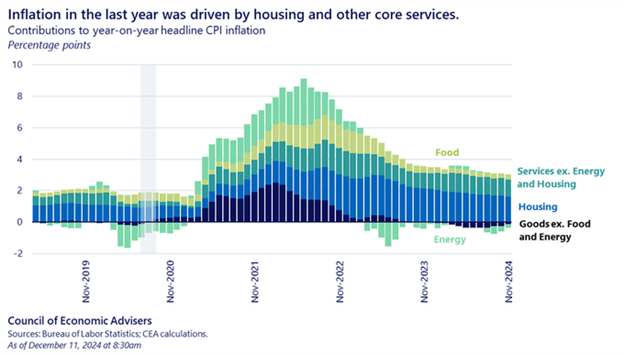
Housing costs continue driving inflation, CEA says
The White House Council of Economic Advisers (CEA) released a blog post discussing the December 2024 CPI report and updating their housing inflation model. Housing continues to play a substantial role in inflation beginning in late 2022, and remains elevated as a driver well above pre-pandemic levels. The housing inflation trends show a peak of 8.3% in April 2023, with November data showing a fall to 4.8% year-over-year. Within the last year, core services excepting housing have risen 4.3%, and notably add 1.4 percentage points to core inflation in November. However, housing remains challenging to measure due to lagging datasets every six months.
| |
|
Vox published an article exploring how public housing was “designed to fail”. It argues that public housing but was systematically undermined by political opposition, racial segregation, and inadequate funding. Lawmakers imposed restrictions like construction cost caps and income limits that prevented mixed-income housing, and as public housing projects increasingly housed Black residents, white families left, adding to stigma of public housing as homeownership policies targeted white households.
A new report from the National Low Income Housing Coalition reveals that voters approved over $640 million in bonds for affordable housing during the November elections. While lodging and real estate transfer taxes were successful, tenant protection measures had mixed outcomes, with some victories and rejections contrasting with previous election trends. Additionally, there were concerning approvals of punitive measures against homelessness, highlighting the need for effective policy solutions.
The New York Times asks in an article if the U.S. can climb out of its unprecedented housing crisis. It notes that builders have struggled with increased costs for materials and labor, while mortgage rates remain high around 6-7%, keeping many potential buyers sidelined. The situation has reshaped the housing landscape and led to record numbers of Americans becoming rent-burdened, with housing costs consuming over a third of their income. The headwinds result in the slowest housing market in decades.
| |
The National Housing Conference is a diverse continuum of affordable housing stakeholders that convene and collaborate through dialogue, advocacy, research, and education, to develop equitable solutions that serve our common interest. | |
Defending Our American Home since 1931 | |
Copyright © 2024. All Rights Reserved. | | | | |