| | |
POLICY & ADVOCACY UPDATE
Issue #77, 6 August 2026
| | | |
- From the AA CEO James Goodwin
- Further restrictions on skilled migration
- Industry not receiving its fair share of skills funding
- Mixed results for tourism-related accommodation
- Capital city hotel performance for July
- Job mobility eases in latest ABS review
- Hospitality vocational training continues to fall
- Household spending climbs in the June quarter
| |
| |
From the AA CEO
A key emerging issue this week is the prospect of imminent government announcements to reduce migration. For our industry, this would further tighten labour supply at a time when businesses are already facing workforce shortages.
| | | |
|
The Home Affairs Minister Tony Burke was due to make a significant speech to the National Press Club today, but this has been suddenly postponed after Cabinet asked questions about the proposed visa changes. However, we need to be clear that more time won’t necessarily mean a better result for our sector, and we will continue to push for settings that meet our workforce needs and is balanced with more funding to improve incentives for our sector to train and upskill more Australians. Next week, the Accommodation Australia National Board will hold its meeting in Parliament House in Canberra where we will be raising these concerns directly with policymakers to ensure the voice of our members is heard and the industry’s needs remain front of mind.
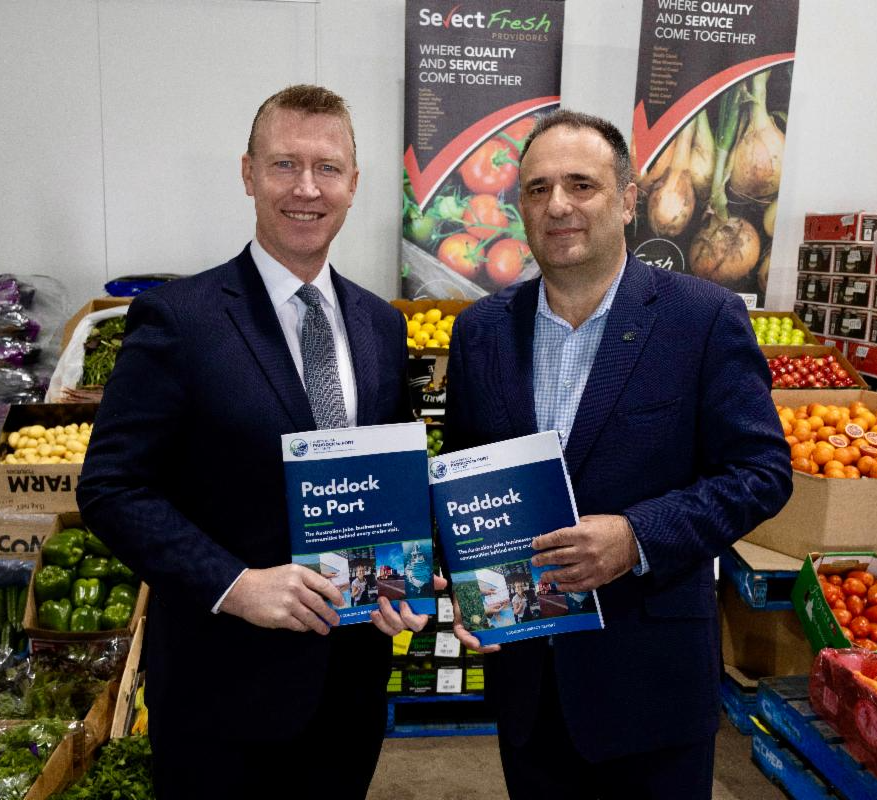
I was pleased this week to be invited to join our peers from the cruise industry for the launch of the Paddock to Port Alliance. The cruise industry is concerned Australia is becoming harder to deal with and through this campaign is highlighting the number of jobs created across the economy as well as the millions of dollars in produce and supplies that Australian businesses supply for the ships when in port.
| | | | |
Our message was that when cruise activity is strong, accommodation benefits from increased demand before and after sailing dates and that off-ship activities and excursions benefit hotels - particularly in regional areas. (Pictured is the CEO of Cruise Industry Australia Joel Katz with me at the event).
James Goodwin
Chief Executive Officer
| | | |
Further Restrictions on Skilled Migration
This week has seen media reports on a new directive to those that process visa applications from the Minister for Home Affairs, Tony Burke, that will further negatively impact members who are seeking to sponsor skilled migrants. The new directive, since obtained by Accommodation Australia, removes the prioritisation of regional businesses for permanent skilled sponsorship, and replaces it with a rolling set of priorities for both permanent and temporary applications that preference industries such as defence, law enforcement, construction, health and education. Preference will also be provided to on-shore applicants. As our industry is not included in these priorities, there will likely be even further delays in processing. Whether that goes beyond the already signalled nine-months as the norm (reported in the last Advocacy Update remains to be seen.
| | |
Industry not receiving its fair share of skills funding
In detailed analysis undertaken by Accommodation Australia, we have identified a major shortfall between the amount of funding the hospitality industry receives for our apprenticeships compared with the contribution made to the migration Skilling Australians Fund. Excluding the large apprenticeship subsidies provided during the pandemic, the industry previously received over $33 million per annum in apprenticeship incentives. In 2025-26 this was estimated to be only around $11.8 million, and this financial year will drop to only $6.4 million due to policy changes made and the falling number of apprentices. In stark contrast, in the last two financial years, hospitality employers have paid over $70 million per annum to the Skilling Australians Fund as a levy applied to sponsoring a skilled permanent or temporary migrant.
In the last month, we have shared this analysis with the Prime Minister, Treasurer and the relevant Skills & Training and Migration Ministers. In discussions with the Ministers, it is obvious that they are somewhat embarrassed but whether that translates to a change of policy is yet to be seen.
For a full copy of the Achieving Fairness in Government Investment in Hospitality Skills analysis, see here.
| | |
Mixed results for tourism-related accommodation
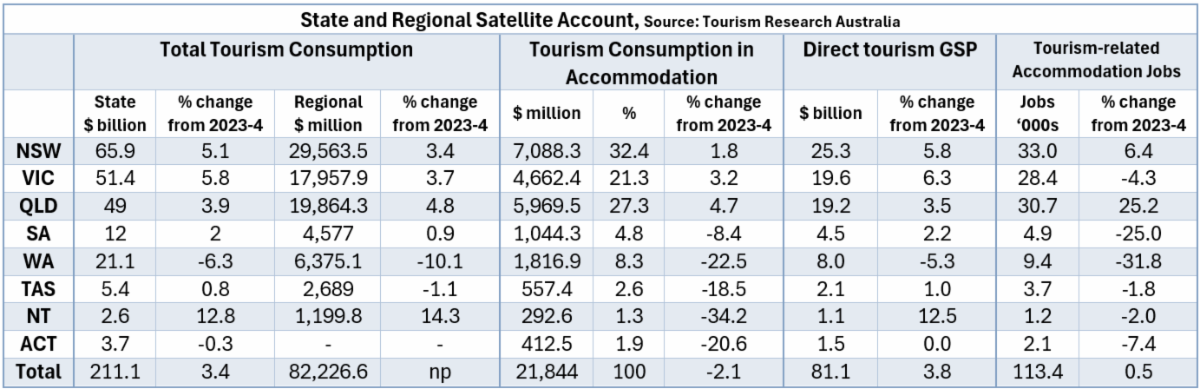
The latest State and Regional Tourism Satellite Accounts, released by Tourism Research Australia (TRA), provide new state and territory insights into tourism performance in 2024-25, building on the national results released earlier this year. Most states and territories recorded stronger tourism activity, with 79% of tourism regions reporting growth in direct tourism gross value added. The Northern Territory recorded the strongest growth in total tourism consumption, increasing 12.8% on the previous year, with regional tourism consumption also rising 14.3%. By contrast, regional tourism consumption in Western Australia declined 10.1%, the largest fall of any jurisdiction, as presented in the table below.
Accommodation-related tourism activity was mixed across the country. Tourism consumption on accommodation increased in Queensland, Victoria, and New South Wales, while declines were recorded in South Australia, Tasmania, the Australian Capital Territory, Western Australia and the Northern Territory. Employment outcomes also varied significantly between jurisdictions. Queensland recorded the strongest growth in tourism-related accommodation jobs, up 25.2% to 30,700 jobs. Western Australia and South Australia recorded the largest declines in tourism-related accommodation employment.
For the full State and Regional Tourism Satellite Accounts, click here.
| | |
Capital city hotel performance for July
Preliminary capital city CoStar data for the month of July shows that occupancy softened across most capital city hotel markets, although several destinations continued to achieve moderate growth in average daily rates:
- Sydney saw a 0.2% fall in occupancy to 79.2% and ADR decreased 0.2% to $248.09.
- Melbourne occupancy rose 0.5% to 74.4% and ADR fell 7.6% to $196.55.
- Brisbane occupancy fell 2.9% to 79.0%, while ADR declined 9.0% to $249.36.
- Adelaide occupancy fell 4.5% to 71.9% and ADR fell 1.8% to $190.24.
- Perth occupancy fell 1.9% to 76.6% but ADR was up 2.6% to $229.39.
- Hobart occupancy rose 5.0% to 72.2% and ADR increased 2.0% to $181.45.
- Darwin occupancy fell 4.9% to 81.1% but ADR rose 10.1% to $292.96.
- ACT and Canberra occupancy decreased 5.0% to 76.7% and ADR down 8.7% to $183.07.
- Gold Coast occupancy was down 3.0% to 71.6% and ADR up 7.0% to $292.08.
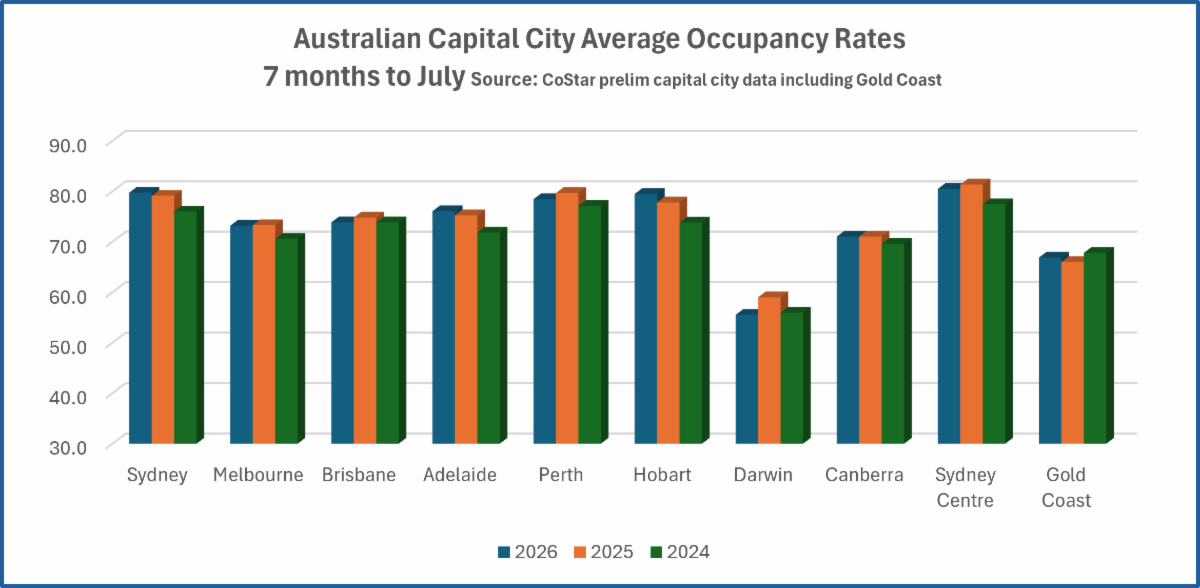
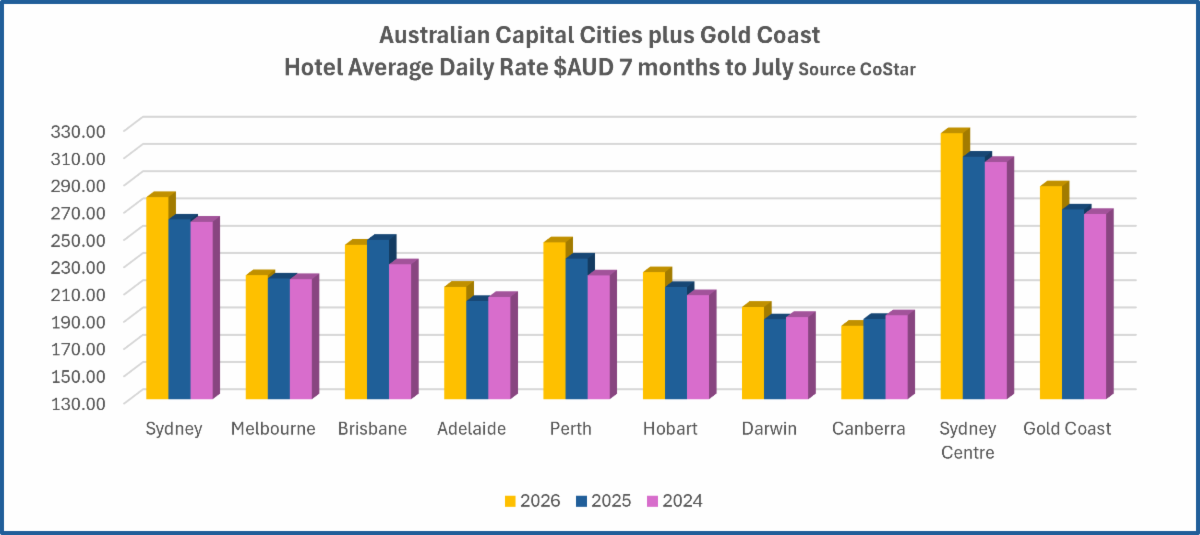
The graphs below derived from the CoStar data show the average occupancy rate and ADR experienced in the capital cities in the first seven months for each of the last three years. Over the seven months, six cities have recorded a decline in average occupancy compared to 2025: Adelaide, Darwin, Brisbane, Gold Coast, Perth, and Canberra. Canberra and Brisbane are the only capital cities to see a fall in average room rate. The Gold Coast has recorded the strongest increase in ADR, up 6.3% to $286.23 averaged over the seven months, with Sydney, Adelaide, Perth, and Hobart also showing strong ADR performance.
| | |
Job mobility eases in latest ABS review
This week the ABS released its annual review of job mobility, highlighting that mobility across all industries fell to 7.2 per cent, down from 7.7 per cent the previous year. The rate doesn't vary greatly between males and females, but 7.2 per cent continues a downward trend seen over recent decades and remains well below the highs of the 1980s, when mobility peaked at 19.5 per cent in 1989.
Younger workers were more mobile than older workers in the year to February 2026, with 12 per cent of those aged 15-24 changing jobs, compared with 4.6 per cent among 45-64 year-olds. Over the reporting year, 2.1 million people left or lost a job, and the annual retrenchment rate was 1.8 per cent.
Health care led all industries for new entrants, with 231,000 new starters in the year to February 2026. Accommodation and Food Services (AFS) was second, with 198,900 new starters. However, only 81,800 AFS workers changed jobs in the past 12 months, compared with 157,600 in health care. Notably, our industry attracted more new starters than retail and construction, yet saw fewer people changing jobs -- a sign of stronger retention.
| | |
Hospitality vocational training continues to fall
The latest NCVER data released for 2025 shows that qualification enrolments in Food, Hospitality and Personal Services fell by 15.1% compared to an average decline of 5.9%. The overall decline in qualification enrolments was largely driven by a decrease in Certificate III and Certificate IV enrolments, particularly among government-funded qualifications which fell by 6.6%. In contrast there was an increase in the number of short course enrolments which are largely driven by workplace and regulatory compliance. For example, significant growth can be seen in domestic fee-for-service activity in the Responsible service of alcohol skill set (increasing 253.4% to 43,630 enrolments in 2025). This coincides with a corresponding decrease of 43,480 enrolments in the stand-alone subject Provide responsible service of alcohol for all funding sources. This suggests a move from stand‑alone subjects to skill set enrolments for Responsible service of alcohol training, rather than an overall increase in participation. First aid related single subject enrolments remain the most popular VET activity.
| | |
Household spending climbs in the June quarter
Household spending rose 0.7 per cent in the three months to June, according to seasonally adjusted figures released this week by the Australian Bureau of Statistics (ABS). Spending on alcoholic beverages and tobacco rose 2.7%, and for hotels, cafes and restaurants, spending was up 1.0% over the quarter. Travel spending dropped 0.1% over the quarter, but in June it rose 3.0% month-to-month. The ABS attributed much of this rise to air travel, the category's second largest contributor, as it returned to levels last seen before the disruptions linked to the Middle East conflict. Fuel spending, meanwhile, has eased from its March peak, reflecting falling world oil prices and the continued flow-through of the temporary fuel excise cut, which applied from 1 April until 30 June.
| |
| | |
3 things for you to do today to support the industry's jobs and careers platform eeger.com.au:
- Register on eeger to build your employer profile
-
Follow eeger on LinkedIn to stay in touch
- List your job vacancies on the site that has been developed for industry by industry
| | | | |
Drop me an email at policy@accommodationaustralia.org or give me a call on 0418 277 919 if you have any national policy issue that you think AA should be following up. If you know an AA member who is not receiving this advocacy report but wants to, then encourage them to email me and we can add them to the distribution list. Back issues of the fortnightly advocacy updates can be found here.
Kind Regards
Jenny Lambert OAM
National Policy Director
Accommodation Australia
| | | | |