Bytes and Insights Logo

Learn21's Weekly EdTech Update

May 15, 2025

Rethinking Social Skills: What It Means to Connect in 2025

by Stacy Hawthorne, Ed.D.

Rethinking Social Skills: What It Means to Connect in 2025

For years, we’ve heard a familiar refrain: “Kids don’t know how to talk to each other anymore.” The assumption is clear - screens are to blame. Critics point to teens texting at dinner tables, scrolling through TikTok at recess, or gaming online instead of “playing outside” as evidence that social skills are eroding.


But what if the real problem isn’t all about screen time, but how we define social skills in the first place?


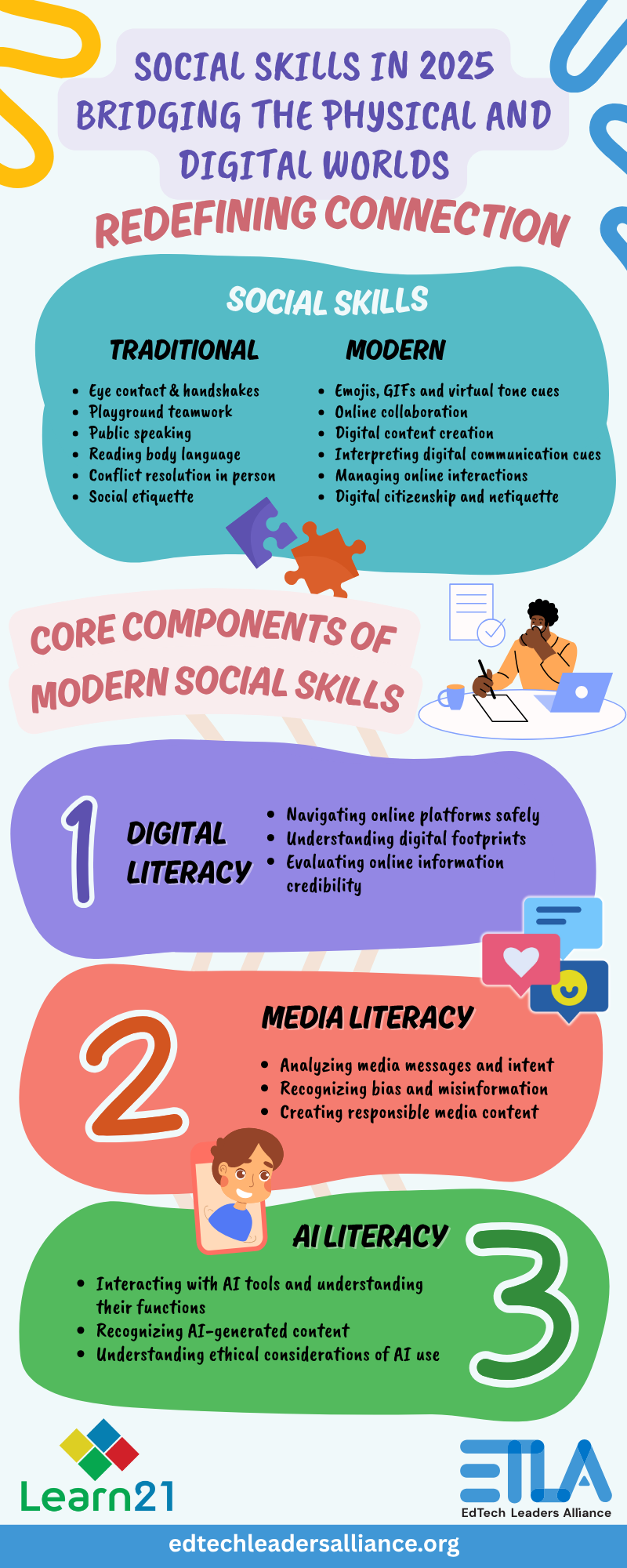
In 2025, connection looks different. We are a quarter of the way through the 21st century, yet many of our conversations about social development remain anchored in 20th century norms. Yes, it’s still important for young people to learn how to make eye contact, read facial cues, and shake hands with confidence. But these traditional social markers are no longer sufficient.


Today’s students are building relationships, collaborating on projects, advocating for causes, and navigating conflict online. These are not lesser interactions, they’re different contexts. And mastering them requires new competencies: digital literacy, media literacy, and even AI literacy.


Social Skills Are Expanding, Not Disappearing

Let’s be clear: being able to decode the tone of a text message, identify a deepfake, or engage respectfully in a Discord server is just as socially demanding as negotiating a playground game of tag. Today’s students must move fluidly between digital and physical spaces, understanding not just how to communicate but how to do so ethically, safely, and effectively across mediums.


We now need to teach kids:

  • How to read and respond to tone in text, email, or video chats
  • How to build trust and have a healthy level of distrust in virtual spaces
  • How to manage their digital presence and reputations
  • How to spot mis/disinformation and AI-generated content
  • How to disagree respectfully in online communities


In short, we need to broaden our definition of social skills to include digital fluency. Otherwise, we risk preparing students for a world that no longer exists and ignoring the world they’re already navigating.


The Role of Schools and Families

Parents and educators play a crucial role in shaping this new understanding. Social-emotional learning needs to expand its scope. Media literacy shouldn’t be an elective - it should be foundational. And AI literacy isn’t just for computer science students. It’s part of helping young people understand the systems influencing their communication and information.


Rather than frame tech use as a social hindrance, we should recognize the incredible opportunities it presents for global connection, empathy, and voice—if students are equipped with the right skills.

Media Literacy Minute

Media Literacy Minute

Helping Digital Natives Overcome Digital Naiveté

The New York Times outlines four practical steps to help students develop media literacy skills and move beyond surface-level digital engagement. While today’s youth are often fluent in navigating platforms, the article stresses that they are still vulnerable to misinformation, persuasive algorithms, and digital manipulation. The four recommended steps include: analyzing sources, slowing down the scroll, questioning emotional reactions, and practicing lateral reading. The piece makes a strong case that digital fluency doesn’t always equal digital wisdom.


8 Digital Literacy Skills That Can Protect You

Rolling Out presents a practical list of eight digital literacy skills every user should know to navigate today’s media landscape safely. These skills include understanding privacy settings, identifying phishing scams, verifying sources, recognizing algorithmic bias, and more. The article emphasizes that these are not just tech skills, but essential tools for safeguarding personal information and mental well-being in an increasingly digital world.


The Deeper Harms of Deepfakes: Why Control Over Our Likeness Matters

Biometric Update explores the rising concerns around deepfakes, particularly the ethical and psychological harms of having one’s likeness used without consent. The article explains that the technology is no longer limited to celebrity impersonations—ordinary people are now at risk of being misrepresented in manipulated videos, audio, and images. Experts warn that without regulatory safeguards or robust media literacy, the public remains vulnerable to exploitation, misinformation, and identity-based abuse. The piece underscores the urgent need to educate students and adults alike on how to recognize and critically assess synthetic media.

Advocating for EdTech at the Federal Level: Ohio Voices in Washington, D.C.

by Stacy Hawthorne, Ed.D.

On May 6, 2025, I had the honor of attending the annual EdTech Advocacy and Policy Summit in Washington, D.C., hosted by CoSN, SETDA, ISTE+ASCD, and SIIA. This national event brings together education leaders to meet with members of Congress and advocate for the policies that shape the future of education technology in America.


I was joined by my colleague, Danielle Tymitz, an Educational Change Agent at Learn21 and the ISTE+ASCD Partnership Co-Chair for the EdTech Leaders Alliance. Danni is also a school board candidate for Mason City Schools in Ohio — and a powerful advocate for civic engagement at both the local and national levels. Together, we proudly represented Ohio and shared our experiences with federal leaders who play a role in shaping education policy.


During the day, we met with staff from Congressman Greg Landsman’s office, Senator Bernie Moreno’s office, and Senator Jon Husted’s office. In every meeting, we were welcomed with thoughtful questions and an authentic interest in the challenges and opportunities EdTech leaders face in Ohio. We’ve invited each office to continue the conversation  and to join us at our upcoming ETLA conference to see our work in action.


Each of our meetings was anchored around six key policy briefs that outline critical areas of federal support. Here's a summary of what we shared:


Artificial Intelligence in Education

Advocating for Responsible Use and Educator Support

  • Integrate districts and states into the federal AI Education Task Force.
  • Fund AI-literate workforce development for educators and students.
  • Ensure AI tools comply with FERPA, IDEA, and protect student data.
  • Promote transparency and bias mitigation in AI systems.
  • Encourage ongoing research informed by practitioners and community voices.

More at: www.cosn.org/AI


E-Rate Program

Ensuring Equitable Internet Access and Cybersecurity Readiness

  • Preserve E-Rate’s role in providing broadband and Wi-Fi connectivity.
  • Expand eligibility to include cybersecurity tools like firewalls and filtering.
  • Maintain support for bus and home Wi-Fi, addressing access gaps for rural and low-income communities.

Fun fact: 99% of public school students rely on E-Rate connectivity.


ESSA Title II-A

Supporting Educators Through Professional Learning

  • Fully fund Title II-A at its original $2.3B level.
  • Expand support for digital learning, privacy training, and AI integration.
  • Prioritize leadership and coaching initiatives to prepare educators for future learning needs.

This grant helps districts recruit and retain EdTech-savvy educators.


ESSA Title IV-A

Funding Safe, Well-Rounded, and Tech-Enabled Schools

  • Fund the Title IV-A block grant at $1.6B to support STEM, mental health, safety, and digital infrastructure.
  • Support flexible local investments in emerging areas like AI and privacy.
  • Prioritize digital equity and access, especially for underserved communities.

This grant also supports music, arts, AP, and other enrichment programs.


Student Data Privacy

Empowering Schools to Use Data Responsibly

  • Bolster support for the U.S. Department of Education’s Privacy Technical Assistance Center (PTAC).
  • Invest in professional development to build privacy capacity in schools.
  • Avoid restrictive policies that hinder ethical data use for learning.
  • Fund adaptive privacy programs that evolve with emerging technologies.

73% of tech leaders say privacy isn’t in their job description, yet 90% oversee it.


Cybersecurity for K-12

Defending Schools Against Growing Threats

  • Restore funding for CISA’s K-12 cybersecurity efforts and MS-ISAC services.
  • Re-establish the K-12 Cybersecurity Government Coordinating Council.
  • Invest in cyber workforce development, including apprenticeships.
  • Help schools acquire essential cybersecurity tools and resources.

K-12 schools face an average of five cyber incidents per week.


We left D.C. with renewed optimism. The federal representatives we met were engaged, inquisitive, and eager to support the work happening in Ohio and across the country. As we continue these conversations, we invite our members to stay involved, share your stories, and advocate for the policies that help your schools thrive.


Want to get involved? Reach out to your representatives, attend the ETLA Conference, and stay tuned for upcoming LinkedIn posts where we’ll explore each of these topics in more depth.

Big Ideas

A 3D Display You Can Reach Into

Flexivol’s new volumetric display projects interactive holograms into space—no glasses needed. Think of it as grabbing a molecule, spinning a solar system, or sculpting in mid-air. This could transform everything from science labs to design studios. See It in Action.


Digital Fridge Poetry: A Fun Twist on Creative Writing

FridgePoem.com brings the nostalgia of magnetic poetry into the digital age. Great for a classroom brain break or a poetic warm-up, this tactile-free tool still inspires creative wordplay. Who says creativity needs a magnet?


The AI Race Is On: 2025 AI Index Report Reveals What’s Next

The latest AI Index report shows that the U.S. leads the world in top AI models, open-source tools are thriving, and education is racing to keep up. While frontier models dominate headlines, the real impact may come from how quickly institutions adapt—or fall behind. Dig into the trends!

If you'd like to take a hiatus from Bytes & Insights, please use the Update Profile link below. This will allow you control over which emails you receive from Learn21.

X Share on X
LinkedIn Share on LinkedIn

www.learn21.org

LinkedIn        X        YouTube        Instagram