Elmo Peeler Note-for-Note Piano Transcriptions |
|
|
Greetings!
Today is the first day of March and time again for my monthly newsletter, to keep you informed of recent transcriptions and other news of the last month.
|
|
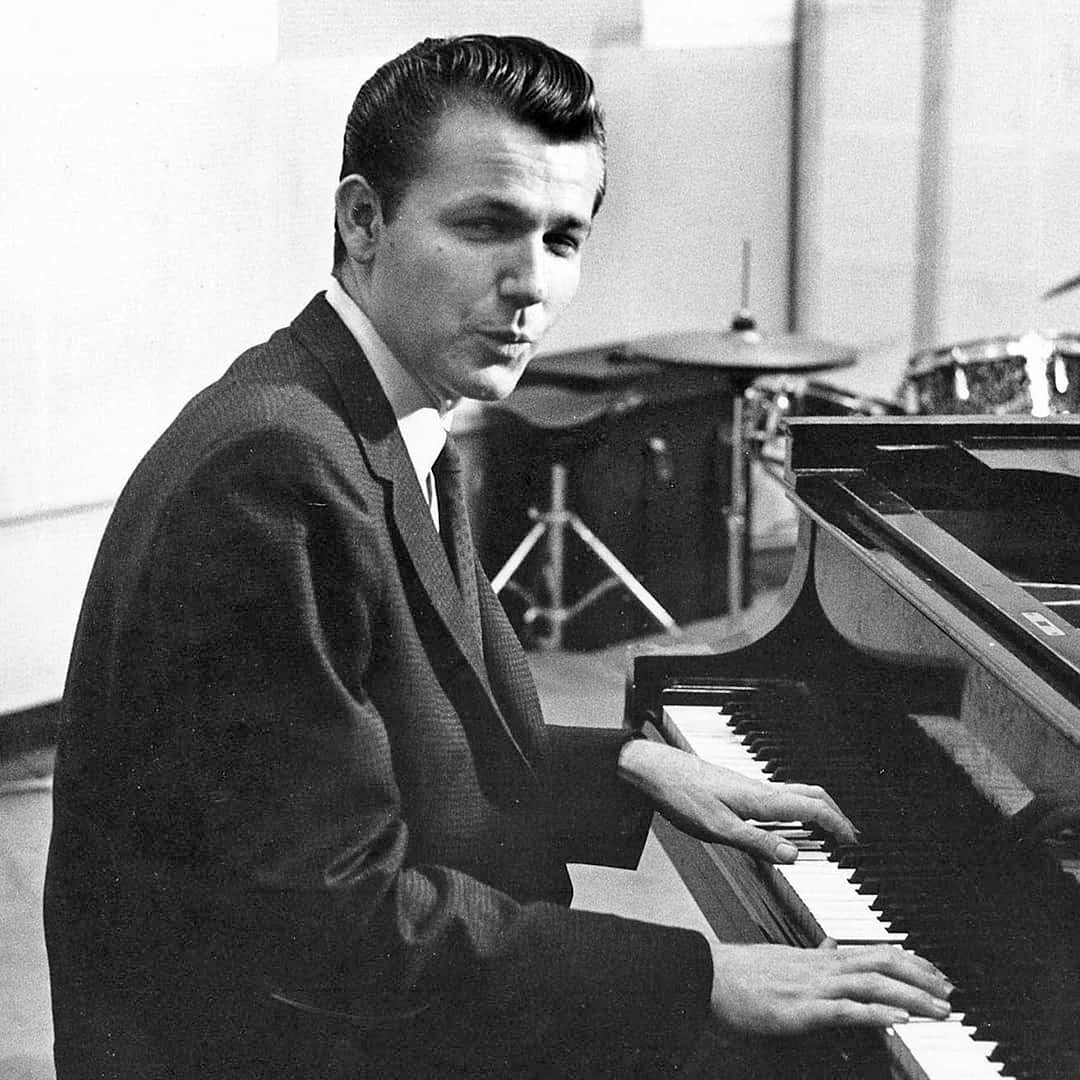
Floyd Cramer - Nashville genius |
|
If you like Floyd Cramer's beautiful slip-note piano style or Gospel, you're going to love this month's new transcription, which combines the best of both worlds.
Also new this month is the terrific bluesy piano solo from Gerry & The Pacemakers' classic 1964 hit, "How Do You Do It".
Plus, Assembly of Dust's "Second Song" (Live) which has an excellent jazz-influenced electric piano solo.
And this month's new exercise is an in-depth study (123 measures) on how to play any melody using Floyd Cramer's style - and it's not just about slip-notes.
BTW, to make sure that my email doesn't end up in your Spam folder, please add me to your Contact list and/or mark my email as "Not Spam".
Note that every Title Heading is clickable.
|
|
ALL of the Sheet Music listed on my website has been personally transcribed by me, and guaranteed to be note-for-note perfect.
Whether you:
- have a cover band and want to get your keyboard parts exactly correct,
- are a professional who wants to study the styles of rock's greatest keyboard players, or
- are a hobbyist that wants to learn how to play pop/rock and great piano music,
...these note-for-note transcriptions will prove extremely helpful.
|
|
Born in 1933 in Shreveport, Louisiana, Floyd Cramer grew up in the small sawmill town of Huttig, Arkansas. He taught himself to play the piano by the ear.
After graduation from high school in 1951, he moved to Shreveport and found a job on the Louisiana Hayride.
He arrived just as Lefty Frizzell’s records were popularizing what Cramer termed “a plinking honky-tonk type piano.” He played in that style on Jim Reeves’s “Mexican Joe” and made his first record for Abbott Records in 1953, "Dancin' Diane", backed by the Louisiana Hayride Band, for the local Abbott label, whose other artists included Jim Reeves and Johnny Horton.
|
|
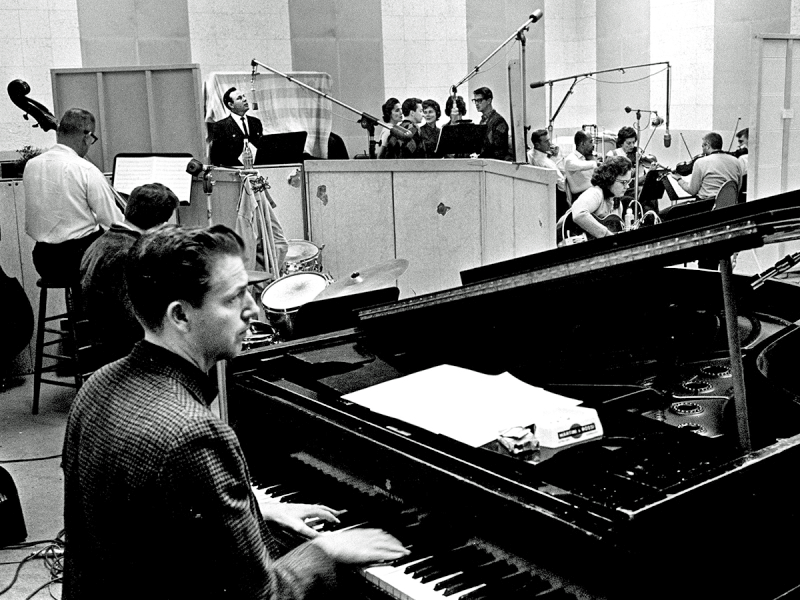
Floyd Cramer in a Nashville session |
|
When Cramer first went to Nashville in 1952, there were few studio pianists in Nashville, aside from Owen Bradley, Poppa John Gordy, and Marvin Hughes. After a year or two of commuting, Cramer talked to Chet Atkins about becoming a session pianist and in January 1955 he left Shreveport for Nashville, rejoining Atkins as the house pianist at RCA Records.
That same year he played dates with an emerging talent who would later figure significantly in his career, Elvis Presley. After Presley performed on Louisiana Hayride in 1955, he hired his own band which included Cramer, Scotty Moore (guitar), Bill Black (bass), and D.J. Fontana (drums). This group remained as Elvis' supporting band for much of that year; however, when Presley asked them to relocate to Hollywood, Cramer declined to follow him there, preferring to remain in Nashville as a studio musician.
In Nashville, Cramer found that piano accompaniment in country music was growing in popularity. By the next year he was, in his words, "By 1956 and '57 I was in day and night doing sessions."
Under Atkins' guidance, Cramer played on hundreds of sessions, including many for Presley, among them "Heartbreak Hotel", Elvis' first #1 on Billboard's pop singles chart and his first gold record award winner.
|
|
|
|
Before long, Cramer was one of the busiest studio musicians in the industry, playing piano for stars such as Elvis Presley, Brenda Lee, Patsy Cline, the Browns ( "The Three Bells"), Jim Reeves, Eddy Arnold, Roy Orbison, Don Gibson, and the Everly Brothers, among others.
One of the few records on which he played something other than piano was Jimmy Dean’s “Big Bad John” (he created the pickaxe soundeffects by hanging an iron doorstopper on a coat hanger and hitting it with a hammer).
In 1958 Atkins signed Cramer to RCA as an instrumental artist; his fourth single, released in 1960, was “Last Date,” an instrumental piece that exhibited a relatively new concept in piano playing known as the "slip note" style.
|
|
It was at Atkins’s suggestion that Cramer wrote “Last Date” to showcase the slip-note style. It seems to have first emerged at the earlier 1960 session for Hank Locklin's hit "Please Help Me, I'm Falling", when Cramer was asked by Chet Atkins to copy the unusual piano styling of songwriter Don Robertson, who had played piano on the demo, sliding up into a note from the one beneath. That was the technique that Cramer incorporated into his style.
Of the characteristic "slip note" style, Cramer commented, "The style I use mainly is a whole-tone slur which gives more of a lonesome cowboy sound. You hit a note and slide almost simultaneously to another." The origin of the style is uncertain. Cramer also acknowledged the influence of 'Mother' Maybelle Carter's autoharp playing. “It’s been done for a long time on the guitar by people like Maybelle Carter,” Cramer said, “and by lots of people on the steel guitar. Half-tones are very common, but the style I use mainly is a whole-tone slur which gives more of a lonesome, cowboy sound.”
A bigger pop than country hit, the record went to number two on the Billboard Hot 100 pop music chart, sold over one million copies, and was awarded a gold disc. The song was kept out of the number 1 position by Elvis Presley's "Are You Lonesome Tonight". The session pianist for Elvis's recording of that #1 song, in a very early morning session (about 4:00 AM) at RCA Studio B in Nashville, was none other than Floyd Cramer himself.
|
|
Following the release of "Last Date", Cramer commented in November 1961:
"Trying to launch myself on a solo career, after being Elvis Presley's pianist for so long, placed me in an unenviable position. Some people thought I was trying to cash in. If I had wanted to cash in on my association with Elvis, I would have done it five years ago."
In 1961, Cramer had a hit with "On the Rebound", which went to number 4, and number 1 on the UK Singles Chart ("On the Rebound" was featured during the opening credits of the 2009 Oscar-nominated film An Education, which was set in England in 1961). Also in 1961, Cramer had a hit with "San Antonio Rose" (number 8).
|
|
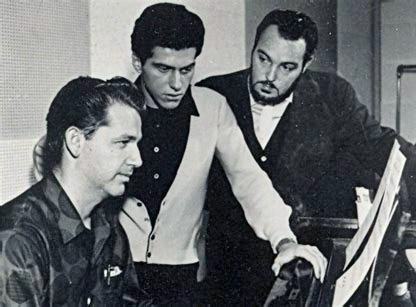
Floyd Cramer, Johnny Rivers & Jimmy Bowen |
|
By the mid-1960s, Cramer had become a respected performer, making numerous albums and touring with guitar maestro Chet Atkins and saxophonist Boots Randolph, sometimes headlining and sometimes as the opening act for Eddy Arnold. Cramer also performed with them as a member of the Million Dollar Band.
Cramer had a long career as a solo performer with dozens of his own albums and singles, including some Top 40 instrumental hits.
Over the years, he continued to balance session work with his own albums. Many of these featured standards or popular hits of the era. From 1965 to 1974 he annually recorded a disc of the year's biggest hits, entitled Class of . . . . Other albums included I Remember Hank Williams (1962), Floyd Cramer Plays the Monkees (1967), Sounds of Sunday (1971) and Looking for Mr. Goodbar (1978). In 1977 Floyd Cramer and the Keyboard Kick Band was released, on which he played eight different keyboard instruments.
In 1980 Cramer's final major chart entry was a version of the theme of the television series Dallas.
In the spring of 1984 when Cramer picked up his phone in Nashville, there was an unmistakable voice on the other end of the line. It was Michael Jackson, inviting the famed pianist to perform at an event honoring matriarch Katherine Jackson. “I’ve been listening to ‘Last Date’ all my life,” said Michael, referring to Cramer’s 1960 signature instrumental. The keyboardist was Katherine’s favorite recording artist, and that’s how he wound up tickling the ivories behind Michael on “For the Good Times,” backing Jermaine on “Moon River” and entertaining the entire Jackson clan in Hollywood that spring.
“I was just overwhelmed, and very surprised,” Cramer commented. He shouldn’t have been. As a key member of Nashville’s “A Team” of studio musicians, he was one of the most influential piano players in history, regardless of genre.
Sadly, Floyd Cramer, a heavy smoker, passed away of lung cancer on New Year's Eve, 1997 at the age of 64.
My Floyd Cramer transcriptions:
My Floyd Cramer arrangement:
|
|
March's New Transcriptions - Floyd Cramer - "One Day at a Time", Gerry & The Pacemakers - "How Do You Do It", Assembly of Dust - "Second Song"
Note-for-Note Accuracy
|
|
Floyd Cramer - "One Day at a Time (Sweet Jesus)" |
|
There are three new transcriptions this month - one being the complete piano part in Floyd Cramer's recording of "One Day at a Time", released in 1990 on his Gospel Classics album. It is filled with not only his slip-notes but also uses six other types of Right-hand embellishments. BTW, my new exercise explains and illustrates all seven types.
The song itself is a Gospel classic, written in 1973 by Kris Kristofferson.
This note-for-note transcription includes Cramer's Left-hand part, also, of course, and can help you to better understand exactly what he's doing.
The piano part is an excellent example of a classic Gospel song filtered through Floyd Cramer's own beautiful style.
If you'd like to study Cramer's 'sound' in general, or Gospel specifically, this should be a big help.
|
|
BTW, a MIDI file is also available in addition to the PDF sheet music. |
|
My second new transcription this month is the tack piano solo on Gerry & The Pacemakers' 1964 classic, "How Do You Do It", which was produced by George Martin, The Beatles' producer. Although the song itself has a Major Key sound, the piano solo is decidedly minor-key bluesy, complete with several 'flips' plus six 'crushed' notes where the D and E-flat (in the key of A) are played simultaneously to really enhance the bluesy effect.
This Piano Solo transcription also includes the two bars immediately preceding and the two bars immediately following the solo, so that you can get into and out of the solo just as it was recorded.
|
|
And my third new transcription is the Electric Piano Solo on "Second Song", released by Assembly of Dust on their 2016 live album, Tales from the Oregon Trail. The pianist, Jason Crosby, rips through a jazz-influenced uptempo solo with lots of running 16-notes plus three 'flips' of his own. |
|
Learn How To Play like Floyd Cramer
|
|
|
|
My new exercise this month will help you to better understand, and to play, Floyd Cramer's slip-note style.
If you think that Floyd's slip-notes were his only 'trick', you'd be quite wrong. This exercise identifies seven different techniques from Cramer's "bag of tricks". Slip-notes are only one of them.
This exercise contains eight sections. The first is just a statement of the main theme that will be gradually transformed.
I chose "Mary Had a Little Lamb" because if that simple nursery rhyme melody can be transformed into Floyd Cramer's style, then any other melody certainly can.
The seven transformative steps are:
|
|
1) The chords & meter are changed, and Cramer-style Left Hand part added.
2) Slip-notes are added.
3) A harmony note is added above the slip-notes, the essence of Cramer's style.
4) Six other types of Cramer's embellishments are added (and discussed in the Performance Notes).
5) The melody is slightly altered to reflect his style.
6) Warm mid-register phrases are added.
7) A busier Left Hand pattern is used.
Learn how to play Floyd Cramer's style much better with this step-by-step exercise.
|
|
(to listen to it, click here) |
|
Another Exercise for Transforming a Melody into a Different Style:
(to listen to it, click here)
|
|
The Hangout Place for Gospel Classics
|
|
You don't have to be from the Deep South to love Gospel piano, nor do you need to belong to any particular religion. All you have to have is a love for wonderful old-time, swinging, uplifting piano-playing.
Leon Russell, Billy Preston, Richard Tee and Ray Charles, some of the greatest keyboard players ever, loved the style and infused their own performances with Gospel licks and rhythms.
Inspired by the wonderful playing of the portly Associate Pastor/Musical Director of my childhood's Baptist Church deep in the piney woods of Mississippi, in recent years I've transcribed and/or arranged a few Gospel classics.
This little corner of my newsletter is where I'll keep you informed of my latest efforts to share that old-time Gospel sound.
Here are my Gospel transcriptions and/or arrangements, plus some exercises:
Full-blown Gospel:
Heavily Gospel Influenced:
Moderately Gospel Influenced:
Gospel-related Exercises:
|
|
Helpful for Those that Don't Read Sheet Music Well
|
|
Most of my transcriptions have heretofore been available only as sheet music in PDF's. That is gradually changing - some are now also available as MIDI files, which can be especially helpful for those who would prefer to listen to them than to read the sheet-music notation.
This section of my newsletter is where I'll keep you informed of which transcriptions and exercises are available as MIDI files.
BTW, if you'd like my sheet music in a MIDI file, just let me know which one(s).
Here are the currently available MIDI files of my transcriptions, arrangements, and exercises:
MIDI Files of Rock & Pop Transcriptions:
MIDI Files of Exercises:
|
|
If you're using a vintage synthesizer, please check out our synth patches here.
These are the most highly-organized and best-sounding synth patches available anywhere, guaranteed. Get the most out of your vintage hardware with these large patch libraries:
Ensoniq
Kawai
Korg
Roland
Yamaha
Even if you don't use the actual hardware synthesizers, there are software emulations that will allow you to play these patches on your computer, as VSTI's in your sequencer. These include:
Korg Legacy Digital Edition (for M1 & T1 synths)
Native Instruments FM8 (for DX7 synths)
Aurora FM (for DX7 & TX81Z synths)
SQ8L (for ESQ-1 synths)
|
|
For the B3 players out there, we have a request for a transcription of an “all-time favorite” Rock Classic... Steve Miller’s “Fly Like an Eagle”. I have marveled at this track for some time now. This song contains one of the greatest recordings of Rock Hammond playing, featuring virtuoso Joachim Jymm Young.
A student of mine made the request and he has kicked in $300 towards the effort. The piece is 4:41 long so it is a monster and will require a monster effort. The total fee for the transcription will be $695 so we are almost halfway there. Please contribute any amount, small or large to help us reach the goal ($25-50-75-100). I am particularly excited to do this transcription because I've come across a multitrack recording which contains the Keyboard part by itself, so it'll be a perfectly accurate transcription.
Performance Notes will be included, dynamic indicators (crescendo and decrescendo markings), and where appropriate, notation of places that he uses both hands for simultaneous chords. It is impossible to accurately know the drawbar settings because each Hammond is different, but I'll estimate these as closely as possible.
I hope we have a lot of interest in this great song, so please spread the word.
To listen to the organ part on "Fly Like an Eagle" click here. |
|
If you play in a cover band, you know the challenges of playing the piano and organ parts exactly like the record. Or if you're a classical pianist, you might not be able to play by ear as well as you'd like.
Over the years I've had the good fortune to have not only toured with some very talented musicians but also to have taught others, and I'll be happy to help you, too, regardless of your skill level.
By means of Skype lessons (or in-person if you're in L.A.), I can coach you and help you to improve your technique, your rhythm, your ability to improvise, your knowledge of music theory, your sight-reading, and to develop relative pitch.
|
|
- The Beach Boys
- Rod Stewart - All 'Unplugged' Concerts
- Ricky Nelson - Stone Canyon Band
And I've also won classical piano competitions performing Beethoven, Rubinstein and Saint-Saens' Piano Concerti. See me playing here. "Josie's Boogie" is quite the virtuoso dramatic minor-key showpiece; check out the ascending double-octave run at the ending... :)
Thanks to the internet, I can help you play piano better - rock or classical, by ear or by note.
Or if you live near the Hollywood Hills, I'll teach you in my home or yours.
1) Your musical background
2) Where you are currently, musically-speaking
3) Your musical goals
|
|
|
My students include members of:
- Weezer (Rivers & Brian)
-
Vampire Weekend (Ezra & newest addition, Greta)
- Incubus (Mike)
- The Strokes (Nick)
- Rooney (Robert)
-
Jason Schwartzman (Mozart in the Jungle)
- Courteney Cox
- Pablo Dylan
|
|
|
|
|
"Thank you! It (Floyd Cramer - "One Day at a Time") is beautiful. It was quite easy to sightread. I always thought his music was more difficult... We just don't do the slip (his bag of tricks), and it seems harder than it actually is. I've been searching for this arrangement for years. I've never found this song from him written down. Sure wish I could do what you do... it is significant for me, so thank you."
- Sandra W.
|
|
|
Los Angeles, CA
323-650-6602
|
|
|
|
|
|
|
|