Independence Day, the 2024 Olympics, and the July edition of the Dyer & Co. newsletter! We’re interrupting those hot summer days with some cool updates and information to help you reach your financial and personal goals. | |
Should You "Sell in May and Go Away"?
You might have heard the phrase "Sell in May and go away" circulating in the financial world. With a long-standing history among investors, this saying suggests selling stocks in May and returning to the market in the fall. The idea is based on historical trends showing weaker market performance during the summer than the more substantial gains often seen from November to April. Some investors believe they can enhance returns and reduce risk by following this seasonal pattern.
While very long term historical data does show a trend of lower average returns during the summer months, it doesn’t guarantee future performance. Economic conditions, geopolitical events, and market attitudes influence markets. Over-relying on historical trends without considering current market conditions can be risky. While returns do tend to be lower during the summer and early fall months, there's no reliable trend you can bank on. In fact, going back to 1971, the S&P 500 has risen from Memorial Day to Labor day 70% of the time according to Dow Jones Market Data.
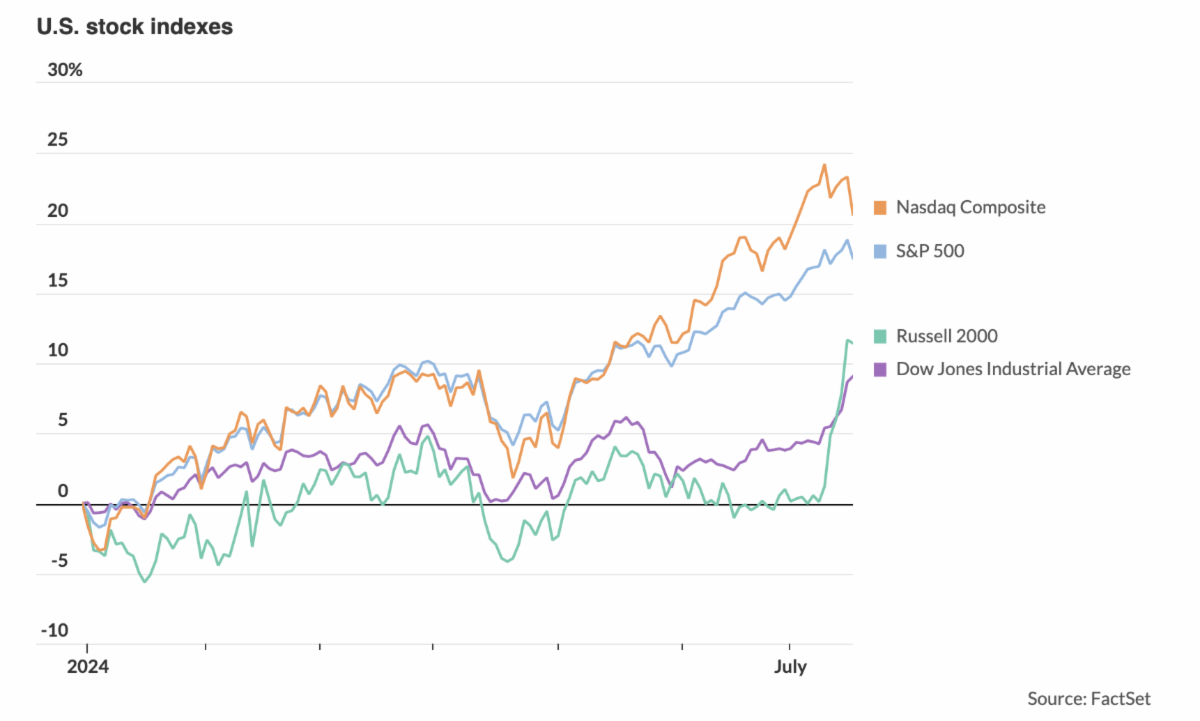
When looking at this year especially, the tall tale of exiting the market during the summer months is less appealing. The S&P 500 has recorded an eye-popping 14.4% from the beginning of the year to the end of June--with nearly 4% of that return happening since Memorial Day. Plus, the U.S. stock market is starting to broaden beyond "The Magnificent Seven" (Apple, Alphabet, Amazon, Nvidia, Microsoft, Meta, and Tesla), leading investors to believe the "summer 2024 rally is getting healthier" and the S&P 500 hitting new highs provides some evidence of this. As you can see, selling in May and exiting the market would've caused you to miss out.
|  | |
Today’s market environment is different from the past. According to Invesco, with stock buybacks on the rise worldwide and geopolitical tensions not derailing stocks, the market’s behavior has evolved. Adhering strictly to “sell in May and go away” may not be as effective as it once was.
“Sell in May and go away” is an old market tale, but it shouldn’t dictate your investment strategy. Investing should be guided by your long-term goals, individual risk tolerance, and the constantly changing market environment. By staying informed and maintaining a balanced approach, you can navigate the markets effectively, regardless of the season.
It’s time to stop worrying about the timing and spend more time IN the markets. A well-thought-out plan and the discipline to stick with it through various market cycles are crucial to market success. If you're still concerned about your investing plan this summer, it might be time for a mid-year financial check-up (😉). Happy investing this summer, and remember to reach out with any questions or concerns.
|  | |
Mid-year Financial Checkup
Last year, Forbes posted a useful and evergreen article highlighting key insights to a mid-year financial checkup. As we start to gear towards the back half of 2024, we wanted to share some of the most helpful tips.
-
Increase Your Retirement Savings: Boost your retirement savings to match your company’s contributions, then aim for more. With the decline of pension plans, most professionals rely on employer-defined contribution plans for retirement. If you can’t afford to maximize contributions immediately, increase your savings rate by 1% annually to build significant savings over time.
-
Rebalance Your Portfolio: As you approach the transition from accumulation to withdrawal in retirement planning, ensuring your asset allocation aligns with your risk tolerance is crucial. Market volatility can cause portfolios to deviate from their original allocation. Rebalancing means adjusting your portfolio back to its planned asset distribution. Review and rebalance your portfolio at least once a year to maintain your investment strategy.
-
Plan for Irregular Expenses: One common budgeting mistake is neglecting irregular but expected expenses. These costs, like annual car services or home repairs, don't occur monthly and often need to be accounted for in a typical budget, leading to financial strain when they arise. To avoid this, list these irregular expenses, estimate their annual costs, and divide them by 12 to incorporate into your monthly budget. Consider setting up a separate savings account or padding your checking account to prepare for these expenses. Choose the method that works best for you.
-
Schedule Your Annual Health Checkups: Ensure you keep up with annual physicals and essential tests like mammograms and colonoscopies. Early detection and prevention are key to long-term well-being. Schedule these appointments before the year ends. Prioritize your physical health to enjoy a long, fulfilling life and retirement.
-
Plan Your Charitable Giving: If you're inclined to give, create a tax-efficient charitable giving plan. For those over 73, consider donating directly from your IRA using a Qualified Charitable Distribution. Focus on how you give, not just how much. For instance, donating appreciated stock can be an intelligent part of your strategy.
-
Update Your Financial Plan: Review your financial plan before year-end to make necessary adjustments. Evaluate your net worth, savings rate, and goals to ensure you're on track for retirement. Have your goals changed? Check your investment allocation and update as needed. Many focus on finances at the start of the year but neglect regular check-ins, so a mid-year review is crucial to staying on track as time passes. Contact us if you're ready for a financial checkup.
| |
Navigating the Costs of Higher Education
As higher education costs continue to rise, planning ahead has never been more crucial. Understanding the financial landscape and exploring savings options can make a significant difference no matter what stage you're in when preparing for college. Here’s how you can start thinking about it and some effective ways to save and prepare for those next steps:
Understanding the Costs:
While there’s no hidden secret that college is expensive, so many expenses are often overlooked when it comes to planning and budgeting for higher education. Fees such as tuition, room and board, and books/supplies vary widely depending on the institution. However, there are many miscellaneous expenses that some may not consider when financially preparing for college, such as transportation, personal expenses, and any additional fees. While these may be little things that are hard to plan for, they can accumulate over time and can be pretty costly.
A College Kid's Guide to Budgeting:
I've (Eli) just wrapped up my sophomore year at Davidson College, and I've had some amazing experiences and met some amazing people. However, the freedom I now have as a young adult at college was more expensive than I had thought.
Before making the trip from Pittsburgh down to Davidson College, my parents and I worked out a straightforward budgeting plan that allowed me to (mostly) stay on track, not run out of money or creep into my savings, and develop healthy budgeting tricks:
- With a few months left in my senior year, I started looking for a summer job in my area where I could make a decent amount of money before starting school in the fall. I worked in a restaurant 4-5 days a week in the summer for about 6 hours each day, and this was a great opportunity to enjoy my summer before college without breaking the bank. Getting a summer job before college was super crucial for me to know that the money I was making was going straight into my "school fund" that I could use on those miscellaneous expenses (this doesn't have to be anything related to your career and should be focused on making money and still having fun).
- One habit that helped me as I was saving money for the summer was putting portions of my paycheck from my job that summer into a "savings pile" that I created with my parents. This helped me take less out of my overall savings, outside of the money I was making at my job before I left for school. This taught me how to budget while still enjoying my summer and some of the money I was making.
- Towards the middle of the summer, I sat down with my parents, and we started planning and budgeting for the school year. We began by looking at how many weeks I would be at school each semester, disregarding Thanksgiving break and other instances where I would be at home/not spending any money. We started by looking at how much I would need for each semester if I paid $100/week (this was super unrealistic because of the meal plan my school offers and being able to take advantage of the free things offered to students).
- We then did some simple math for the amount of money I would need for the whole school year, and said that's what my savings goal should be by the end of the summer. Regardless if I had made more money or had savings from previous summers, graduation, birthdays, or elsewhere, I would only have the amount we calculated in my checking account when I started school.
- I recommend starting at a high number, such as $100, when calculating how much you think you may spend each week. Although it is rather unrealistic, and I found myself rarely hitting that $100 limit, it allowed for more of a buffer if I did spend over my limit later on. Also, by the end of the semester, I would have money left that would go back into savings or would carry over through the next semester.
This simple budgeting tool not only allowed me to understand what miscellaneous expenses I would need to keep in mind for the years to come but also developed healthy budgeting tactics to use in all walks of life. If I were getting close to my limit, I would stay on campus and use the pre-paid meal plan instead of going out. If I found that I had barely spent any money one week, I wouldn't rush to spend it all but save it for emergencies later in the semester and continue building my savings. Throughout my two years, and as I continue to learn more about financial literacy and freedom, this simple tool and conversation with my parents has taught me to treat money with respect for overall success.
|  | Navigating the costs of higher education requires thoughtful planning and disciplined saving. By understanding the different expenses involved and taking advantage of various savings plans, you can ease the financial burden and help secure a brighter future. Helping your children with budgeting into their time at college can kickstart their financial literacy and planning understanding early on. Start early, stay informed, and make the most of available resources to turn the dream of higher education into a reality. Don’t hesitate to reach out to us for any advice or more detailed information on savings plans. | We hope that you’re having a safe and relaxing summer! As the fireworks light up the sky this Fourth of July, remember that a sound financial plan is just as remarkable. We’re here to help you achieve your goals and ensure you have a fantastic summer and beyond! | Thank you for reading. If you liked this content, please share with a friend. You can always reach us by replying to this email or at 704-323-6872. |
| | | |