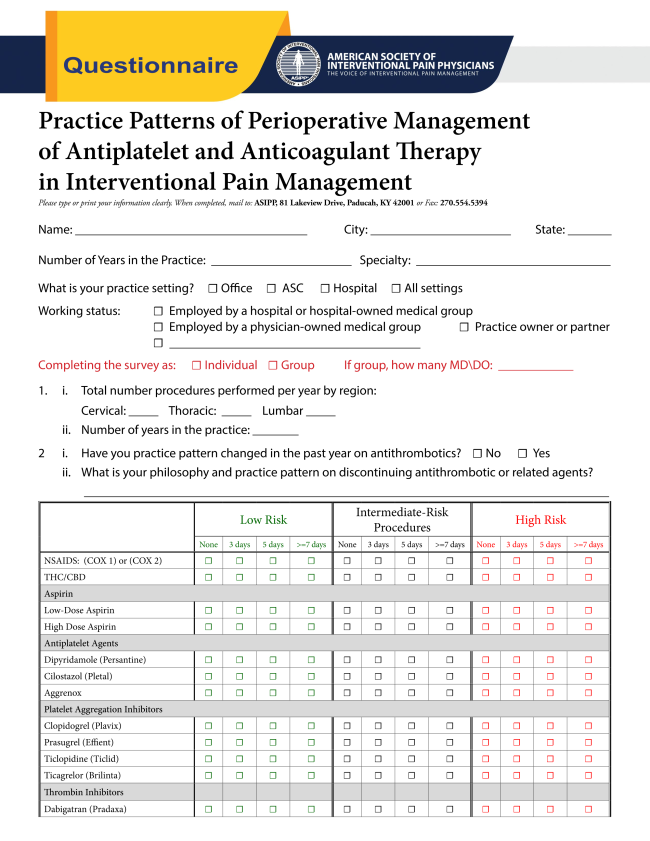
ASIPP is conducting a survey on the practice patterns of perioperative management covering antiplatelet and anticoagulant therapy in Interventional Pain Management. We last surveyed this topic 10 years ago. We would like to compare the 2011 data to 2021 to see the changes to the practice pattern. Your help is needed to accomplish this!
We recently mailed to you the survey titled Practice Patterns of Perioperative Management of Antiplatelet and Anticoagulant in Interventional Pain Management. If you did not complete the survey, please take a few minutes to complete it mail it back to us in the prepaid return address envelope.
If you did not receive the survey, you may download the survey by clicking here. Please complete and e-mail it back to drm@asipp.org or fax to 270.554.5394.
This survey is most important to ASIPP and its members. It will demonstrate how our members practicing Perioperative Management utilize antiplatelet and anticoagulant therapy in pain management procedures. The more members that participate will increase the impact of the survey.
Please complete the survey and mail, e-mail, or fax back as soon as possible.
|
|
Paxlovid first oral antiviral authorized to treat high-risk COVID patients
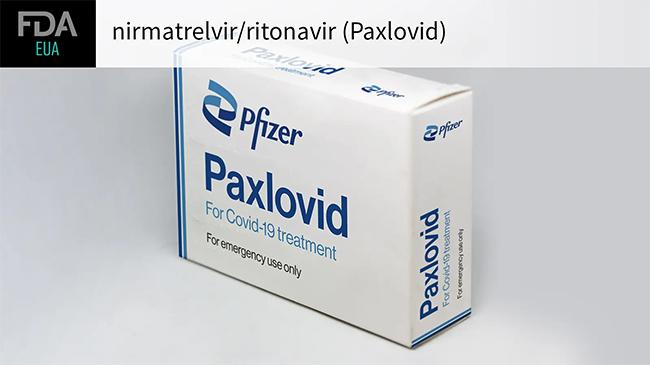
Oral antiviral treatment for COVID-19 is now on the table following FDA's emergency use authorization (EUA) for nirmatrelvir/ritonavir (Paxlovid), the agency announced on Wednesday.
Paxlovid is authorized for use in adults and pediatric patients with mild-to-moderate COVID-19 who are at high risk of progressing to severe illness. It is administered as three pills (two of nirmatrelvir and one of ritonavir) twice daily for 5 days, for a total of 30 pills, the agency said.
However, the FDA added that the drug is only available by prescription, must be given within 5 days of symptom onset and is not authorized for use longer than 5 days.
|
|
Moves will include new testing and vaccine sites, help for overburdened hospitals from military medical personnel
The Biden administration is preparing to distribute 500 million free at-home Covid-19 testing kits to Americans and deploy military doctors and nurses to overburdened hospitals this winter, as the Omicron variant spreads around the country.
President Biden will outline the moves during a speech at the White House on Tuesday. His administration is grappling with how to publicly underscore the urgency surrounding the highly transmissible variant, while seeking to convey that the U.S. is better prepared to battle the pandemic than it was a year ago.
Mr. Biden is expected to stress that Americans should take the Omicron variant seriously but shouldn’t panic, according to administration officials. The president will tell vaccinated Americans who are following public health guidelines that they should feel comfortable spending the holidays with their families. Unvaccinated Americans, however, are at much greater risk of hospitalization and death, Mr. Biden will warn, according to the officials, who added that the administration is preparing for cases to keep rising.
|
|
Booster shot significantly increased levels of immune-system antibodies against Omicron in the experiments, company says
Moderna Inc. said a third dose of its COVID-19 vaccine increased immune responses against the Omicron coronavirus variant compared with two doses in lab tests, signaling the shot could still offer protection despite the variant’s mutations.
The findings, reported by Moderna on Monday, were the latest positive — though preliminary — results from lab tests suggesting boosters can protect against the worrisome new strain.
The new data may reinforce calls by public-health officials for vaccinated people to get booster shots. In the U.S., only about 29.5% of fully vaccinated people have received booster doses, according to the Centers for Disease Control and Prevention.
|
|
The plan gets a lot right, but actually carrying it out is the real challenge
The Biden administration recently released the National HIV/AIDS Strategy (2022-2025), an update from the 2010 and 2015 versions spearheaded by then-President Obama. Seeing this in my email inbox and social media timelines was a welcome sight, signifying that our federal government has not forgotten its commitment to ending the HIV epidemic, despite the persistent scourge of COVID-19. The 98-page document not only covers the major goals of the domestic strategy, but also describes how these goals will be implemented and how systems will be held accountable for achieving measurable outcomes.
What's in the Plan?
First, the strategy aims to achieve a 75% reduction in new HIV infections by 2025, and a 90% reduction by 2030. This is similar to the goals in the 2019 End the HIV Epidemic (EHE) initiative. In fact, the updated strategy describes how the two initiatives work in concert, with the national strategy focused on the overall federal response and the EHE program targeting communities and areas disproportionately impacted by HIV.
|
|
More than 8.4 million fake pills seized since end of September
Mexican drug cartels are flooding the U.S. market with fake prescription pills that contain fentanyl, leading to thousands of overdoses and deaths, according to the Drug Enforcement Administration (DEA).
At a press conference Thursday afternoon, DEA Administrator Anne Milgram, JD, said that one morning this past May, the parents of a 15-year-old high school freshman in Idaho "found their son in his bedroom. He wasn't breathing. Despite starting CPR right away and immediately calling for help, their son died of a fentanyl overdose."
The boy's death was caused by one pill that he purchased on Snapchat -- "a pill he thought was a prescription oxycodone," she continued. "It looked like a prescription oxycodone pill, but it was not. It was actually a fake pill containing a deadly dose of fentanyl."
|
|
With the federal requirement in limbo because of legal challenges, some major multistate hospital systems have stopped enforcing their own policies.
The legal uncertainty over a federal requirement that the nation’s 17 million health care workers be vaccinated against the coronavirus has led some well-known hospital chains to drop their own mandates — at least temporarily.
The Cleveland Clinic, HCA Healthcare and Intermountain Healthcare, among others, have said they are no longer requiring employees to be vaccinated until the courts sort out whether the federal mandate can go into effect. The hospitals’ decisions were first reported by The Wall Street Journal.
The moves are likely to slow down efforts to quell the latest surge in infections, potentially worsened by holiday traveling, large gatherings indoors and the introduction of the Omicron variant. Public health officials are renewing their pleas for more people to get vaccinations and booster shots as this latest wave of COVID cases threatens to again overwhelm hospitals. Some 66,000 Americans are now hospitalized with COVID.
|
|
CDC panel demotes vaccine but stops short of recommending against use
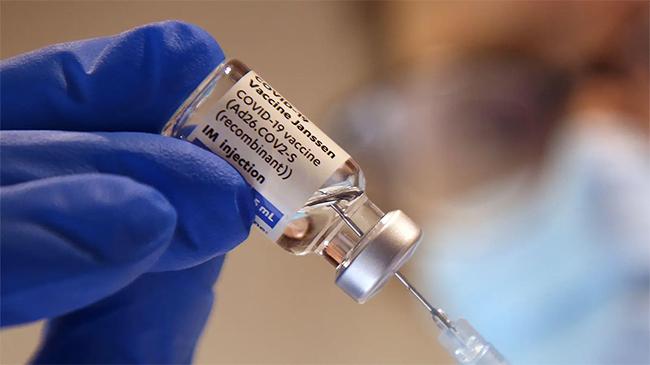
Pfizer and Moderna's COVID-19 vaccines are recommended over Johnson & Johnson's for all adults, the CDC's Advisory Committee on Immunization Practices (ACIP) said on Thursday.
The ACIP voted 15-0 that either of the two mRNA vaccines are preferred over the Johnson & Johnson vaccine for adults ages 18 and older. This interim recommendation applies to the vaccines both as a primary series and a booster dose. Previously, the committee had no preferential recommendation for any COVID vaccine.
Many committee members wanted more forceful language, such as "strongly preferred," but CDC staff noted that the strength of the recommendation would be communicated in the clinical considerations.
|
|
Israel is to offer a fourth dose of a COVID-19 vaccine to people older than 60 or with compromised immune systems, and to health workers, as part of a drive to ramp up the shots and outpace the spread of the Omicron variant of the coronavirus.
A Health Ministry expert panel - whose findings have yet to be implemented - recommended on Tuesday that those eligible receive the fourth shot at least four months after receiving their third.
Prime Minister Naftali Bennett, who has sought to drum up higher Israeli turnout for vaccines, welcomed the panel's statement as "great news that will help us overcome the Omicron wave that is spreading around the world".
|
|
The change of expert opinion was sudden. Researchers at Harvard Medical School now say the omicron variant, not delta, is likely fueling the current surge in Covid-19 cases in the northeastern U.S. That’s cause for alarm, because they still don’t know much about the variant, and it’s unclear how well vaccines will protect people. Harvard’s labs are optimized for speed but omicron is spreading faster than they can track it.
“I think we are in the omicron surge,” Bronwyn MacInnis, director of pathogen genomic surveillance at the Broad Institute of MIT and Harvard, said at a press event on Tuesday afternoon. “There’s no system on the planet that could keep up with the pace of this doubling time.”
Though the Centers for Disease Control had reported just a few days earlier that omicron probably made up just 3% of U.S. infections, she said that’s probably a big underestimate as cases grow by the day. In New York and New Jersey, the percentage that are from omicron was estimated at 13% as of Wednesday.
|
|
-
To log in for the first time you will need to click “forgot password” at the bottom of the login window.
- Check your email and then log in as directed.
-
If you have problems logging into your account, click here.
|
|
A panel of experts that advises the CDC on the use of vaccines said the Pfizer and Moderna mRNA COVID-19 vaccines should be the preferred shots for adults in the U.S. because the Johnson & Johnson shot carries the risk of a rare but potentially fatal side effect that causes blood clots and bleeding in the brain.
In an emergency meeting Thursday, the CDC’s Advisory Committee on Immunization Practices, or ACIP, voted unanimously (15-0) to state a preference for the mRNA vaccines over the Johnson & Johnson. The vote came the panel heard a safety update on cases of thrombosis with thrombocytopenia syndrome, or TTS, a condition that causes large clots that deplete the blood of platelets, resulting in uncontrolled bleeding.
The move brings the U.S. in line with other wealthy countries. In May, Denmark dropped the Johnson & Johnson shot from its vaccination program because of this risk. Australia and Greece have limited the use of a similar vaccine, made by AstraZeneca, in younger people because of the TTS risk. Both vaccines use the envelope of a different kind of virus, called an adenovirus, to sneak the vaccine instructions into cells. On Thursday, health officials said they had determined that TTS was likely due to a class effect, meaning it happens with all adenovirus vector vaccines.
|
|
FDA and CDC experts said the plan was ill-advised, so the agencies cut them out of the decision process.
The U.S. government is pushing COVID-19 vaccine boosters for 16- and 17-year-olds without supporting clinical data. A large Israeli population study, published in the New England Journal of Medicine earlier this month, found that the risk of COVID death in people under 30 with two vaccine shots was zero.
Booster mandates for healthy young people, which some colleges are imposing, will cause medical harm for the sake of transient reductions in mild and asymptomatic infections. In a study of 438,511 males 16 to 24, 56 developed myocarditis after their second Pfizer dose (or 1 in 7,830, at least seven times the usual rate). True, most cases were mild, but in the broader group of 136 people (including older and female patients) who developed myocarditis after the vaccine, seven had a “complicated course,” and one 22-year-old died. Moderna’s vaccine carries an even higher rate of heart complications, which is why some European countries have restricted it for people under 30. But in the U.S., the Food and Drug Administration and the Centers for Disease Control and Prevention indiscriminately push for boosters for all young people.
Those recommendations came over the objections of the agencies’ own experts. The last vote by FDA advisers, in September, rejected the proposal 16-2. FDA leaders revisited the proposal in November and simply bypassed the experts. So did the CDC, whose advisers had rejected boosters for people not at high risk. Two top FDA scientists, including the head of the agency’s vaccine efforts, quit around the time of the September vote over White House pressure to authorize boosters for all. They wrote in detail about their concerns.
|
|
Call for
Abstracts & Poster Presentations
|
Proposals accepted through March 1st
|
A $50 submission fee is required upon completion of the form. |
Questions can be directed to
Savannah Gold at 270.554.9412 ext 4219 or
|
|
After reading the 2022 Abstracts & Poster Presentations guidelines, please complete the form along with the presenter's CV by clicking here.
- Top 3 will present during the general session on the final day.
- Top 10 will present during the abstract breakout session.
-
Rapid review and publication in the Pain Physician journal will be extended to the Top 10 authors accepted for meeting presentations.
Click here for Abstract and Poster Presentation
|
|
Registration coming soon! |
|
Pain Medicine Case Reports (PMCR) and Editor-in-Chief Alaa Abd-Elsayed, MD, PhD would like to invite you to submit case reports and case series to the PMCR journal. Your article will be published free of charge.
Open access journals are freely available online for immediate worldwide open access to the full text of published articles. There is no subscription fee for open access journals. Open access journals are no different from traditional subscription-based journals: they undergo the same peer-review and quality control as any other scholarly journal.
Interested in becoming a member of the PMCR Editorial Board?
Editorial board members are asked to review 2-6 manuscripts per year. Please submit your most up-to-date CV to sgold@asipp.org for consideration.
For more information or to submit your articles, click here.
|
|
| CASE REPORT |
Ali-Amin Ali, BA, and Daltry Dott, MD
Abstract
BACKGROUND: Spinal cord stimulation and neuromodulation has led to a vastly increased quality of life in patients since its introduction. Despite this, there remains a variety of potential complications to be aware of.
CASE REPORT: The following case presents a patient with postlaminectomy syndrome who developed a right-sided Bell’s palsy following a spinal cord stimulator (SCS) trial. He presented to the emergency department with right-sided facial weakness and right ear pain, reporting that the symptoms began a few hours after he returned home from the SCS trial. After an unremarkable neurologic workup, his presentation was found to be most consistent with Bell’s palsy. He received appropriate treatment and achieved full resolution of his symptoms at the 2-month follow-up.
CONCLUSIONS: Peripheral facial nerve palsy can result from a variety of etiologies. Special care is required to eliminate secondary causes before establishing an idiopathic source. Strict infection control remains a significant protective factor against SCS complications.
KEY WORDS: Spinal cord stimulator, Bell’s palsy, peripheral nerve palsy, low back pain, postlaminectomy syndrome
|
|
| NARRATIVE REVIEW |
Jinpu Li, MD, and Alexandra Szabova, MD
Abstract
BACKGROUND: Ultrasound guided nerve blocks have become a popular tool in the armamentarium for pain physicians because of its advantages over fluoroscopy by offering portable, radiation-free and real-time imaging. But ultrasound guided procedures require training and practice to gain the expertise. There is a scarcity of review articles describing ultrasound guided injections techniques for nerve blocks of the head and neck.
OBJECTIVE: To elucidate the anatomy, sonoanatomy, indications, techniques, side effects and complications for the most frequently utilized nerve blocks of the head and neck in chronic pain management.
STUDY DESIGN: Narrative review.
SETTING: Academic medical center.
METHODS: Literature review of publications in English language of the related topics using Medline (Ovid) search engine.
RESULTS: Deep cervical plexus block, cervical sympathetic ganglion block, trigeminal nerve and pterygopalatine ganglion block at the pterygopalatine fossa, greater occipital nerve block, third occipital nerve and medial branch block, and cervical selective nerve root block are discussed in this paper. The review begins with in depth discussion about the anatomy of the target nerve, followed by reviewing the available literature on the indications for the procedures. Detailed description of the procedure techniques is also presented. The volume and selection of medications is also discussed if there is available research. The review will conclude with summary of side effects, complications and precautions.
LIMITATION: We only review those nerve blocks of the head and neck that would benefit from ultrasound guided injections in chronic pain management. Other nerve blocks such as transnasal sphenopalatine ganglion block, the interscalene brachial plexus block, superficial and intermediate cervical plexus block, anterior suprascapular nerve block, superficial trigeminal nerve block are not discussed due to either that ultrasound guidance is not warranted or they are rarely utilized in chronic pain management. This paper is not a systematic review, thus it might not include all the available evidence. Many of the available evidence is case series and case reports. More randomized control studies are warranted in the future to validate these techniques.
CONCLUSION: Ultrasound guided nerve blocks of the head and neck are useful techniques for pain physicians to learn.
KEY WORDS: Cervical plexus block, cervical ganglion block, pterygopalatine ganglion block, trigeminal nerve block, greater occipital nerve block, medial branch block, selective nerve root block
|
|
| NARRATIVE REVIEW |
Jay Karri, MD, Mani Singh, MD, Devas J. Modi, MD, Vwaire Orhurhu, MD, Caleb Seale, MD, Michael Saulino, MD, Anuj Marathe, BBA,
Darrell Vydra, MD, Jonathan M. Hagedorn, MD, Brian Bruel, MD,
and Alaa Abd-Elsayed, MD
Abstract
BACKGROUND: Numerous combination intrathecal drug therapy (CIDT) strategies exist and are utilized for varying pain syndromes, typically when monotherapy dose escalation or medication alternation is deemed untenable or unfeasible. Unfortunately, the supportive evidence basis for the use of these strategies and specific drug combinations is generally lacking and unclear, with many medications being used for off-label indications.
OBJECTIVES: In this manuscript, we provide a robust exploration and analysis of the literature to provide an evidence-based narrative for the use of CIDT strategies in regard to clinical indications, pharmacologic parameters, specific drug combinations, safety profiles, and future directions.
STUDY DESIGN: Narrative review.
METHODS: This was an evidence based narrative performed after extensive review of the literature.
RESULTS: Variances in intrathecal pharmacokinetics and pharmacodynamics are utilized advantageously with CIDT strategies to achieve improved analgesic benefit; however, appropriate use may be limited by increased or compounded risk of adverse effects. The supportive evidence for CIDT use for chronic pain conditions is largely lacking and limited to small, uncontrolled, observational studies, with many having various confounding factors, including a lack of standardized dosing. The most evidenced CIDT strategies include polyanalgesia with morphine-ziconotide, opioid-clonidine, and morphine-bupivacaine. Notably, in addition to pain relief, morphine-bupivacaine has been shown to decrease early opioid escalation requirements.
LIMITATIONS: The supportive evidence for CIDT use for chronic pain conditions is largely lacking and limited to small, uncontrolled, observational studies, with many having various confounding factors including a lack of standardized dosing.
CONCLUSIONS: CIDT strategies and polyanalgesia combinations can be effective for treating various patient populations with chronic pain. The appropriate use of these strategies may be limited by increased or compounded risk of adverse effects, both of which are highly patient and scenario dependent. Therefore, practitioners should maintain a particularly low threshold of suspicion for adverse effects in patients with CIDT such that safety profiles associated with this therapy can be favorably maintained.
KEY WORDS: Intrathecal, polyanalgesia, chronic pain, ziconotide, morphine, clonidine, bupivacaine
|
|
Since this malpractice insurance program officially launched in November 2018, ASIPP has signed up hundreds of providers with an average savings of 30%. This is professional liability insurance tailored to our specialty and will stand up for us and defend our practices.
Norcal Mutual is A-Rated by AM best and is licensed in all 50 states. To read a few important points to keep in mind about the program, including discounts, administrative defense, cyber coverage, aggressive claims handling, and complimentary award-winning risk management CME activities, click here.
|
|
ASIPP® has formed a partnership with Henry Schein and PedsPal, a national GPO that has a successful history of negotiating better prices on medical supplies and creating value-added services for independent physicians. Working with MedAssets, PedsPal provides excellent pricing on products like contrast media that alleviate some of the financial pressures you experience today.
|
|
ASIPP® is now offering our members the benefit of a unique revenue cycle management/ billing service.
We have received a tremendous amount of interest in the ASIPP® billing and coding program.
Click here to learn more about the negotiated rate for practices and more!
|
|
|
up-to-date news related to you, your practice, and your patients!
|
|
|
|
|
|
|