The voice for pharmacy compounding | May 7, 2021

LAST DAY to complete our compounder survey. CLICK HERE.
From APC’s President
Don't let us fail
Dear A4PC,

Michael Blaire, RPh, FIACP
APC President
Major General Michael Collins passed away last Wednesday at age 90. He was born on Halloween day 1930 in Rome, the child of an U.S. Army officer stationed there. The Collins family moved often as he grew up, living in cities across the country before Collins went to college at the U.S. Military Academy at West Point. After graduation Collins entered the Air Force, where he was inspired to try out for NASA and become an astronaut.
Collins would go on to make two space flights, and upon his retirement received the Presidential Medal of Freedom, the highest honor a civilian can receive. Collins served as a director of the National Air and Space Museum in Washington, DC, and wrote several books chronicling the history of America's space program, most notably Carrying the Fire. But Collins is most remembered for the one thing that he did not do.
When Apollo 11 journeyed to the moon, Michael Collins stayed in orbit, alone (“the loneliest man in history”), while Neil Armstrong and Buzz Aldrin took mankind's first steps on the moon.
Imagine, after decades of training and preparation, and traveling hundreds of thousands of miles, not getting to walk on the moon. We are at a point like this at APC.

The best laid plans
Several months ago APC embarked on an extremely ambitious public affairs campaign to save compounded hormones. We interviewed and hired consultants. We worked tirelessly to obtain patient and prescriber testimonials. We developed content and collateral that can be used by pharmacy owners and prescribers to engage patients and politicians to help save cBHT.
Now it’s time to start broadcasting our message through ad placement on social media, podcasts, television and radio commercials, and the like. But we have run out of money. The campaign budget for 2021 is $1.5 million; we have raised (and spent) $900,000. We are orbiting the Moon. It is time to deploy the Lunar Module.
Whatever his true feelings were, Collins never publicly expressed disappointment or frustration, and he never displayed any animosity or jealousy toward his crewmates Neal Armstrong and Buzz Aldrin. In an interview given shortly after Apollo 11 returned to Earth, Collins said, "This venture has been structured for three men, and I consider my third to be as necessary as either of the other two."
As the APC Board of Directors developed the cBHT Media Campaign, it was believed that funding would come from three sources: our members, our corporate partners, and affiliated advocacy associations. At this point, the bulk of our funding has come from our membership. Thank you. Several of our corporate partners have also invested significant amounts, and we are thankful for their involvement.
But there are still members and corporate partners and associations who have not yet contributed. Whatever reason is holding you back, please know that your support is greatly needed and greatly appreciated. Every contribution is vital to the success of our campaign. Write a check or contribute online today. Let's make sure that none of us are remembered for what we did not do.
Michael Blaire is APC’s president, but his day job is vice president for government and regulatory affairs at Wedgewood Pharmacy in Scottsdale, Arizona. You can reach him at mblaire@wedgewoodpharmacy.com.
This Week
A welcome new wrinkle on FDA's MOU
FDA has launched a new web page to help answer questions regarding the MOU. Of note is point number 6, which is new information:
Can a state that is prohibited by a state law from disclosing a complainant’s name and contact information fulfil the agreed upon data reporting under the MOU?
Yes. Under the MOU, the state is agreeing to report the name and contact information of the complainant, if available, to FDA. If providing this information is prohibited by state law, FDA does not consider it to be “available” for purposes of the MOU.
That could make a difference for states such as Florida that have indicated concern that the MOU conflicts with their confidentiality laws.
Which states have signed? Will sign? Won't? Here's the latest map from NABP (click to enlarge:)
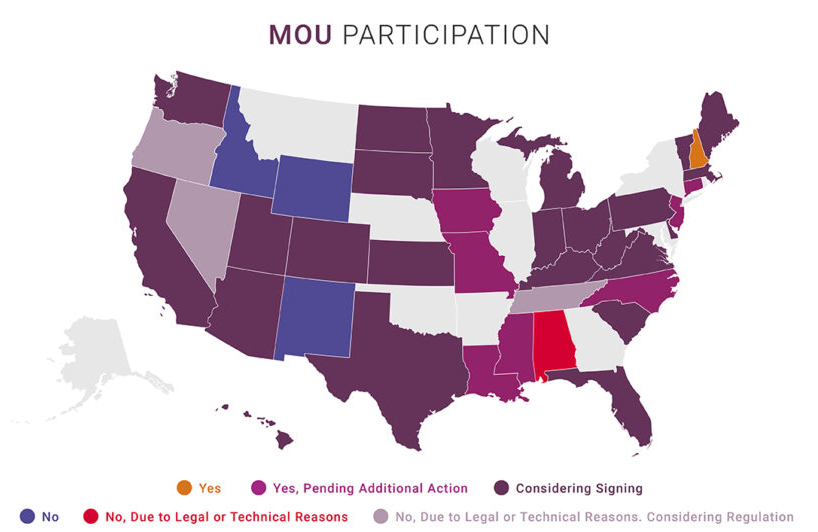
(It's also available on the NABP website.)
REMINDER: While the MOU is flawed, APC’s position is that compounders need to reach out to their board of pharmacy now and urge the board to determine if it can or will sign. Several states have discovered that state law prohibits them from signing.
If your state determines it can sign, urge it to do so before the October 26 deadline. If it determines it cannot sign — and it’s best to determine that now, and not at the last minute — the board of pharmacy needs to contact FDA immediately and urge the agency to extend the signing deadline. Ultimately, it’s better for states to sign the MOU if they can, than to have a catastrophic five-percent cap imposed on out-of-state shipments of compounded preparations.
APC members briefed on MOU reporting
APC held a virtual briefing Thursday with Melissa Madigan of NABP. She explained how reporting would likely work (including what information would be gathered and how it would be used) in states that sign the MOU and choose to use NABP’s online reporting tool. She also demonstrated that tool — the Information Sharing Network (ISN) — which states can choose to use for their reporting to FDA under the MOU.
The system will collect or calculate compounded-prescription information and notify state boards about inordinate amounts shipped out of state — that is, more than 50 percent of compounded prescriptions in states that have signed the MOU. Boards will then be required to pass that information to FDA. Note that it is perfectly legal to ship that much out of state, but it may trigger a closer look by the BoP or FDA.
Compounding pharmacies will need to submit their prescription information annually. If their state chooses to use NABP's ISN, it can be done through the pharmacy's existing NABP e-Profile and will look like this (click to enlarge):
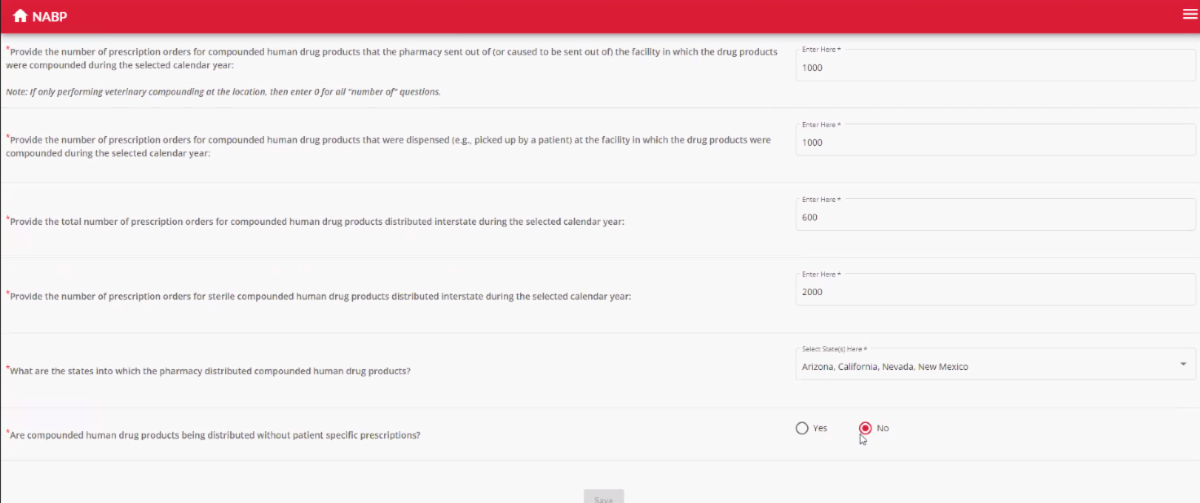
(Currently the ISN is manual — it does not connect with pharmacy software platforms, although Madigan said it would consider building such a connection.)
Anticipating more questions, NABP has built a website full of information about the MOU and how information will be shared — it also answers a lot of questions about the process.
Missed APC’s briefing yesterday? No worries. We've made it available for viewing here.
Task force submits BUD recommendations
APC sent a list of formal recommendations to the USP CEC subcommittee that’s grappling with the issue of beyond-use dates for sterile preparations under Chapter <797>. Under the chairmanship of APC member Tenille Davis of Scottsdale, Arizona, the Beyond-Use Date Task Force researched, deliberated, and developed these recommendations.
You can click here to read the letter sent to Connie Sullivan, chair of USP’s CEC <797> Subcommittee (just four pages), which includes all those recommendations.
Foot-dragging by Tricare/ESI on recoupment refunds
Remember last year’s Tricare/ESI recoupment attempt – in which the agency tried to recoup funds on compounding claims from 2015 from about 400 compounding pharmacies, but then reversed course when challenged by APC and NCPA? And remember how Tricare indicated that funds it recouped would be returned to affected pharmacies who appealed the action?
Yeah, well, now it’s been six months, and for many of those pharmacies that filed the proper appeal paperwork, their funds have not yet been returned.
This week, NCPA’s Ronna Hauser, on behalf of NCPA and APC, reached out to Tricare leaders to express concern about ESI’s dithering in returning pharmacy funds as promised, and reminding the agency that in some cases, more than $100,000 was taken from individual pharmacies and is being held without due process. Came the reply that Tricare is looking into the situation and will get back to us.
So for now we wait. Some more.
Our cBHT campaign: Once more, with feeling
Learn the threat to compounded hormones. No policy affecting so many people should be based on bad science like the now-debunked NASEM report. Go to A4PC.org/cbht to find the detailed analysis of what was wrong with the NASEM report, and the proof of FDA interference in the process.
Recruit your patients to help save cBHT. Explain the issue and direct them to compounding.com where they can share their stories — stories that can make a difference with policy makers.
Recruit your prescribers. Explain the threat to their patients, share the Berkeley white paper that details the problems with the NASEM report. Ask that they engage their patients — and yes, ask that they contribute financially to the campaign.
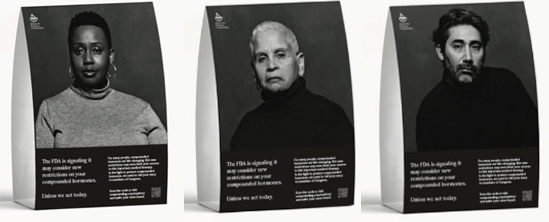
Get the member-only tools to spread the word. We’ve made it easy with posters, rack cards, bag stuffers, and even sample letters to customize and send to patients and prescribers. You'll find them all through our cBHT campaign support page.
Give to save cBHT. Saving compounded hormone therapy is the biggest — and most expensive — initiative in APC's history. We are still well short of raising the funds needed to place the targeted ads we've created across the country.
We need to get the message to policymakers, and we need your help to do it. Without your financial support we can't confront the threat. Help us fund this effort by contributing at A4PC.org/cbhtcampaign.
Because together is the only way we’ll save compounded hormone therapy.
So you want to serve telemedicine prescribers?
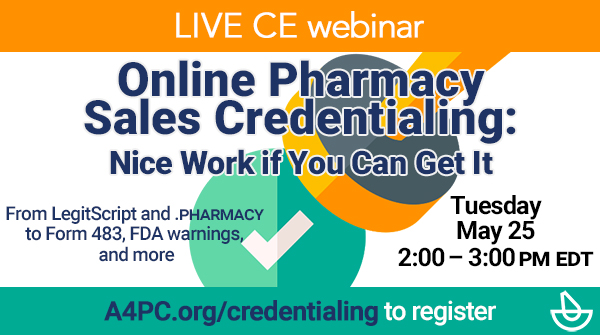
It may not be so simple if you're a compounder. Don't worry, we've got you covered with a one-hour webinar on credentialing: "Nice Work if You Can Get It," on Tuesday, May 25. Hit up a4pc.org/credentialing for info and to register.
Last day for the survey!
If you haven't yet taken the APC/University of Mary Washington Compounding Profile Survey — we still need your help. We're working to paint the the first comprehensive picture of the breadth and depth of compounding in the U.S.
Go to A4PC.org/2021survey, and it should take about 10 minutes.
Don't wait! The survey closes TODAY, May 7, at 5:00pm EDT
Coming Up
May 25 — APC CE: Online Pharmacy Sales Credentialing: Nice Work if You Can Get It
June 10–11 — PCCA ACT Conference (virtual)
June 16–17 — Informa Connect's Compounding Pharmacy Compliance Virtual (APC members: Use code APC10 for 10% off registration!)
July 13 — APC CE: Reading a Certificate of Analysis: Calculations Based on C of A Data
September 14–15 — Compounders on Capitol Hill (mark your calendars!)
September 22–24 — Informa Connect's Compounding Pharmacy Compliance East
Short Takes
Are you ready for a DEA inspection? Remember, it's not all about controls and suspicious activity — the agency is watching the record-keeping and reporting side, too. The good folks at FDA Law Blog are thinking of you, with the first of three posts on "Preparing for and Managing DEA Inspections".
Owner Summit keynote available. If you missed APC's Owner Summit on Jekyll Island, here's some good news: Our kickoff keynoter, Mike Wittenstein, has made his keynote available, and is also available to answer your questions. So if you want to check out "What if? Why not? How can?" or have a question for him, you can do it all at storyminers.com/events/a4pc.
Could this be in your future pharmacy? British researchers have made a nifty kind of breakthrough: A way to 3-D print medication — pills "that have the accurate dose and drug combinations tailored to individual patients” by adjusting the porosity of the material. (In fact, you can even have multiple drugs in the same physical pill.)
Covid is somehow causing diabetes. Is it lack of exercise during lockdowns? The virus attacking the pancreas? Something we haven’t figured yet? A side effect of Covid-19 seems not only to be making diabetes worse, but actually triggering it in people — including children with mild cases.