National Pharmacare … my take on it
|
|
Martine Elias, Executive Director
|
|
On June 12
th
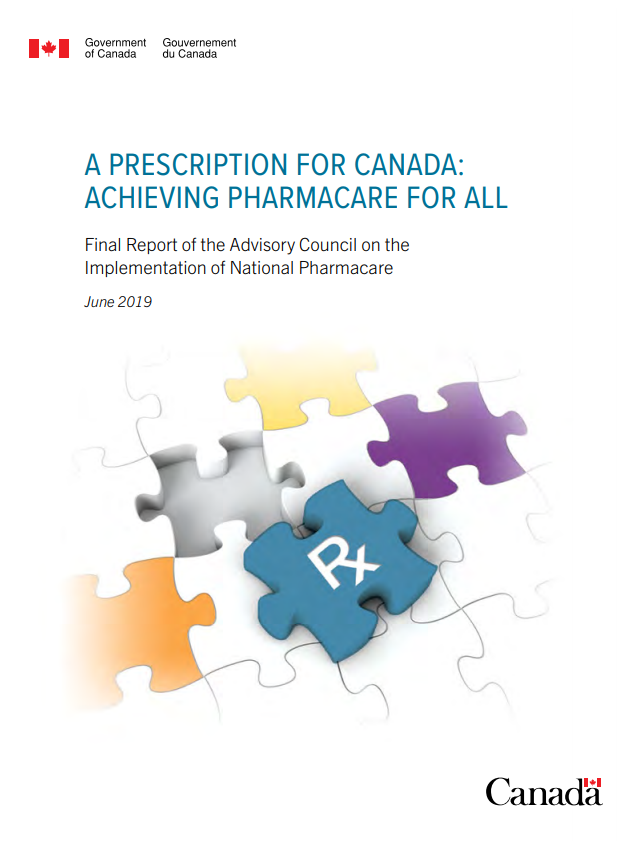
2019, Eric Hoskins, Chair of the Advisory Council on the Implementation of National Pharmacare, released the council’s recommendations for the implementation of a National Pharmacare program called
Prescription for Canada: Achieving Pharmacare for all
.
|
|
Last Fall, Myeloma Canada published its position,
written by Aldo Del Col
, on the National Pharmacare proposal. Essentially, through its consultation process, we submitted a document warning the Council to “go high” and “be bold”… to take an enlighten approach where a pharmacare program must transform our currently inequitable patchwork of drug coverage to one that ensures all Canadians have access to the prescription drugs they need. In other words,
we need to demand a national program that
improves
drug coverage rather than limits it
. These principles were echoed by many other patient organisations like ours.
|
|
Myeloma Canada also warned the Council that although pharmacare is understood to mean a system of public insurance for drug coverage, there are several interpretations of what such a program could look like. Alternative proposals include:
- a national pharmacare program run by the provinces under national standards with one formulary;
- one pan-Canadian, single-payer pharmacare program run by the federal government;
- a mixed public-private model.
|
|
We are pleased the Council acknowledged the important role that patients play in providing valuable input to the process as evidenced by their recommendations, summarized below:
|
|
- That the federal government work in partnership with provincial and territorial governments to establish a universal, single-payer public system of prescription drug coverage in Canada to ensure that everyone has access to the drugs they need to maintain their physical and mental health.
- That a Canadian drug agency be established that would be responsible for developing a national list of prescription drugs (the formulary) beginning with an initial formulary of common, or so-called essential, medicines by January 1, 2022. The Council recommends that this initial formulary expand to a fully comprehensive formulary, to be in place no later than January 1, 2027.
|
|
|
While the initial list of essential drugs would likely not include the myeloma drugs we need, these recommendations are hopeful, but only if the formulary to be put in place by January 1, 2027 is a
comprehensive list and does not cater to the lowest common denominator
(ie, the formulary with the least amount of myeloma treatments for our community). At the end of the day, removing access barriers for all Canadians is very good and very “Canadian”.
The implementation of a Canadian drug agency, in my mind, is positive. Common sense would dictate that a “one-stop-shop” for evaluation, assessment and implementation would help improve timely access to drugs and treatments, and place every Canadian patient on equal ground.
Myeloma Canada is looking forward to working with this new Canadian Drug Agency, and other levels of governments, to ensure 1) the patient voice is heard, and 2) the right patient outcomes are incorporated in their reviews so that Canada becomes the best healthcare standard worldwide.
The document we submitted recommends the
establishment of a distinct pathway for the consideration of expensive drugs for rare diseases.
As part of this framework, the drug agency should work with clinicians and patients to gather structured real-world evidence (RWE) on the impact of rare disease drugs and negotiate performance-based funding agreements with manufacturers.
|
|
Additionally, our recommendations stipulate that Canadians and employers continue to be able to purchase private drug insurance as a form of supplementary insurance to national pharmacare. We believe in the importance of Canadians’ ability to keep their mix of private and public plans.
All-in-all, we support the key elements within the National Pharmacare Program
that will introduce a step-wise approach to pharmacare. We look forward to the development of a program that keeps patients’ needs at the forefront, and that will result in the roll-out of a strong, equitable, universal and comprehensive healthcare plan for all Canadians.
As we all know, like in any large transformational initiative, the devil is in the details. Flawless execution will either make or break what could be the best National Pharmacare Program for Canadians. As such, I will continue to be involved - and be a leader - in ensuring our myeloma patient community is heard.
|
|
As the Federal elections approach, the topic of a National Pharmacare will likely be very prominent. Later this summer, we will be updating our Myeloma Advocacy Program (MAP) on our website. Through MAP, we will invite you to make your voices heard and encourage you to contact all party candidates about this important pharmacare issue.
Stay tuned for more information.
Meanwhile, I invite you to please share your thoughts with me at any time at
melias@myeloma.ca
.Together, we’re making our voices heard for the benefit of all Canadians.
Enjoy this first month of summer!
|
|
Martine Elias
Executive Director
|
|
Follow us on social media for the most up-to-date information and resources:
|
|
|
|
|
|
|