|
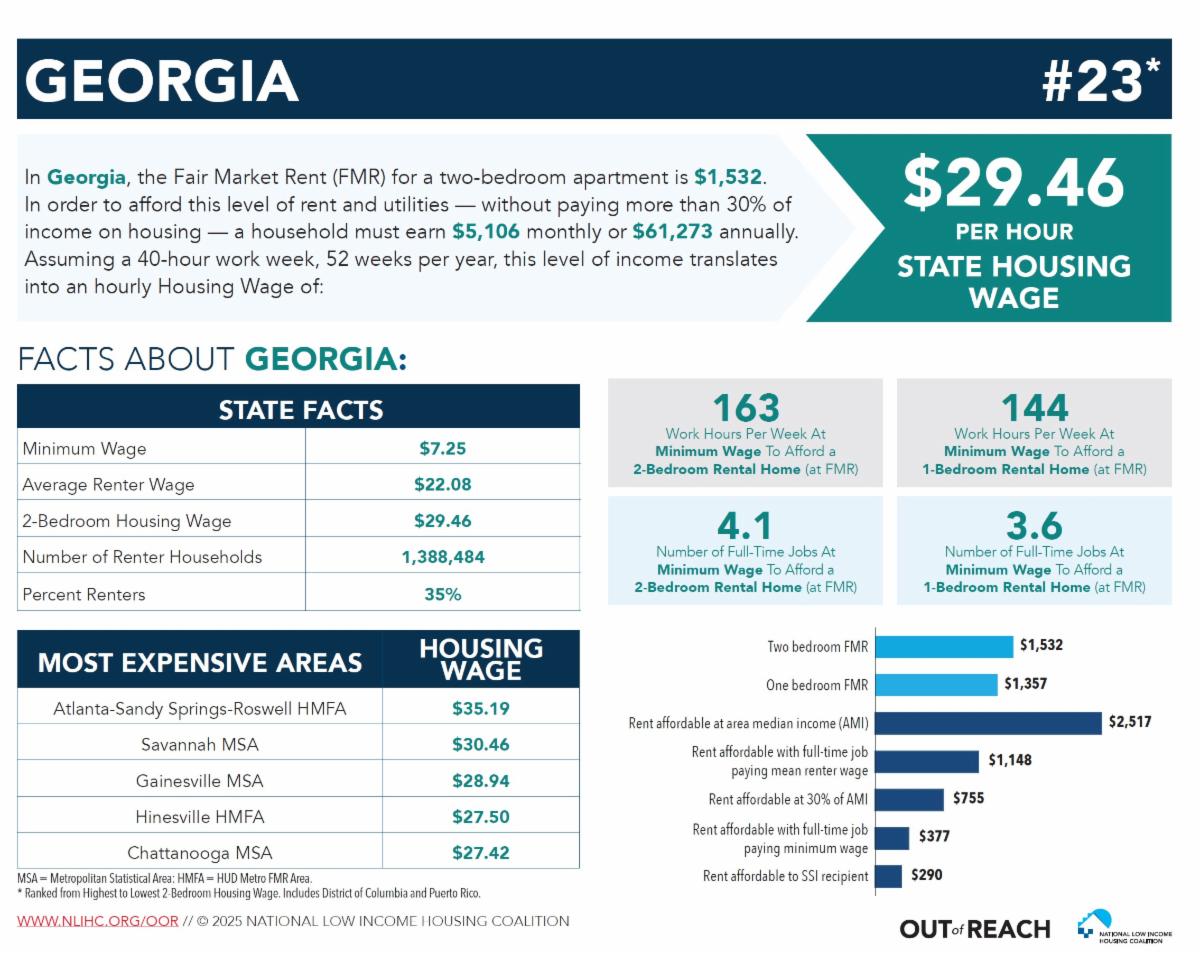
In Georgia, wage earners working at the minimum wage of $7.25 per hour
must have 3.6 FULL-TIME jobs or work 144 hours per week to afford a modest one-bedroom apartment. Georgia wage earners must have 4.1 FULL-TIME jobs or work 163 hours per week to afford a two-bedroom apartment.
“The 2025 Out of Reach Report paints a sobering but necessary picture of Georgia’s housing landscape in urban, suburban, and rural communities. Right now, a minimum wage earner in our state must work 144 hours per week—that’s 3.6 full-time jobs—just to afford a modest one-bedroom apartment. To afford a two-bedroom, it takes 163 hours, or 4.1 full-time jobs.
This challenge doesn’t just affect minimum wage workers—it touches the lives of many Georgians in essential roles like home health care, retail, and food service. These are the individuals who support our families and communities every day, yet often struggle to find a safe and stable place to call home.
At Georgia Advancing Communities Together, we believe that affordable housing is the foundation of thriving communities. This report is a call to action for all of us—policymakers, nonprofit leaders, philanthropy, and the private sector—to work together toward practical, people-centered solutions. That includes investing in affordable housing development, increasing wages, strengthening tenant protections, and expanding support for community-based organizations across our state.
We envision a Georgia where everyone—regardless of income—can afford a safe, decent place to live. With commitment and collaboration, we can make that vision a reality.”
— Dr. Bambie D. Hayes-Brown
President & CEO
Georgia Advancing Communities Together, Inc.
Board Chair, National Low Income Housing Coalition
Having an adequate federal housing safety net would go a long way toward ensuring the housing stability of renters regardless of whether the economy is strong or in a downturn. When people live in safe, decent, and accessible homes they can afford, they are better able to find and maintain employment, achieve economic mobility, and stay healthy. Federal rental assistance is chronically underfunded, however, with only one in four eligible households able to receive it due to funding shortages. Further, instead of providing this essential foundation for those who need it most in a time of uncertainty, the president and his allies in Congress are threatening to slash funding for essential housing programs by 44%, further deepening the housing crisis. The American public must reject these harmful budget cuts and insist that Congress make sustained, long-term investments in a federal housing safety net that will ensure the lowest-income renters can access and maintain decent, safe, and stable homes. For more information on Out of Reach 2025, visit: https://nlihc.org/oor.
|