Long Island Swimming Officials Association
Serving Long Island Swimmers for 64 years!
July 2021
|
|
Let's see how this goes ...
Why do I include so much from outside sources in here - Referee Magazine, NFHS, NYSPHSAA, SwimSwam, NASO, John Tesh?
I believe that the primary role of association leadership is to provide membership the tools that you will need to become a knowledgeable, consistent, happy, successful official. There are excellent, helpful resources regarding officiating, health, and safety from many sources. The best ones that I run across, that I think will be helpful, I share with you.
Referee Magazine publisher Barry Mano, a long time basketball official, recently had these comments regarding bad behavior by fans, spectators and coaches during contests:
"Ejections have always been a serious matter in officiating. We do not take them lightly. We resist ejecting a player or a coach...with so many incidents being witnessed in so many places, we need to get more serious about enforcement... We need to talk through this topic in our own pregame... Our job is to observe, enforce and then refer the matter to the designated administrator... know your options ahead of time rather than trying to figure them out as the storm is raging. Find calm out of chaos."
Of course, I also include items that I just like.
Thank you,
George Fleckenstein
president
|
|
Swimming and Diving Rule Changes Rationale - NFHS
3-2-5: Changes protocol for declaration of the lead-off swimmer in a relay to be submitted prior to the start of the event.
Rationale: The lead-off swimmer must be declared at the specified time and place prior to the start of the event, which is consistent with entry procedures for identification of all relay participants.
3-3-5: Permits competitors to wear suits providing full body coverage for religious reasons.
Rationale: Eliminates the need for state association authorization of suits providing full body coverage. Added language allows for exercise of religious practice without creating a competitive advantage for the athlete.
3-3-5b,c,d: Permits the application of temporary adhesives for divers.
Rationale: Allows divers to protect themselves from hand slippage, minimizing risks for the diver.
5-4-3 NOTE: Clarifies protocol for conducting swim-offs and what purposes the time can be used.
Rationale: Updated language clarifies the impact of the swim-off time on future seedings.
9-2-1: During championship meets, new language establishes when diving boards should be open for practice if breaks between sessions extend longer than ten minutes.
Rationale: Defines when diving boards shall be made available for practice during the break between sessions of a championship meet unless the meet director establishes specific guidelines prior to the start of competition.
9-3-7 PENALTIES, 9-5-2, 9-5-5, 9-7-4f, 9-7-5k, 9-8-2c: Permits standing forward takeoffs, clearly defining the proper procedure for performing a standing forward takeoff and the protocol for application of the mandatory two-point deduction.
Rationale: The standing forward takeoff is a critical part of the educational process in teaching new dives. This provision allows divers to participate in competition sooner and encourages growth in the sport.
9-5-4b: Clarifies that only four oscillations are permitted before the diver leaves the board.
Rational: The removal of vague language clarifies the number of oscillations a diver may take while on the diving board.
9-6-4: Defines process to rectify announcing errors that occur during diving competition.
Rational: Language establishes protocol when an announcer error occurs. The diver should not be penalized for the error of meet personnel; the referee retains broad discretion to resolve such problems in the most equitable and efficient way possible.
|
|
LISOA Calender
Required Rules Interpretation Meeting - September 29
Diving Clinic - October 20
Better and Consistent Workshop - November 10
Pre-Season Meeting - November 23
WINTER BOY'S SWIMMING AND DIVING SEASON BEGINS - November 30
Section VIII Relay Carnival - Nassau County Aquatic Center - December 1
Annual Meeting - January 5, 2022
Recognition Dinner Meeting - March 14, 2022
|
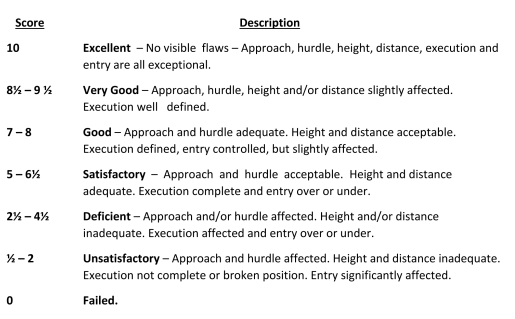
Things Every Diving Judge Should Know...
...Unsatisfactory dives that receive a 2‐point deduction are not considered fail dives because they technically score points and then receive a deduction. They are considered Zero Sum Dives.
Examples are:
failing to come out of a somersault after committing a balk;
doing a dive in clearly the wrong position on an undeclared standing forward take‐
off;
balking and then hitting the board;
failing to come out of a twist with a balk or undeclared standing forward takeoff.
Generally, "Failed Dives" are declared by the diving referee however, when the referee gives the diver the benefit of the doubt and allows a dive to be scored and all judges give it zeros it would be a fail dive.
|
The NFHS Exam
will be open
August 1 to September 19, 2021.
|
|
READING THE RULES IS NOT GOOD ENOUGH
Referee Magazine
|
|
The best way to know the rules is to study them throughout the year, and not just read them. A mistake people make is thinking they’re studying something when they read it. In my college days, a professor taught me the two words are not synonymous, and he suggested an approach that resulted in high grades and that I applied to rules study with positive results.
First, don’t wait until a couple of days before the season starts, or you have an exam, to crack open the book. Although I can procrastinate as well as anyone, I force myself to start about three months early so I can limit my study to an hour a day, if that. Any more and my retention isn’t what it should be.
Take the book one section at a time. Read it straight through, without stopping, to get a feel for the landscape. Then, go back and carefully work through the words. Don’t highlight anything until the second run-through, for then you’ll highlight much less. I see books that are 90 percent highlighted, maybe in various colors, but if you do this you essentially highlight nothing. Be more sparing; for example, if a rule says action is illegal only if it’s intentional, highlight that word because it’s the key part of the rule. In the end, maybe 10 percent of the book should end up highlighted, if that.
Don’t consider the words in abstract; visualize them in action. Take the balk rule in baseball. Instead of just reading the list of can’t-dos, I would see, in my mind’s eye, pitchers making various moves and think about what should be called and ignored under advantage-disadvantage and given the intent of the rule. Then I’d put the book down and say, “OK, a pitcher can do so-and-so but not thus-and-such.” Runners trying to score with a catcher taking a throw and a collision. Who’s at fault? What if he’s up the line? This visualization process makes the material come alive and stick with me. When I face that play on the field I can rule properly because I have, in effect, already seen and thought about it.
Next, try to articulate the rule to a friend, or to thin air if no one is around, without looking at the book. You’ll probably miss a few things, but you should be able to grasp its essence; if you can’t, you didn’t absorb it, so start over. The best way to learn something is to teach it, and that’s what you’re basically doing.
Once you’ve finished this process with a section, go to the next one and start over again. Time-consuming? You bet. Productive? Yes.
If you can find exams with answers, go through them. Dealing with rules as applied in specific situations is better than trying to understand them in the abstract. Form study groups. If several people tear the book apart they’ll gain insights from each other, especially if some have encountered situations involving the rule in question.
Watch video, games and plays on YouTube and ask yourself how you’d rule on situations that happen. Maybe you can’t quote the applicable rule verbatim, but do you know it well enough to apply it properly? If you were the referee, could you explain your ruling to a coach?
Finally, you can’t stay sharp if you only study rules before the season starts. I suggest focusing on at least a couple of the more complex ones each week during the season. You can do this when you’re in the bathroom or on an elliptical machine at the gym. In sum, reading rules only gets us so far. We’ll understand them and how to apply them only by dissecting a few at a time; visualizing plays; seeing, via video, interpretations, and exams, how they should apply in specific situations; and batting them back and forth with other folks. Digging deep below the surface, in other words, instead of skimming it. That’s what rules study means.
|
|
WE MUST,
as Officials at an interscholastic athletic event, exercise a high level of self‐discipline, independence and responsibility and shall
- master both the rules of the game and the mechanics necessary to enforce the rules, and shall exercise authority in an impartial, firm and controlled manner.
- uphold the honor and dignity of the profession in all interaction with student‐ athletes, coaches, athletic directors, school administrators, colleagues, and the public.
- prepare themselves both physically and mentally, shall dress neatly and
appropriately, and shall comport themselves in a manner consistent with the high
standards of the profession.
- be punctual and professional in the fulfillment of all contractual obligations.
- remain mindful that their conduct influences the respect that student‐athletes,
coaches and the public hold for the profession.
- while enforcing the rules of play, remain aware of the inherent risk of injury that competition poses to student athletes. Where appropriate, they shall inform event management of conditions or situations that appear unreasonably hazardous.
- take reasonable steps to educate themselves in the recognition of emergency
conditions that might arise during the course of competition.
- maintain an ethical approach while participating in forums, chat rooms and all
forms of social media.
The coaches CANNOT: be insulting, make derogatory remarks, acts or gestures, show disgust or try to influence our decisions.
NFHS SWIMMING & DIVING RULES BOOK
SECTION 6 CONDUCT
ART. 1 . . . No team personnel/competitor shall display unsporting conduct. This includes any act the referee deems unsporting, including but not limited to, the following:
a. making insulting or derogatory remarks, gestures or acts including taunting;
b. trying to influence or showing disgust with officials’ decisions;
c. interfering with meet officials in the performance of their duties.
NOTE: The NFHS disapproves of any form of taunting which is intended to embarrass, ridicule or demean others under any circumstances including on the basis of relative ability, race, religion, gender or national origin.
PENALTIES:
1. Team personnel shall be disqualified from further participation for unsporting conduct. For excessive unsporting conduct, team personnel (as defined in 1-4-2) may be ejected from the competition area.
|
|
SPORTSMANSHIP:
The NYSPHSAA recognizes and appreciates that the influence and responsibility of the school administration with regard to good sportsmanship extends to all levels of competition.
However, it must also be seen that the NYSPHSAA has been vested with the responsibility to ensure that all contests under its jurisdiction are conducted satisfactorily.
1. Any coach excluded by a certified official from an interschool competition for
unsportsmanlike conduct, including taunting, is ineligible to coach any interschool
competition in that sport until after the next previously scheduled contest at the same level
(e.g. Junior varsity, varsity, etc.) has been completed. In individual sports, a multi-day
contest is considered to be a contest.
Disqualification from one season carries over to the next season of participation. The coach may not be present at the game site nor communicate in any manner during the contest with any person present at the site.
NOTE: "Not being physically present at the site” means a disqualified coach is not to be
present in the locker room, on the sidelines, in the stands or site area before, during or after the game/meet.
Any coach that does not serve the penalty for violating the Sportsmanship Standard will be ineligible to participate in the next two regularly scheduled contests. If the coach continues to not serve the penalty, the matter will be referred to the Section for further action. If the coach is involved in the NYSPHSAA play-offs, the matter will be referred to the Executive Director of the NYSPHSAA
Any coach:
1. Who receives a disqualification penalty in a sport shall not participate in the next
regularly scheduled contest;
2. Who receives a second disqualification penalty in the same sport in the same
season shall not participate in the next two regularly scheduled contests; and
3. Who receives a third disqualification penalty in the same sport in the same season
will not be allowed to participate for the rest of the season (regular season or post
schedule play), the Section Athletic Council will assess the penalty carrying over into
the next season of participation.
4. The Section Athletic Council will have the authority to extend the period of
ineligibility in those cases where the actions of the individual that was disqualified
from a contest or scrimmage are warranted. The period of ineligibility cannot
exceed one year from the date of the disqualification.
2. A coach who strikes, shoves, kick or makes other physical contact with the intent to
annoy, harass or intimidate another person (e.g. official, another coach, player, fan) shall be expelled immediately and banned from further participation or coaching in all sports for a period of time to be determined by the section not to exceed one year from the date of the offense.
|
|
CAN HIGH SCHOOL ATHLETES NOW EARN MONEY FROM THEIR NIL? NO, SAYS NFHS! |
|
The much-anticipated changes to the fundamental structure of college sports occurred last week when the NCAA suspended its longstanding amateur rules to allow college athletes to monetize their success and profit from their own Name, Image and Likeness (NIL).
While it is not our position to debate the merits of current college athletes earning money from their NIL, it should be understood that these changes do not affect current high school student-athletes. Current high school student-athletes CANNOT earn money as a result of their connection to their high school team.
The NFHS and its member state associations will continue to protect the high school environment. While amateurism may be a thing of the past at the college level, it must be maintained to preserve the greatest programs in this country – education-based interscholastic sports in our nation’s high schools.
|
|
Those of you that receive and read Referee Magazine saw an interesting feature article on MLB Baseball umpire Jim Reynolds in the July issue.
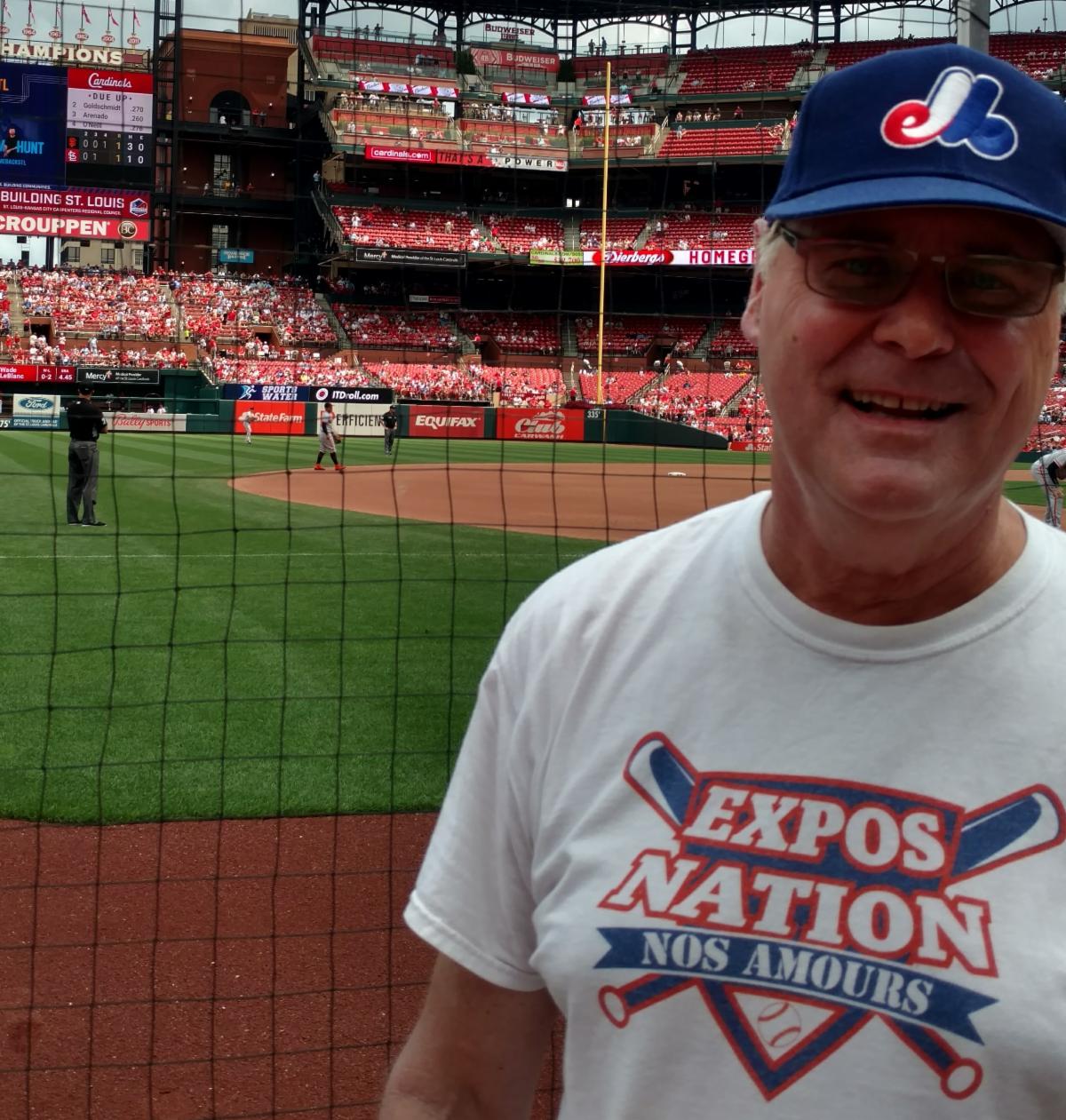
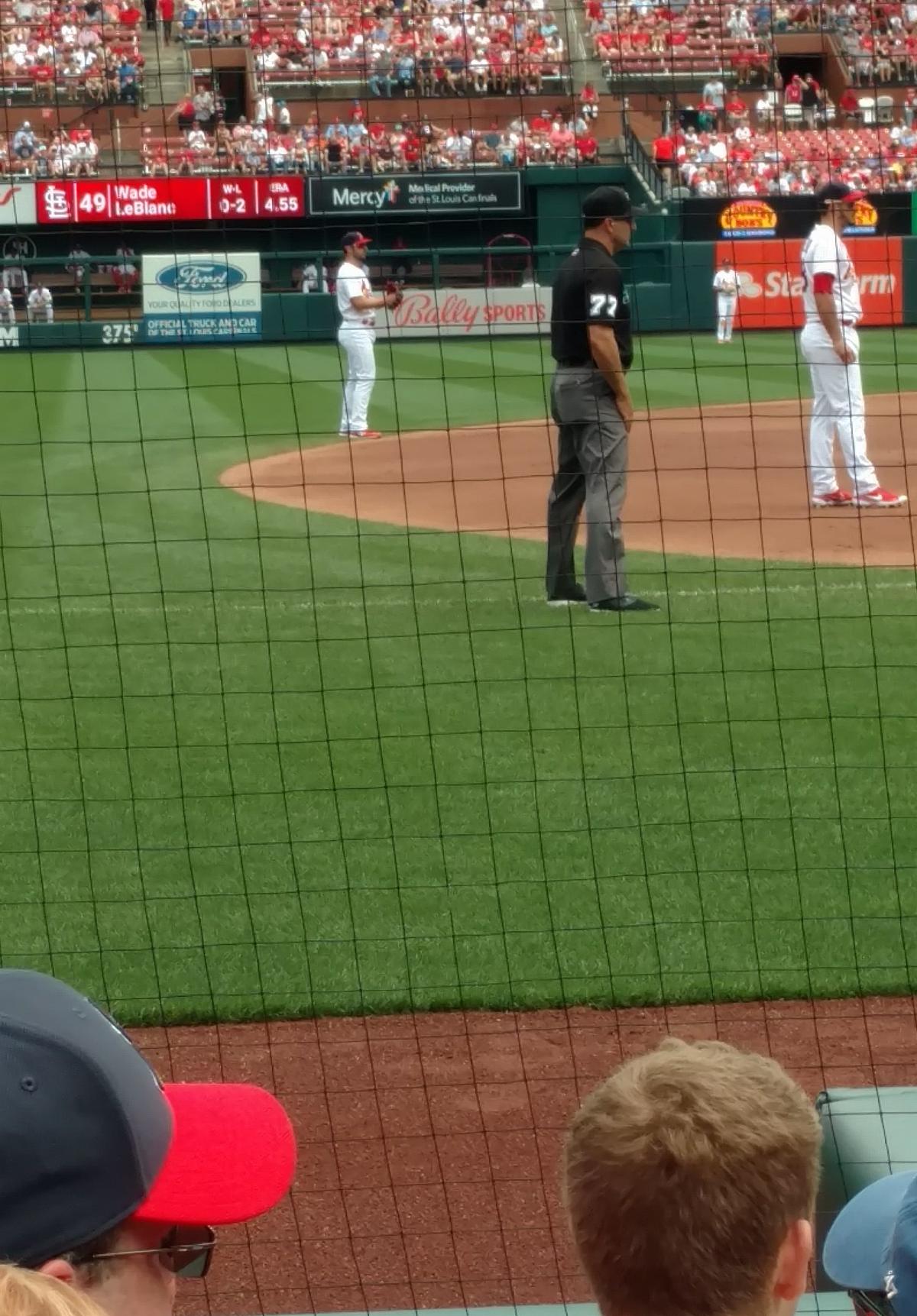
A few weeks ago I was in St. Louis and I went to a Cardinal baseball game and Jim Reynolds was umpiring the third base line (I recognized him from the article) and my seat was five rows from the field, right where he stood all game.
Well, if you know me, you know that I was going to talk to try to talk to him.
Between innings I went to the wall and called his name and got his attention. I yelled that I enjoyed the article about him in Referee Magazine and he smiled and gave me a thumbs up. I asked if he would come over for a picture with me and he laughed and waved his hands no. (I told the security guy standing there that most people come to the game to see the players, I go to watch the umpires)
That's me in attire from my favorite MLB team - "Our Beloved". Nos Amours
|
|
|
The primary role of the official is to ensure fair competition which is conducted in a positive, safe and healthy environment and that actions of the competitors, coaches and other team personnel are in compliance with the rules. |
|
The purpose and goals of the LISOA and its members shall be to:
Officiate all meets in a competent and professional manner.
Have its members actively work to improve interscholastic swimming and diving officiating.
Provide a consistent interpretation and administration of interscholastic swimming and diving rules.
Service and collaborate with the swimming and diving community for the improvement of swimming and diving.
|
|
The official must establish the best possible competitive climate for fair competition with the attention on the athletes, rather than on the official. The conduct of each official affects the public’s attitude toward all officials. Therefore, every official must uphold the honor, integrity and dignity of the profession. |
|
President:
George Fleckenstein
Vice President:
Nelson Gonzalez
Secretary:
Christine Duong
Treasurer:
Barbara Wendt
|
|
Directors:
Doug Virkus
Larry Wachter
|
|
Rules Interpreter:
Bob Kersch
Past President:
Frank Dowd
|
|
OUR CHARTER MEMBERS (1957)
Charlie Schlegal
George Columbo
Jim McAllister
Dick Atwater
Jack Reilly
Frank Krayer
|
|
NYSCSO Distinguished Service Award Members
Laurette Tekverk (2020)
Jim McAllister (2019)
Doug Virkus (2011)
Mush Masters (2008)
Pete Moeschen (2004)
Stan Adler (1993)
Bob Kersch (1990)
|
|
|
|
|
|
|
|