Pfizer Booster Vaccines Now Available
BRHD is now administering Pfizer COVID-19 booster vaccines by appointment only to individuals who qualify in accordance with the CDC recommendations as listed below. Booster vaccines can be administered any time 6 months after the second dose. Please note: people who qualify do not need to get their booster shot exactly 6 months out, it can be any time after 6 months.

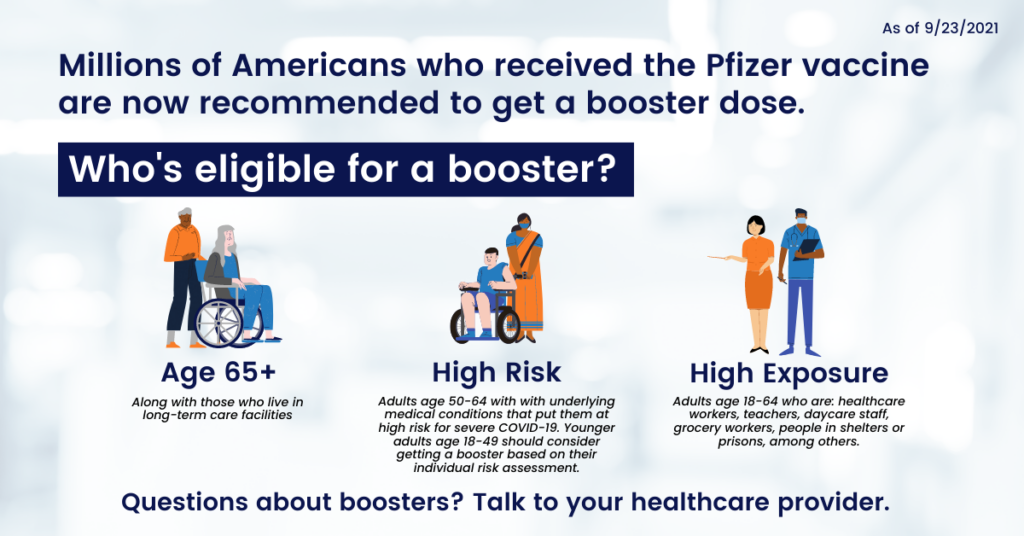
  • people 65 years and older should receive a booster shot of Pfizer's COVID-19 vaccine at least 6 months after their Pfizer primary series,
  • residents in long-term care settings should receive a booster shot of Pfizer COVID-19 vaccine at least 6 months after their Pfizer primary series,
  • people aged 50–64 years with underlying medical conditions should receive a booster shot of Pfizer COVID-19 vaccine at least 6 months after their Pfizer primary series,
  • people aged 18–49 years with underlying medical conditions may receive a booster shot of Pfizer COVID-19 vaccine at least 6 months after their Pfizer primary series, based on their individual benefits and risks, and
  • people aged 18-64 years who are at increased risk for COVID-19 exposure and transmission because of occupational or institutional setting may receive a booster shot of Pfizer COVID-19 vaccine at least 6 months after their Pfizer primary series, based on their individual benefits and risks.
  • Occupations at increased risk for COVID-19 exposure and transmission include front line essential workers and health care workers as previously detailed by the CDC (this list is subject to change), including:
  • First responders (healthcare workers, firefighters, police, congregate care staff)
  • Education staff (teachers, support staff, daycare workers)
  • Food and agriculture workers
  • Manufacturing workers
  • Corrections workers
  • U.S. Postal Service workers
  • Public transit workers
  • Grocery store workers
People can schedule an COVID vaccine appointment HERE.

At this time, there are NO recommendations for boosters for those who received Moderna or Johnson & Johnson vaccines. As more information becomes available from the FDA and CDC, BRHD and VDH will keep you informed. 

Additional Information Regarding Booster Vaccines:
  • There is NO RUSH for eligible individuals to get a booster dose right away. Boosters of the Pfizer vaccine are recommended at least 6 months after receiving the second dose, and individuals still have good protection against COVID-19 if they don’t receive a booster dose as soon as they are eligible. 
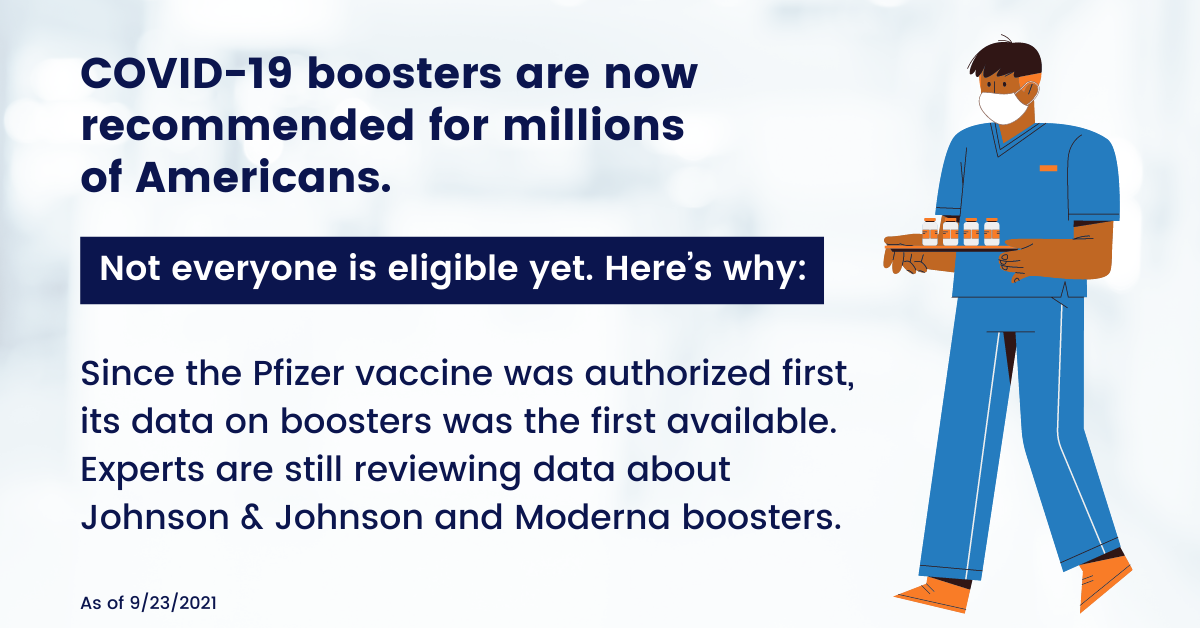
  • What should I do if I received the Moderna or Johnson & Johnson vaccine? At this time, we are still awaiting further research and guidance regarding boosters for Moderna and Johnson & Johnson. Pfizer was the first vaccine to be authorized, and therefore its data on any waning effectiveness was also available first. Pfizer was the first vaccine to be authorized, and therefore its data on its ongoing effectiveness was also available first. Guidance is still forthcoming about boosters for the Johnson & Johnson and Moderna vaccines and the safety of mixing different vaccines.”
  • The top priority for VDH is still to fully vaccinate people who remain unvaccinated. Recent data show hospitalization rates are 10 to 22 times higher among the unvaccinated compared to vaccinated adults. 

For more information about booster vaccines, visit this CDC website.
Answers to Tough Booster Questions
I want to get a booster dose, but I’m not eligible yet. Why not?
The Pfizer vaccine was the first COVID-19 vaccine to be authorized in the U.S., so its data about booster doses were the first to be available. Guidance and recommendations about boosters for the Johnson & Johnson and Moderna vaccines and whether it’s advisable to mix and match vaccines and boosters are still forthcoming.

…But can I anyway?
The COVID-19 vaccines have received the most intense safety monitoring in U.S. history, and that monitoring has allowed public health officials to make science-based recommendations that keep people safe. There is limited data about the safety and effectiveness of mixing COVID-19 vaccines, and data is still under review concerning booster doses for the Johnson & Johnson and Moderna COVID-19 vaccines, so people are advised against seeking “off-label” uses of the vaccines. Read more.
Third dose or Booster?
The vaccine and dosage given to third doses or boosters is the same as any other dose in the series. What's different? Timing and intention. Here's the definitions of third dose vs. booster to help:

THIRD DOSE: Studies have shown that people with a compromised immune system can have a weak response to the standard vaccine regimen, and that a third dose is needed to strengthen immunity in these persons and protect them from serious COVID-19 complications. The first two doses are given either 21-days (Pfizer) or 28-days (Moderna) apart; the third dose is given at least 28 days after the second dose. Both Pfizer and Moderna vaccines are approved for third doses for people who are immunocompromised.

BOOSTER: A booster dose is given six months following the last dose of a vaccine series in order to boost declining immunity over time. The dose literally "boosts" the body's ability to fight off COVID-19. Currently, Pfizer vaccine is approved as a booster for anyone who completed the 2-dose Pfizer series at least six months ago.

NOTE: Your protection against COVID-19 does not expire immediately at the six month mark after the second dose. In fact, studies show that your protection from the vaccine against COVID-19 remains highly effective after six months.
Remember, vaccination is only one tool to end the pandemic.
We need to use them all in order to return to normal day-to-day activities.
Continue to wear face masks, maintain physical distance, wash hands frequently and properly, and limit indoor social gatherings.