|
Monday Morning Brief
(Est. read time without clicking the links, 7 minutes, 52 seconds.)
Why read the Monday Morning Brief? We don't bring you the news. You can get that anywhere. We bring you the small-print, overlooked stories that make you think about your small business in a different way. Little things outside your own industry that can have a big impact often get lost because, well, they're not in your industry. The Brief helps take the blinders off to give you a new perspective.
| | |
Looks like it's gonna be a Cruel Summer with an El Niño brewing in the Pacific. There's an 80% chance El Niño develops between June and August. The naturally recurring Pacific pattern could ripple through the global economy, touching trade, agriculture, and energy markets. El Niño hits every two to seven years when Pacific trade winds weaken, pushing warm water back toward the Americas. El Niño usually dries out Australia and southeast Asia while raising flood risk across the southern US and Central America. The odds of a stronger "Super El Niño" have jumped to 37% from 25%. This could make 2027 a record-hot year. One Dartmouth study tied the 1997 event to a $5.7 trillion drop in global GDP over five years.
It's also going to be a rough summer for teens entering the workforce. Teen unemployment is higher now than it was this time last year, hitting almost 15% for those aged 16-19. Factors causing the rise in teen unemployment include inflation, high oil prices, thin profit margins, AI & automation, older employees staying on longer, and teens prioritizing sports, college prep, and even content creation over working a summer job. Employers in locations where the minimum wage has seen significant increases also must calculate whether a teenage worker with no work experience or skills is worth $15 or $20 per hour - a stark reminder that the true minimum wage is $0.
While most folks are worried about politics, finances, and why country music just isn't as good as it used to be, astronomers have been trying to figure out who's sending us strange radio signals from deep space. Since 2022, radio telescopes have been picking up strange signals from deep space that repeat at precise intervals (some every few minutes, some every few hours, one for over 30 years straight). Nobody could explain them. An international team just locked onto one of these signals with three different telescopes at once and finally figured out what's been sending them. Should we add this to our list of things to worry about?
If you're looking for an Instagram account that makes you better with zero time wasted, give financial coach Marc Russell a follow. In Part 1 of "30 Luxury Expenses Society Made You Believe Are Normal," Russell includes truths on weddings, home ownership, tipping, college, luxury autos, attending social events, drinking, vacations, food delivery, weekends, coffee, and much more. Part 2 drops even more truth bombs on your financial beliefs.
What do the movies "Killers of the Flower Moon," The Wolf of Wall Street," "Goodfellas," and "Gangs of New York" all have in common? They were directed by Martin Scorsese, a human. Until now, we've been told humans didn't want AI involved in the business of making movies. Yet, Scorsese just went public as an adviser to AI image startup Black Forest Labs. He did so with a new video detailing himself using the company’s FLUX model to help storyboard a new film. Scorsese uses FLUX AI image models for preproduction of a new film. His use is for storyboarding only, with no AI-generated actors, sets, or footage. He also said that “Cinema is a young medium, only around 125 years old, so we have to be open to how it can evolve”. This relationship is bound to ruffle some anti-AI Hollywood feathers, but an icon like Scorsese publicly supporting an AI tool is a big deal. It’s also a good example of using the tech in a way that aids the creative process without replacing it, a more palatable entry point for skeptical filmmakers than jumping straight to full AI films or studios.
A small Sequoyah Fund troupe traveled to Maine last week for a conference, and we found ourselves discussing lost luggage. Some in our party were surprised to learn there is a supersized Unclaimed Baggage Store in Scottsboro, Alabama, just south of Chattanooga, TN. You'd think more people would heed the final announcement before deplaning to, "Make sure you have all your belongings," but it apparently escapes many. People leave some really cool - and some really weird - stuff on airplanes (McDonalds golden arches sign, bear pelts, a space shuttle camera, live rattle snake, shrunken head). Seems they leave some really weird stuff in Ubers, too. Recently, the rideshare behemoth released its annual Lost and Found Index, which this year included a 15-pound bowling ball, dentures, and a large marble duck. For the first time, the list also included items left in robotaxis. To get those back, owners must either pay an Uber courier a flat $15 fee or pick them up from wherever the cars are charged. Oh, and if you're ever in the neighborhood, Scottsboro is a must-see shopping adventure. It is the sole repository for items left on commercial airlines.
As Ferris Bueller said, "Life moves pretty fast. If you don't stop and look around once in a while, you could miss it." The problem with our AI-fueled world is that there's little time to actually stop and look around. By the time you get back to work, things may look very different. Take, for instance, the segment we wrote just last week about Google search. Google was touting the fact that about 75% of your queries could be answered right on the Google page so you'd never need to visit a website. We stopped and looked around, and BAM! things changed.
Last Wednesday, Google announced it's building an opt-out feature for that type of search. This means Google's AI won't be able to vacuum up all the hard work you put into writing brilliant blog posts, user guides, boring but useful terms of service, etc. According to a ruling by the U.K.'s Competition and Markets Authority (CMA), that's a no-no. Google also agreed to the ruling (maybe a bit to willingly?) that also requires the company to properly credit publishers with clear, highly visible links when their content does voluntarily appear in AI responses.
Happy about that? Your joy may be warranted. It also might not be. The name of the game for small businesses will still be to get noticed and be easily findable when customers need them. It's a big ol' world out there, and AI will be looking at data somewhere (maybe your competitor's site), eventually pointing searchers to those sites that "play nice," and shadow banning (silently blacklisting) those that don't. We'll see. After all, life moves pretty fast.
BTW, Ferris Bueller's actual day off was June 5, 1985 - a mere 41 years ago. One of the adventures he, Cameron, and Sloane had that day was catching a Cubs game at Wrigley Field (back before they installed lights for night games). The game we saw on the television (Principal Rooney in the pizza restaurant) was between the Cubs and the Atlanta Braves. This was a real game (Braves won 4-2). However, the actual game they attended - the one that was filmed - was between the Cubs and the Montreal Expos (relocated to D.C. and rebranded the Washington Nationals in 2004). The Expos won 17-15. Ferris may have caught some lucky breaks that day (as well as a foul ball), but he was unlucky for the Cubs x2. Oh, and because both visiting teams wore their powder blue away uniforms, director John Hughes was able to perform some editing magic to make it look like the same game.
The University of Michigan consumer sentiment index hit 44.8, the lowest reading in the survey's history. But there's a bit of controversy in this year's number. Some argue the data misreads the current economic situation. Consumers are not broke, but adapting. They're waiting longer on big purchases and trading goods for experiences. The deeper issue is a consumer balance sheet built for a declining nuclear-family model, with oversized homes, family-sized cars, and groceries aimed at households that increasingly do not exist.
And while we're on the subject of balance sheets that increasingly run the risk of not balancing... Rhode Island is in the middle of a massive statewide school construction boom that is occurring at the same time as sinking student enrollment. The strategy is "newer and fewer" schools to capture savings on maintenance and operating costs while staving off growing excess capacity. This is but one example of how government, business, nonprofit, and even personal planning is geared toward future needs based on current trends. Humans may be slow, but we eventually get there. As you plan for a new store location, warehouse expansion, technology implementation, or new hires, don't just extrapolate from where you are now and assume linear growth. Run some scenarios that include no growth (or even contraction), vast market swings, and demographic changes. Imagine technologies, processes, and a world that does not exist yet and ask what you'll need, how you'll get things done, who your customers will be, and how you'll remain relevant.
Couples have traditionally shared a bank account. Up until 1974, many banks required a woman to have a male cosigner before opening an account or taking out a loan. Today, couples are marrying later in life, and women are more financially established. They often already have their own banking relationships and have no need to combine all household finances into a joint account. Additionally, those who are marrying are keenly aware of the divorce rate, so maintaining separate accounts protects both parties in case they go from happy to "statistic."
| | |
Scroll down for training & development opportunities and events.
At the bottom of this email:
-
Tip of the Week (How Do I Chat With Thee? Let Me Count the Ways.)
-
AI Lesson of the Week (The Delegation Engine)
| | |
Development
Opportunities & Events
| | |
✅ One focused topic each month
✅ Facilitator-led discussion
✅ Confidential conversation
✅ You leave with practical notes and next steps
📅 Wednesday, June 17, 2026
🕛 Noon – 1:15 p.m.
📍 Ginger Lynn Welch Complex Sochan Conference Room, 810 Acquoni Rd.
| |
Cherokee Business Owners' Roundtable
Cherokee-area business owners: We’re starting something we’ve wanted for a long time!
Introducing the Sequoyah Fund Small Business Roundtable, a monthly BYOB (Bring Your Own Bag Lunch) meet-up where owners talk owner-to-owner about the real stuff.
Roundtable events are limited to 20 participants.
| | | |
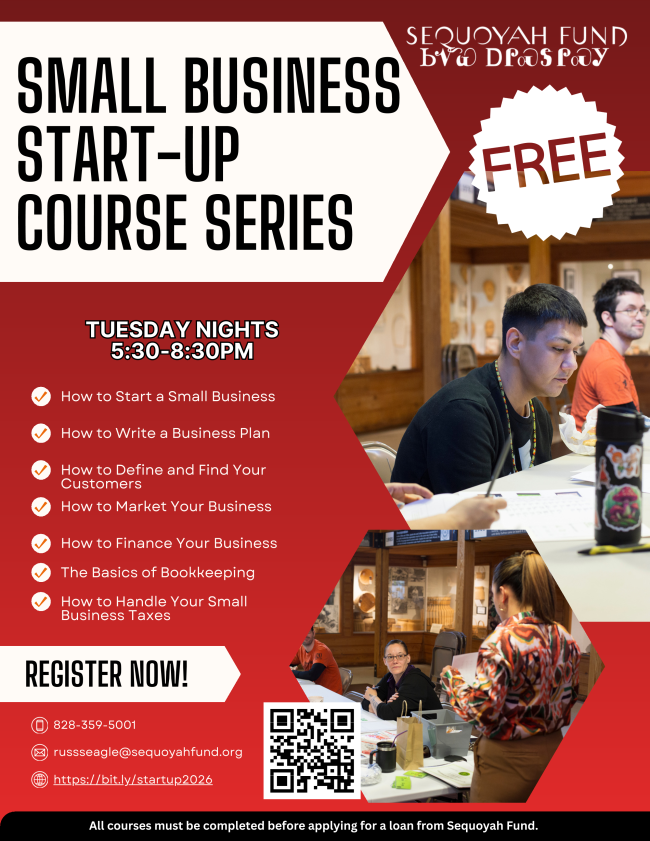
Learn How to Start and Operate a Successful Small Business
This week: The Basics of Bookkeeping
| | |
This FREE course provides a solid foundation for starting and operating a successful small business.
Join the course at any time - No need to start with the first topic.
Think of this course as a hop-on/hop-off sightseeing tour bus! Miss a night? No problem! Catch it next time it's comes around.
Once all topics are complete, you will be eligible to apply for a Sequoyah Fund small business loan.
| |
|
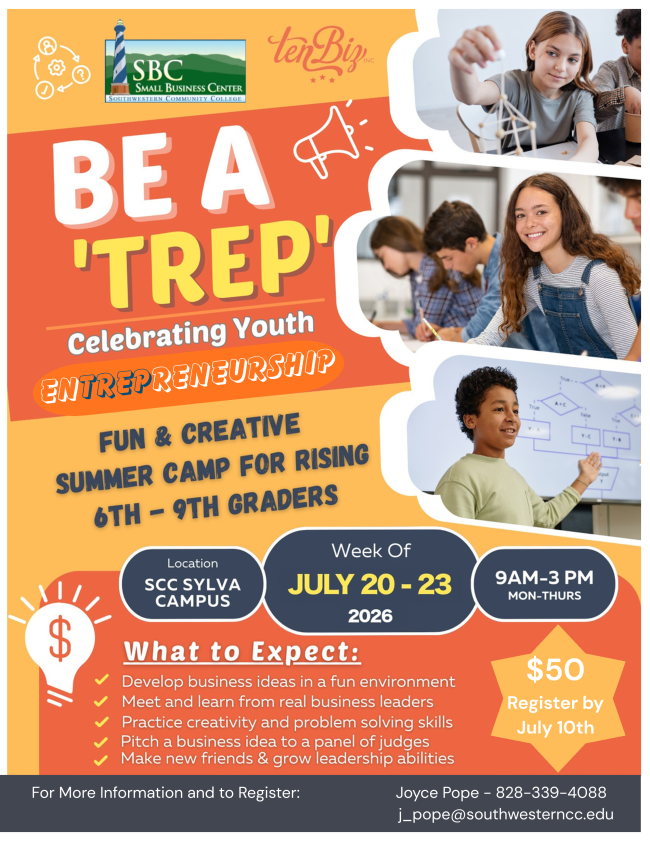
Have a budding entrepreneur in the house?
This summer camp is for rising 6th-9th graders
| |
Be a Trep! Youth Entrepreneurship Camp is back for year 4! This summer join Southwestern Community College's Small Business Center for a week-long youth entrepreneurship camp for any rising 6th - 9th grade student for the fall of 2026 with an interest in entrepreneurship. It will be held on the Southwestern Community College (Sylva campus) July 20-23, 2026 from 9-3 pm.
Student objectives:
~Gain insight into the entrepreneurship and business fields
~Learn what it takes to turn an idea or passion into a product or career
~Meet and learn from real entrepreneurs
~Create and develop business ideas in a fun environment
~Pitch a business idea to a panel of judges
~Make new friends
This camp will teach entrepreneurship as a viable career option, teach business skills, and give students the opportunity to explore the world of entrepreneurship. Through fun games, activities, group projects, and a business simulation, students will learn business and marketing strategy, teamwork, and essential problem-solving and leadership skills.
Every day is filled with interesting and challenging activities to help students learn the fundamentals of entrepreneurship and creating a startup business. Each student develops an idea for a business that he or she can start individually or as a group, and on the final day will pitch the idea in front of a panel of judges in the form of a contest. And we will be taking a field trip to downtown Sylva on July 22, where we will visit small business owners and have lunch! We will provide transportation for the field trip.
Parents will be invited to the student's ‘Business Pitch Party’ on the last day of camp Thursday, July 23 at 1 pm. Lunch will be provided each day, but please bring refillable water bottles. Parents will be responsible for providing transportation to and from camp each day.
Spots will go fast so call or email now!
The fee for the camp is $50 per camper and we will accept the first 20 students to register.
Please contact the SBC at 828-339-4088 or email j_pope@southwesterncc.edu or m_harris@southwesterncc.edu to secure your spot and for registration instructions.
Registration ends July 10
| |
| |
Goldman Sachs 10,000 Small Businesses
Applications Are Open
The 10,000 Small Businesses program is a no-cost business education initiative designed to help small business owners unlock growth and scale their operations. Through this program, participants gain access to:
- Practical, hands-on business education
- One-on-one advising and mentorship
- A powerful network of fellow business owners and alumni
- Tools to develop a customized growth plan for their business
To be eligible, businesses should generally:
- Be in operation for at least two years
- Have at least two employees (including the owner)
- Generate a minimum of $75,000 in annual revenue
| | | |
Join us for Paperwork & Progress Night
Sequoyah Fund hosts a monthly after-hours working session for small business owners in Cherokee and surrounding communities.
You bring the paperwork, renewals, bookkeeping cleanup, emails, planning tasks, or that one project you keep pushing to the side.
We’ll provide a welcoming space, light refreshments, and a Sequoyah Fund team member to help you get unstuck and connect to helpful resources.
This is a confidential, owner-to-owner environment designed to turn procrastinated admin work into real progress and new connections. Owners only, no substitutions.
| | |
✅ One focused topic each month
✅ Facilitator-led discussion
✅ Confidential conversation
✅ You leave with practical notes and next steps
📅 Monday, June 15
🕛 5:30-8:30 p.m.
📍 Ginger Lynn Welch Complex Large Conference Room, 810 Acquoni Rd.
| | |
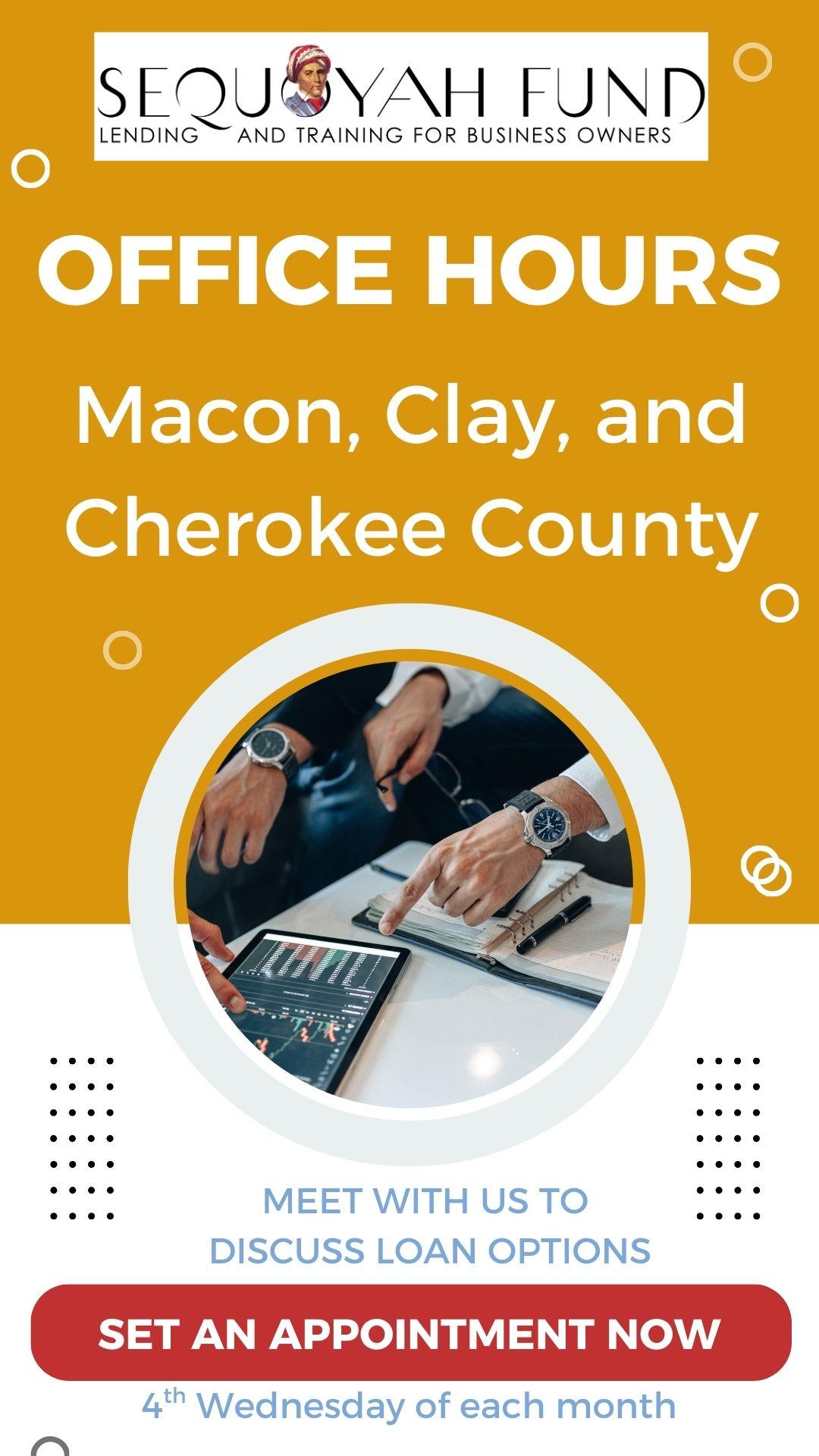
Sequoyah Fund Staff is Holding Office Hours in Clay, Cherokee, and Macon County
Sequoyah Fund staff can meet with you at the following locations on the last Wednesday of each month:
- Industrial Opportunities, Inc. in Andrews
- Clay County Chamber of Commerce in Hayesville
- Franklin Chamber of Commerce in Franklin
CLICK HERE or the image at left to complete an appointment request.
Talk with us about a small business loan, housing rehab loan*, small dollar loan*, or credit builder loan*.
*Available only to enrolled members of the EBCI.
| | | | | | |
Small Business Start-Up Loans Available!
- Start-up loans up to $50,000
- Interest Rates as low as 5%*
- Terms that fit your business
- Business must be in and owner must reside on the Qualla Boundary or in the seven western counties of NC.
- Business plan required.
-
For more information, contact Dorian Walkingstick at 828-359-5004 or dorian@sequoyahfund.org.
*Credit restrictions apply. Rates may be set as high as 12% depending on creditworthiness.
| | |
Repair Your Credit the RIGHT Way - With a Credit Builder Loan!
Loan Terms
- Amount: Up to $2,500
- Interest Rate: 10% Fixed
- Term: 2 years
How to Qualify
- Must be enrolled member of the EBCI
- Submit application to identify your goals and needs
- Have an average credit score of below 650 as reported by Experian, Equifax, and Transunion
| | | | | |
Free Financial Coaching
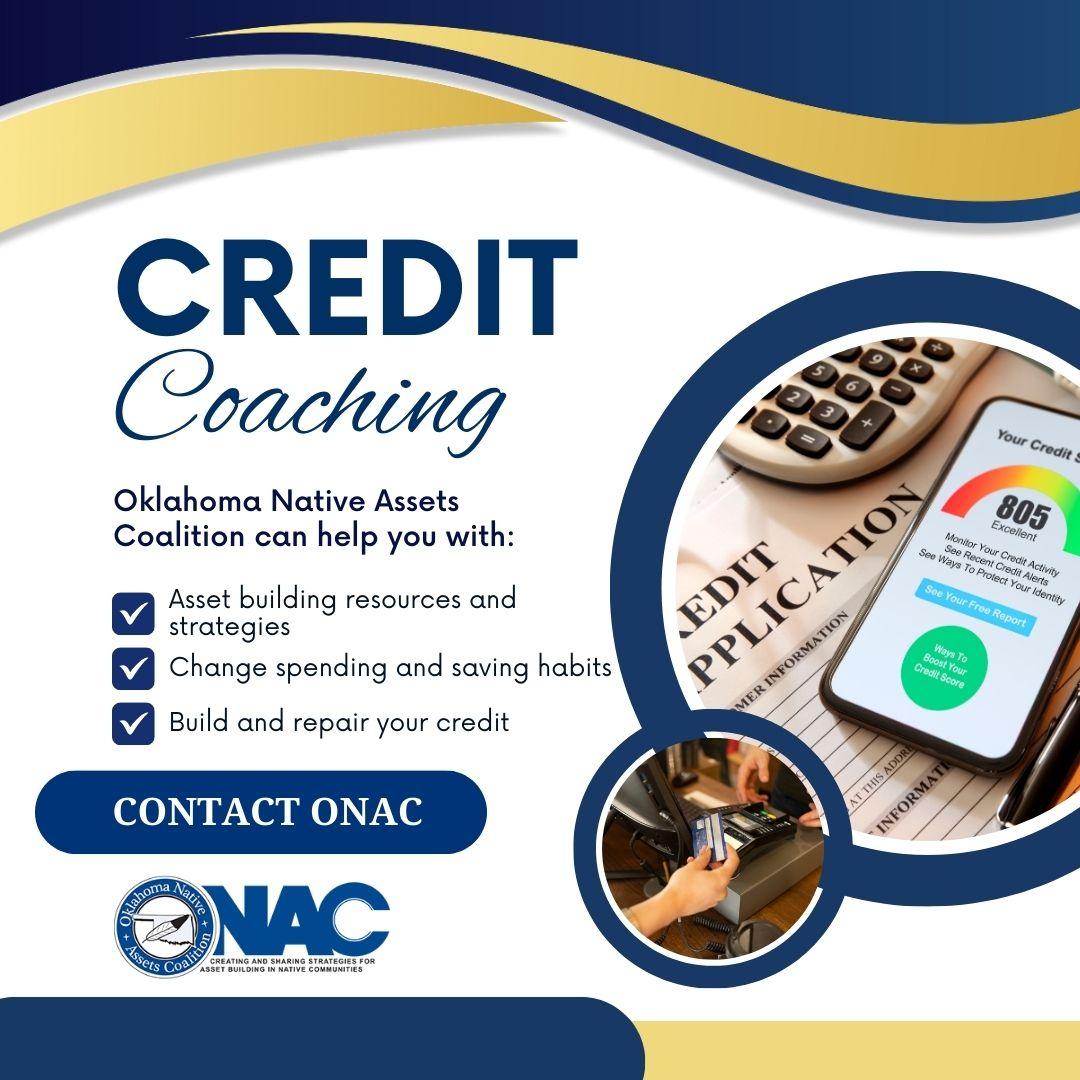
ONAC offers free financial coaching (by phone and teleconference) to American Indians and Alaska Natives, regardless of where they reside in the U.S.
From June 2020 to present, 1,497 tribal citizens (from 137 Native Nations and 41 states) have registered for the coaching.
This coaching qualifies as a prerequisite for Sequoyah Fund's Credit Builder Loan.
| | |
Register today to become a Got Your Back Recognized Business.
This online program is brought to you by the CREATE BRIDGES Initiative and CREATE Bridges WNC.
| |
Create a Positive Workplace Culture & Retain Employees
The CREATE BRIDGES-WNC initiative has designed a free online course to help business owners in the WNC retail, hospitality, and tourism sectors, as you face staffing shortages and other challenges.
Learn effective leadership strategies, including how to find and keep the right employees, how to offer affordable benefits, how to handle challenging customers and employees, as well as ways to improve your workplace environment. This course offers tools you can immediately put to use in your business. Industry experts bring their own expertise and resources. They address what keeps our business owners up at night and offer new ways to maneuver the current workplace challenges.
| |
Are Your Employees Ready 2 Rock?
Ready to Rock is a 3-hour online workshop series designed to help WNC regional employees learn to develop soft skills such as empathy, emotional intelligence, de-escalation tactics, and more! These soft skills are invaluable in our lives as well as in our work.
| | | | |
Tip of the Week:
How Do I Chat With Thee? Let Me Count the Ways.
| |
Gone are the days when customers either called, wrote a letter, or paid you a visit. Heck, gone are the days when people just emailed you (yes, we deliberately skipped over the fax).
How many avenues do you provide for people to contact you?
You may be limited by law or industry regulation as to how far you can go. If you're a doctor, CPA, or lawyer, even email needs to be secure, so it's not likely that you'll be chatting with clients over WhatsApp.
But if you own a delivery service, personal service, home service, retail, food service, hospitality business, or just about any other type of business, you should be open to meeting people where they (digitally) are. This includes:
- Phone
- Email
- WhatsApp
- iMessage
- Facebook (and Facebook Messenger)
- Instagram
- X (the artist formerly known as Twitter)
- Carrier pigeon
- Telegraph operating monkeys
- AOL Instant Messenger (Sorry, RIP AOL IM!)
- Pack mule
You get the picture. As we mentioned above, life moves fast, and customers often communicate quickly, on the fly, with whatever tech they have in their hand at the moment while they have you on their mind. If they're in Facebook, they're not going to switch over to email. If they're in Instagram, they're not going to call.
We at Sequoyah Fund aren't particularly comfortable discussing loan details over Facebook Messenger. That doesn't mean we block or ignore those messages. We politely respond and move them toward a more "official" communication channel. If it's a non-loan-specific question (i.e. "How can I sign up for_______?), those get answered right there. No relocation.
The old saying about the three things that make a piece of property desirable (location, location, location) is just as true as it ever was. Only, in the 21st Century, location isn't necessarily physical - it's wherever customers expect you to be.
If you have only one way of communicating, only people with a preference for that mode will contact you. And that means you'll miss out on the monkey-generated telegraph [STOP].
| | |
AI Lesson of the Week:
The Delegation Engine
| |
It's been a while since we dropped a good prompt into this space, so this week we thought we'd give you a way to turn the work clogging your plate into clean briefs you can actually turn over to someone else your AI.
THIS is what AI was supposed to do for us -
Prompt:
You are my Chief of Staff. Your job is to get low-leverage work off my plate
without dropping any balls. I'll paste my current task list / open loops below.
For EACH item, do the following:
1. CLASSIFY it into one of four buckets:
- DO (only I can do this: founder judgment, key relationship, or legal/financial sign-off)
- DELEGATE (someone else could own this with the right brief)
- DEFER (real but not this week: give it a trigger date or condition)
- DELETE (low impact, sunk-cost, or solving a problem that no longer matters: say why)
2. For every DELEGATE item, write a HANDOFF BRIEF I can paste to a teammate or contractor, using exactly this structure:
- Outcome: the finished result in one sentence (not the activity, the result)
- Why it matters: the business reason, so they make good judgment calls
- Definition of done: 3-5 concrete checkboxes
- Constraints / guardrails: budget, tone, deadlines, what NOT to do
- First check-in: when and what they should show me
- Decision rights: what they can decide alone vs. what needs my yes
3. For every DO item, tell me the smallest version of it that still gets the
outcome (the 20% that delivers 80%), so I stop gold-plating my own work.
Then give me a summary:
- "This week you should personally do ONLY: [list]"
- "Hand these off today: [list]"
- "The single task that, if delegated well, frees the most of your time: [item] and why"
Ask me up to 3 clarifying questions ONLY if a task is too vague to classify.
Otherwise, make a reasonable assumption and label it [ASSUMPTION] so I can correct it.
Here is my list:
[PASTE YOUR TASKS, OPEN LOOPS, AND RECURRING RESPONSIBILITIES HERE]
Where to use it:
For solo founders, overloaded operators, and team leads who are the bottleneck on their own org. Drop in your weekly task list, an end-of-quarter backlog, or everything you’re holding for a teammate before a vacation or a new hire’s first week.
BONUS: Stress Test Your Business Idea with Perplexity
You can use Perplexity Deep Research to stress test any business idea. Save the prompt below once and rerun it on every idea you have to see what’s feasible to build.
Here's the step-by-step guide:
-
Open Perplexity and switch to Deep Research mode. This works on the free plan (5 queries per day) and is basically a hidden version of Perplexity Computer.
-
Paste this prompt with your idea in the chat, hit run, and walk away for 5 to 6 minutes. Perplexity does the research and builds the slide deck in the same run.
- Save the prompt somewhere you will actually use it again, like in a dedicated Perplexity space.
- Then, every Saturday morning, take one idea off your list and run it. You will burn through a year of half-evaluated ideas in a month.
Pro tip: Build variants. A version that compares two ideas, or a 90-day MVP (minimally viable product) plan for ideas that already cleared validation.
| | |
Pssst! Before you go, consider sharing this newsletter on your social media
of choice. We'd love for your friends and colleagues to join us here!
| | | | |