|
Mount Sinai Tisch Cancer Center
Seminar Series
Tuesdays at noon, Davis Auditorium
October 13
Andy Minn, MD, PhD
Chair, Immuno-Oncology Program, Memorial Sloan Kettering Cancer Center
“Chronic Inflammation and Mechanisms of Cancer Immunotherapy Resistance”
Hosted by Emily Bernstein, PhD
October 20
Yu Chen, MD, PhD
Human Oncology and Pathogenesis Program, Memorial Sloan Kettering Cancer Center
“Transcription Dysfunction in Tumor Initiation and Progression”
Hosted by Juan Arriaga, PhD
October 27
Zachary Hartman, PhD
Associate Professor of Surgery, Pathology, and Integrative Immunobiology
Duke University School of Medicine
"Harnessing Therapy-Induced Immunity With ADCs and Cancer Vaccines"
Hosted by Javier Bravo-Cordero, PhD
See complete schedule, September - December
| | Faculty Efforts Lead to FDA Approval | | |
Maaike van Gerwen, PhD, has been awarded R21 funding from the National Institute for Occupational Safety and Health for “Mechanisms of WTC Dust-Induced Thyroid Cancer Progression in Organoids.” Exposure to endocrine-disruption chemicals present in World Trade Center (WTC) dust may contribute to the elevated incidence of thyroid cancer in WTC-exposed populations. Using novel thyroid (cancer) organoid models in toxicology research of WTC dust in combination with cutting-edge multiomics techniques, this project aims to understand the pathways of WTC-related thyroid cancer. Findings may inform future strategies for risk assessment, early detection, clinical surveillance, and preventive measures following exposure.
Ya-Wen Chen, PhD, and Eric Genden, MD, are co-investigators.
| | |
Eirini Papapetrou, MD, PhD, has been awarded R01 funding from the National Cancer Institute for “Targeting Inflammatory RAS-Mutated AML Leukemia Stem Cells.” RAS pathway mutations have recently emerged as a major driver of resistance in acute myeloid leukemia in the era of newer targeted therapies, including the BCL2, FLT3 and IDH1/2 inhibitors. This proposal builds upon recent work in the Papapetrou Lab on unique properties of RAS-mutant leukemia stem cells, to identify and test new therapeutic targets, specific to RAS-mutant acute myeloid leukemia stem cells. Marina Konopleva, MD, PhD, with Montefiore Einstein is Co-PI.
| | |
Stephanie Blank, MD, Chung Yin (Joey) Kong, PhD, and colleagues have been awarded renewed U01 funding from the National Cancer Institute for “Comparative Modeling for the Prevention and Control of Uterine Cancer.” The overarching goal of this project is to inform cancer control and prevention strategies to reduce uterine cancer incidence and mortality by improving the prevention, screening, and treatment of the disease. A collaborative modeling consortium involving Mount Sinai, Columbia, Duke, and Tufts is focused on developing natural history models of uterine cancer that incorporate known risk factors and population level changes in the prevalence of these risk factors over time.
| | |
Susanna Curtis, MD, PhD, was awarded R01 funding from the National Heart Lung and Blood Institute for “Inflammatory Biosignatures for the Identification of Sickle Cell Associated Pain Phenotypes (IBIS-CAP).” Dr. Curtis will develop proteomic signatures to identify phenotypes of chronic pain in sickle cell disease. She will examine these signatures using longitudinal data and genomic data to perform a network analysis to determine drivers of chronic pain phenotypes. This will be done in the context of a randomized study of dronabinol, a safe low-cost FDA approved agent, which will serve as proof of concept that agents that target pathways involved in signatures of a pain phenotype will have superior outcomes on that phenotype.
| | |
Chiara Falcomata, PhD; Brian Brown, PhD, and colleagues
A serpin-myeloid axis in pancreatic cancer heterogeneity and immune evasion
Nature. 2026 Sep 9. PMID: 42717081
Using Perturb-map spatial functional genomics, Dr. Brown and team determined how different genes shape the growth and cellular environments of pancreatic ductal carcinoma (PDAC) clones across space and time. The analysis revealed early gene-driven remodeling of local immune neighborhoods preceding late-stage spatial clonal dominance. The findings identify cancer-derived SERPINE1 and SERPINB2 as local spatial organizers of immune suppression, linking tumor-intrinsic heterogeneity to local microenvironmental control and immunotherapy resistance in PDAC, and inform a potential strategy for overcoming pancreatic cancer's resistance to immune-based treatments.
Press Release
| | |
Jian Jin, PhD, and colleagues
PRMT7 restricts CD8+ T cells expansion via the NF-κB pathway
Nature Communications. 2026 Sep 6.
Jian Jin, PhD, and Stéphane Richard, PhD, (McGill University) led a research team that developed the first-in-class PRMT7 degrader, MS54. PRMT7, a protein arginine methyltransferase, acts as a checkpoint on CD8+ T cell proliferation through a non-enzymatic protein–protein interaction with RelA (p65), a core subunit of the NF-κB pathway, restricting its translocation into the nucleus. Pharmacological degradation of PRMT7 by MS54 releases this constraint, driving NF-κB activation and upregulating key T cell activation markers. MS54 successfully boosted CD8+ T cell proliferation and antitumor activity in preclinical melanoma models.
| | |
Douglas Tremblay, MD; Dahniel Sastow, MD; John Mascarenhas, MD; Ronald Hoffman, MD, and colleagues
Impact of cytoreductive therapy in myeloproliferative neoplasm-associated splanchnic vein thrombosis
Blood Advances. 2026 Aug 20. PMID: 42623680
In the largest cohort of MPN-associated splanchnic vein thrombosis (SVT) patients studied to date, Douglas Tremblay and team analyzed 757 patients from the international GASTRO-MPN Consortium, treating cytoreductive therapy as a time-dependent covariate to account for starts, stops, and switches in treatment. Over a median follow-up of 7.4 years, cytoreductive therapy was associated with a 33% reduction in recurrent thrombosis risk, driven primarily by lower rates of SVT extension/recurrence, with no significant impact on bleeding risk. These findings provide the strongest evidence to date supporting cytoreductive therapy's role in preventing recurrent thrombosis in this population.
| | |
Franco Izzo, PhD; Tamara Prieto, PhD, and colleagues
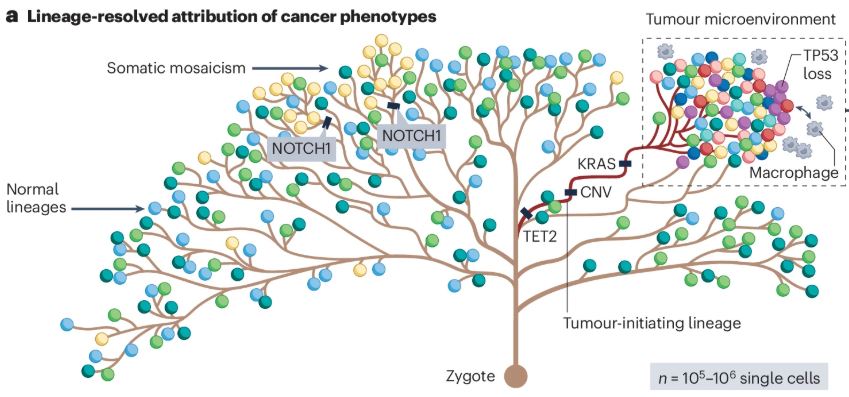
A single-cell lens into the co-evolution of genotypes and phenotypes in cancer
Nature Reviews Cancer. 2026 Sep 8. PMID: 42711452
This review discusses multimodal single-cell technologies that enable the measurement of genotypes and additional molecular features from the same cell—these technologies unveil mutant-specific phenotypic traits and can define therapeutic vulnerabilities for precision elimination of disease-propagating mutant cells. Genotype–phenotype and temporal mapping of somatic evolution in human tissues offers a new framework for understanding the biology of cancer development across stages, from pre-cancer states to cancer onset, progression and therapy resistance.
| | |
Keith Sigel, MD, PhD, and colleagues
Impact of beta blockers, statins, and cholinergic agents on clinical outcomes in pancreatic cancer: a retrospective VA cohort study
Cancer Epidemiology, Biomarkers & Prevention. 2026 Aug 18. PMID: 42611506
This retrospective study of 7,578 Veterans with pancreatic cancer showed that exposure to commonly prescribed medications, in particular beta blockers, was associated with notable differences in stage at diagnosis and survival outcomes. Findings suggest that pharmacologic modulation of sympathetic and parasympathetic signaling, as well as cholesterol metabolism, may influence tumor biology and clinical outcomes in pancreatic cancer, with beta blockers showing the most consistent association with benefit.
| | |
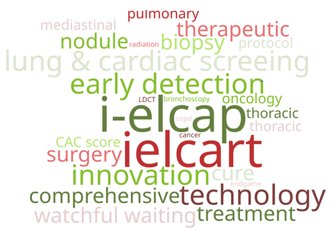
50th International Conference on Screening for Lung Cancer (I-ELCAP) and
18th Initiative for Early Lung Cancer Research and Treatment Conference (IELCART)
October 22-24
Goldwurm Auditorium
No fee, in-person and virtual
Registration
| |
-
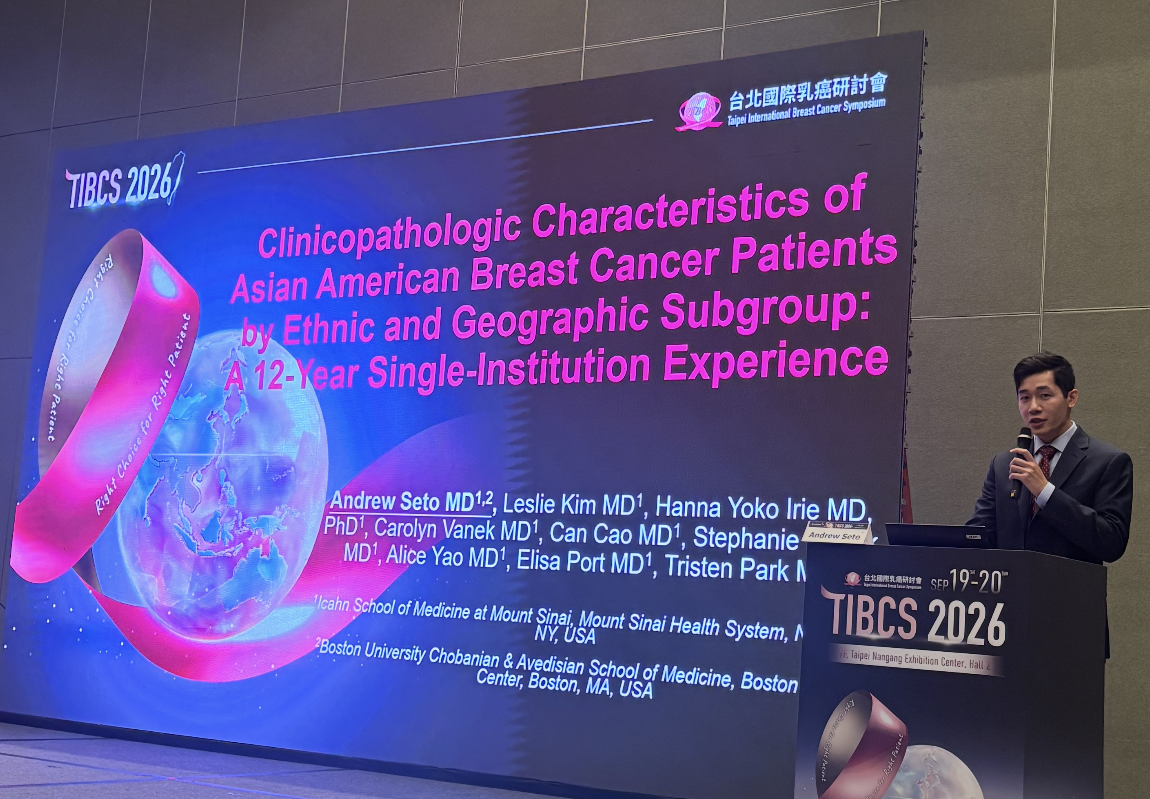
Tristen Park, MD, was senior author on a presentation by former breast surgical oncology fellow, Andrew Seto, MD, now at Boston Medical Center, at the Taipei International Breast Cancer Symposium, held September 19-20. The presentation, “Clinicopathologic Characteristics of Asian American Breast Cancer Patients: A Twelve-Year Single-Institution Experience,” highlighted research conducted at Mount Sinai.
| | Alexandra Gori, MPH, with the Community Outreach and Engagement (COE) program, presented "From Pantry to Prevention: Building Trusting New York City Partnerships to Advance Equitable Cancer Screening" at the annual Cancer Center Community Impact Forum conference in Seattle, held September 27-29. The poster highlighted how COE is building trusting partnerships to advance cancer control in TCC’s catchment area communities. | | |
Do you have news for the next issue of TCC Connections?
Please send to Janet.Aronson@mountsinai.org.
Remember to share breaking news and high impact news that might be appropriate for media coverage with Diego Ortiz Quintero in the Press Office. This may include pending FDA drug/device approvals, studies/trial results being published in high-impact journals, and patient stories. The more lead time you can give Diego, the better—ideally, four weeks or when a paper is accepted by the journal. Embargoes will always be honored and news will only be released with your approval. Contact Diego at diego.ortizquintero@mountsinai.org or 201-572-5703.
| | | |
TCC Connections is a monthly publication of the Mount Sinai Tisch Cancer Center
Ramon Parsons, MD, PhD, Director
Janet Aronson , Editor
Past issues of TCC Connections are available on the Mount Sinai Tisch Cancer Center website
| | | | |