RETIREMENT SECURITY MATTERS
A forum for retirement innovation information sharing focused on
states, supporters, and service providers.
Vol 32 | June 17, 2021
|
|
Greetings! welcome! to Retirement Security Matters – where we talk about retirement readiness innovation by states, supporters, and service providers.
|
Yep, it’s the start-of-summer edition. Grab yourself a beverage and nestle in for a good read:
-
Jamaica’s Sanya Goffe shares some ideas about retirement security useful to all
-
State metrics – closing in on a quarter of a billion – dollars
-
States in action: California, Colorado, Illinois, New Mexico, Virginia, and New York State
- Grant’s Go To’s – thinking about the cost of doing nothing
-
Hot Stuff: on retirement income, getting back in the saddle, and grappling with retirement savings in 2021. Plus Roger Stone and the Clevelands, separately
-
And do not miss this week’s 🌊 Pix!
|
|
Yah Mon! Jamaica Innovates in Retirement Security
|
|
Sanya Goffe, Attorney at Law and Partner,
Hart Muirhead Fatta
|
|
Sanya Goffe was called to the Jamaican Bar in 2003 after studying at the Norman Manley Law School and the University of the West Indies. She is a Partner in the law firm Hart Muirhead Fatta with a practice focused on the areas of pensions law, intellectual property law, capital markets, and corporate law. Sanya is also President of the Pension Industry Association of Jamaica, among many other spaces of influence that she inhabits.
We met Sanya during her Eisenhower Fellowship – what caught us immediately was the freshness of her thinking. Some of you know what we mean. And we had to hear a bit more about this fresh thinking in Jamaica. PS, yes we do apologize for the corny headline!
|
|
Sanya Goffe, we're so pleased to have you with us. You're working on pension security in Jamaica. Tell us how you came to this place.
I don't know why I get so excited about retirement security. All my friends think I'm really nerdy, but I get so passionate about this. It's really where I see my contribution to nation building.
I'm an attorney and I was called to the Jamaican Bar 18 years ago, around the same time of the introduction of a regulatory framework for private sector pensions in Jamaica. The law firm I was working for at the time put together a pensions law practice group. I was very interested and asked to be a part of it.
From early tax code allowances to a private sector pensions regulatory framework – what’s Jamaica's retirement savings infrastructure today?
We have the traditional three pillar system. We have our government savings arrangement which is our National Insurance Scheme. We also have private sector pensions, our second pillar. That's a combination of employer sponsored pension arrangements and our Approved Retirement Schemes (ARS). ARS are similar to what you have as IRAs in the US. The third pillar would be your private savings.
Now, the challenge we have is that coverage is very low. When you look at the private sector pension coverage hovering at about 11%. When you include civil servants, who are part of the public sector pension arrangement, which is not the NIS, that number bounces to about 24%, so still very low.
Sanya, what are some of the unique characteristics of Jamaica that lead to lower levels of retirement plan coverage and use?
We have a large percentage of low income informal workers. Because of that, bringing people into the formal pension space, even so that they receive first pillar NIS contributions and benefits, is a challenge.
We also have a cultural expectation for your children to look after you. We have a phrase in Jamaican dialect. We say: “mi pickney a mi pension”. ‘Pickney’ is a dialect word for child, so “my pickney, my child, is my pension”. At the same time, we have a worsening old age dependency ratio. That means fewer workers for every retiree.
When people are earning just that minimum wage, it's hard to encourage them to think about making a contribution to their NIS or to a private sector pension arrangement. So we have to look at a multifaceted, multi-pronged approach in terms of solutions for pension coverage in Jamaica.
One facet is auto enrollment; that's something that I'm championing and we are making progress with key concepts. Another is “micro pensions.”
Micro pensions, auto enrollment, and a great place to have lunch in Kingston? Click for the rest of the story right here.
Sanya Goffe, thank you so much for your fresh update on retirement security innovation in Jamaica. We can’t wait for your next news. Want more? You can connect directly with Sanya by email here. You can follow at the Pension Industry Association’s work here and @jamaicapensions on Instagram and Twitter. You can also connect with Sanya at LinkedIn.
|
|
*Fresh!* State Program Metrics - Auto IRAs |
|
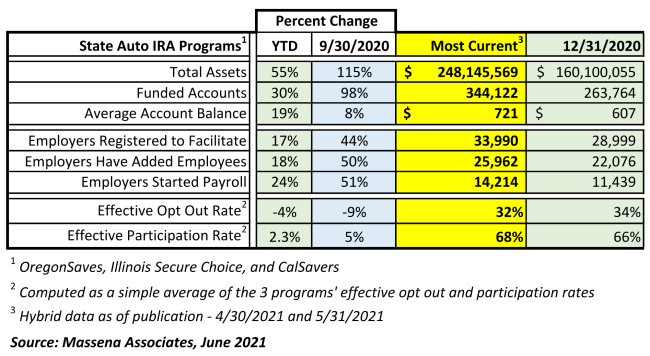
What’s Up Here: Combined assets are now close to $250 million – a quarter of a billion dollars saved across the three programs. Program assets are up more than 50% since the start of the year. Funded accounts are over 344,000 – up 30% year to date and nearly double where they were at the end of September 2020. Average account balances are at $721. Recall that this includes many new accounts. CalSavers reports that more than 13% of their savers now have more than $1,000 set aside in their accounts, and average contributions are $127 per saver per month.
Employer facilitation figures are up. Across the three programs, nearly 34,000 employers have now registered to facilitate. A little less than half have started payroll deductions for their employee savers. The number of new facilitating employers has grown by 50% since September 2020, and by 24% since the start of 2021.
Employee opt out rates are running at about 32%, with participation rates at 68%. Opt outs have been trending gradually but consistently lower.
|
|
State Facilitated Retirement Programs - Fresh Highlights |
|
California (workforce 17.9 million) – The CalSavers registration deadline for employers with more than 50 employees is June 30, 2021 (for more information, see this news release). More than 11,000 employers have registered since the statewide launch in July 2019, and participants have already saved $78 million with CalSavers. Three months after the first CalSavers deadline took effect, the number of registered accounts increased by 108 percent, the number of funded accounts by 249 percent, and total program assets by 157 percent.
|
|
Colorado (workforce 3.2 million) – The Colorado Secure Savings Program Board met on June 10 in an extended executive session. The purpose of the meeting was for Board members to evaluate confidential RFP responses from prospective vendors for the program and investment consulting functions.
|
|
New Mexico (workforce 1 million) – The New Mexico Work and $ave Board met June 10, 2021. The agenda included an update and discussion of the preliminary project plan outline to develop and implement the program. AKF’s Andrea Feirstein and team presented organizing concepts to the Board. Work and $ave committees will be meeting in planning sessions between now and fiscal year end to complete a more detailed plan, which is anticipated to be discussed at the Board’s June 30 meeting.
|
|
Virginia (workforce 3.8 million) – On April 15, 2021, Virginia’s Governor Northam signed HB 2174 which establishes the VirginiaSaves auto-IRA state-facilitated retirement savings program. The eligibility threshold for the program is employers with 25 or more employees; eligible employees will be those who work 30 hours a week or more. The program’s implementation deadline is July 1, 2023, and the effective date for work to begin is July 2021.
|
|
New York State (workforce 9.3 million) – AB 3213, a legislative proposal to ensure employees are automatically enrolled into the New York Secure Choice Savings Program passed in the Assembly on May 11 and the Senate on June 7.
|
|
Grant's Go-To's: What is the Cost of Doing Nothing?
|
|
In the last “Go-To” I wrote about the start-up costs of state-facilitated retirement savings programs (SFRPs). This time I thought I’d flip the cost question upside down and ask: what are the costs of not doing anything to make it easier for workers to save for retirement?
It’s an important question, but one that’s difficult to answer. Projections about cost savings that might be generated by SFRPs depend, among other things, upon reasonable and well-informed assumptions about how changes in the income of the retirement-age population affect economic growth, tax revenues and the costs of social services.
|
|
Is there also a moral cost to consider that is not explicitly captured in these studies? What is the cost to us as a society if we fail to do more to enable people to save for a retirement that provides the security to live without worrying about basic needs, the comfort to enjoy life in one’s retirement years, and the dignity that comes with both?
For the next installment of “Go-To’s”, we’ll turn our attention to the numerous efforts in 2021 to establish or expand SFRPs throughout the U.S. Not all proposals will make it to the finish line this year, but it’s encouraging to see how many there are.
Stay tuned! / Grant
|
|
Columnist and Senior Associate Grant Boyken is based in California. You’ll see his Golden State perspectives reflected here – along with 50-state insights into retirement security innovation around the country. He’s also a good sport when we mess with his head shot.
|
|
This week’s fresh stuff focuses on retirement income, getting back in the saddle after a pandemic, some inequality economics, and grappling with retirement savings in 2021:
From Amanda Umpierrez at Plan Sponsor based on new research from BlackRock (whew!): Annuity Interest Grows Among Workers. Umpierrez reports: “the 2021 BlackRock DC Pulse Survey finds that 89% of participants are interested in owning a product designed to generate retirement income, and almost nine in 10 believe that having guaranteed income in retirement would have a positive impact on their financial wellbeing.” If plan sponsors get motivated to solve the transition to retirement income from retirement savings, that would be a big deal in the US.
LAST ONE! Umpierrez is working overtime this week, also reporting that Americans Continue to Grapple With Retirement Savings. About half of DC plan participants say the pandemic has had an adverse effect on their retirement savings. Getting back on track will be a priority over the next several years.
Retirement Security Lovers SIGN UP TO JOIN US! June 21-25. Yours truly and a raft of more important and very interesting people will be speaking in a 5-part set organized by NAST. Want to attend but aren’t registered for NAST TMTS yet? Please reach out to Kari Arfstrom here for a special opportunity to join. Sessions include:
-
State Auto-IRAs Landscape: Building on the Trend with Andrea Feirstein, Peg Creonte, Treasurer Tobias Read, and Treasurer Dave Young
-
State MEPs and Marketplace Models in 2021 with Deputy Treasurer Michael Clasen, Claudia Armijo, Beth Halberstadt, David Lynch and Troy Tisue
-
Research & Innovation: Driving Future Success for State Retirement Programs with Courtney Eccles, Matt Golden, John Scott, and Stacey Tovrov
-
Turning Recommendations into Reality: How Research & Engagement Pushes Policy with Lisa Massena, Nicola Coakley, Ethan Conner-Ross, Treasurer Sarah Godlewski, and Treasurer Mary Morris
-
Federal Updates & Initiatives: National Retirement Work and the Impact on States with Katie Selenski, Angela Antonelli, Melissa Kahn and Michael Kreps
Please reach out to Kari Arfstrom here for a special opportunity to join. Yes, we said it twice.
What We’re Reading: Actually, we weren’t reading at the time, but we learned a lot when we happened to watch Get Me Roger Stone on Netflix. Yes, it came out in 2017 and we’re late to the party (bad joke there) but suddenly many things make more sense to us.
We’re still chewing away on An Honest President: The Life and Presidencies of Grover Cleveland. Cleveland’s just wrapped up his first term and is looking forward to a time out with new bride Frances Folsom Cleveland. She tellingly says to the staff as she leaves the White House: “Now, look after everything … we’ll be back in four years”. One thing we’re liking about Cleveland is his conservative fiscal policy and, related, a reduction in the tariffs and other tax collections that were causing Treasury coffers to swell. He is quoted as saying: “When more of the people's sustenance is exacted through the form of taxation than is necessary to meet the just obligations of government, such exaction becomes ruthless extortion and a violation of the fundamental principles of a free government.” Forbes writes an interesting piece on Cleveland here.
|
|
... and, Pix of the Week! |
|
Thank you Sanya for sharing your lovely family with us and for this beachy-beachy scene. Welcome to our pages Dad ❤ Gavin and beautiful son Julian ❤. You’re inspiring us to throw on something light and get to swimming … in Jamaica of course. |
|
If you happening to be taking a weekend a little closer to home and really need to get out of the late spring rain, you may find yourself driving up the Columbia Gorge, first on the Oregon side to Hood River where you’ll stop for breakfast at Bette’s and get great service. You may walk your dog in the park to enjoy the view across the whitecaps to the Washington side. And then you’ll probably drive over there, because you are curious.
|
|
You’ll think about going to see Washington’s version of Stonehenge, and the Maryhill Museum with its 80 pieces by Rodin. But you might actually find yourself resting on a sunny balcony at Maryhill Winery, enjoying good company, cool refreshments, and the dramatic view.
|
|
That’s it for this edition! ❤ Hug your people and change the world.
If you like this piece, please stick with us. We’ll be back in about two weeks. If you don’t like it, please unsubscribe below. Comments for us? Please let us know. Want your own subscription? Request one here. All information shared is from public sources or used with express permission.
|
|
Massena Associates provides process, policy, and implementation consulting on retirement savings programs and products.
Our clientele includes states, governments, policy organizations, and private sector providers. Our specialty – efficient, targeted results. We are an active speaker on retirement security topics, including state-facilitated programs, MEPs and more.
If you’d like to explore working together, we welcome the conversation. Connect with us here, and at 339-236-0684. |
|
Looking for a great retirement savings innovation resource? Led by Dr. Alicia Munnell, the Center for Retirement Research at Boston College develops and hosts terrific content and proprietary research related to states, financial security, social security, and more.
Pew’s Retirement Savings Project studies the challenges and opportunities for increasing retirement savings and is another great resource - check out the work of John Scott and his terrific team.
|
|
|
|
|
|
|