Aug. 31, 2026

Top stories

■ US Treasury blocks certain journalists from G20 meeting in North Carolina (Associated Press) / Statement on exclusion of journalists from G20 meeting (National Press Club)


■ Stars and Stripes employees sue Pentagon over firings at military newspaper (Washington Post) / ‘More than six months after the United States and Israel attacked Iran, the Pentagon is waging a concurrent war on the American press.’ (Columbia Journalism Review)


■ Washington Post columnist slams 'traitor' Pentagon source leaking Hegseth meetings to paper (TheWrap) / Pentagon secretly installs military influencers in civilian roles (Washington Post) 


■ Trump's press attacks reveal a gender gap (Axios) / Trump promises NBC’s Welker will be reported to FCC ‘for rebuke or punishment’ (The Hill)


■ Trump updates defamation suit against The New York Times (New York Times) 


■ Trump’s DHS is using an obscure law to secretly snoop on journalists, non-profits and unions: ‘It’s outrageous’ (Guardian) 


■ Karoline Leavitt says goodbye as White House press secretary (Poynter) / ABC’s ‘The View’ invites Karoline Leavitt to appear as a guest (CNN) 


■ California's new attempt to help struggling newsrooms faces key test (Los Angeles Times) / ‘Late last night, the California Senate voted 29-10 for the historic Community NEWS Act — the most significant public policy effort to help local news ever. Goes back to the Assembly TODAY for a final vote. If it passes there, it goes to Gov. Newsom.’ (Steve Waldman)


■ ‘Scripps is cutting hundreds of jobs and replacing some local anchors with faceless streams. Staffers tell Status that the company's talk of "connection" doesn't match what's left of the newsroom.’ (Status)


■ North Minneapolis neighborhood newspaper quietly shuts down after 50 years (MPR News)


■ Antonia Hylton’s first solo MS NOW show joins weekend lineup next month (TheWrap) / PBS Reno promotes Helen Krohn to content and marketing project manager (PBS Reno via Editor and Publisher) / Audience’s new deputy for community (New York Times) / Time is expanding its artificial intelligence coverage (Talking Biz News) / POLITICO expands global Events business, promotes Annie Allen to VP of global special events (POLITICO) / Business Insider hires Cohen as editorial head of video (Talking Biz News) / Longtime WNBC investigative reporter reveals network eliminated her position, cites changing media landscape (TheWrap) / Roxanna Scott out as ESPN’s top editor after less than a year (Front Office Sports) 


■ NBC correspondent speaks out after he and his team were attacked on camera by Israeli settlers (People) 


■ AI news lurks in Austin. Who’s behind it? (Austin Chronicle) / Are newspaper opinion sections embracing AI-written op-eds? (Nieman Journalism Lab)


■ How Miles O’Brien and Arizona PBS created a national science series (Current) / How state grants are expanding public media’s role in rural Kansas (Current)

CRAFT

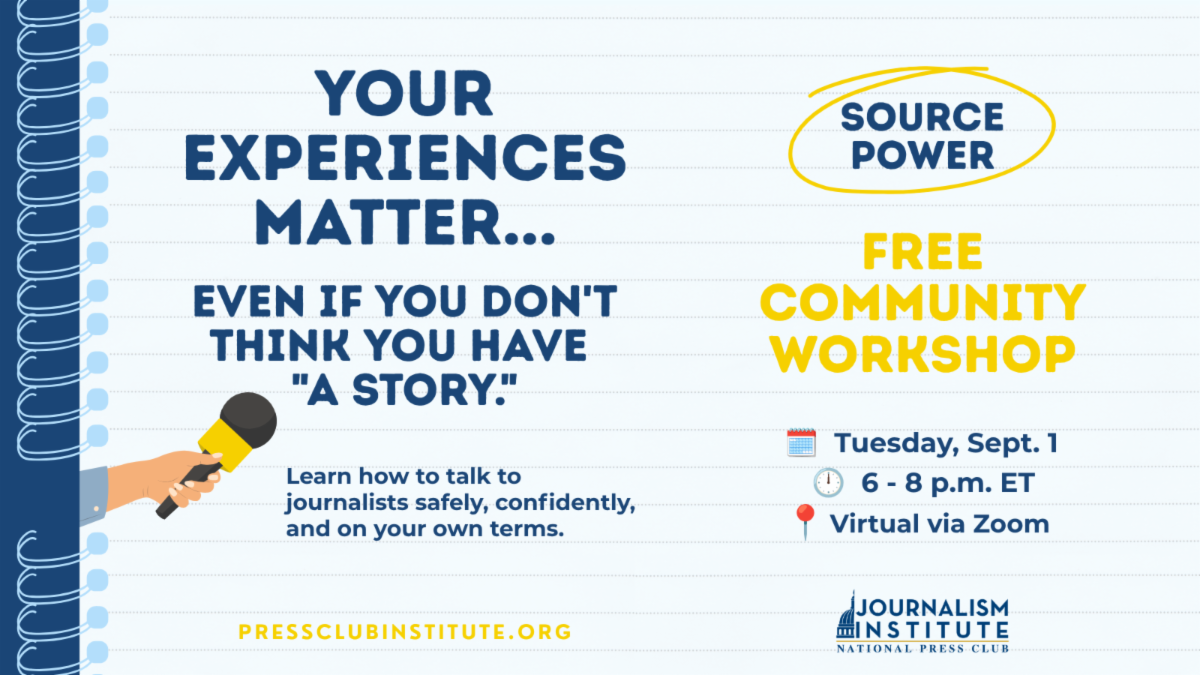
Source Power: Free community workshop tomorrow

The Institute is hosting “Source Power,” a free and virtual community workshop tomorrow designed to help members of the public feel comfortable talking to journalists.


🗓️ Tuesday, Sept. 1 | ⏱️ 6-8 p.m. ET | 📍Virtual via Zoom | 🎟️ Free


This training session is geared toward people involved in activism, education, community groups, and related spaces. It will provide free information and education for individuals who may have not encountered a journalist before and help them feel empowered to choose if and how to speak with members of the press about issues that are important to them.


Help spread the word about this free training to people outside of the journalism space!

The workshop starts with the basics and explains how news interviews work, what journalists are looking for in their storytelling, and what questions sources should ask before deciding whether to participate in an interview.


Attendees will learn how journalists gather and verify information; how to protect one’s privacy and communicate boundaries; what to ask before agreeing to an interview; and how to share experiences in a way that aligns with one’s goals.


After the successful completion of the workshop and an informal assessment, attendees will earn a digital badge for being Source Power certified.


Whether participants are advocating for their community, considering sharing a personal experience, or want to understand their rights before saying “yes” to an interview, this training offers practical tools to make informed decisions.

CAREER


Fundraising Tip: Be a good reporter


“We’ve built a fundraising culture that tells people they need to perform. To show up as a polished, carefully calibrated version of themselves that doesn’t actually exist the other 364 days of the year. And then we wonder why it feels so hard, so unnatural, so draining to be in this job, so much like something we have to survive rather than something we actually want to do.


Nobody told you that you, the journalism professional reading this, already know how to fundraise. The skills that make you good at your job as a journalist are the same skills that make someone great at fundraising. You were just led to believe that the training didn’t count here too.


... So stop performing. Stop giving away your power before the conversation even starts. Be a human. See the other humans in the room. You already know how. 


Go be a reporter.”


-- Jake Hylton, founding executive director of LOOKOUT News, excerpt from "You don't need to become someone else to raise money" (Lenfest Institute)


COMMUNITY

Sober Isn't Boring: Rethinking recovery in a high-stress newsroom


Editor’s Note: The National Press Club Journalism Institute is committed to providing journalists resources and connections that support their personal and professional lives. Continuing in 2026, we are collaborating with several groups to widen those networks of support.


By Bill Nichols, advisory committee member, Journalists Recovery Network

A headline in the New York Times caught my eye earlier this month: "What else do we lose when people give up booze?"


The gist of the piece, written by Gina Bellafante, looks at the impact of a societal shift in views about alcohol on places for which it remains a crucial part of the local economy. In this case, she focused on Louisville, Ky. and how the crucial bourbon industry there has taken a nosedive.


Bellafante, who curiously mentions no link between the Trump administration’s tariff policies and the woes of the local liquor economy, goes on to make a larger point about the growing recovery/abstinence/sober curious movement,

As someone who will have been sober for four decades on Feb. 21 of next year, I really don’t have to wonder about the answer to that question. “The temperance revival,” as Bellafante so unfortunately terms it, has hopefully carried away some percentage of the broken families, ruined careers, lifelong health issues and bottomless depression those who struggle with alcohol misuse often face.


To be fair, midway through the story, Bellafante underscores the positive benefits for those who try to cope with addiction. But the overall frame of the story underlines a popular myth that often is a major stumbling block for those looking to explore recovery — the notion that not drinking relegates one to some kind of joyless purgatory, where you sit guzzling coffee and doing needlepoint and preaching the evils of Demon Rum to all who will listen.


The Journalists Recovery Network takes no position on how to structure your recovery; we have members who are in 12-step programs, who want nothing to do with 12-step programs, who are fully abstinent and who are not. We simply share what has worked for us, the resources that are available, the reality that journalism is a crushingly stressful occupation and the likelihood that a good number of us may misuse alcohol and other substances to try to deal with that.


What our organization does fully agree on is that yes Virginia, there is not only a real Santa Claus but also rewarding life and even FUN without drinking and using. As a sober person, I have closed bars, eaten too much, laughed too loud, cried, treasured good friends, told silly jokes, danced to great music. The only difference is that I didn’t also put others in danger and/or end up in an ER or rehab at the end of the evening.


JRN hopes to lead a new awareness of the need for healthy stress reduction techniques among journalists and be a resource for those who are concerned about over-dependence on alcohol or other substances.


Make no mistake: recovery is hard, particularly early on. But to explore it, you aren’t risking becoming Carrie or Carl Nation, leaders of a national temperance movement, mean-spirited scolds who go to bed at 8 p.m. 


You’ll be exploring a new and vibrant life. You’ll even have fun.


If you are a journalist in recovery from alcohol or substances and are interested in learning more, email us anytime at journalistsrecoverynetwork@gmail.com.

Resources

This newsletter is written and edited by the National Press Club Journalism Institute staff. Send us your questions and suggestions for topics to cover.


Get this from a friend? Subscribe and view the archives.

Bluesky  Facebook  Linkedin  X  Youtube

DONATE TO THE INSTITUTE


The National Press Club Journalism Institute promotes First Amendment values by equipping journalists in Washington, D.C., and nationwide with the skills, knowledge, standards, resources and networks to empower and inform the public. As the non-profit affiliate of the National Press Club, the Institute powers journalism in the public interest. The Institute's tax ID number is 52-1750908.