Wishing all our clients, friends, and community business partners a happy and healthy 2021. May the new year bring peace, joy and prosperity. |
|
Litigation associate attorney Sumble Manzoor joined our law firm in 2016 following a clerkship with the United States Bankruptcy Court, Northern District of California. Ms. Manzoor devotes her practice to representing clients in a variety of civil litigation matters including complex and mass torts, business, personal injury, employment and trusts and estates litigation. As a part of her employment law practice, Ms. Manzoor also counsels businesses in all aspects of labor and employment law compliance.
Ms. Manzoor earned her B.A. in Economics and Spanish Translation from Rutgers University, New Brunswick. She graduated from Temple University Beasley School of Law where she served on the editorial board of the Temple Political and Civil Rights Law Review. During law school, Ms. Manzoor worked as a judicial extern for the United States Equal Employment Opportunity Commission and was recognized as a Rubin Public Interest Law Honor Society Fellow for her work with the Volunteer Income Tax Assistance Program.
|
New Year – New Employment Laws
No Extension of FFCRA
The Families First Coronavirus Response Act (“FFCRA”) expired on December 31, 2020, as scheduled. Employers may voluntarily choose to extend the program and apply for the tax credit for any leave given until March 31, 2021.
In March 2020, with passage of the CARES Act, Congress created the FFCRA, which required employers to give employees paid emergency family and medical leave and emergency paid sick leave. It covered private employers with fewer than 500 employees and certain public employers. Employers were given a payroll tax credit for paid leave provided under the Act.
Congress’ new COVID relief package does not include an extension of the program. Under the new legislation the tax credits will continue until March 31, but the mandate ends. Employers can choose to provide FFCRA leave and seek the tax credit, but they are no longer required to.
Employers who elect to extend do not need to provide employees with additional leave. To the extent that an employee had already exhausted paid sick leave or paid emergency family and medical leave, they will not be entitled to a new bucket come January 1. However, to the extent they still have leave available, the employer can extend the employee’s time to take that leave through March 31, 2021.
When deciding whether to extend the leave, employers will have to balance the fact that, with COVID cases on the rise, employees will likely still need the paid leave and not extending the program increases the risk that employees will come to work infected (and in turn infect others) with the administrative and financial burdens on their business related to extending the leave.
New COVID Prevention Reporting Requirements for Employers
Under Assembly Bill 685, employers must now provide written notice to all employees at a worksite of potential COVID exposures. Notice must also include information regarding COVID related benefits and protections and notification of disinfection and safety measures that will be taken because of the exposure. Employers must also notify appropriate local public health agencies of any “workplace outbreaks,” defined as three or more laboratory-confirmed cases of COVID among employees who live in different households within a two-week period.
The new law expands Cal/OSHA’s authority by allowing issuance of an Order Prohibiting Use to shut down a worksite or specific worksite area when it determines employees are being exposed to an imminent hazard related to COVID. Cal/OSHA’s authority to issue citations related to COVID does not require the usual 15-day notice before issuance.
Expansion of the California Family Rights Act and
Paid Family Leave
The California Rights Act (“CFRA”) requires covered employers to provide up to twelve weeks of unpaid, job-protected leave to eligible employees due to the birth, adoption, or foster care placement of a child, to care for an immediate family member with a serious health condition or due to the employee’s own serious health condition.
Senate Bill 1383, which takes effect January 1, 2021, expands the number of California employees eligible to take CFRA leave. Under the new law, private employers with at least five employees, as opposed to the previous threshold of fifty employees, will now be required to provide leave to eligible employees. In addition, Senate Bill 1383 expands its definition of “family members” to now include a child of any age, grandparent, grandchild, sibling and domestic partner. Click here to see the bill.
California’s Paid Family Leave (“PFL”) will also be updated come January 1, 2021 as Senate Bill 1123 and Assembly Bill 2399 take effect. PFL provides benefits to employees who need to take time off of work to care for ill family members or to bond with a new child. Changes in the laws will expand PFL to include time off for employees to attend to a “qualifying exigency” related to an individual’s spouse, registered domestic partner, parent, or child who is an active duty member of the United States Armed Forces. PFL coverage will also expand for active military members and their families by using the more expansive definition of “family members” consistent with the new changes to CFRA.
In addition to CFRA and PFL, other leave laws, including kin care leave and crime victim leave will also be expanding effective January 1, 2021.
Update Your Employee Handbook
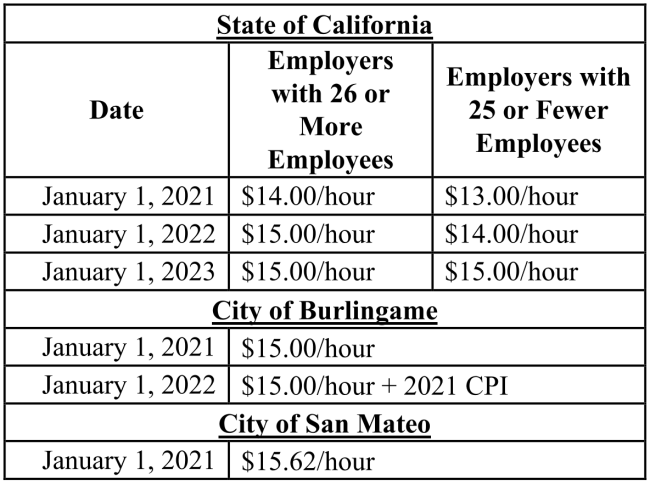
SB3: Minimum Wage
|
Estate Planning Update on Proposition 19
If you own real property and plan to transfer it to your children, you need to be aware of the effects of Proposition 19 which was passed on November 3, 2020 by a bare majority vote.
Under the old rules, parents could transfer their primary residence, regardless of its value, to their children, and the children were entitled to keep that property with a historical property tax base (limited to 2% annual increases). Essentially that meant your children would pay a similar property tax that you paid at the time of your death. This was a tremendous property right enjoyed by parents and children who transferred property between themselves.
Under the new rules (which take effect February 16, 2021), property transferred from parents to children (whether by gift, sale or inheritance) will be fully reassessed to its full fair market value UNLESS the child moves into the home and makes it their primary residence. If a child makes the home their primary residence, up to one million dollars of the fair market value may be exempted from a reassessment, depending on the assessed value at that time.
Regarding rental property, under the old rules, parents could transfer property with a combined assessed value up to $1 million to children without the property being reassessed. This was a tremendous benefit to children who wished to hold the property and continue generating rental income.
Under the new rules, if that transfer takes place after February 15, 2021, the rental property will be fully reassessed. The parent to child exemption disappears on transfers between parents and children.
Only the very basic elements of Proposition 19 are described here. If you wish to make a transfer of property to children before the new rules come into effect on February 16, 2021, please contact a member of our estate planning team to discuss possible solutions: Stevan N. Luzaich, Edward A. Daniels, Andrea A. Nguyen and Dallas E. Dean.
|
We're Open!
We continue to offer our legal services remotely for your safety and convenience. Our offices are open to clients on a limited basis in accordance with public health official recommendations and regulations. We’re following the current CDC guidelines of social distancing, with procedures in place to promote a distance of 6 feet or more from others while in our office. All clients and members of our team are required to wear face coverings while in our offices. We’ve made many other changes to ensure a safe and healthy environment for our clients and members of our team.
|
|
Employment Law Litigation
When issues arise, our attorneys focus on early intervention to resolve problems within the business before the issue escalates ...
|
|
Business & Commercial Transactions
Since 1964, our firm has provided tailored advice to business clients of all sizes. From sole proprietorships to Fortune 500 companies ...
|
|
Probate & Trust Litigation
Along with the provision of estate planning legal services, we have extensive experience litigating matters resulting from estate disputes involving ...
|
|
Millbrae Office
700 El Camino Real
Millbrae, CA 94030
Phone: (650) 871-5666
Email: info@coreylaw.com
|
|
Half Moon Bay Office
625 Miramontes Street, Suite 106
Half Moon Bay, CA 94019
Phone: (650) 726-7578
Email: info@coreylaw.com
|
|
|
|
|
|
|