Technology in Support of National Security


Monthly News & Updates


december2024

Happy Holidays!


Recently Published Patents

Optimization of quantum-active defects and spins in chemical systems using machine learning


This innovative approach involves analyzing how fabrication parameters impact key quantum properties, like fluorescence and coherence times, to create a predictive model for optimizing production. By refining these parameters, the system can fabricate improved samples of materials, such as diamonds with nitrogen-vacancy centers, which are critical for applications in quantum computing and sensing. This method not only enhances material performance but also streamlines the development of next-generation quantum technologies


Newsletter Highlights

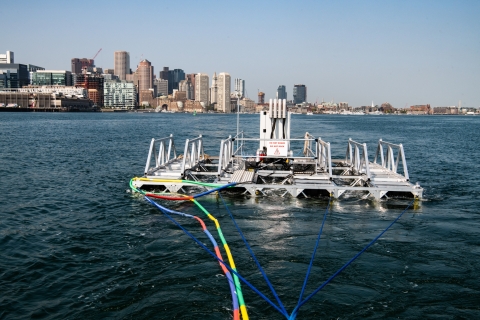
Surface-based sonar system could rapidly map the ocean floor at high resolution

On June 18, 2023, the Titan submersible was about an hour and a half into its two-hour descent to the Titanic wreckage at the bottom of the Atlantic Ocean when it lost contact with its support ship. This cease in communication set off a frantic search for the tourist submersible and five passengers onboard, located about two miles below the ocean's surface.

Read More

R&D 100 Award Winner Highlight

This software uses artificial intelligence (AI) techniques to create high-resolution maps, or atlases, of the brain's network of neurons from high-dimensional biomedical data. NeuroTrALE addresses a major challenge in AI-assisted brain mapping: a lack of labeled data for training AI systems to build atlases essential for study of the brain's neural structures and mechanisms. The software is the first end-to-end system to perform processing and annotation of dense microscopy data; generate segmentations of neurons; and enable experts to review, correct, and edit NeuroTrALE's annotations from a web browser. This award is shared with the MIT Chung Lab.

Learn More
 

70 Years Ago in 1954


Lincoln Laboratory Occupies Current Facility

Groundbreaking for Lincoln Laboratory (then called Project Lincoln) began in 1951 at a site in Lexington, Mass. The facility was sited partially on land owned by MIT and primarily on land at what is now Hanscom Air Force Base, and included four laboratory/office buildings plus a concrete-block utility structure. Lincoln Laboratory moved into this facility in 1954 and still occupies those original five buildings as well as many newer buildings, including the Microelectronics Laboratory (c. 1992) and South Laboratory (c. 1994).


We offer opportunities to license, sponsor, and contribute to our research and development.


Facebook  Instagram  LinkedIn  X  YouTube