April 2023
Greetings!
With taxes on our mind these days this month's InFocus shares a collection of resources and insights that take a wide-eyed look at the importance of sound tax planning.
This anonymous quote summarizes a general feeling toward taxes: "People who complain about taxes can be divided into two classes: men and women."
True, taxes are unavoidable, complex and disliked. The overall impact they have on a wealth management plan can be significant. So let's turn the lens on you: what questions are you asking (or should you be asking) about building tax efficiency into your wealth management plan. Here are some prompts for you:
- How can I create a spend-down strategy that decreases the taxes I pay over my lifetime, increasing the odds of never running out of money?
- How do I avoid getting locked into a high tax bracket for the rest of my life?
- How can I identify opportunities to lower taxes through IRA conversions and distributions?
- How can I make my portfolio more tax-efficient when I rebalance?
- How do the latest tax rules and regulations directly affect me?
- How can I best blend the tax benefits I receive while I support the charities most special to me?
If any of these questions -- or other tax-related issues -- are on your mind, we are happy to have a conversation with you.
Dream. Plan. Prosper.
|
|
2022 TAXES - LAST-MINUTE OPTIONS
|
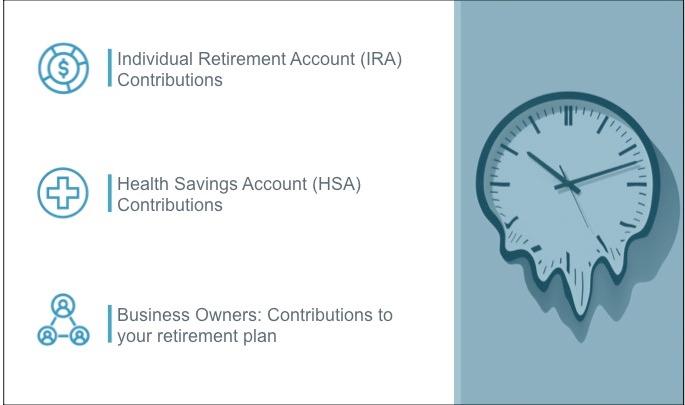
Even though 2022 is in the rearview mirror, you can still act now to lower last year’s tax liability. Here are three strategies you can implement now to save money on last year’s returns.
- Action #1: Make your annual retirement account contributions in 2023 for the 2022 tax year.
- For IRAs, Roth IRAs, and similar accounts, you have until April 15, 2023, to do so.
- If you’re a business owner making contributions in a SEP IRA, a simple IRA or 401k profit-sharing plan, you can make those payments up to the tax filing deadline as late as October 15, 2023.
- Action #2: Make HSA contributions before the April 15, 2023 deadline.
- This works similarly to IRA contributions to reduce your income from the prior year.
- In order to contribute, you have to have been enrolled in a high-deductible HSA plan in 2022.
- Action #3: Make special elections on your tax return
- Talk to your financial advisor or a CPA to get their thoughts on what elections could be of benefit, especially if you are a business owner.
|
|
|
|
A PROBLEM THAT DIMINISHES US ALL
As a fee-only, certified financial planning professional, I'm committed to helping clients minimize their taxes through strategic long-term tax planning. And as an engaged citizen, I can't help but wonder how the tax system contributes to gross inequality in our county. The United States, the richest country on earth, has more poverty than any other advanced democracy. Why? Why do we allow one in every eight of its children to go without basic necessities?
In his new book, Poverty, By America, Matthew Desmond, Princeton sociologist and the Pulitzer Prize-winning author, lays out a provocative but compelling list of issues contributing to inequality. Suffice it to say that Desmond goes beyond demonization of the 1%. His book forced me to shift my frame of reference. And it my shift yours.
|
|
U.S. vs. INTERNATIONAL EQUITY PORTFOLIO ALLOCATION |
What is the correct U.S. versus international equity allocation for a portfolio? It’s (literally) a million-dollar question. Buckingham Chief Investment Officer Kevin Grogan shares the principles for determining the correct equity allocation split, the cyclical nature of these investments, current valuations and the long-term forecast.
Here are the Main Points:
- While there is no one right answer, please consider these guiding principles:
- Assign at least 20% to 40% of your stock portfolio to international stocks.
- Don’t put all your eggs in one basket.
- Country equity performance is cyclical.
- From 2000 to 2009, international stocks outperformed U.S. stocks.
- From 2010-2020, the U.S. outperformed international stocks by a wide margin.
- Principles of successful investment:
- Diversification is your friend. It’s important to own both foreign and domestic stocks.
- There are two ways to approach equity allocation:
- Take note of the global stock market as a starting point. The U.S. represents about 55% of the way the world allocates capital in the stock market.
- On the opposite side, some investors tilt towards domestic investments.
- Less expensive to invest in the U.S. stock market versus internationally.
- Familiarity.
- International equities expose investors to foreign currencies, and most U.S. based investors expenses are in U.S. dollars.
- Look at the price-to-earnings ratios of U.S. companies versus non-U.S. companies over the long term. This is known as valuations.
- Currently the valuation of a U.S. stock market index is about 19, which means an investor is paying $19 for every $1 earnings from a U.S. based company.
- For international companies, that ratio is closer to 13, which means investors are paying a lot less for a dollar of earnings from an international company than a U.S. company.
The academic evidence suggests there will be higher expected returns for international rather than domestic stocks over the long term.
|
|
|
|
|
|
|
|
|