Weekly Digest Number 40 - October 5th, 2021 |
|
(Editor's Note: RWU stands behind the unions of the operating crafts. The NS - and the other rail carriers - must be confronted for their flagrant wholesale contract violations. We urge all T&E workers on the NS system to vote YES when polled on whether to strike.) |
|
Unions Join Together to Thwart Norfolk Southern’s Effort to Eliminate Train Service Crafts |
|
The Brotherhood of Locomotive Engineers and Trainmen (BLET) and the Transportation Division of the International Association of Sheet Metal, Air, Rail, and Transportation Workers (SMART-TD) have joined forces to defeat efforts by Norfolk Southern Railway to supplant the train service crafts of conductors and brakemen by calling locomotive engineers to work their assignments.
BLET National President Dennis Pierce and SMART-TD President Jeremy Ferguson issued the following joint statement regarding their action: “On October 24, 2018, Norfolk Southern Railway announced plans to implement Precision Scheduled Railroading. PSR is an operational scheme that makes irrational cuts to employment, maintenance and service levels to generate artificially higher profit rates for hedge funds and similar investors.
“Because of PSR, NS has eliminated the jobs of over 35% of its operating crew members since December 2018. NS also has been fighting since the summer of 2019 to cut the size of operating crews by half. “As part of its plan to simply eliminate the train service crafts of conductor and brakeman, NS has willfully depleted its train service workforce. The shortage of conductors and brakemen is so severe that NS started ordering locomotive engineers — under threat of termination for insubordination — to work conductor positions even though both the BLET Agreement and the SMART-TD Agreement prohibit the use of locomotive engineers in train service positions.
“Today, our unions have initiated legal actions that are intended to compel NS to follow our contracts and obey the laws of our land. NS cannot lawfully lay off roughly 4,000 conductors and brakemen, and then give their work to another craft. Nor can NS lawfully deprive locomotive engineers of the jobs, wages and working conditions to which they are contractually entitled by forcing them to perform the work of other crafts.”
|
|
Wave of US Labor Unrest Could See Tens of Thousands on Strike Within Weeks |
|
Tens of thousands of workers around the US could go on strike in the coming weeks in what would be the largest wave of labor unrest since a series of teacher strikes in 2018 and 2019, which won major victories and gave the American labor movement a significant boost. The unrest spans a huge range of industries from healthcare to Hollywood and academia, and is largely focused on higher wages, fighting cuts and better working and safety conditions, especially in light of Covid-19.
It also plays out against a backdrop of an economy bouncing back from the torrid experience of widespread economic shutdowns during the coronavirus pandemic, but one that is still marked by profound inequality. However, the pandemic is also seen as potentially providing a shot in the arm for US labor unions by increasing bargaining power amid increased union drives and labor shortages in some industries.
About 24,000 nurses and other healthcare workers at Kaiser Permanente in California represented by the United Nurses Associations of California/Union of Health Care Professionals will vote on a strike authorization from 1 to 10 October....
An additional 3,400 health workers in Oregon and 7,400 health workers with USW at Kaiser Permanente also announced strike authorization votes. Other unions representing thousands of workers at the company with expiring union contracts are considering strike authorization votes....
After four months of negotiations with the Alliance of Motion Picture and Television Producers (AMPTP), the International Alliance of Theatrical Stage Employees (IATSE)announced a strike authorization vote for 60,000 workers across the film and television industry in the US. If the union moves forward with the strike, it would be the first among Hollywood production workers since the second world war....
Several other large groups of workers have voted to authorize strikes around the US while continuing new union contract negotiations, such as 2,000 Frontier Communications workers in California, transit workers in Beaumont, Texas, and Akron, Ohio, about 450 public works employees in Minneapolis, Minnesota, dining workers at Northwestern University, and hundreds of group home workers in Connecticut....
About 1,100 coal miners in Alabama have been on strike for the past six months and 2,000 carpenters in Washington have been on strike since 16 September....
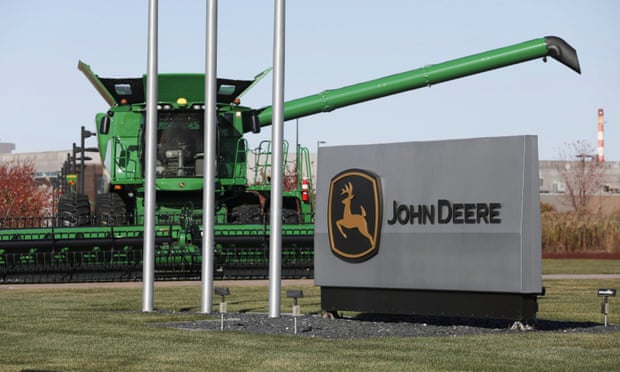
On 12 September, 10,100 John Deere production and warehouse workers in Iowa, Illinois and Kansas, represented by nine locals with the United Auto Workers voted 99% in favor of a strike authorization if a new six-year union contract isn’t attained through negotiations with the company....
|
|
(Editor's Note: It's about time! For more than a year, the rail carriers have cynically used the pandemic as an excuse to cut inspections, circumvent longstanding safety regulations, and jobs.) |
|
The Federal Railroad Administration on Sept. 21 sided with a SMART Transportation Division request to reject the extension of COVID-related regulatory waiver requests by the Association of American Railroads (AAR) and the American Public Transportation Association (APTA).
The waivers, initially granted in March 2020 by the Trump administration in response to the emerging coronavirus pandemic, were roundly criticized by the SMART Transportation Division at their inception. They had been extended on multiple occasions since then and covered regulations governing:
- Training
- Locomotive engineer skills examinations
- Locomotive and conductor certification
- Territorial qualifications
On Sept. 13, the SMART-TD National Legislative Department filed public comments in objection to the latest extension request, saying the following:
“It is hard for this Organization to grasp that the railroads are seriously concerned about the pandemic when they are doing little to nothing to prevent its spread. In fact, it seems they only want the CDC guidelines to apply where they might be most able to cut an operational corner, rather than provide a safe and sterile work environment,” National Legislative Director Greg Hynes wrote. “According to our applicable members: locomotive, crew room, and transport vehicle cleaning and sanitation has all but stopped (and has been for quite some time). Clearly, prevention of the spread of the virus has taken a back seat to waivers and relief from rules. Safety is either important or it isn’t. It doesn’t just apply here and there.”
FRA concurred with many of the points referred to by SMART-TD in its response, especially regarding training of new rail employees. The agency noted that carriers appeared to use the waivers of at least two rules for an intent outside the purpose originally sought. “FRA’s investigation of these concerns revealed that in numerous instances the railroads were utilizing this relief not to facilitate social distancing, but instead, out of administrative convenience,” FRA’s Karl Alexy wrote.
|
|
NTSB Urges Railroads to Better Protect Rail Roadway Workers |
|
The National Transportation Safety Board Thursday again called on the Federal Railroad Administration and Amtrak to put an immediate end to the use of “train approach warning” as the sole method of on-track safety in areas covered by positive train control.
TAW is an older method of using designated watchmen to look out for approaching trains in a work zone. By using TAW instead of available protections provided by advanced positive train control systems, Amtrak circumvented important PTC safety features that could help prevent rail worker deaths.
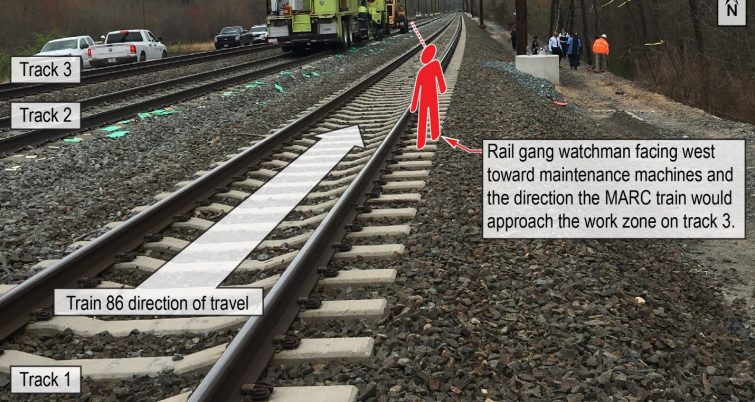
The safety recommendations issued in Railroad Accident Report 21/02, are based on the April 24, 2018, accident where an Amtrak rail watchman was killed in Bowie Maryland. The NTSB determined that Amtrak’s insufficient site-specific safety work plan for the Bowie project did not adequately consider the challenges of multiple main tracks in a high-noise environment. The watchman was focused on the movement of a southbound MARC commuter train when he was struck from behind by a high-speed northbound Amtrak train.
PTC could have been used to enforce speed restrictions, which would have automatically reduced the speed of trains in the work zone. Alternatively, PTC could have been used to prevent trains from even entering the work zone. Amtrak’s decision to use TAW in a high-risk area allowed roadway workers to be exposed to the dangers of simultaneous bi-directional train movements at speeds up to 125 mph.
|
|
(Editor's Note: The nominee to head the FRA was questioned on train crew size, oil by rail, new technologies, the infrastructure bill, Amtrak expansion, blocked crossings, port congestion, supply chains, and more. These issues are all of great importance to rail workers. Of special note, there will once again be a Proposed Rulemaking on train crew size. Once the call for public input is announced, all rail workers and allies must respond vigorously!) |
|
Federal Railroad Administrator Nominee Addresses Senate Committee |
|
Amit Bose, Deputy Administrator of the Federal Railroad Administration, took on questions about automated track inspection, crew sizes, hazardous materials transportation, and port congestion, among other topics, during a Sept. 22 hearing on his nomination by President Biden to be the next Federal Railroad Administrator.
Also part of the Senate Committee on Commerce, Science, and Transportation nomination hearing were Meera Joshi, to be the Administrator of the Federal Motor Carrier Safety Administration; Victoria Wassmer, to be the Chief Financial Officer of the Department of Transportation; and Mohsin Syed, to be the Assistant Secretary of Government Affairs of the Department of Transportation.
The hearing was led by U.S. Sen. Maria Cantwell (D-Wash.), Committee Chair.
The White House on April 23 announced that President Biden would nominate Bose for the top FRA job. Currently, Bose serves as Deputy FRA Administrator, returning to the agency where he was also Chief Counsel and Senior Adviser. Throughout the Obama-Biden Administration, Bose also held positions in the Transportation Secretary’s office as Associate General Counsel and Deputy Assistant Secretary for Governmental Affairs. Before joining DOT, he worked for New Jersey Transit, the New Jersey Department of Transportation, and the U.S. Congress as a Transportation staffer. In addition to his decades in the public sector, Bose previously worked at HNTB as Associate Vice President and Program Director.
|
|
FRSA Alert! Landmark Decision Clarifies Good Faith Safety Reporting |
|
The FRSA protects employees from retaliation for “reporting, in good faith, a hazardous safety or security condition.” But what exactly does that mean? In a case of first impression for the Circuit Courts, the Second Circuit analyzes the plain meaning of that statutory language and concludes:
we hold that a railroad employee engages in protected activity under FRSA Section 20109(b)(1)(A) when she reports what she subjectively believes to be a hazardous safety or security condition irrespective of whether that understanding is objectively reasonable.
Ziparo v. CSX Transportation. In other words, a worker does not have to prove both a subjective and objective basis to believe a condition is hazardous. A subjective belief alone is sufficient.
And what constitutes a “hazardous safety or security condition”? Again applying the plain language of the FRSA statute, the Second Circuit soundly rejects all the district court decisions limiting that term to “physical conditions that are within the control of the rail carrier.” Rather, the Circuit explains why the term is much broader, potentially embracing any work-related condition that may affect the safety of a railroad’s operation:
In sum, FRSA Section 20109(b)(1)(A) protects an employee reporting what she sincerely believes constitutes a hazardous safety or security condition, regardless of whether the railroad or a similarly situated employee would reach the same conclusion or whether the report relates to physical conditions or employment practices that create safety or security hazards.
The Court also held “that complaints of stressful and distracting work conditions may well fall within the scope of hazardous safety or security conditions,” although with the caveat that to qualify such conditions must be generated by or within the control of the railroad, not by an employee’s personal life.
|
|
Investigators Looking at Switch, Rail as Possible Causes of Deadly Amtrak Derailment |
|
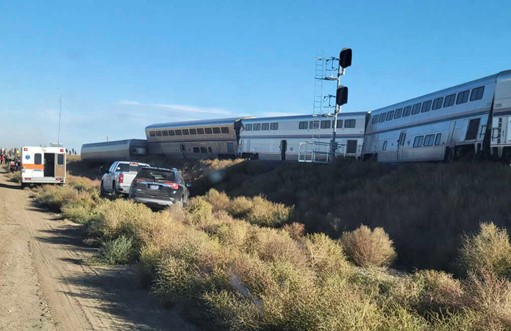
A full 24 hours after a derailment of an Amtrak track that killed three passengers near Joplin, Mont., theories were spreading on the cause of the accident. One possibility is a faulty switch. The derailment occurred close to one, and images show two locomotives and two cars at the front of the train hit a split and continued on the main line track, but the next eight cars fell off the tracks.
A rail defect also is being investigated, although according to BNSF, which owns the line, the most recent inspection was conducted on Sept. 23. A 14-member team from the NTSB is taking a closer look, and large cranes were transported to the scene along with gravel and new crossties. BNSF is ready with replacement rail as soon as NTSB gives the signal.
Amtrak’s Empire Builder No. 7 was traveling westbound from Chicago en route to Seattle with 141 passengers and 16 crew members on board. Seven people have been hospitalized. “Our No. 1 focus is safety and we are committed to taking all steps necessary to prevent a similar event from occurring again,” Federal Railroad Administration (FRA) Deputy Administrator Amit Bose said in a statement.
Bose said the FRA has mobilized a team of 18 consisting of technical experts from core safety disciplines including track, motive power and equipment, signal and train control, and operative practices. The FRA has initiated a thorough forensic investigation and analysis in support of the NTSB.
|
|
Write your Representative: Keep Bigger, Heavier Trucks OUT of the Final Infrastructure Bill |
|
Tthe long-awaited passage of the infrastructure bill has begun. Debate is underway on the floor of the U.S. House of Representatives. The vote may come as soon as Thursday.
This is the critical period when the special interests – particularly the Bigger Truck Lobby – will be working overtime to protect their profits at the expense your family’s safety and the environment. Right now is when they’re pushing the hardest to open our highways to longer, heavier, pollution-spewing trucks.
For the sake of safety on our highways, global climate change and the very air you breathe in Nevada these bigger trucks must be stopped.
Here are the frightening facts about allowing longer and heavier trucks on our highways:
- Bigger trucks have far higher crash rates – as much as 400% higher.
- Bigger trucks are far more likely to have critical safety violations, which are associated with a 362% increase in the likelihood of being involved in a crash.
- Bigger trucks will spew a whopping 55 million tons of additional carbon emissions a year into our atmosphere while crushing our highways and bridges.
- Allowing longer, heavier trucks to spew their carbon emissions would be the same as putting 10.8 million additional passenger vehicles on our roads every year.
|
|
SMART/SMACNA Statement on the Importance of Being Vaccinated |
|
From the beginning of the COVID-19 pandemic, the highly skilled members of SMART and SMACNA have been deemed a key component of the essential workforce. Together we have been able to complete vital projects, while limiting the spread of COVID-19 by following the latest health and safety recommendations from Occupational Safety and Health Administration (OSHA) and the Centers for Disease Control and Prevention (CDC). Unfortunately, with the rise of COVID-19 variants, such as Delta, we find ourselves in the same situation. Both SMART and SMACNA believe that responding to the COVID-19 virus is of critical importance for the health and safety of our members, their families, and communities. That is why the leadership of SMART and SMACNA is strongly encouraging you and your family members to get vaccinated. A vaccinated workforce is vital protection for you and your fellow workers. A vaccinated workforce is also important for our industry. On September 9, 2021, OSHA announced that it is developing a new workplace safety rule. This new OSHA requirement covers all employers with federal contracts, as well as those employers with more than 100 employees.
|
|
Intermodal Volume Down Again in Latest AAR Traffic Report |
|
The recent decline in intermodal volume at U.S. railroads continued through the week ending Sept. 25, according to Association of American Railroads (AAR) data. The railroads logged 272,644 containers and trailers, down 7.3% compared with volume during the same week in 2020. U.S. railroads also hauled 239,069 carloads for the week — up 6.6% — but that wasn’t enough to overcome a 1.3% decrease in combined volumes for the week.
Six of the 10 carload commodity groups tracked by the AAR posted an increase compared with the same week in 2020. They included coal, up 11,681 carloads to 70,002; metallic ores and metals, up 4,418 carloads to 24,120; and nonmetallic minerals, up 4,103 carloads to 34,083.
|
|
(Editor's Note: We have 3% fewer employees now on Class One railroads than this time last year in the midst of the pandemic. Could this be responsible for why the Class One's are incapable of handling current traffic levels?) |
|
U.S. Class I Workforce Shrank in August |
|
U.S. Class Is as of mid-August employed 114,431 people, down 1.07% from July's employment total and down 2.83% year over year, according to Surface Transportation Board data.
All six employment categories registered decreases in August compared with July's data. They were: professional and administrative, down 2.32% to 9,853; maintenance of equipment and stores, down 1.79% to 17,205; transportation (other than train and engine), down 1.52% to 4,659; transportation (train and engine), down 0.82%; executives, officials and staff assistants, down 0.68% to 7,271; and maintenance of way and structures, down 0.63% to 28,334.
Year over year, all categories except transportation (train and engine) logged decreases. They were: maintenance of equipment and stores, down 10.23%; transportation (other than train and engine), down 8.09%; professional and administrative, down 4.83%; maintenance of way and structures, down 3.73%; and executives, officials and staff assistants, down 2.94%.
|
|
(Editor's Note: RWU supports direct elections in all unions at the local, GCA (regional) and national/international levels. Most all rail unions elect top officers at Convention, and all rail unions elect GCA officers at conference, not by direct ballot. If one-member -one-vote is OK for electing local union leadership, why do we not use this method for elections of the tops?) |
|
Auto Workers to Vote on Direct Elections for Officers |
|
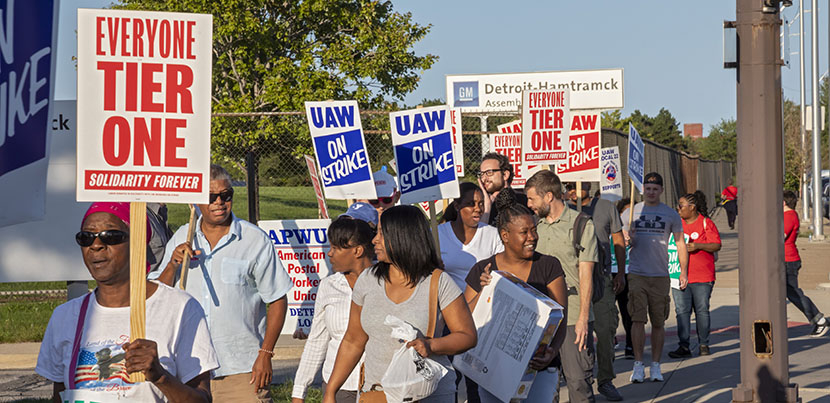
United Auto Workers members will soon vote in an unprecedented referendum to decide whether the union’s 400,000 working members and nearly 600,000 retirees will directly elect their top officers. Ballots hit the mail October 19 and are due back November 29.
The UAW’s executive officers are currently elected to four-year terms by delegates at its convention. An “Administration Caucus” has dominated these positions for the past seven decades, using the powers of appointment available to International officers to wield tight political control.
In the auto industry, where most UAW members work, many are frustrated with years of concessionary contracts that have allowed automakers to build a two-tier workforce, with the number of temporary and lower-paid workers ballooning.
“Two-tier was the worst thing,” says Mark Gevaart, who works at GM’s Fort Wayne Assembly and is a former president of Local 2209. “I work right across the line with someone making half my wage. How do we deal with that?”
For Will Hughes, a line worker at Ford’s Kansas City Assembly and member of Local 249, the referendum is about making leaders answer for the conditions members face on the job. “Right now there’s no accountability for these guys under the current delegate system
|
|
|
|
|
|
|