Big Knowledge = Data for the Business, by the Business, and of the Business
Data warehouses, data lakes, cloud computing, and edge computing are significant trends today. They provide your organization with the opportunity to take control of the data, which is crucial to the business and decision-making. The problem is that the business often leaves the data to IT assuming that technology will help with the understanding of the data while providing the information. IT provides the tools and systems to capture and work with the data, but the business involvement is required to define what data is needed and then, through business rules, turn the data into information and information into knowledge – answering the question of “Why?”.
The business must be fully engaged – otherwise Big Data becomes Big Noise. We sometimes forget what Grady Booch said, “A fool with a tool is still a fool…” meaning that we need the understanding to make tools useful.
It is Crucial that the Business is Involved
I’ve facilitated Business Data Modeling for 30+ years helping the business first identify what data is needed and then “how to” transform the data into information so that they can develop knowledge. I’ve encountered businesses that have more data than they knew what to do with, yet the information was either insufficient and/or incorrect. This happens when the business is not fully engaged in defining their data needs. Data comes from multiple sources and it needs to be structured, blended, reconciled, and made usable. It’s difficult for the business to make informed decisions when the data doesn’t relate. Technology has surpassed the ability of the business user to turn data into knowledge and the process is made overly complex through jargon, methods, etc., resulting in business being overwhelmed causing errors, poor decisions, and costing millions of dollars and fines from regulators.
The Solution
I find that businesses, through facilitated processes, are far more capable of modeling their business data needs than data analysts, data scientists, etc. After all, it’s their business. But too often data modeling is presented in a manner that intimidates the business – not intentionally, but certainly, that is the result. I’ve done more Facilitated Business Data Modeling with non-technical people than with technical people and they’ve always embraced it because it helped them gain not only a better understanding of what the data truly means but also its impact on their business and policies.
The “How to”
Facilitated Business Data Modeling is key and it requires a Facilitator that knows “how to” and has the essential tools to successfully understand, build, and explain Data Models from a business perspective. The Facilitator will engage the business participants with a clear, concise, and consistent process that will enable the business to model, define, develop, and understand their business data model.
The Result…
By engaging the business in developing theirbusiness data model, they can look at big data and develop effective and meaningful taxonomies to extract and structure content enabling analysis that is meaningful to the business. Business can take big data or as George Carlin might say, “Stuff” and turn it into meaningful information.
I continue to be the leading edge in the industry by continuing as a practicing Group Facilitator.
Our FoCuSeD™ Facilitator classes support the International Association of Facilitators (IAF) Core Facilitator Competencies and what students need to learn to achieve them, enabling those who wish to pursue their IAF Certified™ Professional Facilitator (CPF) designation. CPFs receive professional recognition that provides a competitive edge. You can receive a professional CPF certification from the IAF - read FacilitatorCertification. I also provide a "Certificate of Completion" attesting to evidence of a successful class completion - read Certificate vs Certification.
I founded MGR Consulting in 1985, a learning and collaborative leadership development consulting firm, and used my subject matter expertise about group facilitation and designed, developed, and taught the first structured facilitation-training program - FAST. In 2007, I then revolutionized my facilitation-training program with FoCuSeD™ - the 1st Holistic Structured Facilitation™ Technique - by being the first to see and describe how People and Process skills can be seamlessly integrated to drive consensus-based decisions.
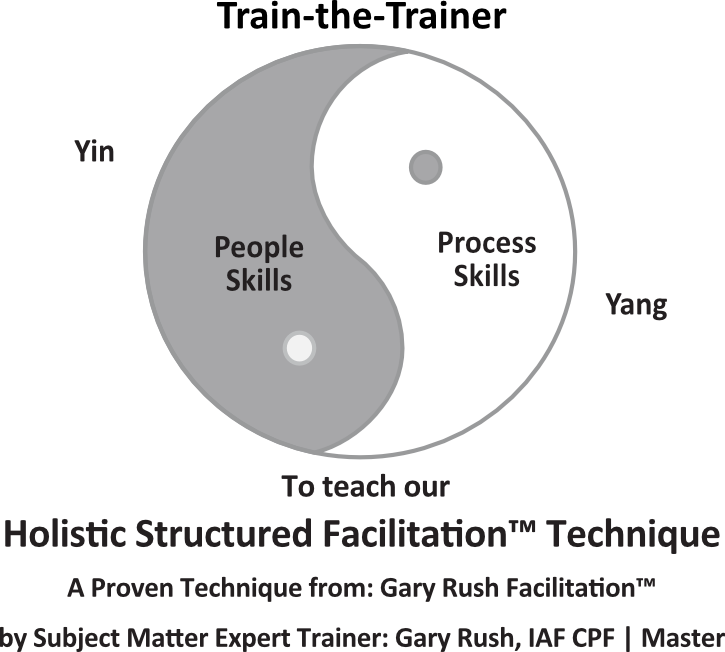
I develop, conduct, and deliver learning programs with FoCuSeD™guide books that train employees and improve their job performance to work with a group to produce better outcomes - online, in-person, and virtual. Check out my Train-the-Trainer program to teach our Holistic Structured Facilitation™ Technique - I want everyone to succeed...
"Continues to be the leading edge in the industry by continuing as a practicing FoCuSeD™ Group Facilitator."