|
Meta Muse: The AI Agent That Runs Your Errands
Meta just launched Muse, a personal AI agent that does not just answer your questions, it actually does your work. Here is what it can handle, what it costs, and how to try it right now.
Your to-do list has two kinds of items.
The ones that need your brain, and the ones that just need somebody to do them.
Booking the flight, turning a recipe video into a grocery list, haggling with the cable company.
Here’s a Cool Tip: hand your errands to Meta’s Muse AI agent.
Meta has introduced Muse, its biggest consumer AI bet yet, aimed at that second kind of task.
Powered by Meta's Muse Spark model, Muse takes plain-language requests and does the work: sending emails, filling out forms, even negotiating on your behalf.
It keeps working in the background after you close the app and checks in when it needs your approval.
Feature Explanation
Muse is an agentic AI. A chatbot answers one question at a time.
An agent takes real actions across apps and websites, works through multi-step jobs on its own, and keeps going in the background.
It runs inside Meta's Muse Secure VM, a private virtual machine with its own browser that books appointments, fills out forms, and handles customer service chats.
A separate watchdog called Sentinel is walled off from Muse on the same machine, making sure Muse never acts without your approval.
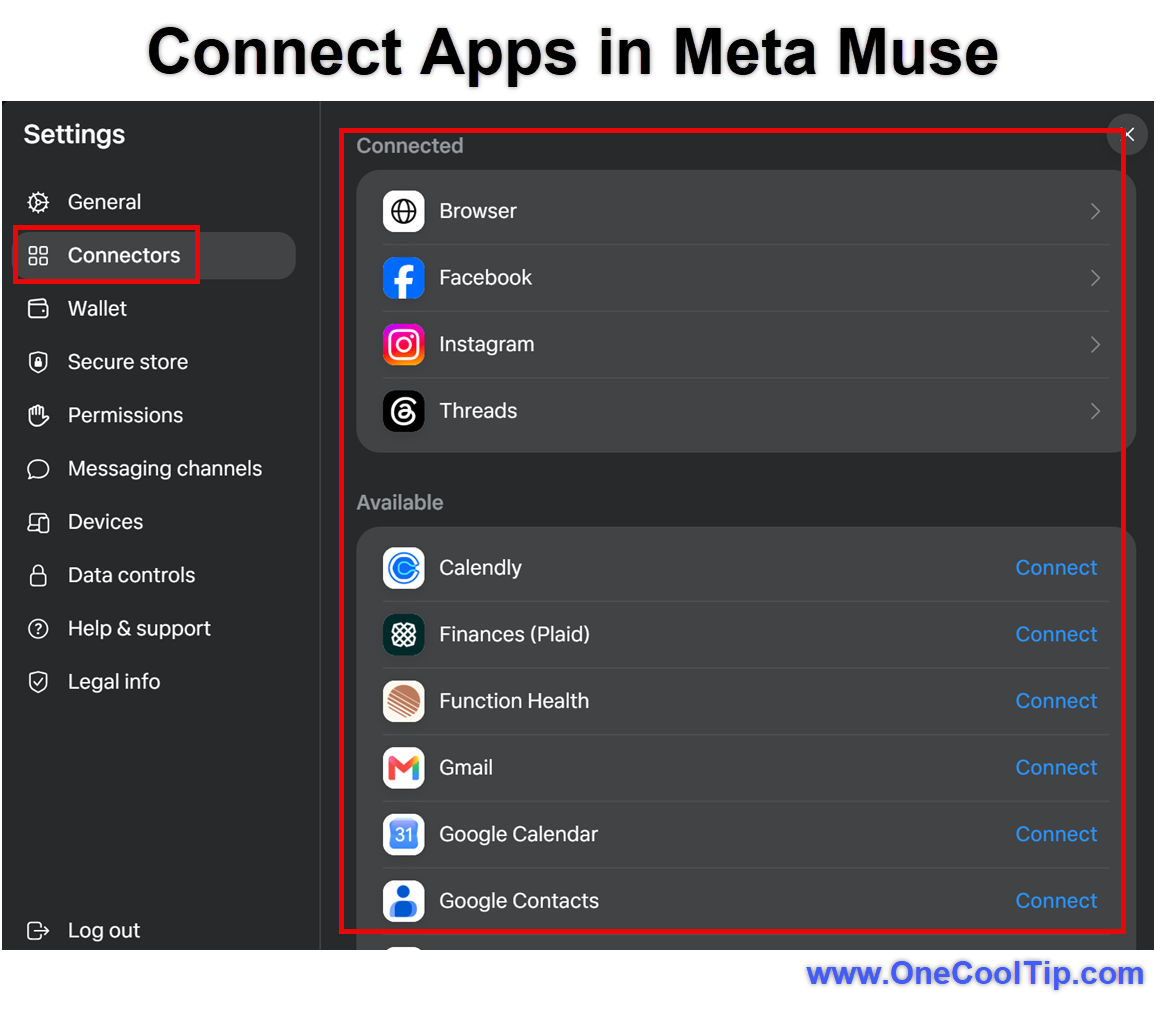
You message Muse like a person in the Muse, app connecting your apps one at a time.
Before anything consequential, a sent message, a purchase, shared data, Muse asks: allow once, always allow, or deny.
An audit trail shows everything it did.
It can turn a saved recipe reel into a grocery list or quietly work a bill negotiation, returning when it needs a yes.
It is brand new, rolling out in the US for 18 and over, with Meta AI glasses support coming soon.
What's the Difference?
Meta AI (meta.ai) is Meta's conversational assistant, basically their ChatGPT.
It answers questions, writes text, generates images, and chats with you.
It lives inside Facebook, Instagram, WhatsApp, and Messenger, and has its own standalone app and site. Free, widely available, been around a while.
Muse (muse.ai) is Meta's new personal AI agent, launched September 8, 2026.
Instead of just answering, it takes real actions across your apps and websites: booking travel, sending emails, filling out forms, negotiating bills, making purchases.
It runs in its own secure virtual machine with a browser, keeps working in the background after you close the app, and asks your approval before anything consequential like spending money.
It's US-only, 18+, free with a usage limit, with $20 and $100 monthly plans for heavier use.
So, Meta AI is "a simple AI chat experience similar to ChatGPT," while Muse is "a personal AI agent that can take actions on a user's behalf across different apps and websites."
They're separate products, but related: Muse is powered by Meta's newer Muse Spark model and represents the step from chatbot to agent.
What You’ll Gain
- Get hours back by handing off travel booking and customer-service calls.
- Stop babysitting tasks. Muse works in the background, pinging you only for approvals.
- Stay in control with per-action approvals and a full audit trail.
- Keep data fenced off with a private virtual machine and one-time card numbers.
Step-by-Step Instructions
Here's how to do it.
Web/Desktop
-
Go to muse.ai and create your account (18+, US only).
-
Skip the payment card for now. The free tier works without one; add a payment method only when you want a paid plan or agent-made purchases.
-
Connect apps one at a time, starting with email and calendar.
-
Personalize your agent: name it, pick an avatar, set its tone.
-
Type a task in plain language, such as "Find a cheaper Chicago flight next month and show options before booking."
-
Review every approval request before Muse sends or spends anything.
|