Product Stewardship Updates |
|
Colorado Packaging EPR Legislation Is a Game-Changer |
|
When Colorado’s legislature passed a packaging EPR bill last month, the state changed the game for an entire industry. Spearheaded by Representative Lisa Cutter and Senators Julie Gonzales and Kevin Priola, the legislation was developed by Recycle Colorado, based on PSI’s policy model. The Producer Responsibility Program for Recycling bill (HB22-1355) represents a paradigm shift in the way paper and packaging products are designed and managed in the United States. That’s because this program is fully funded and managed by producers — unlike legislation that passed in Maine and Oregon, where producers will reimburse recycling programs run by municipalities or private sector operators. Once signed by Governor Jared Polis, Colorado’s new packaging EPR law will facilitate the development of robust recycling infrastructure and services in the state and create an enduring spoke in the wheel of the emerging circular economy.
|
|
Connecticut Passes First-Ever Gas Cylinder EPR Law |
|
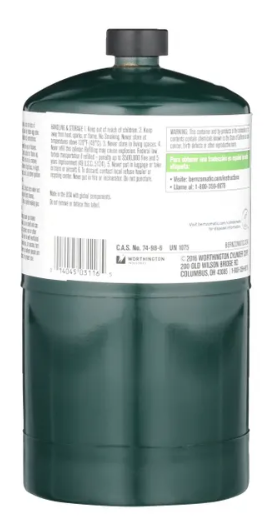
Even though refillable and reusable products are available, many gas cylinders – such as those found in camping stoves and barbecues – end up as trash. The smallest amount of residual propane can cause explosions and fires, which is why the cylinders are typically rejected by recyclers, even though they are made of valuable materials. But that’s all about to change in Connecticut, which recently became the first state to enact EPR legislation for gas cylinders.
PSI worked for two years to adapt our model gas cylinder EPR legislation and generate support for HB 5142, which passed the General Assembly in May and was signed by Governor Ned Lamont on May 10. Under the leadership of Representative Joe Gresko and Senator Christine Cohen, PSI board members Jen Heaton-Jones of the Housatonic Resources Recovery Authority and Tom Metzner of the Connecticut Product Stewardship Council developed a bipartisan coalition. By January 1, 2024, cylinder producers must ensure that every community in Connecticut has free, convenient access to safe gas cylinder recovery.
In 2015, our analysis found that Connecticut's existing EPR programs diverted more than 26 million pounds of materials from disposal and yielded a cumulative cost savings of more than $2.6 million per year for Connecticut municipalities. We anticipate similar results for gas cylinders in Connecticut with the implementation of HB 5142.
|
|
EPR Masterclass Webinar: Packaging Redesign |
|
Extended producer responsibility (EPR) for packaging and paper products began 35 years ago in Europe and continues to gain momentum around the globe. EPR policies and laws have reduced waste, invigorated stagnant recycling rates to as much as 70%, increased consumer convenience, and saved municipalities significant funds. But one common critique of EPR programs is that they have not led to design changes in consumer packaging. This is changing: As policy tools like eco-modulated fees are implemented, consumer brands are beginning to redesign their packaging to be reusable, recyclable, non-toxic, made with recycled content, and circular.
Join us on Tuesday, June 7 at 11 EST (1700 CEST) for a webinar with global packaging EPR experts including Jürgen Dornheim (P&G), Feliks Bezati (MARS), Gloria Gabellini (PEPSICO) Karen van de Stadt (KIDV), and Joachim Quoden (EXPRA), moderated by Scott Cassel, PSI's CEO and Founder, with Sydney Harris, our Policy & Programs Manager, to discuss how EPR can help achieve packaging redesign and advance the circular economy. This live webinar is open to our entire community but the recording will be limited to PSI Members and Partners only. Register today!
|
|
If you're a Member or Partner, join us on Wednesday, June 8 from 12-1:15 EST for our Annual Meeting. Register here.
|
|
Legislation News in Brief |
|
New York's Carpet Bill is now on the Governor's desk! Two bills based on PSI's model carpet bills – S 5017C and A 927a – were reconciled last month and passed both chambers. With the new law, New York will join California in helping to increase recycling of the three million tons of carpet that is currently landfilled each year.
In California, The Responsible Battery Recycling Act of 2022 passed the Senate and is being considered by the Assembly. Beginning last August, PSI facilitated discussions with stakeholders, including the Consumer Product Safety Commission, Californians Against Waste, and the San Francisco Department of the Environment, and we are hopeful that SB 1215 and AB 2440 will soon become law.
Last month, Governor Phil Scott signed H.500 into law, prohibiting the sale of mercury lamps in Vermont.
Members and Partners receive regular legislative updates and can track EPR bills and laws in our Legislation Library.
|
|
Calling on PSI's definition of product stewardship, a new report predicts global market growth of more than 12% through 2028, the Daily Vale reports.
We appreciate the comprehensive reporting behind Stateline Midwest’s deep dive into EPR, including this takeaway from our CEO Scott Cassel: “We use a method that starts with a basic model, and we work with each state…there is always some degree of producer management, and the question again is, how much gets incorporated into the law?”
Missouri recycled paint demonstrations featured in PCI magazine — check out the before and after slideshow!
In light of New York’s new carpet law, great perspective on PSI’s role in developing carpet EPR from Waste Advantage.
What’s the impact of New York’s new carpet bill? Construction & Demolition Recycling reported that, “Projections show that New York could [decrease] greenhouse gas emissions by 165,000 tons per year, which is equivalent to taking 32,000 cars off the road, according to the Product Stewardship Institute.”
Impact metrics of Washington’s PaintCare program detailed in the Spokesman: “In its first nine months of operation, the program collected 581,363 gallons of paint, diverting most of it out of landfills and putting it to beneficial use. Now, a year into the program, PaintCare estimates that Washingtonians have dropped off approximately 842,000 gallons of unwanted paint."
Hawaii considered a packaging bill this session. But was it EPR? PSI’s Scott Cassel shared his perspective in the Honolulu Star-Advertiser.
|
|
Alberta: The Alberta government is in the process of developing EPR regulations for Packaging and Paper Products (PPP) and Household Hazardous Waste (HHW). These regulations are anticipated to be introduced by June of this year. Implementation of the system will result in an EPR system for these materials in Alberta. Learn more.
California: On May 11, 2022, CalRecycle’s director approved the California carpet stewardship program goals for 2023 to 2027. The approved goals include recycling rates, recycling efficiency rates, collection rates, public access to drop-off sites, and flooring proximity to drop-off sites. Visit CalRecycle’s Carpet Stewardship Program Goals for more information.
California: On May 17, 2022, CalRecycle reviewed the Mattress Recycling Council’s (MRC) amended Used Mattress Recovery and Recycling Plan and notified MRC that the Plan was found to be complete via the letter posted on CalRecycle’s website. CalRecycle will determine whether to approve, disapprove, or conditionally approve the Plan by July 25, 2022.
Saskatchewan: Changes to The Household Packaging and Paper Stewardship Program Regulations (blue bin recycling program) are being considered. The Ministry of Environment has completed a review of the regulations and wants to understand how the proposed changes may impact your municipality, business, or organization. Click here to review the draft regulations and summary of proposed changes.
|
|
Partner Spotlight:
Flexible Packaging Association
|
|
The Flexible Packaging Association represents flexible packaging manufacturers and suppliers to the industry in the U.S. Flexible packaging represents over $36 billion in annual sales; is the second-largest and fastest-growing segment of the packaging industry and employs about 79,000 workers in the United States. Produced from paper, plastic, film, aluminum foil, or any combination of these materials, flexible packaging includes bags, pouches, labels, liners, wraps, rollstock, and other flexible products.
From a water and energy consumption, product-to-package ratio, transportation efficiency, food waste, and greenhouse gas emissions reduction standpoint, flexible packaging is one of the most environmentally sustainable packaging types – but circularity options are limited. Thus, FPA and its members worked with the Product Stewardship Institute to formalize our principles on well-crafted Extended Producer Responsibility (EPR) legislation. FPA believes that EPR will provide necessary investment to modernize the U.S. recycling system and provide an onramp to full circularity for flexibles. Read more on the blog.
|
|
PSI welcomes our newest partner, Éco Entreprises Québec. ÉEQ is a private non-profit organization that represents the companies that place containers, packaging, and printed matter on the market in Québec in their responsibility to finance the costs of effective and efficient municipal curbside recycling services. As an expert, ÉEQ optimizes the curbside recycling value chain and implements innovative approaches with a view to sustainable development and circular economy.
|
|
Virtual or in-person attendees are welcome June 10 at the CWMA AGM Speaker & Networking Event "Momentum in Product Stewardship" in Victoria, CA. Register here.
Registration for the 2022 Conference on Canadian Stewardship, taking place September 20-21 at the Metro Toronto Convention Centre, is now open. Register here.
|
|
Suna Bayrakal, PhD, PSI's Director, Policy & Programs, will present on EPR for Household Hazardous Waste and Lelande Rehard, our Senior Associate, Policy & Programs, will present on Pharmaceuticals EPR. Register here.
|
|
NPR’s recent spotlight on EPR legislation in NY misses a significant point: the Kaminsky bill (using PSI’s model legislation) was developed with multi-stakeholder input – including local governments, environmental NGOs, and producers – while the Englebright bill was generated by environmental NGOs. Also, true EPR always includes state oversight and is never managed unilaterally by industry.
The National Institute of Standards and Technology recently released Facilitating a Circular Economy for Textiles, a report generated by a 2022 workshop in which manufacturers, industry associations, recyclers, waste managers, researchers, policymakers and fashion brands discussed strategies to increase textile circularity – including PSI’s Scott Cassel, who contributed information on EPR policy options.
Great perspective from the Ellen MacArthur Foundation: “By 2050, the expected waste from solar panels and wind turbine blades is expected to reach 78 and 43 million tonnes, respectively. To prevent this solution becoming a problem, renewable energy infrastructure needs to be built for a circular economy."
“New York is close to becoming the second state to require producers to fund carpet collection and recycling. Meanwhile, California regulators approved carpet fees that vary based on recycled content.” Insight on new EPR legislation from Resource Recycling.
"Alberta set to make companies pay up on plastics: Recycling costs will shift onto industry." Sprawl Calgary reported on Alberta's new EPR legislation.
|
|
The Product Stewardship Institute is a policy advocate and consulting 501(c)(3) nonprofit that powers the emerging circular economy. We rely on the generosity of our members, partners, and supporters to convene diverse stakeholders to build extended producer responsibility (EPR) policies, programs, and laws. Thank you!
|
|
The Product Stewardship Institute, Inc. is an equal opportunity employer and provider. Persons with disabilities who require alternatively formatted materials to ensure effective communication should contact Amanda Nicholson at amanda@productstewardship.us or 617.236.4855, TTY: use 711 or 800-439-2730; MassRelay.
|
|
|
|
|
|
|