Weekly Digest Number 30 - July 26th, 2022 |
|
Welcome to the RWU Rail & Labor News! This news bulletin is produced and emailed out each Tuesday morning. We hope you find each week's news and information useful. If so, please share with co-workers, friends, and colleagues. If you like, you can sign them up to get all the news from RWU HERE. Or forward them the link. Note: If you read over this news bulletin each week, you will be sure to never miss the important news of what is going on in the railroad world from a worker's perspective!
|
|
(Editor's Note: The big mainstream news networks are now reporting on rail news as well. This piece from NBC is more pro-worker than we can usually expect from the corporate controlled media outlets like FOX, MSNBC, CBS and so forth.) |
|
Rail Workers Push to Strike - Here's Why They're Angry |
|
Freight train workers are fed up. One conductor said he nearly missed his wife’s funeral because he couldn’t get time off. An engineer said he was put on a disciplinary path after having to stay home to fix a broken water heater. Other freight train workers blamed the industry’s on-call, 24/7 scheduling requirements for health problems and divorces — a lifestyle they said had turned one of the best-paying blue-collar jobs in the country into one marred by misery and neglect.
After years of cutbacks and service tumult, the country’s freight rail workers are pushing to strike, which could further clog supply chain networks and amp up political heat on a White House already under the microscope for economic woes. The Biden administration said Friday it will appoint a three-person commission to stave off what would be the first strike by freight rail workers in 30 years. Rail companies say that they are offering salary increases to help keep their workers among the highest paid and working on making their systems more consistent.
NBC News talked to more than 10 current and former workers about the conditions on the rails. All of the current workers said they supported a stoppage.
“The company keeps making working conditions worse,” said a conductor with Union Pacific in the Midwest, who asked that his name be withheld for fear of reprisal. “They’re making billions per quarter and they’re only paying those dividends out to shareholders, when it’s the workers who are moving freight and making sure this country keeps the supply chain moving.”
|
|
(Editor's Note: Engineer Michael Lindsey's actions are a fine example of what all rail workers can and should be doing: investigative reporting, deep diving, and blowing the whistle on the Class One railroads' hijinks. Front line rail workers can serve as the eyes and ears of the Surface Transportation Board, the Federal Railroad Administration and other agencies that need to reign in the carriers. Lindsey previously wrote to the STB to explain why train crews are leaving railroads and why the Class I systems are having trouble hiring conductors.)
|
|
Union Pacific Engineer Laments High Level of Misrouted Freight Cars
In letter to federal regulators, engineer claims cars are on sent on their way to reduce terminal dwell figures
|
|
WASHINGTON — Pressure to reduce terminal dwell figures has prompted some Union Pacific yards to routinely depart trains that include misrouted cars simply to get them moving, a UP engineer alleges in a letter sent to federal regulators.
Michael Lindsey, a veteran engineer based in Pocatello, Idaho, used a train he ran to Nampa, Idaho, over the weekend as an example. Lindsey was at the throttle of North Platte, Neb.-Hinkle, Ore., merchandise train MNPHK15, which had 146 cars — 22 of which were apparently on the wrong train.
“Normally this train consists of mostly manifest traffic bound for the Portland area as well as other destinations in the Pacific Northwest,” Lindsey wrote in a July 18 letter to the Surface Transportation Board. “At Hinkle, which is the large hump yard in central Oregon, the train would be switched and cars would be taken further towards their destination. Hinkle is approximately 600 rail miles west of Pocatello and two days transit time. On today’s train, however, cars for several misrouted destinations were placed carelessly throughout the train with seemingly zero regards for the supply chain or customer needs.”
Wayward loads in the consist included cars bound for California, Idaho, Utah, and Wyoming. They were carrying commodities including diesel fuel, automobiles, tallow, and grain.
“Complete disregard was made by the originating terminal in North Platte to correctly block this train to serve our customers and the supply chain. I can only speculate that there was some sort of time metric, surely related to PSR, that required that cars move out of the yard by the cutoff time, regardless of which direction they were heading,” Lindsey wrote, referring to UP’s Precision Scheduled Railroading operating model.
|
|
(Editor's Note: This is certainly a step in the right direction for a Class One carrier to looking to further recruitment and retention of new employees. But only a start. Advice to the Class Ones: Get rid of entry level rates and the pay progression, start promoted conductors at 100% of pay, and stop threatening to destroy the conductor job altogether and you will have a LOT of success recruiting and retaining T&E employees, as it was prior to the 1985 "Halloween Agreement.") |
|
Norfolk Southern to Increase Pay for Conductor Trainees |
|
ATLANTA — Norfolk Southern is increasing conductor trainee pay to $25 per hour, with a minimum of $200 in earnings per shift, the railroad has announced.
Trainees will also be eligible for an on-the-job training incentive of $300 per biweekly pay period, provided they make themselves available to work.
“We are committed to ensuring our newest team members are well-compensated while they work toward qualifying as conductors,” Brad Dodd, director of talent acquisition, said in a press release. “Norfolk Southern is a great fit for those who want responsibility, autonomy, and take pride in the work they do. We offer competitive compensation, best-in-class healthcare benefits, technical training, and professional growth opportunities.”
The railroad is also offering up to $5,000 in starting bonuses at priority locations and up to $2,500 in starting bonuses elsewhere. Priority locations include Bellevue, Ohio; Binghamton, N.Y.; Cincinnati; Conway, Pa,; Decatur, Ill.; Elkhart, Ind.; Fort Wayne, Ind.; Harrisburg, Pa.; Louisville, Ky.; Peru, Ind.; Princeton, Ind,; and Roanoke, Va.
|
|
(Editor's Note: Another fine piece from the American Prospect. News outlets like this one have discovered the railroad this past year. Rail workers and our unions should make use of these news sources to get our side of the story in front of the public.)
|
|
Railroad Profit-Making Strategy Comes at a Cost
A looming strike and struggles with a proposed merger could reflect a reckoning for the rail industry’s determined efforts to squeeze capacity
|
|
If you thought that the worst of the supply chain woes might be behind us, think again. In the next few days, we could see either a strike or a lockout of the entire U.S. rail industry, more than two years after negotiations began on a new agreement.
President Biden has a narrow window to intervene and create a “presidential emergency board” to mediate the dispute, between today and Sunday. If he doesn’t, a walkout is likely. The Brotherhood of Local Engineers and Trainmen (BLET), which is leading the coalition of a dozen unions in talks, announced on Tuesday that they passed a strike authorization vote with 99.5 percent support. It’s the first nationwide strike vote in 11 years.
The backdrop to this looming labor unrest, and the larger supply chain crisis, is the rail industry’s big bet on throttling its own capacity. Class I railroads have reduced their workforce by 29 percent over the past six years, according to the unions. In the middle of the supply snarl last summer, Union Pacific closed service for a week between Los Angeles and Chicago, two key hubs, due to a lack of equipment or manpower.
As the Prospect has reported, Wall Street has effectively controlled the prerogatives of the industry, directing massive consolidation and “precision scheduled railroading,” a euphemism for running faster and longer trains, demolishing resilience, and sidestepping safety considerations. In other words, the largest rail companies intentionally gutted their own spare capacity, which meant the surge in goods production during the pandemic has produced skyrocketing freight prices—and then record profits—instead of more deliveries.
|
|
Draconian New Rail Industry Policy Worsens Supply Chain Crisis, Crushes Workers |
|
Editor-in-chief of The Real News, and former member of Teamster Rail Conference, Jeff Kurtz, discuss a new attendance policy for railway workers. The Real News has done a number of in depth stories in recent months and provided railroad workers with some invaluable coverage of our issues, bringing our side of the story to the American people.
|
|
(Editor's Note: It would seem that the more data that was officially collected the better. The carriers have long been able to do what they wish because there is not the hard and fast evidence we need to show how their style of railroading is not in the interest of workers, shippers, or the nation.) |
|
STB May Seek to Continue Collecting Expanded Railroad Performance Data |
|
LAKE GENEVA, Wis. — Some of the more detailed metrics the Surface Transportation Board has begun collecting as it tracks the rail industry’s service issues could become part of the STB’s regular regulatory oversight, board member Patrick Fuchs said Tuesday.
“I do think that some of the service numbers that we have collected are extraordinarily informative — a vast improvement to what we were previously collecting, and have merit for incorporation into our broader regulations,” Fuchs said in an appearance at the Midwest Association of Rail Shippers summer meeting. “I also think we should think about the types of information that is available to shippers that they can use in their ordinary course of business.”
Whether the detailed employment information the board is currently receiving from railroads would be part of such a change is another matter.
“In this particular interest, we stepped up the focus on labor levels, because it’s so tightly wound up with the service problems,” Fuchs said. “But that’s not to say that every future service problem will be a labor issue. And because we don’t directly regulate labor, there is a question of how much granularity we want going forward, particularly on things like training classes and other things.
“But we do collect monthly employment levels, and to the extent those could be enhanced going forward, I think it’s something we would take a hard look at.”
The merit in the more detailed metrics may well be illustrated by the way they are being used, and not just by the board.
|
|
Surface Transportation Board Receives Earful on CP-KCS Merger |
|
The Surface Transportation Board has been receiving testimony on the proposed merger between Canadian Pacific and Kansas City Southern — and it’s been an earful.
Shareholders of CP (NYSE: CP) and KCS approved the $31 billion deal in December and the merger is now before STB for review. CP has said it hopes for STB approval by early 2023.
Below is just a smattering of excerpts from recent testimony provided to the board:
BNSF: Ensure access to Laredo Gateway and address potential traffic jams in Houston
BNSF has two key concerns with the proposed merger between CP and KCS, according to a July 12 filing — that it would adversely affect competition for traffic going in and out of Mexico and that it would “produce debilitating congestion” in Houston.
“Unless the transaction is appropriately conditioned, CP-KCS will be able to foreclose cross-border traffic from competitors by manipulating rates on the bottleneck segment of the cross-border movements through the Laredo gateway,” attorneys for BNSF said.
BNSF attorneys said the merged company could lock out the Laredo Gateway from competitors by either increasing the rates KCS’ Mexico trains charge there for movements that can originate or terminate in the U.S. on another carrier to make those movements noncompetitive, or lowering CP-KCS rates on the U.S. portion of the movement to compensate for the increased Mexican rates and drive the traffic onto a less-efficient CP-KCS route
BNSF (NYSE: BRK.B) added that testimonies from Canadian railway CN (NYSE: CNI) and Union Pacific (NYSE: UNP) support BNSF’s conclusions about cross-border traffic impacts.
“The commenting parties all agree that a general open gateway commitment is insufficient — too vague and toothless — to protect against these competitive harms,” BNSF said.
|
|
(Editor's Note: While rail freight traffic continues to decline, the profits continue to roll in to the Class One carriers (see articles below). This should come as no surprise, however, as the Class Ones made record profits right through the "Great Recession" of 2008 and the Pandemic of 2020. The nature of monopoly.) |
|
U.S. Freight-Rail Volume Continues to Slide |
|
Carload and intermodal trends continued on a downward spiral for U.S. freight railroads during the week ending July 16, according to Association of American Railroads data.
The AAR reported that for the week, U.S. rail traffic totaled 498,899 carloads, containers and trailers, a 2.8% decrease compared with the same week last year. Total carloads declined 2.4% to 229,809 units, while intermodal volume fell 3.2% to 269,090 containers and trailers.
Three of the 10 carload commodity groups that AAR tracks on a weekly basis posted increases. They were nonmetallic minerals, up 2,211 carloads to 33,017; farm products excluding grain, and food, up 1,099 carloads to 16,695; and motor vehicles and parts, up 867 carloads to 12,916.
Commodity groups that logged decreases included coal, down 3,545 carloads to 65,634; miscellaneous carloads, down 2,295 carloads to 8,496; and grain, down 2,265 carloads to 18,752.
Meanwhile, Canadian railroads reported 73,518 carloads for the week, up 4.6%, and 70,728 intermodal units, up 11.1%. Mexican railroads hauled 22,323 carloads, down 1.4%, and 15,898 intermodal units, down 11.1%.
For the first 28 weeks of 2022 compared with the same period in 2021:
• U.S. railroads reported 13,809,142 carloads and intermodal units, down 3.4%;
• Canadian railroads reported 4,007,538 carloads, containers and trailers, down 4%; and
• Mexican railroads reported 1,035,674 carloads and intermodal containers and trailers, up 0.7%.
|
|
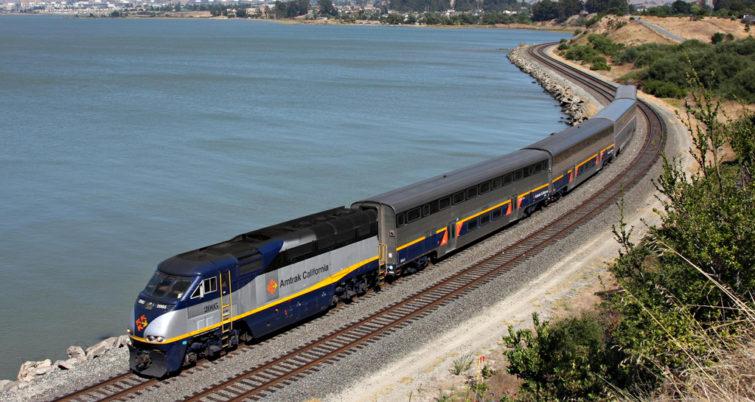
Union Pacific Maintenance Vehicle Struck by Amtrak Train |
|
The tractor was working on the middle track of a three-track section of line when it was hit, and the operator of the tractor suffered major injuries, then rushed to the hospital after being carefully removed from the wreckage. Two other people were also injured, including one passenger on the train, along with a third person. The extent of injuries to the train passenger have not been available to this point, while the third person was not taken to the hospital.
Rob Padgette, the managing director of the Capitol Corridor, issued the following statement to riders after the incident: “Many of you have experienced recent extended delays and may have been impacted by train cancellations for which I would like to express my sincere apologies. In particular, we recognize that July 15 proved to be an extremely challenging day as there were multiple events which took place involving a fatality in one segment of our route, an equipment strike in another, as well as a trackside fire. This series of tragic events caused major delays between Oakland and San Jose, leaving some passengers in a situation where they needed to find other means of transportation. Operations staff did explore alternative transportation options along that segment through a bus bridge; however, driver shortages from local transit agencies prevented that from being an option that we could utilize. AC Transit, BART, County Connection and VTA were able to provide passengers with mutual aid.
|
|
UP Starts Returning its Rail Cars to Service |
|
Union Pacific Railroad is beginning to "strategically and gradually" return some of its rail cars to the network, as the Class I continues to work on improving freight-rail service, a UP executive informed customers late last week.
In a July 15 letter, UP Executive Vice President Kenny Rocker reported that, minus an expected slowdown over the July 4th weekend, UP’s metrics continued to improve this month compared with performance in April.
"We are in the beginning phases of strategically and gradually returning some Union Pacific-owned cars into the network," the letter stated, which is posted on UP's website. "We will continue to work with each of you to balance the need to bring additional cars online as we increase car velocity and reduce cycle times."
Rocker wrote to customers in April to announce UP would remove 2% to 3% of its own rail cars and would begin metering traffic if customers didn’t voluntarily reduce their inventory. The railroad also announced it has added dozens of locomotives since January to help move cars along.
Rocker's letters to customers are part of a broader effort by the nation's largest freight railroads to improve their service to customers. After being inundated with shipper complaints about freight-rail service, the Surface Transportation Board ordered UP and some other Class Is to correct their service problems and regularly report their progress to the board.
|
|
(Editor's Note: While millions of working people are distracted and divided by various "hot button" issues that we read about daily in the press, here is one that can surely unite us. We should collectively revolt at the fact that we take a pay cut while the nation's CEOs and stockholders do better than ever.) |
|
Working People’s Real Wages Fall While CEO Pay Soars
CEOs, not working people, are causing inflation.
|
|
In 2021, corporate CEOs were quick to blame worker wages for causing inflation. But workers’ real wages actually fell 2.4% in 2021 after adjusting for inflation.
Working people experienced a pay cut with every price increase while U.S. companies enjoyed record profits and CEO pay increased at an even faster rate.
In 2021, CEOs of S&P 500 companies received, on average, $18.3 million in total compensation. CEO pay rose 18.2%, faster than the U.S. inflation rate of 7.1%.
In contrast, U.S. workers’ wages fell behind inflation, with worker wages rising only 4.7% in 2021. The average S&P 500 company’s CEO-to-worker pay ratio was 324-to-1.
|
|
(Editor's Note: The Real News Network has done some great reporting on US rail issues this past year. Now they interview four UK railroad worker union activists to learn more about the rail strikes in the UK. Hopefully US and UK rail workers will soon come together to learn and share information and strategies for our mutual benefit.) |
|
PODCAST: The Real News Network Speaks with UK Rail Strikers |
|
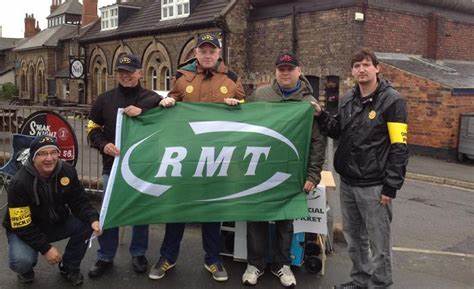
Last month, roughly 40,000 UK rail workers with the National Union of Rail, Maritime, and Transport Workers (RMT) went on strike for three days, bringing major portions of the British rail system to a halt in a historic show of collective strength. This week, after receiving a contract offer from state-owned Network Rail that union leaders described as "paltry," the RMT announced that workers at Network Rail and the train operating companies will engage in another day of strike action on Wednesday, July 27. With these strikes, and in the ongoing negotiations, workers are fighting for livable wages at a time when the cost of living is spiraling out of control and corporate executives and shareholders are stuffing their pockets with cash. As Adam Bychawski writes, "Train companies paid out nearly £800m to shareholders last year before telling rail unions that employees must take a real-terms pay cut for them to stay afloat." But workers are fighting for much more; they are fighting against years of austerity policies and corporate profit-generating schemes that have led to deteriorating working conditions and quality of service on the rails; they are fighting against further job losses for the sake of "modernization"'; and they are fighting for better, safer, more accessible, and well-staffed rail services for the people who depend on them.
In this special panel episode, we speak with four rail workers and RMT members/officers—Mel Mullings, Clayton Clive, Cat Cray, and Gaz Jackson—about the strike and the importance of workers around the world standing in solidarity with strikers.
|
|
(Editor's Note: While rail is the Solution for the transportation needs of modern society, many rail arteries are vulnerable to the effects of climate change in the form of extreme heat, flooding, fire and so forth.) |
|
Fires Near Tracks and Heat Complaints: Hot Spell Shakes Up European Railways |
|
A sweltering heat wave is plaguing European railways, with temperatures surpassing 40 degrees even in Northern Europe. In the south of Europe, continued high temperatures have resulted in fires that also affected train circulation.
The combination of heat and drought means fires continue to wage in Spain, where multiple trains have been cancelled in the past week. On Monday, the Renfe AVE and Alvia train services between Galicia and Madrid were halted. Services resumed on Tuesday, although circulation is still suspended between Zamora and Sanabria stations, where there are transfers via road. Videos circulating online show a train on the section coming to a halt next to the fire.
Initially, Renfe organised an alternative road transport service between the Zamora and Sanabria stations for train passengers who had already departed from their stations of origin. Renfe has activated the appropriate after-sales measures and affected travellers can change or cancel their tickets free of charge.
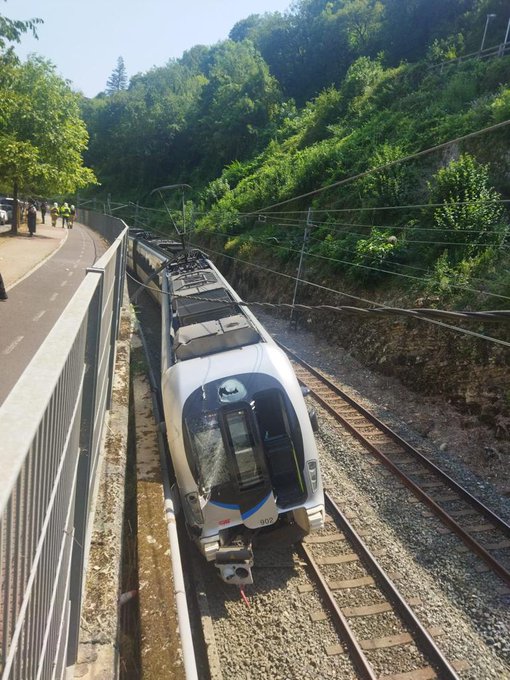
A regional Eukostren train in Nasque country derailed on Monday. While the cause is being investigated, local media reports suggest the incident might be related to the high temperatures. On pictures, it seems the tracks are slightly bent, which could be a result of the heat.
|
|
|
|
|
|
|