|
How did you get into flying?
The summer after graduating from college in 1964, I took flying lessons from a CFI friend at Jack Barstow Municipal Airport in Midland, Michigan, my home town. We were flying a Piper Colt, which is basically a lower-cost, reduced-power, no flaps, two-place version of the popular four-place Piper TriPacer. I logged 41 hours in about 6 weeks plus about one hour of flying to Grand Rapids for the exam and flight test. Total cost, including aircraft and instruction, was less than $700 as I recall. I think the hourly rate for the Colt was $7!
Barstow Airport in Midland is named after my uncle John “Jack” Barstow, my mother’s brother, who was an early barnstormer pilot in the late 1920s and 1930s and became an avid glider pilot. He learned about flying from Orville Wright, whose signature is on his Class A Glider Pilot License now on display at Barstow Airport. Jack set an unofficial world record (he unfortunately didn’t have the required recording equipment on board for that flight) on April 29, 1930 for glider endurance aloft, soaring a Bowlus Sailplane for over 15 hours at the oceanside cliffs of Torrey Pines near San Diego. At the Bowlus Glider School, where he was an instructor pilot in San Diego, Jack helped train Charles and Anne Lindbergh as glider pilots in 1930. He was tragically killed in a closed-circuit pylon race in 1935 in Corpus Christi, Texas, at the age of 29. The accident was caused by an inexperienced pilot who many said never should have been in the race. I was named after my uncle Jack when I was born in 1942, so I really had no choice but to become a pilot!
What are your ratings?
SEL MEL IFR
What type of flying do you enjoy?
When I was living in California, before moving to God’s County in 2010, I had a group of ski buddies who loved to ski Mammoth Mountain, arguably the best skiing in California. Mammoth was about a 7 or 8 hour drive from the San Francisco Bay area, but only 50 minutes in our Piper Malibu. If the snow conditions were right and the weather in the Sierras was good for flying, I would get on the phone the night before, to see who was ready to go skiing on the spur of the moment the next morning. We would meet at the Novato Airport for an 8:00 a.m. departure over to Mammoth Lakes Airport. The flight took you right over Yosemite National Park / Half Dome and Yosemite Falls – absolutely beautiful! We would land and be on the slopes by about 9:30 for a great day of skiing. Then we would head back, landing at Novato at about 4:30 and home for dinner after a great day of flying and skiing. Two of my most favorite activities!
Here in Idaho I am actively involved with Angel Flight West, providing transportation in our Piper JetProp to a wide variety of medical patients needing care that is only available, for example, in Seattle, Portland or Boise. Angel Flights are a great excuse to go flying and stay current, while at the same time helping some people in real need. Angel Flight is always looking for more pilots, and you don’t need a pressurized or turbine-powered airplane to make a difference. Lots of those flights are in Cessna 182s and 210s, Bonanzas, Piper Saratogas, Columbias, Cirrus aircraft, and the like. Information about joining Angel Flights West can be found online at angelflightwest.org.
What’s a favorite flying story?
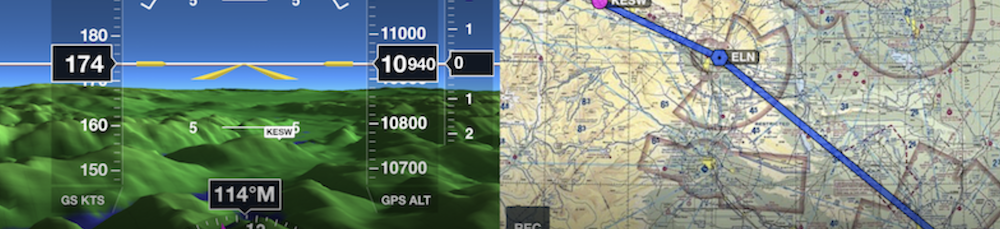
In 1976 and 1977 I was working in El Segundo, CA for The Aerospace Corporation, which had a contract with the U.S. Air Force for administration of the initial design and configuration of the satellite system for the Worldwide Global Positioning System, now known as GPS. The GPS system was initially thought to be primarily a Defense Department project with possible applications in the civilian sector. The military would have full capabilities with location accuracies projected to be better than approximately 3 meters, but civilian users would only have access to degraded accuracies of about 100 to 200 meters. Thankfully that plan was scrapped early in the program, and the full capabilities of the GPS system were made available to civilian users as well (although, I believe the military probably still has the capability to degrade the accuracies for all other users in the event of war.) Some 50 years later, it is just amazing how this system has revolutionized the way we fly our airplanes today.
What are your flying plans for the future?
I’m in Arizona as I am writing this, and I expect to fly back home next week, God willing!
If you could have any plane ever produced, and the budget to operate it, what’s your choice?
The new Piper Fury with 700 hp of turbine power, 1,400+ nm range, 300+ kts cruise, 3,400+ fpm climb rate, the G3000 panel and the Garmin Autoland looks amazing. But, heck, let’s go for a P51 Mustang!
Have you ever had a scary experience as a pilot?
Flying with Tom Logan is about the scariest thing you can imagine. (Just kidding, he’s a great pilot and good friend!)
Favorite flying destination out of KCOE?
The final approach into Boeing Field Seattle, Runway 14R is fantastic. On that approach you fly at about 500 ft elevation right past downtown Seattle, the Space Needle, the Ferris Wheel, Mariners’ ballpark, the Seahawks’ home stadium. All of this while 14,400 foot Mount Rainier sits on Runway 14R centerline some 40 miles to the south. Breathtaking on a clear day.
Also, I have lived in, and flown into,Telluride, Colorado, on a number of occasions. The airport elevation is 9,070 ft and there are 14,000 ft peaks on 3 sides. Lots of fun!
What’s the history of your airplane?
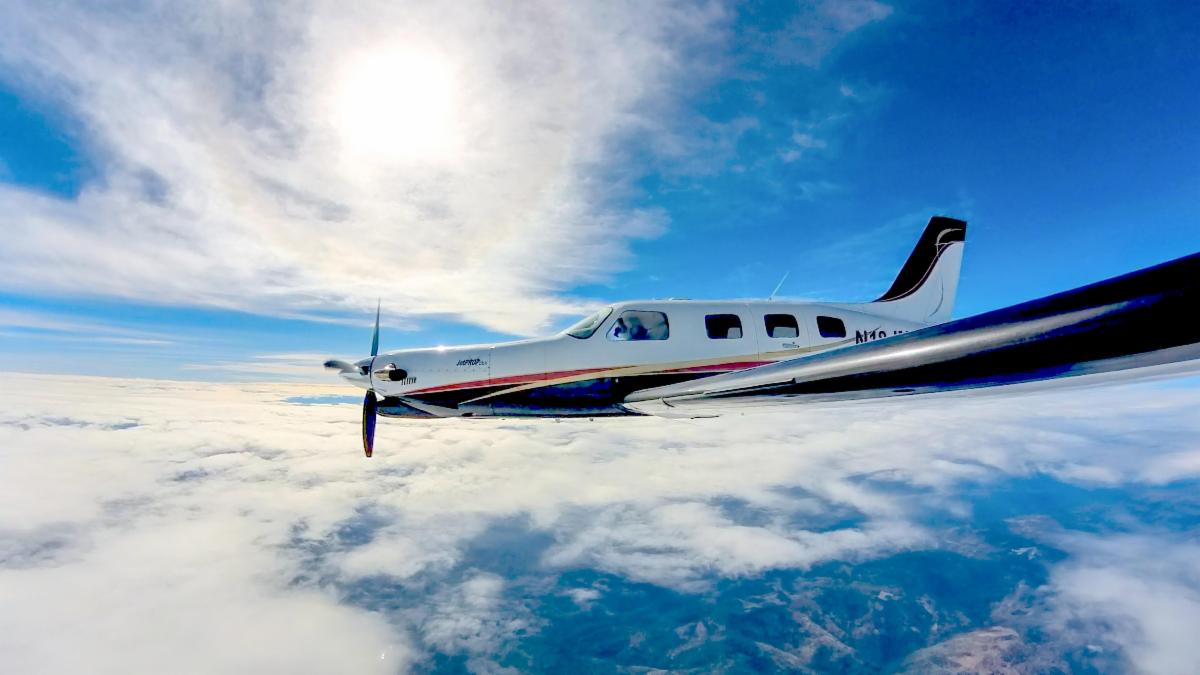
It’s a 1999 Piper Mirage, originally equipped with a 6-cylinder 350 hp Lycoming engine, and converted in 2009 by Rocket Engineering at Felts Field to a JetProp with 560 hp delivered by a Pratt & Whitney PT6A-35 turbine. Typically a Piper Malibu or Mirage will climb out at about 700 to 800 fpm and cruise at about 200 kts true in the flight levels. The JetProp, for comparison, typically climbs out at 1,500 to 2,000 fpm and cruises at a bit over 250 kts true at FL 270 (27,000 ft msl).
What improvements have you done to your airplane?
When purchased in 2017, the paint job was so ugly my wife wouldn’t ride in the airplane, so it was repainted immediately, of course! Also the ADS-B transponder upgrade was done. Other than those items, it was perfect for us.
What are the best things about your plane?
Extremely reliable performance, with a quiet pressurized cabin altitude of about 8,000 ft even when flying at FL270, and truly a delight to fly.
What are the limitations of your plane?
It’s range of about 1,100 nm is not quite enough to get to southern Arizona without a quick stop for fuel somewhere along the way. So we take along a sandwich for a picnic on the way!
|