Materials science professor gives insights on founding successful startups |
|
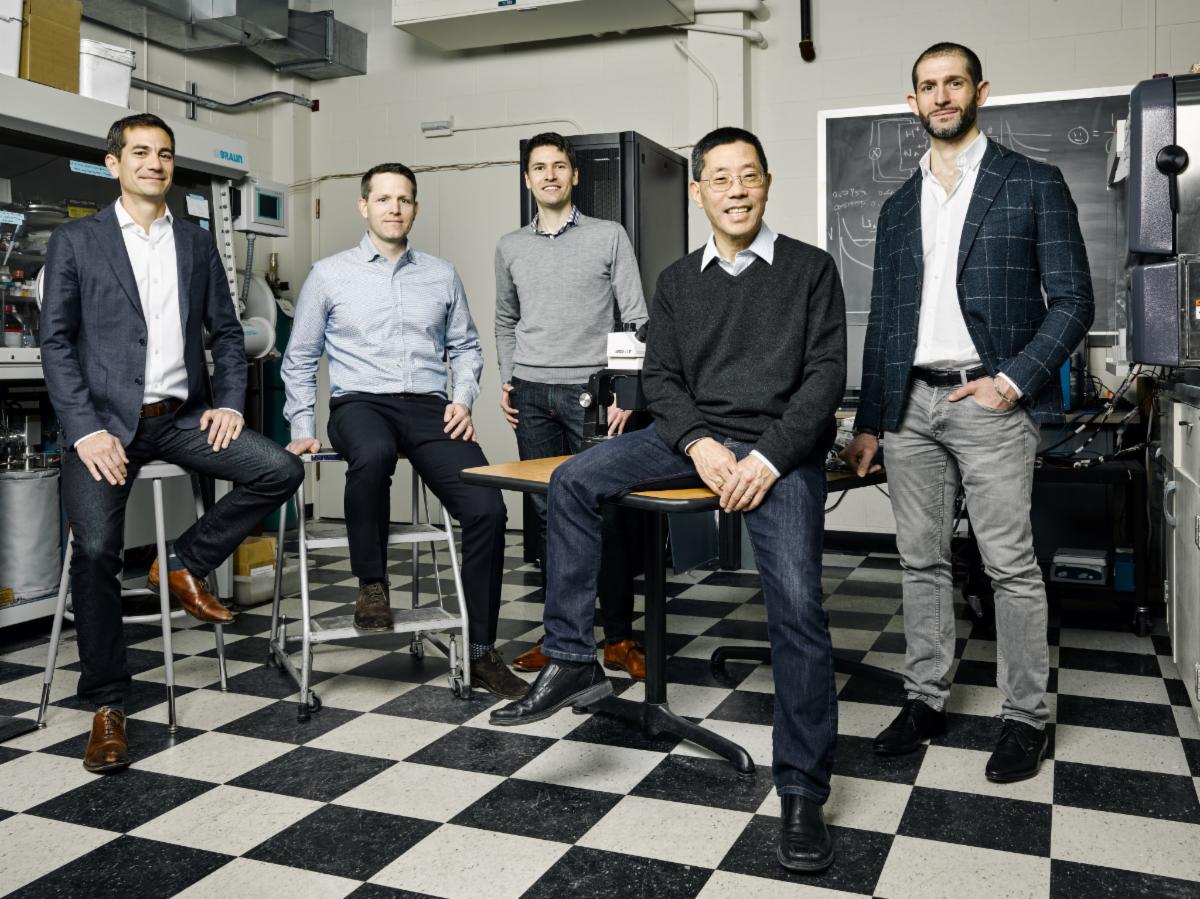
(L-R) Mateo Jaramillo, Ted Wiley, William Woodford, Yet-Ming Chiang, Marco Ferrara, Team from Form Energy - Photo courtesy of the Engine
|
|
Chiang describes moving university research into the marketplace |
|
Yet-Ming Chiang has been a professor at MIT for 37 years. Over that time his primary mission has been to conduct original research and educate students, but along the way he’s also become a very successful entrepreneur, co-founding several start-ups based on his discoveries in materials science. These include two unicorns, or private companies valued at over US $1 billion, as well as three that have become publicly listed.
Recently Chiang talked about his experiences in moving university research into the marketplace as the first speaker at a two-day climate tech summit sponsored by SOSV, a global venture capital firm. Among his insights: how to identify potential spin-offs from the myriad research projects in his lab, the importance of being flexible as a young company grows, and how both start-ups and established companies can feed research ideas back to the university in a kind of circular economy.
|
|
Inspiration at the atomic scale |
|
MIT Associate Professor James LeBeau develops new techniques for gathering and analyzing data in electron microscopy to better understand material properties in fields including electronics, photonics, quantum mechanics, and energy storage. Photo: Adam Glanzman |
|
With new techniques in electron microscopy, James LeBeau explores the nanoscale landscape within materials to understand their properties. |
|
To explain why he loves electron microscopy, Associate Professor James LeBeau uses an analogy: He likens the technique, which uses beams of electrons to illuminate materials at a scale thousands of times smaller than conventional microscopes, to the inverse of astronomy.
“It’s discovering things that no human has ever seen before that really captures the imagination,” LeBeau says. “There is a beauty to the way atoms are arranged in materials, particularly at defects, which give rise to all sorts of material behavior.”
|
|
How "2D" materials expand |
|
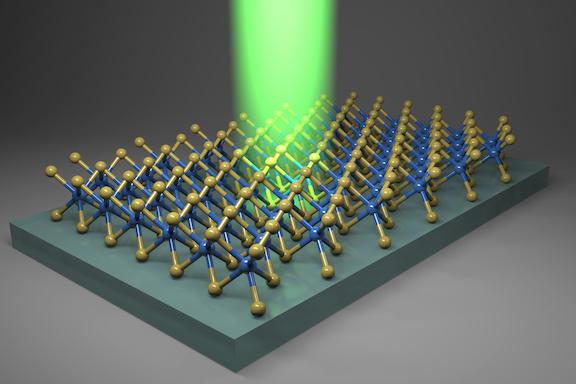
A green laser shines onto an atomically thin material. By probing how atoms vibrate when deposited on substrates and upon heating, researchers turn Raman spectroscopy into a scientific “ruler” to understand how 2D materials expand. Credits: Courtesy of Yang Zhong and Lenan Zhang |
|
A new technique that accurately measures how atom-thin materials expand when heated could help engineers develop faster, more powerful electronic devices. |
|
Two-dimensional materials, which consist of just a single layer of atoms, can be packed together more densely than conventional materials, so they could be used to make transistors, solar cells, LEDs, and other devices that run faster and perform better.
One issue holding back these next-generation electronics is the heat they generate when in use. Conventional electronics typically reach about 80 degrees Celsius, but the materials in 2D devices are packed so densely in such a small area that the devices can become twice as hot. This temperature increase can damage the device.
|
|
Engineers solve a mystery on the path
to smaller, lighter batteries
|
|
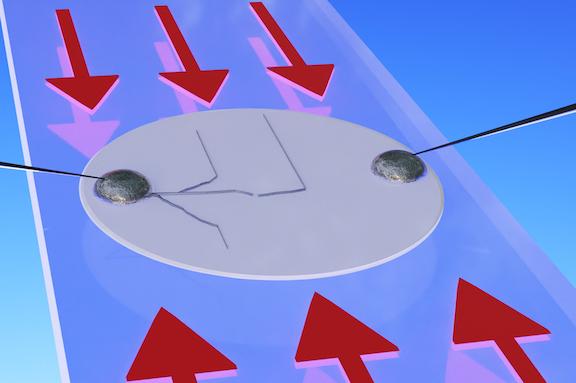
Researchers solved a problem facing solid-state lithium batteries, which can be shorted out by metal filaments called dendrites that cross the gap between metal electrodes. They found that applying a compression force across a solid electrolyte material (gray disk) caused the dendrite (dark line at left) to stop moving from one electrode toward the other (the round metallic patches at each side) and instead veer harmlessly sideways, toward the direction of the force. Courtesy of the researchers |
|
Branchlike metallic filaments can sap the power of solid-state lithium batteries. A new study explains how they form and how to divert them. |
|
A discovery by MIT researchers could finally unlock the door to the design of a new kind of rechargeable lithium battery that is more lightweight, compact, and safe than current versions, and that has been pursued by labs around the world for years.
The key to this potential leap in battery technology is replacing the liquid electrolyte that sits between the positive and negative electrodes with a much thinner, lighter layer of solid ceramic material, and replacing one of the electrodes with solid lithium metal. This would greatly reduce the overall size and weight of the battery and remove the safety risk associated with liquid electrolytes, which are flammable. But that quest has been beset with one big problem: dendrites.
|
|
We invite your company to become a member of the MRL Industry Collegium. As a member, your company will receive:
- premium access to member only briefing materials and information via our website
- periodic publications and research activity highlights
- invitations to workshops, conferences and symposia
- support for research staff visits on-campus
- facilitation of corporate meetings and events
- customized interactions with MIT students
|
|
To join the collegium contact:
Mark Beals
Associate Director, MRL
617-253-2129
|
77 Massachusetts Avenue
Cambridge, MA 02139
|
|
|
|
|
|
|