|
What EVERY Therapist Should Know About Insurance
By Barbara Griswold, LMFT
Author, Navigating the Insurance Maze
Sept. 9, 2026
| | |
Hello!
Yes, I know I keep saying I'm "mostly-retired.” But one training in my course catalog was practically raising its hand and begging for a fresh update. And apparently, I am still powerless against the siren song of bullet points calling my name.
So, I’m officially rolling out my newly-updated training, “What EVERY Therapist Should Know About Insurance — Even if You Want Nothing to Do With It.”
In this entertaining webinar, you’ll follow Dorothy, your new insurance client, who reports she has been chased by a wicked witch and flying monkeys. Whether you’re new to insurance, have the scars to prove you're an insurance veteran, or never want to sign an insurance contract, you’ll learn practical new ways to navigate the insurance maze, reduce income loss, and advocate more confidently for your clients. Find out more here.
Take care of you,
Barbara
| | |
ARTICLE
Are Other Therapists Making More Money?
And Would You Make More If You Quit Insurance?
In these modern times, telehealth is king. And whether you’re huddled in front of a computer in the corner of your bedroom or have an office suite with bottled water, let’s get real: your only human interaction may be with the Amazon delivery person. And if you actually do talk to other therapists, you probably aren't comparing bank balances.
So, it's normal to experience a bit of "imposter syndrome" regarding your business. You wonder, “Am I the only one working so hard and making so little?”
The Heard Surveys
Enter The “Financial State of Private Practice” reports from Heard, a financial management software company for therapists. These reports are the results of annual therapist surveys, and offer a fascinating peek behind the curtain of our profession, revealing the secrets we usually take to our graves (or at least only to our accountants).
The surveys cover everything from our average annual income, our fees, how we get clients, how we structure our practices, our average caseloads, how we manage billing, how many of us are secretly wearing pajama bottoms during video sessions (okay, maybe not that one), and much, much more. I highly recommend diving into BOTH their 2025 report and 2026 report summaries, since some different questions are asked in each survey.
Interesting insurance insights
There's lots of interesting info in the survey results, but since insurance is my jam, let’s look at what the surveys found related to insurance;
From the 2026 survey:
- 75% of clinicians said they accepted insurance
- 21% of clinicians had a waitlist, and these tended to be clinicians that accepted insurance
- 55% of those who billed insurance used billing platforms like Alma, Headway, Grow, and Rula. Of the rest, 16% used a dedicated biller, and 29% did the billing themselves
- Only 25-27% of insurance providers participated in Medicare and Medicaid, perhaps due to complex application requirements and low reimbursement rates in some areas
From the 2025 survey:
-
Overall: The average private pay rate for therapists of all license types was $159, yet the average insurance reimbursement rate was 36% lower at $111; In some states, it was 60% to 77% less than their private pay rates.
-
Insurance reimbursement varied by state; For example, California, New York, and Colorado therapists reported some of the highest average reimbursement rates, averaging $172- $180, while states like Florida ($137), Texas ($140), Pennsylvania ($146), and North Carolina ($145) came in with significantly lower average rates; Remember that these numbers averaged the fees for providers of different licenses.
-
Rates varied by license: The average national reimbursement rate for psychologists was $142, Social Workers $108, MFTs and LMHCs $106, and LPCs $84.
-
Rates varied by health plan: Clinicians reported Aetna’s average reimbursement rate was $115; United, Blue Cross, Oxford, and Oscar averaged $106-$108; Medicaid, Kaiser, and Anthem averaged $101-$102; and Cigna, Humana, and Medicare averaged $91-$96.
Again, keep in mind these rates can vary WIDELY by license, state, and even by city. Averages for LMFTs in Hollywood, CA would not usually be the same as those in some tiny remote city in the state.
So, how long has it been since YOU asked for a raise?
One important reason that these rates stay lower than they should be is simple: many clinicians join a health plan and never ask for an increase. Often, they don’t realize that asking is even an option. But many surveys suggest that providers earning more than the entry-level rates are the ones who requested a raise at some point. You can read more in my article on asking for raises here [and stay tuned --in a future newsletter article, I hope to tell you how to use some new comparative reimbursement rate data to more effectively ask for raises].
Would you make more money if you quit insurance? Not necessarily....
The 2026 Heard report also tackles the big debate: Is it better to take insurance or go cash-pay only? While cash-pay rates might look higher on paper, the survey found it was a bit more nuanced than that.
Because insurance providers reported reimbursement rates 25%–35% lower than average cash-pay prices, it might seem like a cash-pay practice is the obvious winner for income. According to the Heard analysis, “the reimbursement gap means that for insurance-accepting practices, volume matters more. You need to see more clients to reach the same revenue as a cash-pay practice, which has implications for your schedule, your energy, and your admin burden." However, the fact that insurance-accepting providers more frequently reported having a waitlist suggests that insurance helps keep their practices full, and reduces their need for marketing.
Furthermore, the survey concluded that the grass isn’t necessarily greener on the cash-pay side. While the average cash-pay-only clinician grossed $94,000, their profit after expenses averaged $58,000. In comparison, the average insurance provider showed a much lower income of $79,000, but ended up with a similar average profit of $55,000 after expenses. Heard’s analysis notes: “The roughly $15,000 revenue advantage for cash-pay practices was largely consumed by higher operating expenses. Going cash-pay-only doesn't automatically mean taking home more money. The financial picture depends on your caseload, your market, your expenses, and most importantly, how well you manage the money that flows through your practice.”
The Take Away
It’s clear from the Heard data that insurance is a big factor in the lives of most clinicians. While the reports confirmed our biggest grievance—that insurance reimbursements lag far behind cash rates—they also highlighted a major perk: that accepting insurance is often the secret to maintaining a fuller practice and a consistent waitlist. And before you insurance folks envy your cash-pay-only colleagues, remember that their higher gross earnings are often offset by steeper operating and marketing costs. At the end of the day, when the dust (and the expenses) settle, both insurance-based and cash-pay therapists end up with surprisingly similar annual profits.
| | |
REMINDER: My Free One-Stop Medicare FAQ Page
Just a reminder to be sure to stop by my new free Medicare webpage for some answers to your Frequently Asked Medicare questions. This helpful resource is both for Medicare providers and those who don't want to be, but don't know they may have to opt-out. Check out the page now and bookmark it – I’ll try to keep it updated with new information as it happens. Check it out here
| | |
WEBINAR: "WHAT'S MISSING FROM YOUR CHARTS: WRITING GREAT NOTES"
This recorded webinar is aimed at all therapists, since we all can have charts reviewed by insurance, disability, and licensing boards. Includes 8 note examples, 3 note templates, and telehealth note requirements. For info, click here
| |
NEW WEBINAR: "WHAT EVERY THERAPIST SHOULD KNOW ABOUT INSURANCE -- EVEN IF YOU WANT NOTHING TO DO WITH IT"
For all therapists, this newly-updated recorded training will give you all you didn't learn in grad school about dealing with a client's insurance. For info, click here
| |
WEBINAR: "TELEHEALTH LAW & ETHICS: WHAT YOU NEED TO KNOW ABOUT APPS, AI, AND OTHER ADVANCES IN CARE"
While applicable nationwide, this recorded course meets the mandatory telehealth course requirement for all California MFTs, LCSWs, & LPCCs. We discuss the safe usage of latest technology, including AI, email/texting, seeing clients in another state & HIPAA. For info, click here
| |
PRACTICE FORMS PACKET
Get 24 essential forms. Customizable. Designed to meet legal, ethical, and insurance expectations. For info, click here
| |
WEBINAR: "COUPLES THERAPY: BILLING, DOCUMENTATION,
& ETHICAL DILEMMAS"
Couples therapy involves complex billing, documentation, and ethical issues. This recorded course answers all your questions like when can you ethically bill insurance for couples? Who is your client? Do you need two charts/treatment plans? For more info, click here
| |
WEBINAR: "WHAT OUT-OF-NETWORK THERAPISTS SHOULD KNOW ABOUT BILLING"
This recorded webinar covers what every therapist should know about billing and insurance -- even if you have never signed an insurance plan contract. We'll discuss common errors made by out-of-network providers, sliding scale fees, and helping self-pay clients afford treatment. For info, click here
| |  | |
WEBINAR:
"AUDITS AND RECORDS REQUESTS: WHAT EVERY THERAPIST SHOULD KNOW"
This recorded webinar is for all therapists, since even out-of-network therapists can have their notes requested by an insurance plan or other agency -- and can be asked to pay back monies already collected. Learn to prevent this. For info, click here
| |
WEBINAR: "HOW TO WRITE A 10-MINUTE TREATMENT PLAN"
Hate writing treatment plans, worry about the ones you write, or don't write them? This recorded training will teach you how to write brief plans that satisfy legal, ethical, and insurance expectations, so you feel confident if you receive a records request. For info, click here.
| |
PROGRESS NOTES TEMPLATE
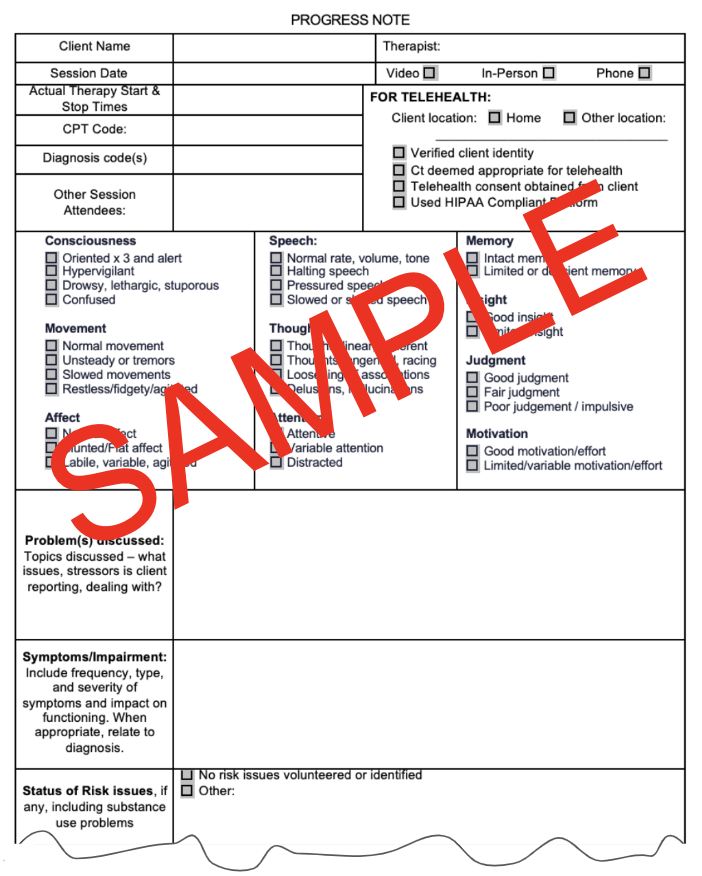
This progress note template has been designed to pass an audit by the toughest insurance plans or licensing boards. Available in fillable PDF format, Word format, and Pages format. Have confidence in your session notes. For more info, click here
| |
WEBINAR: "THE FIRST SESSION: Juggling Clinical & Administrative Tasks"
This recorded webinar gives tips on juggling all those intake tasks -- building rapport and taking a history, doing a diagnostic assessment, while handling paperwork, payment and insurance issues. For more info, click here
| |
WEBINAR:
"SHOW ME THE MONEY: Understanding Rates, Raises, and Resigning"
This recorded course shows you how to increase your chances of getting a raise from a health plan, and outlines the practical and clinical steps to take when resigning. For info, click here
| |
WEBINAR: "ARE YOU COMMITTING INSURANCE FRAUD?"
This recorded webinar answers all your questions about contract violations, sliding fees, waiving copayments, and how to avoid common behavior that is actually fraud. For info, click here
| |
|
MY BOOK!!!
Navigating the Insurance Maze: The Therapist's Complete Guide to Working With Insurance -- And Whether You Should -- 10th EDITION
Get the digital version only or both the paperback and digital versions
Click here for info. Please buy direct from us - Amazon keeps 55% of profits!
CALIFORNIA LMFTs, LCSWs, LPCCs, and LEPs: You can now get 10 CEs for reading my book, and 2 can count as Legal and Ethical CE credits. Buy my book here and buy the CE test here to get your CEs. You can even take the test if you have already read any edition of my book.
| | |
Know a colleague who might appreciate this newsletter?
Forward it!
Did someone forward this to you? Subscribe here
| |
|
Barbara Griswold, LMFT
Author, Navigating the Insurance Maze: The Therapist's Complete Guide to Navigating Insurance -- And Whether You Should
theinsurancemaze.com 408-985-0846
| | | | |