|
Product Stewardship Updates
April 30, 2026
| | |
A NOTE FROM OUR CEO
TESTING NEW POLICY IN AN ERA OF LEGISLATION
| | |
As extended producer responsibility (EPR) and related packaging policies move from enactment into implementation, it is not surprising to see more legal challenges emerge. In Colorado, the Independent Lubricant Manufacturers Association (ILMA) filed suit in March challenging aspects of Colorado’s packaging EPR implementation under HB 22-1355, including fee levels, program structure, and disclosure restrictions that it says burden smaller lubricant manufacturers. In California, a coalition of organizations that includes the Flexible Packaging Association and the American Forest & Paper Association filed a federal lawsuit challenging California’s SB 343 “truth in labeling” law ahead of its October 4, 2026 effective date. Plaintiffs argue that the law’s restrictions on recyclability claims and use of the chasing arrows symbol violate First Amendment protections and could create confusion rather than clarity. Meanwhile, Oregon’s packaging EPR law continues to move forward while litigation brought by the National Association of Wholesaler-Distributors (NAW) proceeds in federal court; a preliminary injunction issued in February applies only to NAW members, while the broader program remains in effect for others. More recently, the court clarified that the injunction applies only to companies that were NAW members at the time of the February 6 ruling and denied efforts by other groups to join the case at this stage.
Taken together, these developments reflect a broader movement across the policy landscape. Over the past several years, states have adopted a growing number of laws focused on packaging stewardship, labeling standards, and recycled-content requirements. As those policies become effective, it is common for stakeholders to test legal boundaries and seek clarification through the courts. The Sustainable Packaging Coalition recently described this moment as part of an “era of legislative activity,” where new policies are being interpreted and refined as they move into practice. Over time, these legislative challenges will help clarify how these new laws function and contribute to greater stability as programs evolve.
PSI will continue to follow these developments closely. In an ever-changing landscape, our role is to help stakeholders understand what is changing, what is not, and what these developments may mean for implementation going forward.
— Scott Cassel, CEO & Founder, Product Stewardship Institute
| | U.S. EPR LAW COUNT NOW AT 150! | | |
As spring takes hold across the country in all its variations, EPR keeps rolling along in its many phases—bill development, enactment, and implementation. This month we celebrate reaching 150 EPR laws enacted on 22 products (i.e., industry sectors) across 34 states and the District of Columbia. Four notable EPR laws pushed us to the 150 mark—vapes EPR law in Maine and battery EPR laws in Wisconsin, Oregon, and Maine.
| | |
On April 24, Maine enacted a new EPR law that seeks to curb the rapid tide of disposable vape litter in communities and schools. It will also keep toxic nicotine residue and heavy metals out of waste management facilities, along with lithium-ion batteries, which are known causes of costly and dangerous facility fires. In addition, the law will relieve municipalities and taxpayers of the significant costs of managing vape waste.
The law covers all electronic smoking devices sold in Maine (including e-cigarettes, e-pipes, vape pens, and electronic hookahs) along with their components, parts, accessories, and all aerosolizable substances, whether or not they contained nicotine. While Vermont's household hazardous waste EPR law includes nicotine vapes within a broader scope of covered materials, Maine's law is the first in the U.S. dedicated specifically to addressing vape devices for both nicotine and non-nicotine substances (including cannabis).
Over the past several years, PSI staff worked with lawmakers, state and local government officials, and industry partners across the country to build a policy framework for vape stewardship. This effort included navigating the complex intersection of state and federal regulations governing hazardous waste, batteries, and tobacco products, which has long resulted in vape waste falling through the regulatory cracks.
Under the new law, vape producers must meet the following obligations either individually or collectively through a product stewardship organization:
- Finance and operate a statewide program for the collection, transportation, and proper end-of-life management in alignment with Maine’s solid waste hierarchy of discarded electronic smoking devices.
- Submit a stewardship plan to the Maine Department of Environmental Protection (DEP) for review and approval by November 1, 2027.
- Establish a network of permanent collection sites so that 90% of Maine residents are located within 15 miles of a collection location within one year of program launch.
- Provide free collection receptacles, staff training, and technical support to municipalities, tribal governments, public and private schools, and retailers that serve as a program collection site.
- Offer a financial incentive of at least $2 per device returned (up to two devices per person per day) to encourage consumers to return unwanted vapes.
- Ensure that all vape product retailers in Maine are serving as a collection site within three years of plan approval.
- Conduct public education and outreach, administer an annual consumer awareness survey, and report annually to the Maine DEP on program performance.
| WISCONSIN, MAINE, AND OREGON ADD NEW BATTERY STEWARDSHIP LAWS | |
During the month of April, Wisconsin, Maine, and Oregon all added new battery stewardship laws, continuing the rapid expansion of battery EPR programs across the country. In Wisconsin, Governor Tony Evers signed AB 713 on April 2, 2026, establishing a producer-funded and operated battery stewardship program for rechargeable portable and medium-format batteries sold in the state. A companion bill, AB 911, establishes the funding mechanism for the Wisconsin Department of Natural Resources to oversee the program. PSI supported AB 713 and recommended adding alkaline batteries to the definition of “covered battery” to reduce consumer confusion and better align Wisconsin with other state battery EPR laws, a recommendation that was adopted in the final law.
Maine followed the next day with LD 474, which had been a concept draft earlier in the session before being amended into a battery stewardship bill through Committee Amendment A (S-565) and was signed into law on April 3. The law requires producers of primary batteries, rechargeable batteries, and products containing those batteries to provide convenient, statewide access to battery collection and recycling in the state. The industry, through a producer responsibility organization or individually, must submit a battery stewardship plan to the Maine Department of Environmental Protection for review and approval. Beginning 180 days after plan approval, producers may not sell covered batteries or battery-containing products in or into the state unless they participate in an approved stewardship program.
In Oregon, HB 4144 was signed into law by Governor Tina Kotek on April 7. The law requires producers of covered portable and medium-format batteries – both primary and rechargeable – and products containing those batteries to join and fund a battery producer responsibility organization (PRO) that operates a statewide collection and recycling program. The PRO must submit a battery producer responsibility program plan to the Oregon Department of Environmental Quality (DEQ) for approval by September 1, 2028, and producers may not sell covered batteries or battery-containing products in or into Oregon unless they participate in an approved PRO beginning July 1, 2029. Notably, the law also bans disposal of removable lithium-ion batteries in mixed municipal solid waste, addressing the growing threat of battery fires at waste and recycling facilities across the state.
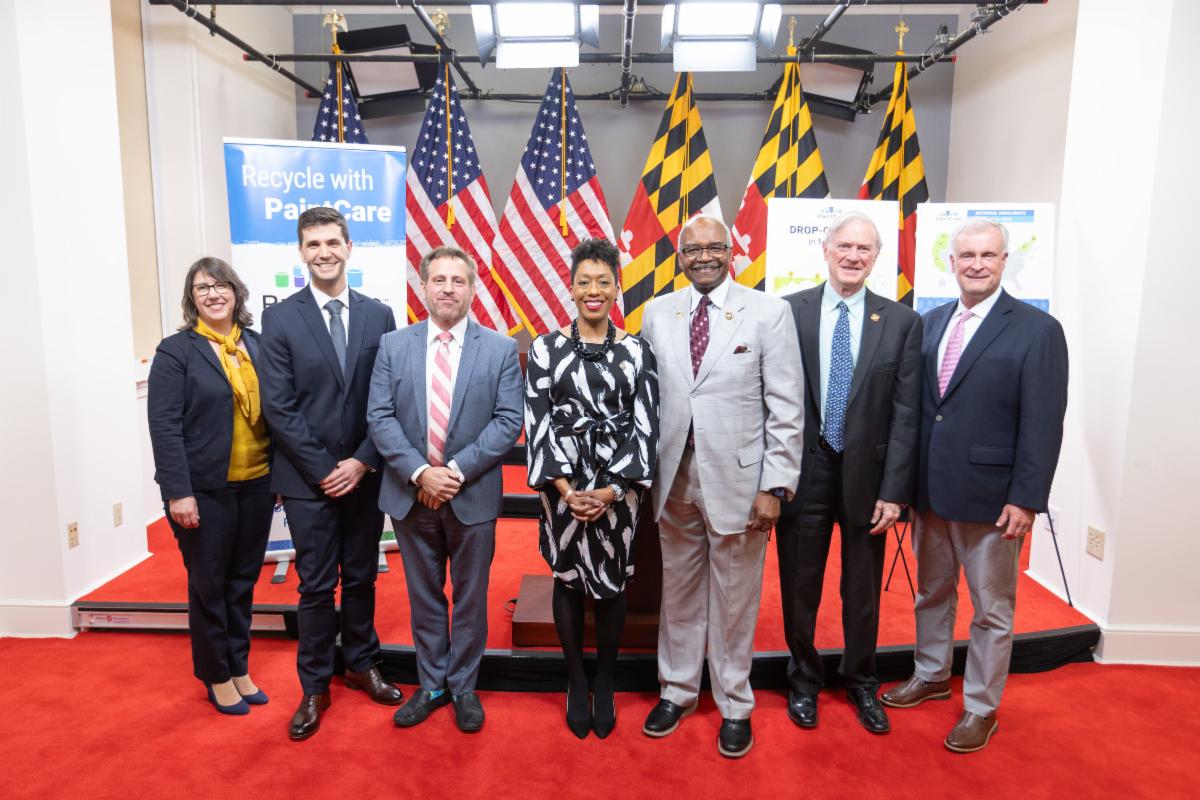
| MARYLAND LAUNCHES STATEWIDE PAINTCARE PROGRAM | Left to Right: Amanda Nicholson (Product Stewardship Institute), Jacob Saffert (PaintCare), Rick Kessler (MDE), Maryland State Delegate Regina Boyce, Maryland State Senator Benjamin Brooks, Maryland State Senator Chris West, Michael Johnson (ACA) | |
A new statewide paint stewardship program is now operating in Maryland, making it easier for residents to recycle leftover household paint. The program, operated by long-time PSI partner PaintCare, establishes convenient drop-off sites across the state where households and businesses can bring unused paint for reuse, recycling, or proper disposal. Paint containers are also recycled. The initiative is funded through a small fee applied to paint purchases and is designed to reduce waste while shifting end-of-life management costs from taxpayers to paint consumers, while also shifting the paint management burden to producers.
The launch event brought together state officials, industry representatives, and program partners to mark the start of the new system. PSI Chief of Operations, Amanda Nicholson, attended and spoke on behalf of PSI, which mediated the national dialogue that resulted in the PaintCare program, and has continued to support paint stewardship policies across the country. With the Maryland program now online, PaintCare is serving more than one-third of the U.S. population with paint reuse and recycling services and is continuing to expand convenient access for residents and build more consistent paint management systems nationwide.
| UPDATE FROM LANDBELL USA - CALIFORNIA TEXTILE EPR REQUIREMENTS AND DEADLINES | | |
Textiles EPR implementation is underway in California. Landbell USA is calling all textiles producers to engage early and often with their educational materials and compliance guidance. Hands on support is available to registered members. Several deadlines are coming up fast.
1. The Compliance Deadline: Under SB 707, all obligated businesses selling CA SB 707 covered materials in California are required to join the CalRecycle implemented PRO. To remain in compliance with state law, covered materials producers must complete their registration by July 1, 2026.
2. Seamless Registration: Registration is managed through Circul8, Landell’s secure partner.
- Eligibility Assessment: Members begin with a brief questionnaire to confirm their obligation status. Once confirmed, the full registration typically takes only five minutes.
-
Registration is LIVE and can be accessed HERE.
3. 2026–2027 Fee Structure: To ensure the PRO is operational immediately, the initial cycle (2026–2027) features a flat annual administrative fee of $1,000 per producer. These funds directly support the mandatory Statewide Needs Assessment operation.
4. Education & FAQs: Landbell USA provides the resources needed to navigate these requirements.
-
Landbell’s comprehensive SB 707 Question & Answer Session provides a deep-dive interview with Patrick Gibbs, Executive Director at Landbell USA, in collaboration with H2 Compliance, where they break down the "what, why, and how" of the new law. This FAQ session provides a definitive roadmap for producers, covering:
- The "What" and "Why": A clear overview of CA SB 707 and the mechanics of EPR.
- Obligated Producers: Crucial guidance on who must register and how to register.
- Exemptions & Marketplaces: Clarity on exemptions and whether platforms like Amazon or Walmart handle registration.
- The Path to 2027: Insight into the upcoming Needs Assessment and long-term financial obligations.
-
Direct Support: Landbell USA Members can reach out to their dedicated team at landbellusa.support@landbellgroup.com or visit landbellusa.com.
| | VIRGINIA GOVERNOR VETOES MATTRESS STEWARDSHIP LEGISLATION | |
On April 13, Governor Spanberger vetoed legislation that would have made Virginia the fifth state to adopt an extended producer responsibility (EPR) law for mattresses. HB 86 would have required mattress producers to develop a program to collect and recycle discarded mattresses, helping reduce illegal dumping, divert a bulky material from landfills, reduce local government costs, and support the recovery of recyclable components such as steel, wood, foam, and fiber. The bill, which had support from the International Sleep Products Association (ISPA), which represents mattress manufacturers, as well Environment Virginia, an environmental advocacy group, passed in the House of Delegates with a clear majority, but met with a 20-20 tie in the Senate where lawmakers questioned the consumer fee that funds the program.
Governor Abigail Spanberger’s veto statement affirmed the need for reliable mattress recycling, but concluded “mandating that all mattress retailers that sell to Virginians participate in a single recycling program and increase their prices makes this program unworkable for the Commonwealth.” Had the bill been enacted into law, the program would have followed the same model as programs successfully operating in Connecticut, Rhode Island, California, and Oregon in which a fee applied to mattress purchases is dedicated solely to used mattress collection and recycling, as well as consumer outreach and education. The Mattress Recycling Council(MRC), the nonprofit organization established by ISPA, administers the programs and has recycled more than 17 million mattresses through its “Bye Bye Mattress” program since 2015.
The consumer fee, convenience standards, and funding allocations are three central discussion points that have stymied mattress recycling legislation in New York, Vermont, Washington, and other states in recent years. PSI is currently working with ISPA, MRC, individual producers, state and local governments, recyclers, and other mattress stakeholders to update and refine the mattress EPR program model to support further expansion to additional states.
| | |
Product Stewardship Institute – Communications and Marketing Manager
The Product Stewardship Institute (PSI) seeks an experienced, ambitious, collaborative, and organized communications expert to join our dedicated team. The ideal candidate will have a well-rounded skill set and a passion for waste reduction, reuse, and recycling policy, with a talent for storytelling. This is an excellent opportunity to work in the rapidly growing field of EPR and to be part of a fast-paced organization that has been at the forefront of the U.S. EPR movement for 25 years. Learn more at https://productstewardship.us/careers/
Chittenden Solid Waste District (Vermont) - Director of Public Policy, Communications, and Waste Diversion
CSWD is seeking a visionary and strategic leader to serve as our Director of Public Policy, Communications, and Waste Diversion. This role guides a dynamic department that connects policy, public engagement, and data-driven strategies to advance the District’s mission and goals. Starting salary range: $100,000-$125,000. For more information on the position and CSWD, visit https://cswd.net/about-cswd/job-openings/
|
| |
NH Recycles Recycling Conference & Expo | In-Person
Join Scott Cassel, PSI CEO and Founder, at the NH Recycles conference for a look at the emergence of product stewardship policy in New Hampshire. Regional solid waste professionals will gather for a full-day conference featuring practical workshops and discussions covering municipal recycling, waste management, safety, compliance, equipment, markets, and policy. See below for more details and to register.
Details:
May 18, 2026
Grappone Conference Center
Concord, NH
Register
Federation of New York Solid Waste Conference & Trade Show | In-Person
Join PSI senior associate for policy and programs, Amanda Trinh, at the Federation of New York Solid Waste Conference on May 18. Hanz will share their work developing a vape waste collection pilot for New York State in partnership with the Center for Sustainable Materials Management and NYSDEC. The presentation is part of the breakout session, Don’t Get Burned: Preventing Battery Fires Before They Spark, which is just one of over 60 technical sessions at this don’t-miss annual conference at The Sagamore. See below for more details and to register.
Details:
May 17-20
The Sagamore
Bolton Landing, NY
Register
Packaging Recycling Summit
Join Darla Arians, Director for Policy and Programs at PSI, at The Packaging Recycling Summit in Chicago this June for practical insights into packaging EPR programs. The Summit unites CPG brands, materials suppliers, reprocessors, MRFs, retailers, and policymakers to explore real-world solutions for advancing packaging recovery and circularity.
Details:
June 15-17
The Loews Chicago O’Hare
Rosemont, IL
Register
SWANA RCon 2026: Where Waste & Resource Management Professionals Go To Think | In-Person
SWANA RCon 2026 is the premier annual gathering of waste and resource management professionals where leaders come together for technical training, keynote and concurrent sessions, roundtable discussions, and networking to advance “waste as a resource.” Join PSI’s policy staff in September for sessions on batteries, vapes, and EPR.
Details:
September 29-October 2
St. Louis, MO
Register
| | (StudioThreeDots / Canva Teams) | |
-
Oregon DEQ Flags 250 Producers for Noncompliance. DEQ released its first quarterly producer status list, which includes 250 producers who have failed to register, report, and/or pay fees under the law. Penalties can reach $25,000 per day. Read more
-
FedEx tests reusable shipping boxes with retail partners. FedEx is partnering with reuse company Returnity to pilot durable shipping boxes designed for repeated use in retail supply chains, an effort aimed at reducing single-use packaging and shipping waste. Read more
-
Wisconsin launches vape collection program to address recycling fire risks. Wisconsin officials are piloting a vape collection initiative to safely manage discarded e-cigarettes, which contain lithium batteries that increasingly pose fire risks at recycling and waste facilities. Read more
-
Quebec packaging PRO reflects on first year of EPR implementation. Éco Entreprises Québec, Quebec’s packaging producer responsibility organization, is marking the first year of the province’s packaging EPR program, highlighting progress in shifting more recycling costs to producers while coordinating with municipal recycling systems. Read more
-
What’s next for waste reduction funding, EPR and organics. Scott Cassel, PSI CEO, and Waneta Trabert, PSI board member and MassPSC Chair, discussed EPR developments in Massachusetts at the 2026 MassRecycle Conference. Batteries are an EPR priority for the state, along with paint and mattresses, on the heels of the first ever EPR Commission in the Commonwealth. Read more
-
Recycling Partnership CEO on navigating ‘really tough’ moment or recycling. The Recycling Partnership’s CEO, Keefe Harrison, gave the keynote address at the 2026 Conference in which she emphasized the role of EPR policies, recycled content demand, and sustained investment in strengthening U.S. recycling infrastructure and improving material recovery outcomes. Read more
-
California stakeholders continue preparations for SB 54 packaging EPR rollout. The Circular Action Alliance and other stakeholders are advancing planning and compliance work as California moves toward implementing SB 54, the state’s landmark packaging extended producer responsibility law. Read more
-
EU releases guidance on new packaging and packaging waste regulation (PPWR). The European Commission has published new guidance to support implementation of the EU’s Packaging and Packaging Waste Regulation, clarifying requirements for recyclability, reuse targets, and producer responsibilities as member states and companies prepare for the new framework. Read more
-
Florida AG Launches Antitrust Probe Into Plastic Organizations’ Costly Climate Goals. Another challenge to industry, government, and nonprofit stakeholders working together to make our economy more sustainable. Read more
| | |
The Product Stewardship Institute is a policy expert and consulting nonprofit that pioneered product stewardship in the United States. Since 2000, PSI has helped enact 150 extended producer responsibility (EPR) laws across 22 product categories in 34 states and the District of Columbia — the bedrock on which the circular economy is built. We work with businesses, nonprofits, academia, and governments to ensure that products are responsibly managed from design to end of life.
Join us at www.productstewardship.us.
| | |
The Product Stewardship Institute, Inc. is an equal opportunity employer and provider. Persons with disabilities who require alternatively formatted materials to ensure effective communication should contact Amanda Nicholson at info@productstewardship.us or 617.236.4855.
| | | | |