Rail Workers Weekly News Digest
Number 41 - December 31, 2019
|
|
Below is a series of articles compiled over the previous week.
They are of interest to railroad workers.
NOTE
: This is the last
RWU Weekly News Digest
for 2019, a new service of RWU which commenced last March. We hope to continue the service throughout 2020. Any and all feedback appreciated. All Weekly News Digests for 2019 are archived on the RWU website. To view, click below...
|
|
Article 1 -
RAIL WORKER RIGHTS
Unions, BNSF Railway Spar Over Employee Medical Records and Information
CHICAGO — Ten unions representing more than 30,000 employees have filed a federal lawsuit against BNSF Railway charging that the railroad’s demand for certain medical records is a violation of their rights under the Americans With Disabilities Act. The suit is in the U.S. District Court for the Northern District of Illinois in Chicago.
The unions contend that since 2012, BNSF has implemented “blanket procedures” which violate the employees rights by “impermissibly requiring employees to self-disclose disabilities which do not impede their work,” and by “conducting impermissible medical inquiries without objective evidence prior to inquiring whether the conditions will impair an employee’s ability to perform the essential job duties.”
Unions also say that their members' rights are violated by BNSF’s “requiring employees to provide detailed medical documentation without a business necessity and in a manner that is significantly broader and more intrusive than necessary; and other violations.”
The suit says that the Equal Employment Opportunity Commission investigated and issued a “for-cause” determination” against the medical policy.
The unions include: American Train Dispatchers Association; Brotherhood of Locomotive Engineers and Trainmen; Brotherhood of Maintenance of Way Employees, Division of International Brotherhood of Teamsters; Brotherhood of Railroad Signalmen; International Association of Machinists and Aerospace Workers District Lodge 19; International Association of Sheet Metal, Air, Rail and Transportation Workers, Mechanical and Transportation Divisions; International Brotherhood of Electrical Workers, System Council 16; National Conference of Fireman & Oilers District of Local 32BJ, SEIU; and Transportation Communications UNION/IAM.
|
|
Article 2 -
RAIL SAFETY NEWS
Rail Union Requests FRA Emergency Order Over Faulty DB-10 Brake Valves
SMART Transportation Division President Jeremy Ferguson has requested that the Federal Railroad Administration issue an emergency order to carriers that train car valves prone to leakage during cold temperatures be replaced and/or repaired immediately.
“The FRA and the AAR have known about this issue for too long and have done too little to address it in a timely fashion. The safety of the public and all railroaders should never be compromised for the sake of productivity,” he said. “Our organization will not tolerate such behavior, nor will it go unchecked.”
In a letter to FRA Administrator Ron Batory sent Dec. 20, President Ferguson expressed his strong disappointment that a known safety issue has not been addressed by the agency or the carriers for more than six years.
“It is unacceptable that the malfunctioning valves remain in service after the better part of a decade without proper oversight and enforcement,” Ferguson wrote. “It is equally unacceptable that the carriers, rather than fix the problem, issue stopgap remedies to solve what we have been informed is a basic issue of preventive maintenance that costs approximately $200 and as little as two hours to repair.
|
|
Article 3 -
CREW FATIGUE NEWS
Union Seeks Rare Court Action Against CP Rail to Cap Working Hours
A Canadian union is taking the unusual step of pursuing contempt of court charges against Canada’s second-largest railroad, in a previously unreported case that escalates the debate over working hours for railroad employees, according to two sources and legal documents.
The Teamsters union argued in court filings that Canadian Pacific Railway should face contempt fines of C$50,000 ($37,591.16) a day for making its conductors and locomotive engineers stay late, despite an arbitrator’s decision that ends duty after their shifts.
The case, which has been filed in Federal Court in Toronto, is expected to go to court in 2020, said sources who spoke on condition of anonymity because the dispute is still wading its way through the legal system. No date has been set.
In an emailed statement to Reuters, Calgary-based CP denied that it failed to comply with the arbitrator’s 2018 order, adding it is “vigorously defending” its claim and believes the case should be resolved outside of court.
Workers’ shifts and fatigue emerged as key issues in November during a crippling, eight-day strike at Canadian National Railway, which ended with an agreement-in-principle set to be finalized in late January.
The recording of an exhausted conductor facing pressure to move a freight train following his 10 hour shift helped spur a breakthrough in the negotiations.
|
|
Article 4 -
HEALTH CARE NEWS
BMWED Endorses State-Based Universal Health Care Act
The House Bill, once enacted, would empower states to expand health coverage to every resident through a series of regulatory flexibility and federal waivers, utilizing several programs like the Affordable Care Act and Medicare.
Health insurance coverage remains astronomically expensive for the majority of Americans and the status quo is not working. This is a major problem affecting us all and doing nothing but protecting the current system is not going to fix it. The BMWED is committed to support policies and legislators who advocate for lowering cost and expanding coverage. The federal government seems committed to dragging its feet in this regard, so empowering states to pursue comprehensive and complete health coverage to all residents is a novel and smart idea.
|
|
Article 5 -
LEGAL ADVICE FOR RAILS
NOTE:
Each month, the Poolson-Oden Law Firm publishes an article in their newsletter - Right on Track - sent by RWU. See the most recent newsletter
Here
. The RWU article is on Page 2. In return, RWU features an article which they submit to the RWU Weekly Summary. See below ...
|
|
Recent Illinois Supreme Court Decision Allows Railroads to Sue Injured Employees for Property Damage
In a recent decision handed down by the Illinois Supreme Court on December 19, 2019, railroad companies can now sue their own employees who file lawsuits for personal injuries after being involved in an accident. The railroads can blame those employees and attempt to collect money for the property damage to the railroad’s equipment involved in an employees’ accident.
In the case of Melvin Ammons v. Canadian National Railway Company, plaintiffs Melvin Ammons and Darrin Riley sued Wisconsin Central for injuries they received when the train they were operating struck another train that was stationary on the same tracks. Both railroaders filed lawsuits that listed various rules and regulations that Wisconsin Central violated which caused the collision.
In response to these lawsuits, the railroad filed counterclaims against Mr. Ammons and Mr. Riley for damage to the locomotives, rail cars, railroad track, and railroad track structures, claiming it had to spend significant amounts of money to repair these structures and equipment. Wisconsin Central claimed that Mr. Ammons and Mr. Riley owed it damages in excess of $1 million.
Plaintiffs filed a motion to dismiss these property damage claims with the trial court. Plaintiffs’ argued that the Federal Employers’ Liability Act [FELA] prevented the railroad from filing a counterclaim as those claims constituted a “device” that could reduce or effectively eliminate a damages award to Mr. Ammons and Mr. Riley for the railroad’s negligence. The trial court agreed and granted the Plaintiffs’ motion to dismiss. Wisconsin Central filed an appeal to the Appellate Court. The Appellate Court agreed with the trial court and ruled:
“The allowance of counterclaims for property damage not only intimidates potential plaintiffs from filing personal injury claims but also serves as a warning to other employees that might not have been injured, but that might be accused of being negligent, not to participate. The threat of retaliatory suits and potential silencing of employees is what sections 55 and 60 of FELA were enacted to protect against.” Ammons v. Canadian Nat'l Ry. Co., Docket No. 1-17-2648, at *8 (Ill. App. Ct. 2018).
However, Wisconsin Central appealed again to the Illinois Supreme Court. This higher court overturned the appellate decision and allowed the railroad to bring its counterclaim and sue its own employees.
|
|
Article 6 -
PSR & RAIL EMPLOYMENT
U.S. Class One Railroads Employed Fewer People in November
(Editor's note: Employment is down roughly 10% over 2018 levels. Likewise, freight traffic is down roughly 10%. And the carriers tout PSR touts as a "success"?)
As of mid-November, Class Is employed 133,225 people, down 1 percent from mid-October's level and down 10.58 percent from November 2018's count, according to
Surface Transportation Board
(STB) data.
All six workforce categories posted month-to-month employment decreases.
They were: executives, officials and staff assistants, down 0.31 percent to 7,629 employees; professional and administrative, down 0.83 percent to 10,910; maintenance of way and structures, down 0.28 percent to 31,242; maintenance of equipment and stores, down 1.72 percent to 23,370; transportation (other than train and engine), down 0.35 percent to 5,438; and transportation (train and engine), down 1.31 percent to 54,636.
On a year-over-year basis, all categories also logged decreases. They were: executives, officials and staff assistants, down 7.97 percent; professional and administrative, down 7.75 percent; maintenance of way and structures, down 3.54 percent; maintenance of equipment and stores, down 15 percent; transportation (other than train and engine), down 4.6 percent; and transportation (train and engine), down 13.66 percent.
By individual railroad, the STB's U.S. Class I workforce data shows that as of mid-November,
BNSF Railway Co.
employed 41,551 people;
Union Pacific Railroad
, 37,013;
Norfolk Southern Railway
, 22,818;
CSX
employed 18,783;
CN
/Grand Trunk, 7,123;
Kansas City Southern
, 3,024; and
Canadian Pacific
Soo Line, 2,913.
|
|
Article 7 -
EQUALITY ON THE JOB
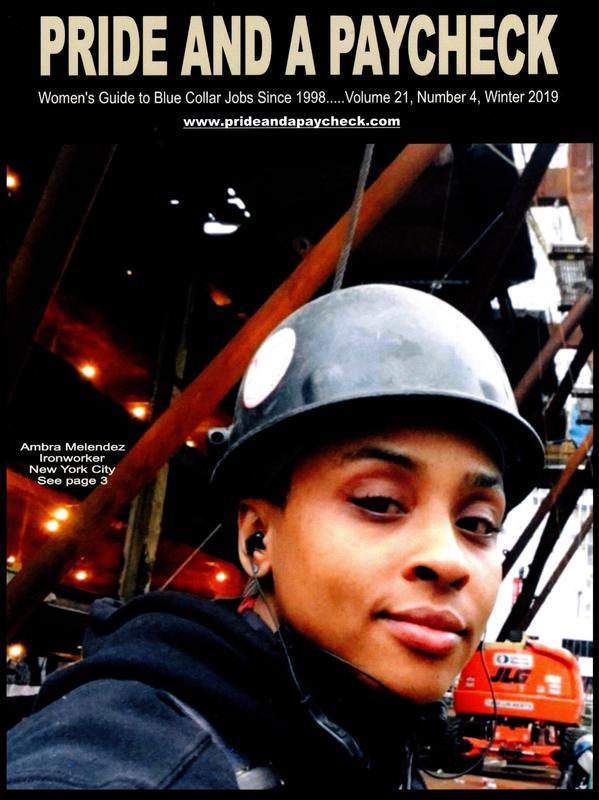
Pride & A Paycheck - A Women's Guide to Blue Collar Jobs
(Editor's Note: Sister Sue Doro formerly worked for the Milwaukee Road in Milwaukee, WI at the wheel shop, where she was a member of the IAM and one of the very few women to work in that capacity back in the 1970s and 1980s. Sue is a Sustaining Member of Railroad Workers United).
Pride and a Paycheck was founded in 1998 by Madeline Mixer (1929-201 Rest in Power) & Sue Doro. Now Owned, Published and Edited by Sue Doro. Pat Williams, (retired Operating Engineer, and co-founder of Tradeswomen Archives and ALL THE KIDS …colouring books) is Pride’s LA contact and international reporter. www.tradeswomenarchives.com Remember our sister Madeline by Giving to Grow Our Numbers! Donate to your local tradeswomen organization and don’t forget about donating to Pride and a Paycheck. We exist through donations and advertisements. Help us keep on going please! You can donate by check to the address below or go on our website www.prideandapaycheck.com and use PayPal. Pride and a Paycheck, 484 Lake Park Ave. #315, Oakland CA 94610. Sue Doro Email: tradesis@aol.com Sue Doro, Oakland, CA, is a retired Railroad machinist, & published author. She is the creator and developer of the Blue Jean Pocket Writers’ workshops. Sue is a member of the National Writers Union, Local 1981 (UAW Affiliate), www.nationalwritersunion.org , the United Association of Labor Education Local 189 (Affiliate of CWA) www.uale.org
Railroad Workers United www.railroadworkersunited.org Working Class Studies Association, www.wcstudiesassociation.wordpress.com Tradeswomen Inc., www.tradeswomen.org, Oregon Tradeswomen, www.tradeswomen.net National Assoc. of Women in Construction, www.nawic.org , Women in Trucking, www.womenintrucking.org Coalition of Labor Union Women, www.cluw.org, retired member of the American Federation of Government Employees www.afge.org, as well as (also retired member) the International Association of Machinists, www.goiam.org Pride and a Paycheck is edited and produced with union labor.
|
|
Article 8 -
RAILS & ENVIRONMENT
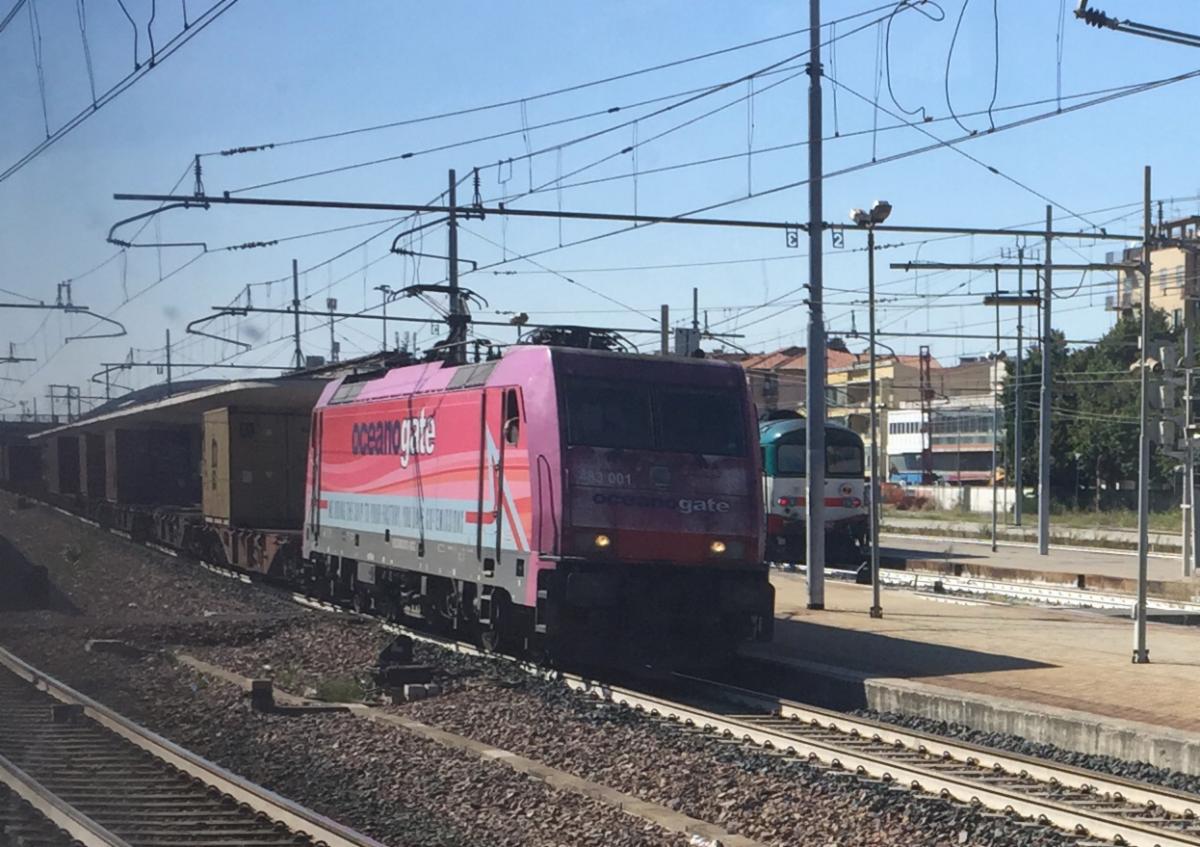
European Railroads See Climate Change as an Opportunity
Railroads across the pond see a huge opportunity to gain freight and passenger volume as part of a European Green Deal that aims to significantly reduce greenhouse gas emissions.
Last month the Community of European Railway and Infrastructure Companies, their version of our Association of American Railroads, argued that boosting rail’s share of the freight market to 30% by 2030, up from 17% today, would go a long way toward making transportation carbon-free by 2050. Already, the CER points out, 90% of rail ton-miles in Europe are powered by electric locomotives, with an increasing amount of electricity generated by renewable sources such as wind and solar.
With proper incentives and various carbon pollution penalties, the railway lobby group says, more freight could be diverted to rail intermodal as well as the carload network. Better integration between national passenger systems could support higher passenger loads on trips of up to 620 miles, particularly when those journeys are across borders.
Transportation is the only sector of the European economy that has not decreased its greenhouse gas emissions since 1990, they note. And they say the European Union and its member states should prioritize investments in rail if the continent wants to meet its ambitious goal of reducing transportation’s carbon footprint to zero as a way to fight climate change.
|
|
|
|
|
|
|