REMINDER: YOUR SUBMISSIONS ARE ENCOURAGED | | |
1. Bindu's Corner: This week, Bindu has brought the Flock a blessing that brings comfort and serenity in difficult times.
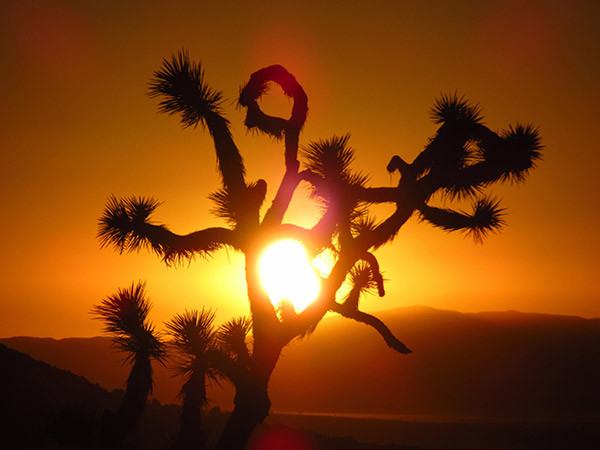
2. Nature: The Joshua tree is a variety of Yucca that can grow up to 40 Feet high.
3. National Parks: Joshua Tree National Park is easily accessible and one of the best places to explore Joshua Tree forests.
4. Reader Submission: Flock reader Margaret Durney has shared a photo with us this week.
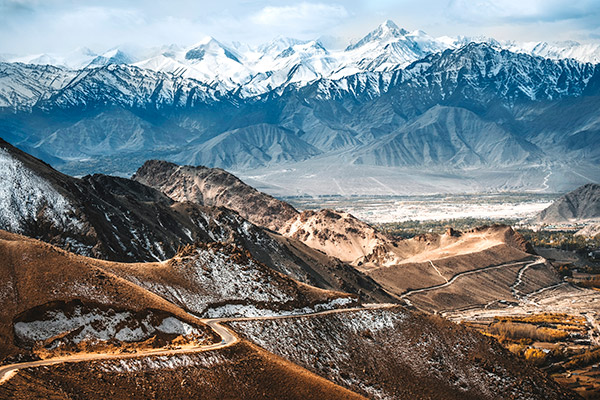
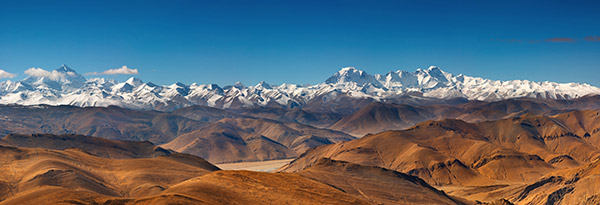
5. Reaching High: The highest mountains in the world, the Himalaya are several chains of mountains smashed together and pushed up by two colliding tectonic plates.
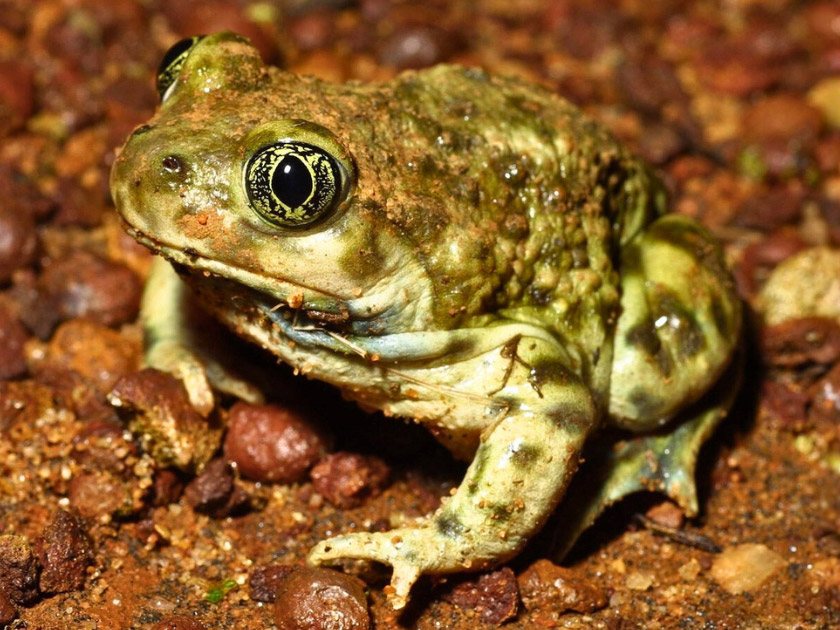
6. Conservation: California has granted the Western Spadefoot temporary protection while state biologists evaluate the species' ability to survive habitat loss.
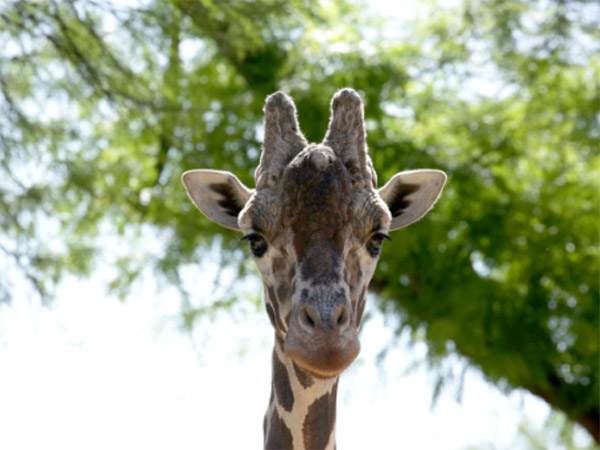
7. Reid Park Zoo: The zoo's oldest giraffe, Jasiri, was recently fitted with a new pair of shoes to improve his comfort and mobility.
8. Wellness: I have three low-impact exercises from Harvard Health that will strengthen your core muscles.
9. Hayward M. Fox, P.h.D: Read the latest post from Dr. Fox's blog.
| | Now, to this week's Flock. | | 1. Bindu's Corner: A Blessing | | Draw on these words during times of stress to restore your balance and find your peace. Thank you, Bindu, for sharing this blessing with us. | | A Blessing for Difficult Times | |
2. Nature: The Joshua Tree
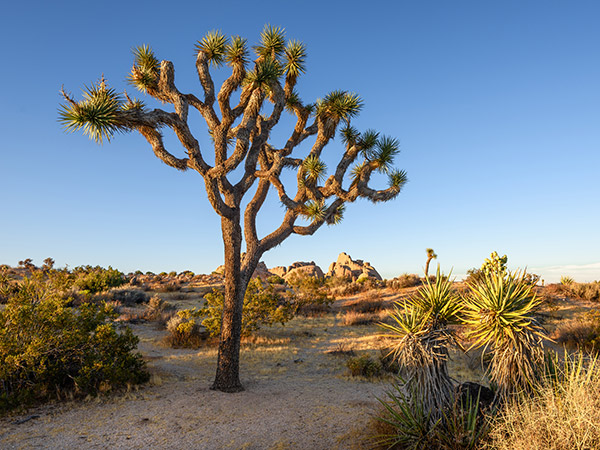
| | Joshua trees have always fascinated me; they possess a unique beauty and look like a Dr. Seuss illustration come to life. Like the saguaros in southern Arizona, these giant succulents can survive extreme heat and drought. | | Joshua Tree
Yucca brevifolia
| |
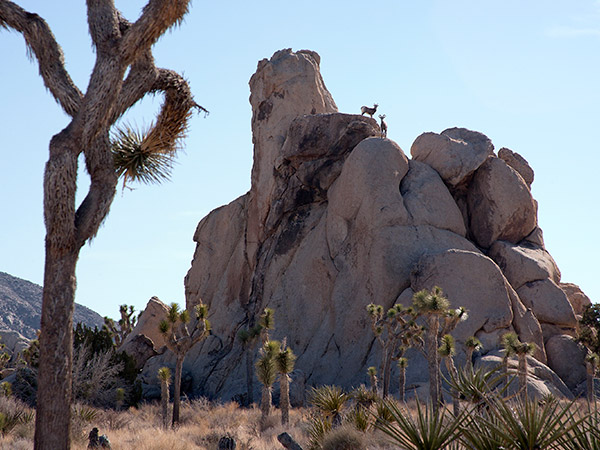
Joshua trees aren’t actually trees—they’re succulents, a type of plant that stores water. In their dry ecosystems, however, they are considered trees of the desert. Joshua trees were named for the biblical figure Joshua by 19th-century Mormon settlers who felt the outstretched tree limbs guided them along their westward journey. Joshua trees usually have a single trunk and grow three to nine feet (0.9 to 2.7 meters) tall before branching. Branches end in clusters of spiky leaves and white, rounded flowers. The trunk of the Joshua tree is usually one to three feet (0.3 to 0.9 meters) in diameter. Joshua trees can grow to between 20 and 70 feet (6 and 21 meters) in height, although they rarely exceed 40 feet (12 meters).
Range
Joshua trees are desert plants and they are most commonly found in the Mojave Desert in the southwestern United States. These trees are such a striking feature of the desert landscape that California even has a national park named for them.
Life History
Joshua trees need to undergo a dormant period of cold weather before flowering, but once they flower, they are dependent upon one tiny insect for pollination. Yucca moths (genus Tegeticula) transfer pollen between flowers to ensure seeds will form, and then they lay their eggs inside the pollinated flower. When the larvae hatch, they feed on some of the seeds and the rest are able to disperse and grow into new Joshua trees. This type of interaction, where two organisms are dependent upon each other for mutual benefits, is called a mutualistic symbiotic relationship. A number of other animals are also served by Joshua trees. For example, 25 bird species nest in Joshua trees. Lizards and invertebrates use various parts of the tree for cover, and a number of mammals rely on Joshua trees for food. Humans have used the trees for food and to make baskets and sandals.
Joshua trees are slow-growing, but because of this, they live for a long time. Joshua trees don’t have annual growth rings like actual trees, so accurately determining their age is quite difficult. Instead scientists measure the height of a Joshua tree and divide it by an estimate of growth per year. One Joshua tree in California is thought to be over 1,000 years old. A more common lifespan is about 150 years.
| | |
Conservation
Because they require a cold period to flower, Joshua trees are vulnerable to climate change. The U.S. Fish & Wildlife Service is currently reviewing the Joshua tree for listing under the Endangered Species Act.
Trivia
- Giant ground sloths that went extinct at the end of the Ice Age may have been the original dispersers of Joshua tree seeds. Today the seeds are dispersed by wind and small mammals.
- Joshua Trees are actually the world's largest yucca. They are sometimes called yucca palms, tree yuccas, or palm tree yuccas. It also bears the Spanish name izote de desierto, which means "desert dagger."
- Joshua Tree flowers begin to develop between March and May, but during winter 2018/2019, Joshua Trees were observed to be blooming beginning in November. This is incredibly uncommon.
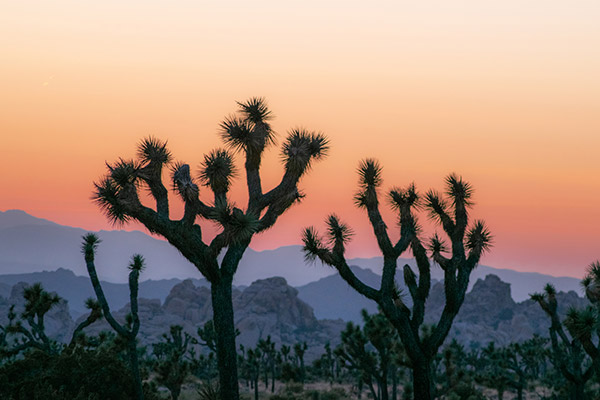
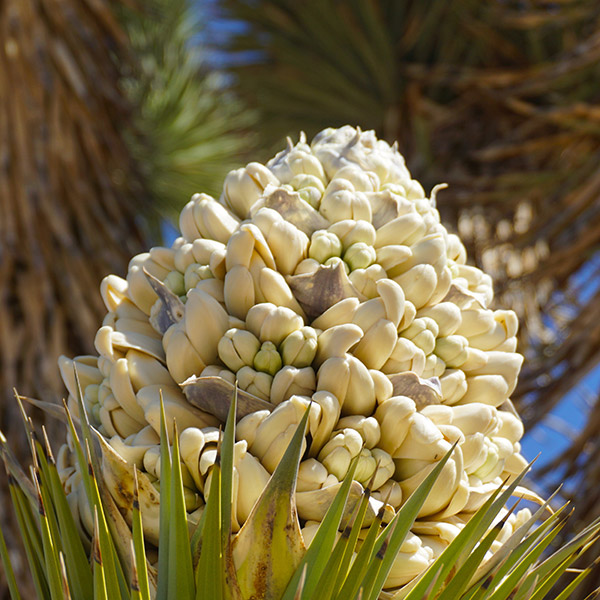
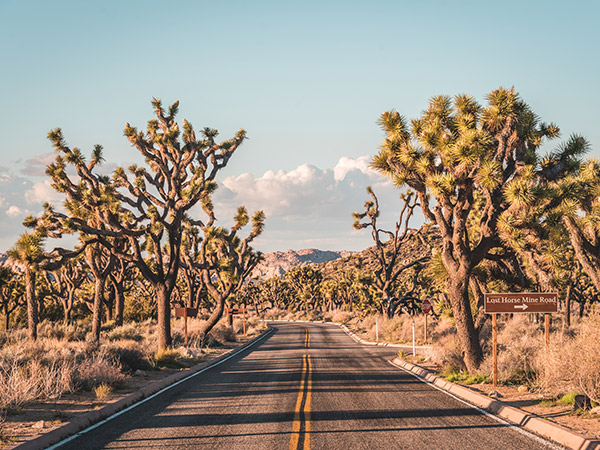
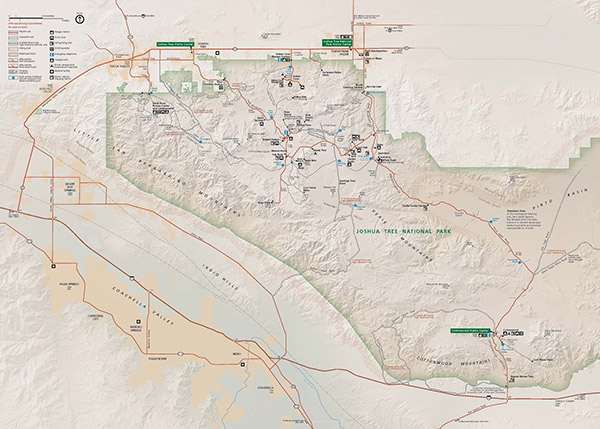
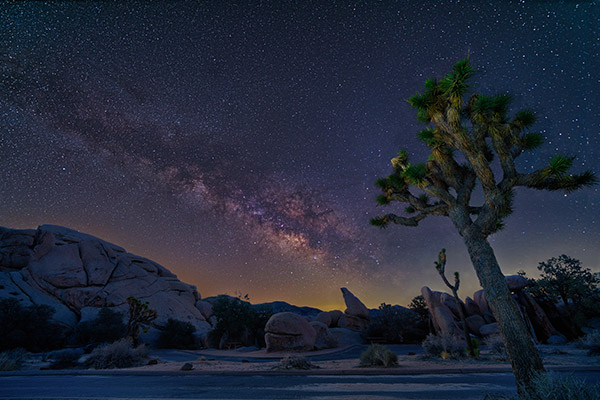
| | Joshua tree flowers grow 18 to 20 inches tall in heavy clusters called panicles. | | 3. National Parks: Joshua Tree National Park | | Joshua Tree National Park lies northeast of Palm Springs, California. When traveling east or west on I-10, it's an easy detour to take a drive through the park before returning to the interstate. Separated from the noise and lights of civilization by the Little San Bernardino Mountains, a short drive into the park feels like entering a completely different world. I can remember riding through the intense summertime heat and being struck by the abundance of Joshua trees and rock outcroppings populating the desert landscape. The park is an International Dark Sky Park, and sundown brings new wonder as the stars and Milky Way are revealed above you. | | Joshua Tree National Park | | |
The Outer Limits of Reality
Long honored, fanciful, and yes, even strange, the Joshua Tree is one of nature’s most peculiar and distinctive creations. Surrender yourself to their mystical qualities in this dreamy California national park.
| | Visitors can explore 800,000 acres of beautiful terrain in Joshua Tree National Park, where wildlife thrives in temperatures over 100 degrees. Crafted over millions of years by torrential rain, battering wind, and extreme temperatures, Joshua Tree National Park stretches over nearly 800,000 acres of rugged terrain. These landscapes, which can seem deceptively barren, are home to several ecosystems. Despite the harsh conditions, Joshua Tree teems with plant and animal life that has adapted and thrived in the area’s fierce climate. | | |
Joshua Tree National Park is home to large herds of desert bighorn sheep, black tailed jack rabbits, coyotes and kangaroo rats as well as a number of smaller mammals. Since it lies along the Pacific migratory bird flyway, many large groups of migrating birds can be spotted overhead or stopping to rest in the park during the winter months.
The Joshua Tree was revered by American Indian tribes because its leaves provided durable materials for baskets and footwear, while the buds and seeds made a healthy addition to their food supply.
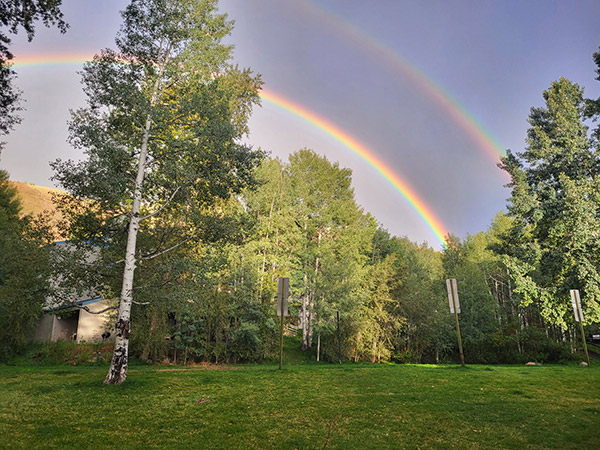
| | 4. Reader Submission: A Double Rainbow | | |
Margaret Durney, mom of the Flock's favorite mouser, Fern, shared this beautiful photo of a double rainbow taken at Fern's playground in Aspen, Colorado.
If you would like to submit photos, poems, stories, or your thoughts with the Flock, please use the "Share Stories & Photos " button below.
| |
5. Reaching High: Himalayan Geography
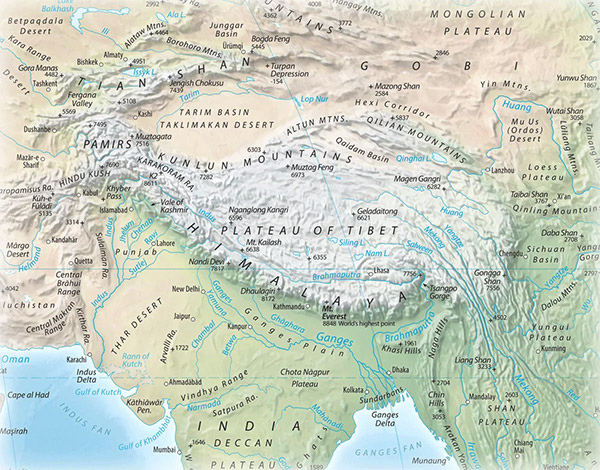
| | The Himalaya Mountains are not a single mountain chain, but several parallel chains squeezed together and pushed up by the massive force of two colliding tectonic plates, which crumple the impact zone and force it upward. | | Geography of the Himalayas | | |
The Geography of the Himalaya Mountain Range
The geography of the Himalaya mountain range is impressive because the mountain range is young in terms of history, giving it striking and imposing features that have yet to be softened by the effects of time like other mountain ranges in the world.
| | |
The Himalaya range was formed by the tectonic movement of the Indo-Australian Plate and the Eurasian Plate converging along their borders deep underneath the surface of the Earth. This plate movement caused the abrupt upheaval of the Earth’s surface, creating the dramatic mountain range we see today.
Both the Indo-Australian and Eurasian Plates are made up of low density continental crust material which allowed them to rise into the mountain range as opposed to subconducting, one above the other. One piece of evidence supporting this theory is that study of the rock material at the top of Mount Everest reveals a significant presence of marine limestone.
| | |
The Indo-Australian plate is also moving horizontally against the Tibetan plateau which also assists in the further lifting of the Himalaya range.
How Fast are the Himalayas Rising?
Current estimations state that the Himalayas are rising at a rate of about 5 millimeters per year as a result of the continued tectonic activity going on deep below. This movement also creates geologic instability in the range, leading to often devastating earthquakes affecting rural areas of India, Pakistan, Nepal and Tibet.
Zones of the Himalayas
The Himalayas can be broken up into multiple zones, each with unique and different material structures and makeups. These zones are often called the Trans-Himalaya, the Tethyan Himalaya, the Higher Himalaya, the Lesser Himalaya and the Sub-Himalaya.
A formation called the Tethys Trench that became part of the Himalaya range when the Indo-Australian and Eurasian Plates collided was made up of a blend of granite and basalt infused into weaker sedimentary layers which is now easily studied, recognized, and placed next to other parts of the Himalaya range for comparison.
| | The Greater Ranges — Earth’s Highest Mountains Explained | | Why the Himalayan Mountains Don't Have Volcanoes | |
6. Conservation: Western Spadefoot
| | California Fish and game has awarded temporary protection to the Western Spadefoot to give state biologists time to evaluate the species viability to survive the loss of habitat. The environment is a big interconnected web and even these little guys play a role in the health of the overall system. We have their cousin, the Couch's Spadefoot here in Tucson and I sometimes see the little guys out on the trail, especially after monsoon rains. | | California Temporarily Protects Western Spadefoots | | |
Thanks to a Center petition, the California Fish and Game Commission has voted to make western spadefoots a “candidate species” under the state Endangered Species Act. Now these cryptic, charmingly plump frogs will get protection for the next year while state biologists study their plight to decide whether safeguards should be permanent.
“This is a ray of hope for a species that has lost vast swaths of habitat,” said Brendan Cummings, the Center’s conservation director. “Spadefoots deserve a fair chance to survive and thrive.”
| | 7. Reid Park Zoo: Jasari's New Shoes | | Jasiri, the zoo's oldest giraffe, has been experiencing some age-related discomfort while moving around his habitat. The zoo's staff has fitted him with new shoes to improve his comfort and help treat degenerative issues in his lower legs. | | |
As part of its dedication to whole life care, Reid Park Zoo recently fitted geratric giraffe Jasiri with a pair of shoes to make him more comfortable while he walks.
“As Jasiri has aged, we became concerned with how he moved. In order for us to better evaluate what his feet look like on the inside, it required an anesthetic procedure,” said Dr. Alexis Roth, Chief Veterinarian at Reid Park Zoo.
During the procedure, the veterinary team identified advanced degenerative changes in his lower legs. These changes are not unexpected in an elderly giraffe, but they create discomfort when he walks. During the procedure, the Zoo’s animal care team was able to work with Steve Foxworth, head of the national Zoo Hoofstock Trim Program, to create shoes specifically designed for Jasiri that will make him more comfortable when he walks.
The shoes are already having a big impact. “Jasiri is adapting well to his new foot wear. For the first time in months, he has been running around his habitat, which is such a joy to see,” Zoo Director of Animal Care Adam Ramsey said.
| |
8. Wellness: Core Exercises
| | These low-impact exercises from Harvard Health will help strengthen your core muscles, improve balance, and support good posture. | | A strong core is vital to staying active. Here are three exercises that can help keep it in shape. | | |
Practically every move you make originates from one area of your body: the core.
When you mention the core, most people think of the "six-pack" of abs, a muscle called the rectus abdominis. But the core is made up of abdominal, pelvic, and back muscles.
Beside the rectus abdominis, the other main muscles include the external abdominal obliques, located on the side and front of your abdomen, and the internal abdominal obliques, which lie under the external obliques. A deeper layer called the transverse abdominis lies under the obliques and attaches to your spine.
"The core is vital for your body, as it serves as the foundation for upper- and lower-body movements," says Shawn Pedicini, a physical therapist with Harvard-affiliated Spaulding Rehabilitation Hospital. "Your core musculature must have a good combination of endurance, stability, and power for many activities."
Everyday moves
Your core is in action every day. For example, when you take a walk, your core muscles provide the support and endurance to maintain a healthy posture. Core strength allows you to transfer power during rotational movements, like swinging a golf club or tennis racket. Your core also generates stability around your spine to prevent back injuries, like when you lift and carry heavy objects.
Core strength is also essential for preventing falls. "Our bodies constantly have to adapt to ever-changing surfaces and environments," says Pedicini. "Adequate core stability and strength can assist you in reacting to sudden changes and prevent falls."
The best core exercises are movements that can activate many core muscles at one time. Here are three exercises that do that.
Plank
To get into the starting position, kneel on all fours with your hands and knees directly aligned under your shoulders and hips.
Movement: Tighten your abdominal muscles, and lower your upper body onto your forearms, clasping your hands together and aligning your shoulders directly over your elbows. Extend both legs with your feet flexed and toes touching the floor so that you balance your body in a line like a plank. Hold. This is one rep. Aim to hold for 30 to 60 seconds, doing as many reps as needed to reach that total. For example, if you can hold a plank for 15 seconds, you would do four reps.
Modifications: Do the exercise with straight arms (harder) or while leaning against a counter or table at a 45° angle (easier).
Diagonal chops
Stand and hold a lightweight medicine ball or dumbbell by your right side with both hands.
Movement: While keeping your abdominal muscles tight and your feet grounded, twist at the waist and swing the ball or dumbbell up until it's just past your left shoulder. Only your arms and midsection should move. Reverse the movement and return to the original position to complete one rep. Repeat five to 10 times, switch sides, and repeat. Complete two or three sets on each side.
Modification: If standing is a challenge, do this in a seated position.
Deadbugs
For this floor exercise, lie on your back with your feet off the floor and knees bent at 90°. Extend your arms toward the ceiling with your hands directly above your shoulders. Squeeze your abdominal muscles and maintain this tension throughout the movement.
Movement: Extend your right leg, holding it six inches above the floor, while at the same time you lower your left arm, extending it over your head, parallel to the floor. Pause and return to the starting position. Repeat with the opposite arm and leg to complete one rep. Do 10 reps to complete one set. Rest and then repeat the movements to complete two or three sets.
Modification: Make the movements less challenging by not lowering your arm and leg as close to the floor.
| | 6 min Balance and Core Exercises for Seniors That Actually Work! | |
9. Hayward M. Fox, Ph.D.: The Latest From Dr. Fox's Blog
| | |
We have a new entry from Dr. Fox's blog this week. Be sure to click through this weeks post and check out the companion meditation, “The Humasnity Within” meditation practice.
Again, thank you, Dr. Fox, for letting me share his insightful posts in the Flock. Please visit Dr. Fox's website at the Institute of Personal and Transpersonal Knowledge to explore the knowledge and guidance he offers.
| | These Flock regulars are always here for you: | | Don't Be Shy: Share Your Stories! | | I'm looking forward to sharing more of your personal stories - oral, written, or otherwise, as we enter our third year. I'd so love to present them to The Flock, hit a mailbox below to share your story. | | Subscriptions & Idea Submissions
Reminder: Your submissions are always welcomed. | | |
Feel free to forward this email to a friend. If this was forwarded to you and you would like to receive your very own Flock Newsletter, you can sign up here. If you have any questions or suggestions for future Flock resources, don't hesitate to contact me.
Your fan and friend,
Beth
| | | The information and materials contained or referenced in this newsletter are for informational purposes only and not intended to be a substitute for professional medical advice, diagnosis, or treatment. Always consult a physician or other qualified medical professional with any questions you may have regarding a medical condition or treatment and before beginning a new health care regimen. Do not disregard professional medical advice or delay seeking medical advice or care based on anything contained in this newsletter. | | | | |