|
|
Preventing Trauma
and Its Consequences
A Series Brought to You By The South Southwest PTTC
|
|
In this Issue:
- The Pandemic of the Centuries: ACEs, Trauma and Prevention
- Additional Resources for Preventing Trauma
- What's Happening Around the Region?
- Five Session Webinar Series on Trauma Beginning March 25
- Data Collection During the Pandemic, Resources and Recordings
-
Targeting Risks and Vulnerable Populations for Adverse Childhood Experiences
|
|
The Pandemic of the Centuries: ACEs, Trauma and Prevention
By Fabricia Prado, LCSW
Pandemic. You must be tired of that word. You may even experience feelings of anger or despair by the mere presence of this word before your eyes. Nonetheless, I dared to start with a potential trigger word to captivate your full attention in order to unpack one of the most important factors related to Adverse Childhood Experiences (ACEs) and how it relates to the moment we are collectively going through.
I will assume that you are already familiar with the 1995 study on the role of adverse childhood experiences and focus on prevention as a protective factor. We now know that ACEs are a pandemic in their own right. Understanding the relevance of the ACEs pandemic in the field of human existence could potentially increase awareness in the work of prevention, while crafting hope and change by implementing actions to mitigate ACEs and reinforce community resilience.
Fundamentally, the ability to engage effectively in preventive action cannot proceed without the ability to pay attention with purpose. You may be surprised to take this perspective, but you may be already doing a lot of prevention work to mitigate ACEs and to build resilience in yourself, your home, your community, and your state. What does this mean?
- You attentively read, watch webinars, get training, train others.
- Engage in creative workforce development and best practices.
- Observe, listen, assess and measure risk and protective factors in your local communities.
- Identify patterns to be interrupted and alternative behaviors to be fostered.
In other words, it means you evaluate and adjust, all while training your own brain and body to notice what unfolds inside you and in your surroundings moment by moment.
Ways you are possibly already contributing to the prevention of ACEs:
- Being an adult in your family and community who can be a safe, stable person and model emotional regulation to children.
- Helping an immigrant who doesn’t understand how their health insurance works and is fearful to go to a hospital and later receive an unaffordable bill.
- Using your time to refer people to available services they may not be aware of.
Ways that you may want to explore the path to ACEs prevention:
- Include ACEs education and updates in your meeting agendas for coalition meetings, board meetings and staff/leadership meetings.
- Create resilience-based initiatives, consulting, creating safe environments, reviewing your standard of operating procedures, your intake paperwork, and protocols.
- Promote cultural competency and linguistically appropriate services by implementing gender sensitive language as well as embracing body and gender diversity, denouncing racism, supporting black, indigenous, people of color (BIPOC), and being aware of the complexities of racial trauma to avoid re-traumatization.
By validating the good you are already doing, you are more likely to feel motivated to be and to do even more. Just like the coronavirus pandemic, the ACEs pandemic will require our continued dedication and attentiveness for it to reach its end.
Links/Resources:
ACE Interface is a company that provides education, analysis, process design, facilitation, and products designed to help you engage and motivate everyone to prevent ACEs and improve well being.
CDC
|
|
About the Author
Fabricia Prado is a trilingual (Portuguese/Spanish/English) licensed Clinical Social Worker (LCSW) in the state of Georgia. Fabricia has obtained certification as an ACE Interface Master Trainer through the National Hispanic and Latino PTTC and is working to increase community awareness of the prevalence of ACEs and its public health impact utilizing evidence-based approaches for building resiliency in the Hispanic and Latino organizations and communities.
She obtained her master's degree in social work from Kennesaw State University in 2012 and finished bachelor’s and master’s degrees in psychology from Pontifical Catholic University of Goiás, PUC-GO, Brazil in 2007. Fabricia is a Certified Child and Adolescent Trauma Professional (CATP) and has received intensive training in trauma-focused cognitive behavioral therapy, Eye Movement Desentization and Reprocessing (EMDR), Mindfulness Based Stress Reduction, and other trauma sensitive approaches.
|
|
Additional Resources on Preventing Trauma |
|
Mid-America Prevention Technology Transfer Center
Conversation between Marie Cox, the Director of the South Southwest PTTC, and Laura Porter, Co-Founder of ACE Interface, LLC. This episode dives into three main questions:
- Will the kids be okay after this pandemic?
- How can we keep creating help that helps?
- You'll discover the third when you listen to the podcast!
Great Lakes Prevention Technology Transfer Center
Provides a place to learn about the impact of stigma on vulnerable populations and offers best practices for preventing and reducing stigma within relevant community sectors.
Mid-America Prevention Technology Transfer Center
Explore how positive childhood experiences can promote resilience and mitigate the impact of ACEs on health outcomes, opening new and exciting avenues for promoting health in children and adults.
National American Indian and Alaska Native Prevention Technology Transfer Center
This newsletter released by the the National American Indian and Alaska Native Prevention Technology Transfer Center provides many resources to explore secondary trauma and compassion fatigue in communities as well as within providers due to effects of the COVID-19 pandemic.
|
|
Virtual Bytes:
Implementing Prevention Services in a Virtual Setting
|
|
In response to your requests from the Changes in Prevention Practice During the COVID-19 Pandemic survey conducted by the South Southwest PTTC May through June of 2020, we will continue to share training, information, and resources related to conducting prevention services in a virtual setting.
Great Lakes PTTC
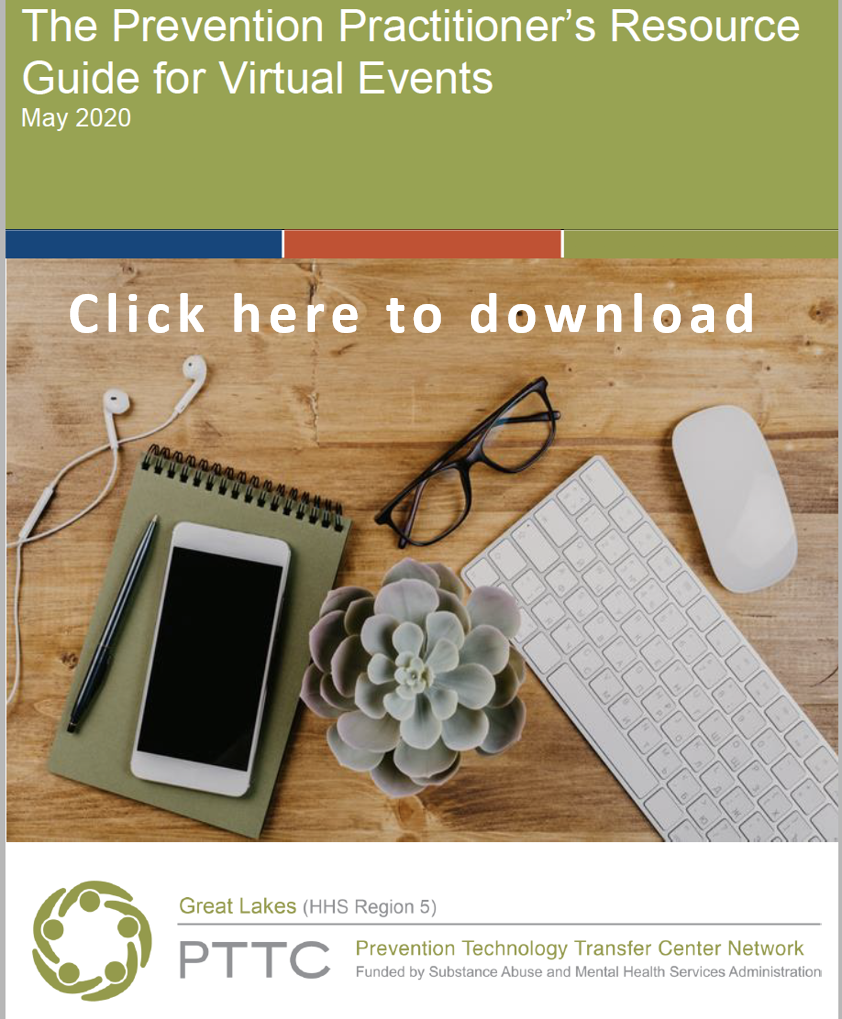
Moving prevention strategies from in-person to a virtual environment requires thoughtful planning and multiple considerations. The Great Lakes PTTC has created a series of resources to help prevention practitioners through this planning process, from selecting technology to adaptations and fidelity considerations. Download the resources listed below from the Great Lakes PTTC Products page linked in the photo of the document.
-
The Prevention Practitioner's Resource Guide for Virtual Events
- Moving "The CSAP 6" Strategies to Virtual Settings
- Organizational Technology Capacity Assessment
- Moving Prevention to Virtual Settings Planning Worksheet
|
|
The South Southwest PTTC is currently suspending in-person training and meetings until further notice. Take advantage of our many virtual products and services available for free from our website.
|
|
What's Happening Around the Region? |
|
Save the Dates
Preventing Trauma and Its Consequences: Practical Steps for the Prevention Professional
A South Southwest Prevention Technology Transfer Center Webinar Series
Please join us in this webinar series as we come together to share the good news about the role of prevention in addressing ACEs and other trauma. Together we'll learn the practical steps to preventing trauma and it's consequences in your community.
We have an incredible line up of of speakers! You won't want to miss it!
Each webinar will begin at 1:30 p.m. CT and run for 90 minutes. Please join our email list to receive notifications about specific topics and registration details as they become available.
|
|
Data Collection During the Pandemic
Presented by South Southwest Prevention Technology Transfer Center
Did you miss the Data Collection During a Pandemic training series? Click on the link below to view the recordings and other helpful materials.
The pandemic makes in-person data collection difficult. The two-session webinar by the SSW PTTC provides researchers and preventionists real-life examples of ways to adapt quantitative and qualitative data collection methods during COVID-19. Participants will have the opportunity to observe barriers, solutions, and lessons learned related to data collection during this critical time.
QUANTITATIVE Data Collection During the Pandemic
Session 1
Previously Recorded
Participants in this webinar explored ways to effectively adapt quantitative data collection methods during the pandemic, specifically addressing confidentiality concerns with participants during online quantitative data collection.
QUALITATIVE Data Collection During a Pandemic
Session 2
Previously Recorded
Participants in this webinar will explore ways to effectively adapt qualitative data collection methods during the pandemic, specifically addressing confidentiality concerns with participants during online qualitative data collection.
The recordings for both sessions are available in the Products section of our website.
|
|
Prevention Online Courses
Free online courses are available through the Prevention Technology Transfer Center.
If you are new to prevention, be sure to take the course, "Introduction to Substance Abuse Prevention: Understanding the Basics (Pre-SAPST)".
|
|
|
Epi Corner
Iris Smith, Ph.D., M.P.H.
South Southwest Prevention Technology Transfer Center
|
|
Targeting Risks and Vulnerable Populations for Adverse Childhood Experiences
The negative impacts of exposure to adverse childhood experiences (ACEs) are well documented in the research literature.1 Exposure to early life adverse experiences can lead to stress responses which can be maladaptive or at worst, toxic to the body. This toxic stress response results from a disruption of the circuitry between neuroendocrine and immune systems and can affect multiple biological systems which in turn may result in poor health outcomes in adulthood.2
While it Is generally recognized that exposures in childhood are associated with elevated risks for poor physical and mental health, substance abuse and social disadvantage in adults, research is still emerging on the identification of specific risk factors for exposure and vulnerable populations.
A British study by Lacey, Howe & Kelly-Irving et al. (2020) examined the clustering of ACEs in a longitudinal study of 8,572 parents and children of a regionally representative cohort of children born between 1991 and 1992 in the Avon region of South-West England.3 The sample was identified prenatally and followed to the age of 19. The results of this study indicated that individual ACEs tended to cluster in specific patterns – i.e., children exposed to one type of ACE were more likely to be exposed to others within the cluster. While gender, death of a family member, and sexual abuse did not appear to cluster with other ACEs, parental mental health problems and poverty were both associated with ACE clusters. Poverty (measured by maternal resources) was found to be strongly related to both individual ACEs and clusters. The researchers conclude that some ACEs may have a greater impact on child development than others.
Maternal mental health, stress and available resources during the prenatal and post-partum period may be important foci for prevention of ACEs. Children of parents suffering from mental illness or substance use disorders (SUD), particularly those in low resource families are at high risk for experiencing ACEs during childhood and adolescence. A systematic review of service needs of young people affected by ACES found that individuals affected by ACEs stressed the importance of stability and continuity in services they received.4 Service needs were divided into 3 categories: connections and interactions with peers; practical advice and information; flexible and dependable support from adults and professionals. These respondents placed a priority on services that built trust, increased sense of worth and belonging, and involved victims and survivors in the development and improvement of services. They also felt it was important to focus on broader social factors and practical support to help them manage everyday challenges.
Resources
_____________________________________________________
1Struck S, Stewart-Tufescu, Asmundson AJN, Asmundson GJ & Afifi TO. (2021). Adverse Childhood Experiences (ACEs) research: A Bibliometric Analysis of Publication Trends Over the First 20 Years. Child Abuse and Neglect 112, pg.
2Bucci M, Marques SS, Oh D, Harris NB (2016). Toxic Stress in Children and Adolescents. Advances in Pediatrics, 63; pg. 403-428.
4Lester S, Khatwa M, Sutcliff K. (2020). Service Needs of Young People Affected by Adverse Childhood Experiences (ACEs): A Systematic Review of UK Qualitative Evidence. Children and Youth Services Review, 118; pg. 1-18.
|
|
|
|
|
|
|