|
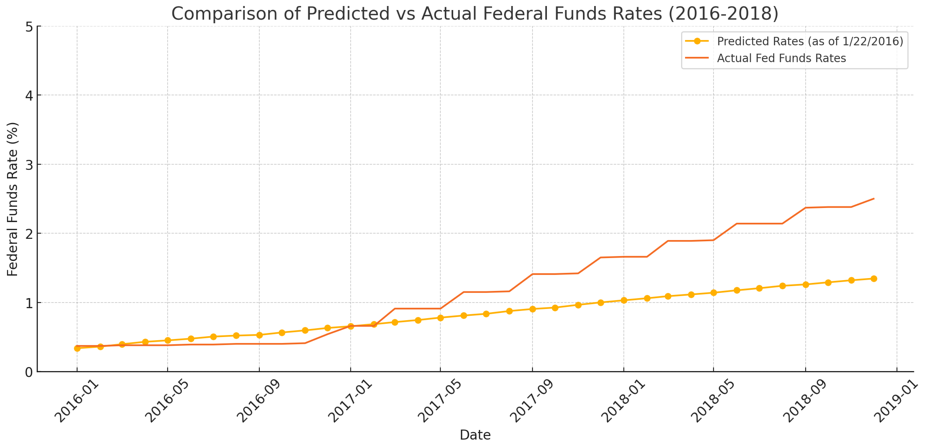
Overall, the market's predictions effectively captured the direction of rate movements, highlighting the Federal Funds Futures market as a valuable tool for anticipating monetary policy, even as real-world outcomes sometimes outpace expectations.
Developments from 2019 to 2023
After reaching 2.50% in late 2018, the Federal Reserve continued to raise rates into 2019, reaching a target range of 1.50%-1.75% by the end of that year. However, as global growth slowed and trade tensions rose, the Fed shifted to a more accommodative stance, beginning to cut rates in the latter half of 2019.
The economic landscape changed dramatically in 2020 with the onset of the COVID-19 pandemic. In response to the severe economic downturn, the Fed slashed the Federal Funds target rate to near zero (0.00%-0.25%) in March 2020, where it remained until early 2022. This unprecedented move was part of a broader strategy to support the economy during the pandemic.
As the economy began to recover in 2021, inflationary pressures emerged, leading the Fed to begin raising rates again in 2022. By mid-2023, the Federal Funds target rate had increased to 5.25%-5.50%, as the Fed sought to combat rising inflation.
The Current Landscape: Impact on Commercial Real Estate and Housing Markets
As of August 2024, the Federal Funds target rate remains at 5.25%-5.50%, and the Federal Reserve continues to navigate a complex economic environment. One area significantly impacted by these rate increases is the commercial real estate and housing markets.
Higher interest rates have made borrowing more expensive, leading to a slowdown in both commercial real estate investments and home purchases. This has contributed to a cooling of the housing market, with fewer transactions and slower price growth compared to the booming post-pandemic market. In commercial real estate, higher borrowing costs have made it more difficult for developers to finance new projects, leading to a slowdown in construction and investment activity.
Inflation and employment data continue to be critical factors in the Fed’s decision-making process. Inflation, while moderating from its peak in 2022, remains above the Fed’s target, prompting continued vigilance. Recent adjustments to employment figures, such as the downward revision of 810,000 jobs from previous reports, have raised concerns about the strength of the labor market and the overall economy.
Future Predictions and Market Expectations
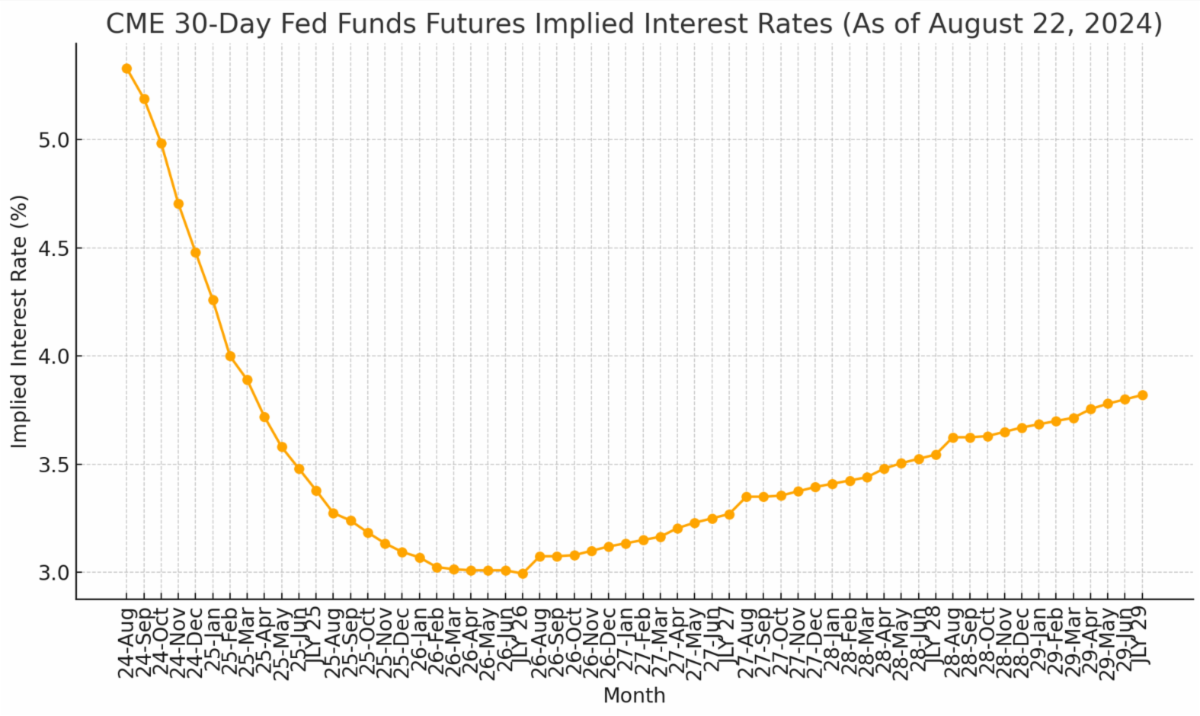
Looking ahead, the Federal Funds Futures market offers a clearer picture of where interest rates may be headed. As of August 2024, the futures data, as illustrated in the chart below, indicates that the market expects a significant decrease in interest rates over the next several months, with rates dropping below 4% by early 2025. This sharp decline suggests that the market anticipates the Federal Reserve will respond to weakening economic conditions, potentially including reduced inflation and slower growth, by lowering rates more aggressively than previously expected.
After this substantial drop, the market predicts that rates will stabilize at lower levels throughout 2025 and gradually begin to rise again in 2026, though remaining below 4% for the foreseeable future. This projection reflects the market's belief that, while inflationary pressures might ease, the Fed will continue to monitor economic indicators closely, making rate adjustments as necessary to support economic stability.
|