FOOD FOR THOUGHT:
Another Canary in the Mine?
|
|
It’s easy to think of summer as a time when schedules are quiet, folks are out of town, and life just generally takes a slower pace. This summer, not so much - particularly on the international stage.
Just in July, former Prime Minister of Japan Shinzo Abe was assassinated, Boris Johnson resigned as Prime Minister of Great Britain, Mario Draghi resigned as Prime Minister of Italy, and yet another Economy Minister in Argentina resigned, followed by massive protests in Buenos Aires, a story generally under-covered by American major media.
Why should anyone reading this care about what’s happening in Argentina right now? If one holds the classic Western Judeo-Christian worldview which values the individual as opposed to holding a worldview that espouses mob rule, events in Argentina matter a lot. They can even be seen as another “canary in the coal mine.”
Argentina experienced a poverty rate of 40% and an inflation rate of over 60% in July. The government spends approximately $6 million per day on welfare. As www.gulf-insider.com states:
Other subsidies, including the country’s notorious welfare program, are also on the chopping block, triggering thousands of angry residents to take to the streets. State-sponsored aid for civilians has soared in the past 20 years, leaving 22 million Argentinians dependent on some form of government assistance. In the first quarter of 2022, the national employment rate was 43 percent, according to government figures. The country’s state funded programs extend to nearly every aspect of the economy, from wages to utilities, education, and health care. Argentina already spends an estimated 800 million pesos per day—a sum of more than US $6 million—on state benefit programs. (All bold is added by us.)
As Praxis Circle’s Contributor Dr. Anne Bradley explains here, is this a prudent or moral way for a people to conduct their nation's affairs? What about the debt that may either be left for future generations to pay off or for the IMF (the rest of the world, in other words) to absorb? And exactly how would reneging on the restructured debt owed to the IMF help Argentina flourish in the future?
|
|
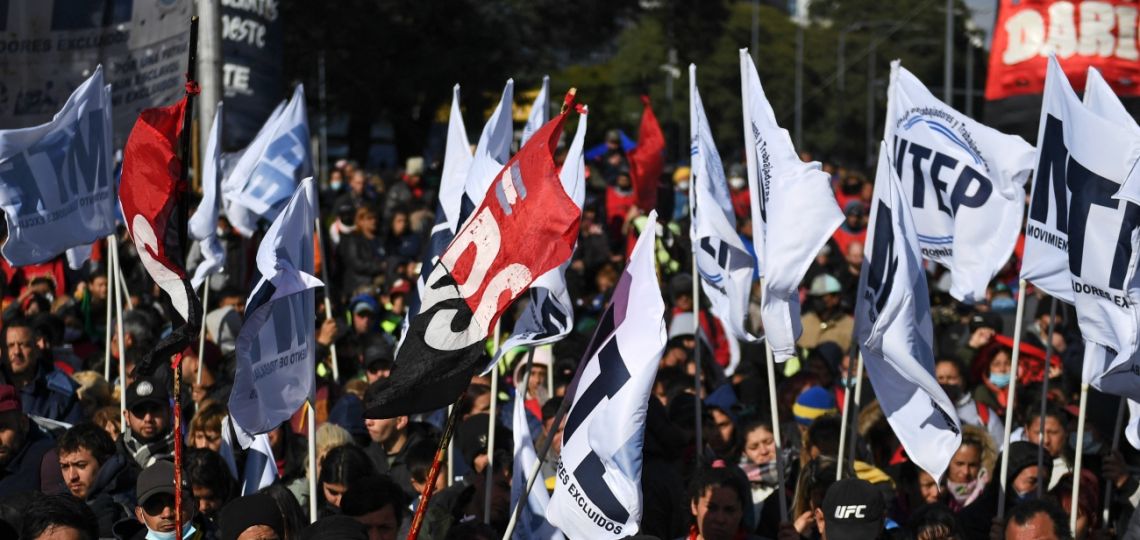
Argentinians protest for a Universal Basic Income in Buenos Aires, July 2022
(from the Buenos Aires Times)
|
This situation also calls to mind the observation from Dr. Walter Williams (deceased), another of our Contributors, that the taxation required to fund these welfare obligations and service the debt could be considered “legalized theft.”
Regardless of the details of almost every different worldview, no society, culture, or government has been able to sustain itself when more people don’t work than do, when the people think only of today and not also of the future, or when too many people believe value can be produced by printing money.
It was only 10-15 years ago that the inflation rate in Argentina was around 10%, barely above what it is currently in the U.S. Some American politicians have already mentioned a Universal Basic Income. Over 60% of Americans paid NO federal income tax in 2020, according to CNBC. Could Argentina be a forewarning of what lies in America's future if we don't change the course of spending by Congress?
As Dave Brat, former Congressman and also Praxis Circle Contributor said here several years ago (therefore the figures he mentions are even higher now), how much governments spend and on what is a moral issue, and therefore, ultimately, a worldview issue. The canary in Argentina is almost dead - the U.S. should learn the lesson.
|
|
"There is no country in the world in which everything can be provided for by laws, or in which political institutions can prove a substitute for common sense and public morality. "
Alexis de Tocqueville
|
|
Who We're Following:
The Manhattan Institute is awarding its inaugural City Journal awards to former U.S. Attorney General William Barr and to Heather Mac Donald, one of Praxis Circle's newest Contributors, introduced on May 3rd here.
The City Journal is the primary publication of the Manhattan Institute, and Ms. Mac Donald is its Thomas W. Smith Fellow as well as a contributing editor to the City Journal.
According to the Institute, the awards are to
. . . recognize individuals whose powerful ideas have pushed back on destructive policies and inspired larger efforts to protect the liberties and unleash the potential of all Americans.
The awards ceremony will be held in New York City at the Intercontinental Barclay on Wednesday, September 28.
Event registration is here.
|
|
What We're Reading:
For those of you who are on Twitter, you may have seen recent trending tweets referring to Twitter's blocking of any links to news stories by the newspaper The Epoch Times. (The cancellation of links has now ended.) It seems the newspaper has been noticed by an increasing number of people and is stirring controversy.
The Epoch Times was founded in 2000 in Atlanta by several Chinese-Americans in response to what they viewed as Chinese Communist propaganda. They were also practitioners of Falun Gong, a Chinese spiritual movement begun in 1992 and an offshoot of qigong, which promoted traditional Chinese medicine but was banned during the Cultural Revolution.
Since its founding, the newspaper has been the largest Chinese-language paper outside of China; it began publishing in 2003 in English as well. It now is published in 22 languages and 36 countries. It has about 6 million followers on Facebook and almost one half of a million followers on Twitter.
We have enjoyed reading The Epoch Times as a relatively new journalistic voice and one that is self-admittedly somewhat based on an Eastern worldview. We recommend it simply based on the fact that others would like it cancelled. Free speech will always be integral to worldview development.
|
|
|
|
|
August 5: The Trinity Forum hosts "Jazz, Hope, and the Gospel: An Online Conversation with William Edgar, Ruth Naomi Floyd, & Carl Ellis." The event will take place from 1:30 - 3:30 PM. Register here.
August 10: The Thomas Jefferson Institute for Public Policy presents "How Republics Elect Their Heads of Government" at 7:00 PM online. "Michael Maibach will provide a timely discussion of the philosophy and history of our federalist system, using the Founders’ federalism as found in the Electoral College as his model. He will then compare our system with how selected constitutional republics around the world select their Heads of Government." Register here.
|
|
|
|
|
|
|