|
Camping With An Electric Truck:
Can you get here on electricity?
| |
|
This is one of my favourite images of our family paddling around the Upper Kananaskis Lake in our 50 year old wood and canvas canoe. Typically, for those of us with young families, camping is our main vacation experience. We load up our truck, vintage camper, canoe, 5 bikes, a Chariot, generator, 80lbs of propane,150 Litres of water and enough clothing and supplies to probably live for 2 months, and make our way to various campgrounds in Alberta and BC a few times each summer. This has given us many cherished memories (and a couple not-so-cherished ones.)
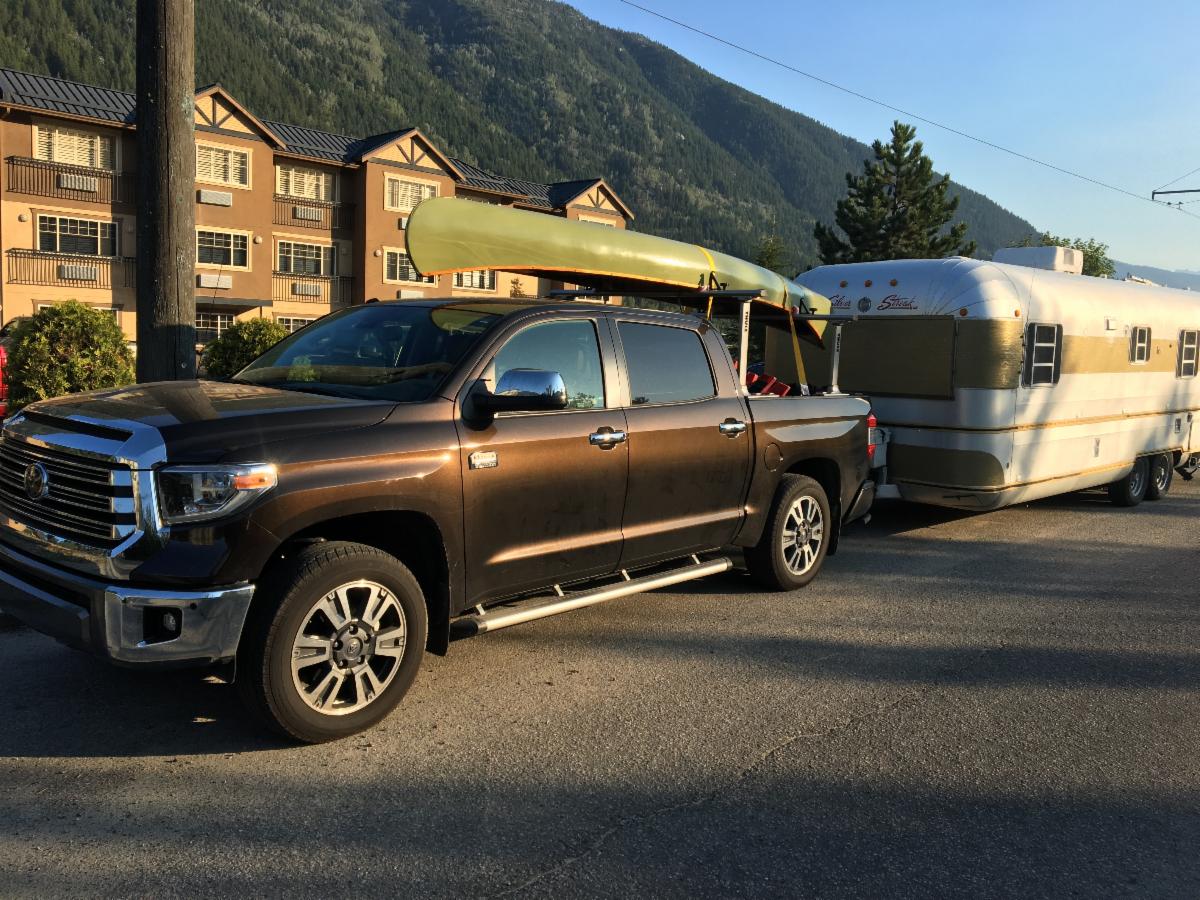
Our truck is certainly not the last word in fuel efficiency, but it is the least large thing that will do the job: a full size 5.7 Litre Toyota Tundra with 380hp and a 150litre fuel tank. The trailer is a 1978 Silver Streak Supreme Rocket Continental (they don't name them like they used to!) that weighs 6,500lbs dry and 7,500lbs with the necessities of life stored away. We are 13,500lbs all up and 50ft long. We are about 1,000lbs under the GVWR, but right up against the weight limit for the rear axle. The truck has to work pretty hard to get up the mountain passes and I use every one of its 6,000revs, going up and down hills. I am alway conscious of brake temperature and stop in the middle of the longer descents to make sure nothing is catching on fire.
I drive slowly. The truck will get 12 L/100km unloaded, and will use 20L/100km with the loaded trailer - a 170% increase in fuel consumption. Theoretical range is about 700km with the trailer but I usually stop every few hours, and fill up every 400km. It takes us a long time to get anywhere, but we're not in a hurry. I try to pull over for fast cars but it's sometimes not so easy pulling a 13,500lb train!
Typically we'll try to visit three or four camping spots, driving 300-400km between them. Any more than a 4 hour drive the kids start to lose their minds, with a cascading affect on our mental health, so we keep to relatively short hops.
These trips admittedly don't have a small carbon footprint. An average trip might be 2,500km and use 500L of fuel. Our fuel consumption per person is about 4L/100km, which is about the same as a modern airliner, though we probably don't go as far as if we were flying.
Is there the possibility to lower our carbon footprint, by switching to an EV Truck? Let's compare what we know about the Rivian and Ford Electric EV's...
| |
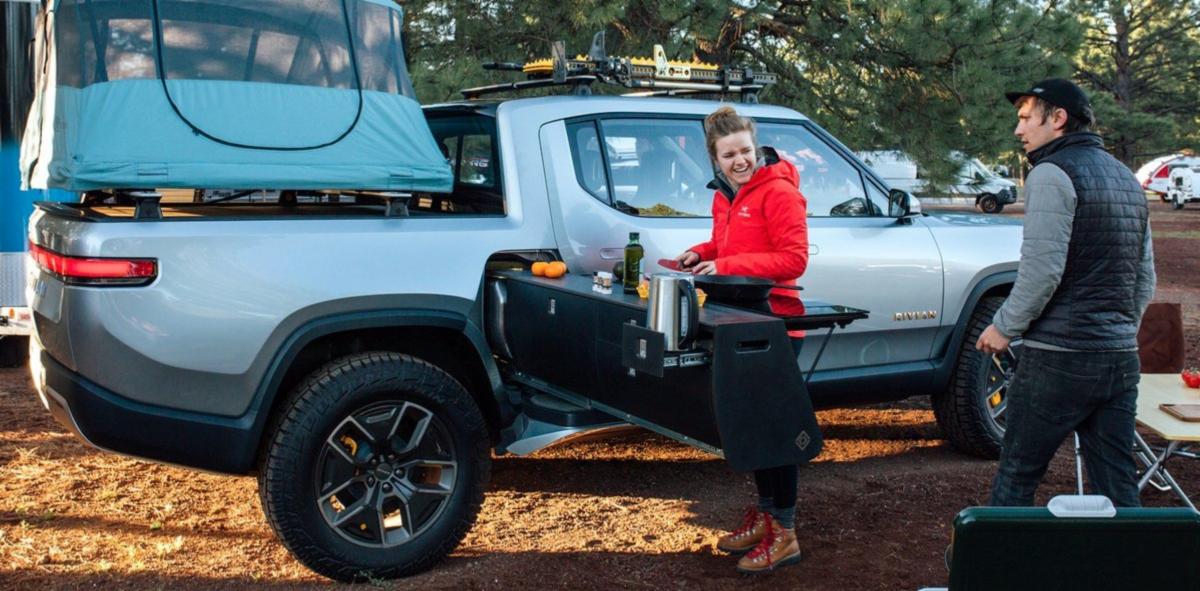
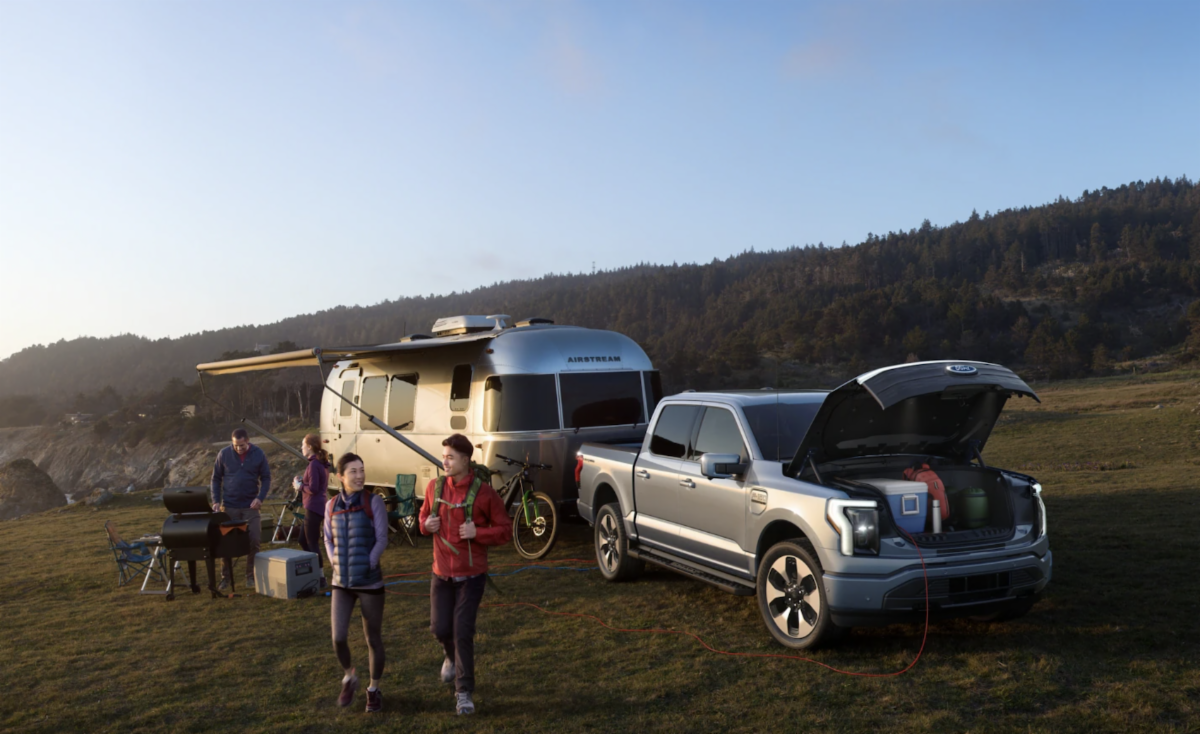
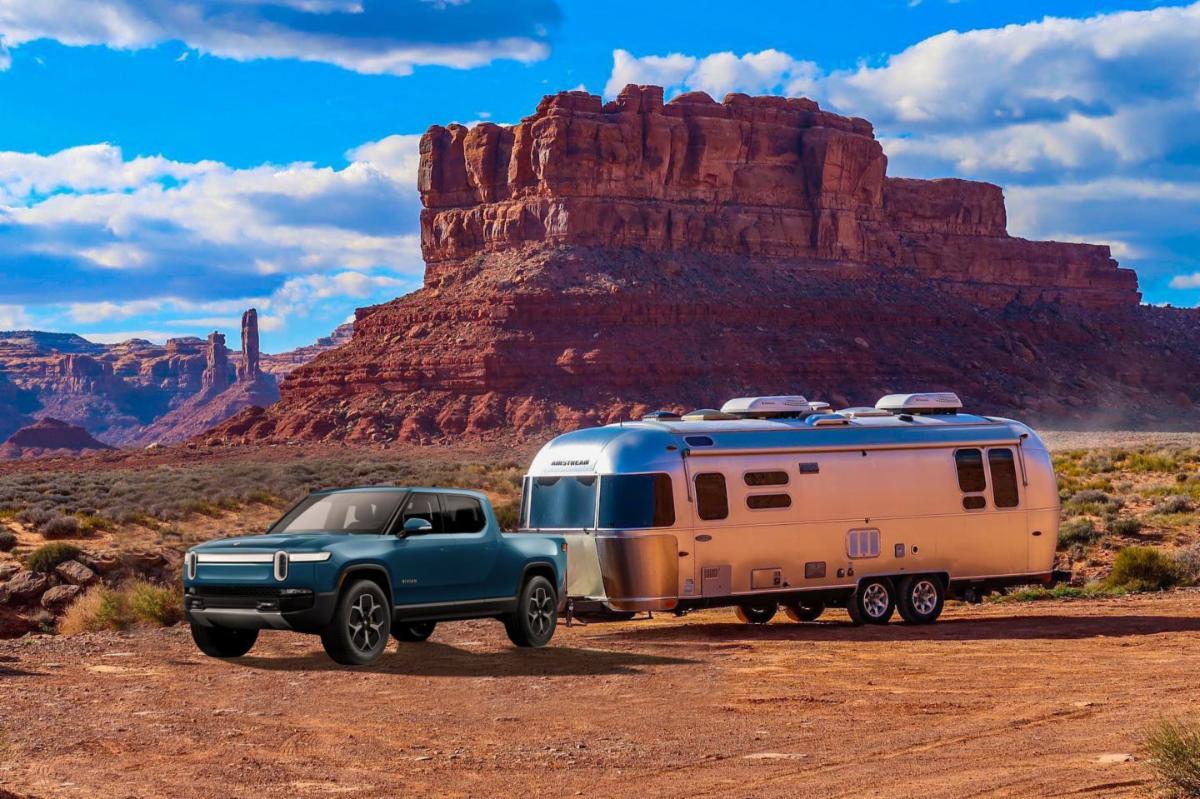
Full size Tundra is right up against it's maximum axle loading pulling 7,500lb trailer. Could it be replaced by a Ford Lighting or Rivian? | Blurring the line between camping and 'glamping'. Would we have to give up the comforts of home and get a smaller trailer if we went electric? Would this have any affect on range? | |
R1T is marketed to well-off 30 somethings with active lifestyles.
Rivian has announced that they will build an 'Adventure Network' of fast chargers near popular camping and recreation areas, starting in 2023. Presumably this would include some Canadian sites.
| |
|
The production Rivians are set to start being delivered this summer. The F150 Lightning will start shipping in Q1 of 22. A version of the GM Silverado will follow.
All the numbers are my own estimations - your mileage may differ!
Ford has not released the size of their battery pack or usable capacity, but most estimate a 150kWh battery pack for the long range version. The Airstreams pictured are 24ft (?), and would likely weigh in the 5,000lb range, about 1,500lbs lighter than the author's beastly Silver Streak.
The unloaded consumption of both EV Trucks should be about 30kWh/100km - about 50% more than the typical EV sedan. Using the same 170% consumption increase as the Tundra, gives approximately 50kWh/100km consumption for the electric trucks pulling the Silver Streak across the mountains.
I would expect the effect of pulling the trailers on consumption to be less with an EV for a a couple of reasons:
- One, the electric motors develop more torque and only have one gear. The Tundra has to downshift often, and needs to use high revs on grades - up and down.
- Second, the EV will be able to generate significant electrical recuperation on the long downhill stretches, where the Tundra turns that energy into (a lot) of heat. One of the main advantages of the EV Truck is that I shouldn't have to worry about brake temperature, and this with the added bonus of 'free' electricity.
In the interest of conservatism I kept the 170% consumption increase factor for this comparison, but I would expect it to be less - perhaps 150% or 45kWh/100km on these routes. We'll know more once these trucks land in customers hands.
| |
|
TOW Vehicle: Ford F150 Long Range
Battery: 150kWh
Battery (Useable): 135kWh est.
MAX Towing Capacity: 10,000lbs
Consumption (unloaded): 30kWh/100km
Trailer Example: 1978 Silver Streak
Dry Weight: 6,500lbs
Loaded Weight: 7,500lbs
Consumption (loaded truck/trailer): 50kWh/100km
Comfortable Range w/trailer: 250km est.
| |
|
TOW Vehicle: Rivian R1T Longest Range
Battery: 180kWh
Battery (useable): 165kWh
MAX Towing Capacity: 10,000lbs
Consumption (unloaded): 30kWh/100km
Trailer Example: 1978 Silver Streak
Dry Weight: 6,500lbs
Loaded Weight: 7,500lbs
Consumption (loaded truck/trailer): 50kWh/100km
Comfortable Range w/trailer: 300km est.
| |
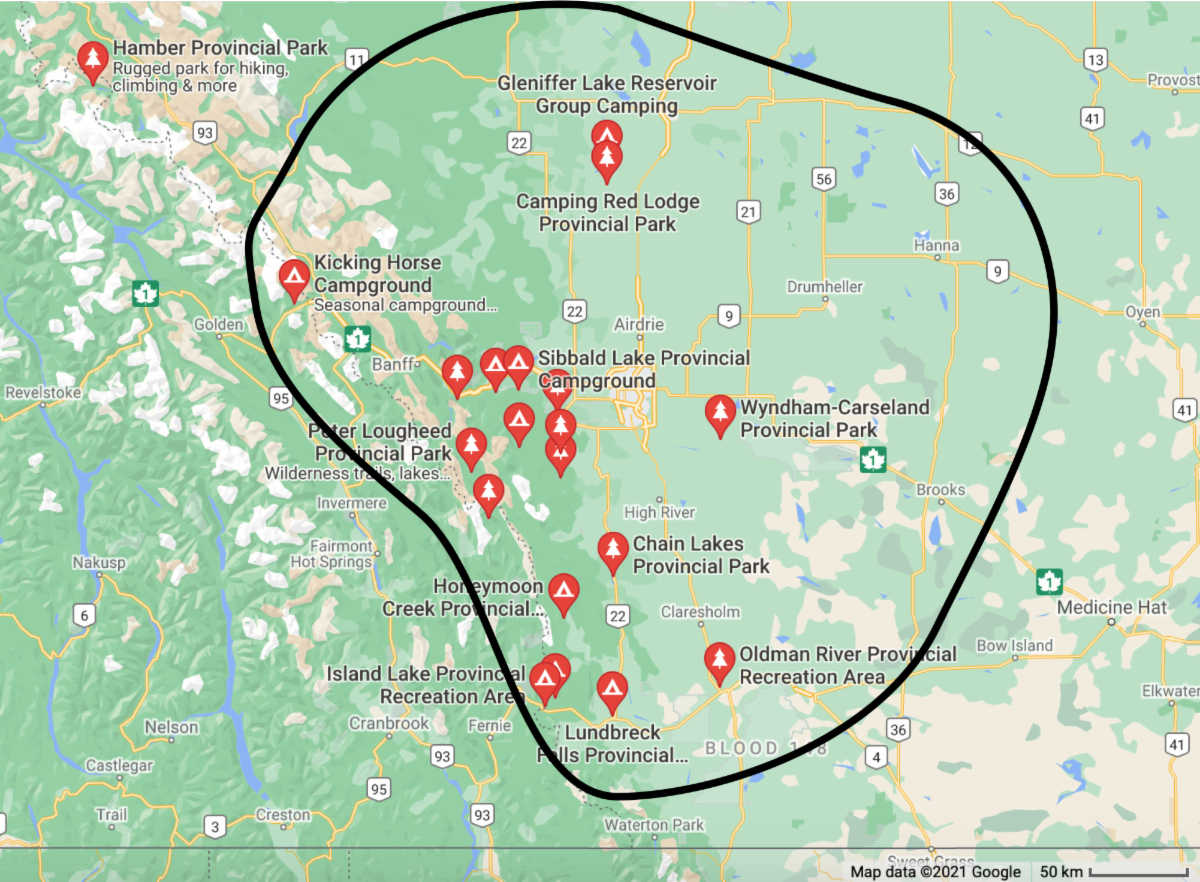
Camping spots within 250km driving from Calgary | |
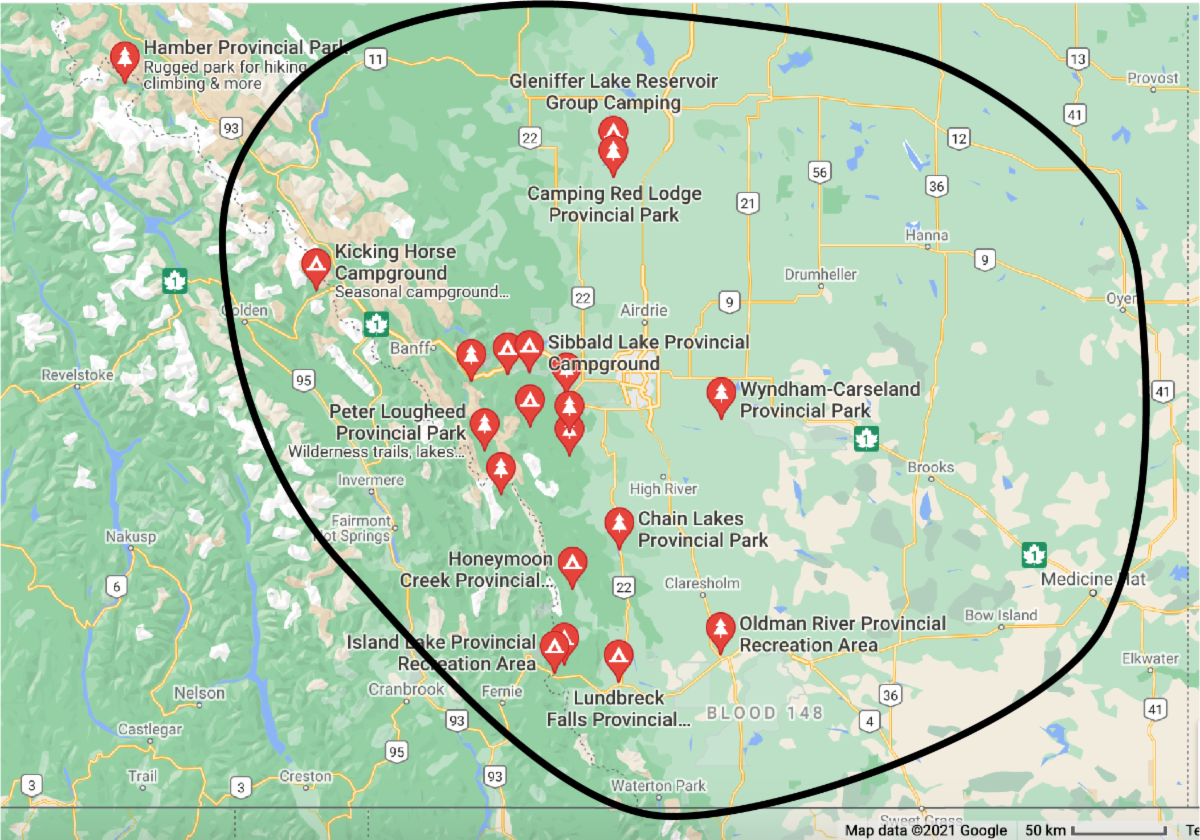
Camping spots within 300km driving from Calgary | |
|
It turns out that the 50km range advantage of the Rivian with its 180kWh battery pack, vs. the Ford's with 150kWh, makes a pretty big difference travelling from Calgary with a heavy trailer. 300km puts you within a lot of places that we usually go: Fernie, Invermere, Fairmont, Radium, Golden, Waterton and Medicine Hat are within reach. With a 250 range we would be limited to Kananaskis, Banff and Lake Louse,
What would the affect on consumption be if the trailer were the 5,000lb 24' Airstream vs. Silver Streak? I would say that most of the incremental consumption is due to air resistance rather than weight, so I don't think shaving 1,000lbs would add more than 20km of range.
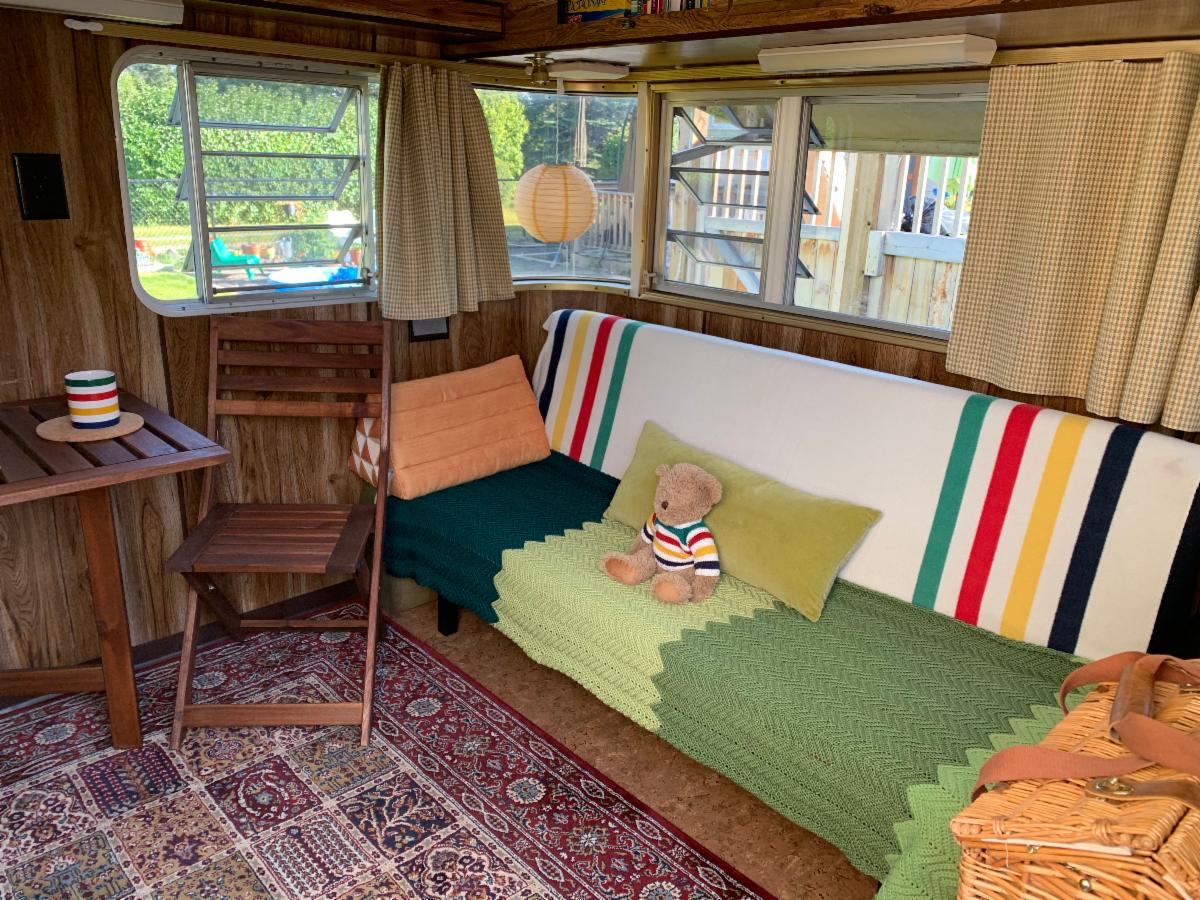
So for us, the Rivian would be the clear choice, as the main reason we have a truck is for camping. The increased range from the Rivian's battery makes all the difference. If we downsized the trailer dramatically, we could perhaps get the range back up, but now that I've replaced every mechanical system in the trailer, I don't want to start again!
| |
|
CHARGING
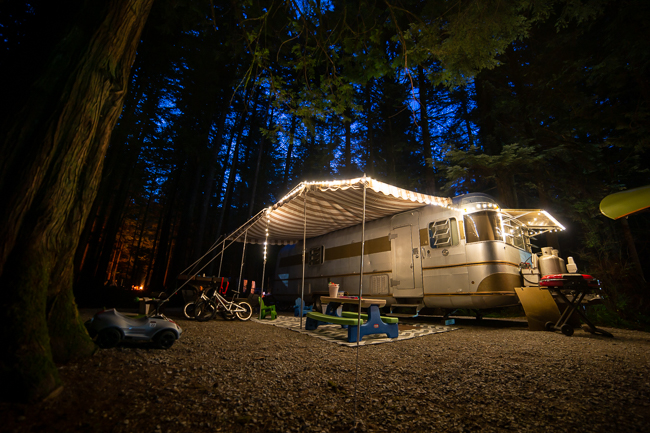
Campgrounds can offer unserviced, electrified (usually with a 50amp service), and fully serviced with power and sewer. The nicest camping spots, like the one above in Golden Ears Provincial Park near Maple Ridge, BC, are unserviced, though they generally allow a few hours of generator time to charge the RV batteries. The fully serviced sites are more densely populated. A 50 amp service should be ample to charge your EV Truck overnight, and shouldn't overtax the system - at least if there aren't too many!
If we wanted to keep staying at unserviced sites, we'd probably have to stay one night at a serviced site, then move to a nicer spot. If you stick to electrically serviced campsites, you can go from location to location without stopping at a fast charge DC station - in theory.
Changing to an EV truck with trailer on the road would be challenging. Pulling 50 feet worth of road train up at a petrol station, then seeing if you have space to get out, is difficult enough. It would be less convenient at a charging station which mostly are not pull-though - most likely I would have to de-couple the trailer to charge the truck, which is a pain. Then, even with the Petro Canada fast chargers along the Transcanada, I wouldn't count on more than 100kW charge rate on average, making the 'refill' a 2/3 hour ordeal. Not the end of the world, but I wouldn't want to have to do it every time.
| | |
|
|
As Lucille Ball and Desi Arnaz demonstrated hilariously in 1953, RV'ing can be a little hard on the nerves - and they didn't bring 3 kids along. An Electric Truck adds another layer of complexity, but it should be able to be overcome with a modicum more planning.
What I worry about most towing our trailer is brake temperature. On anything steeper than a 10 degree slope, the Tundra is in first gear pegged near the 6k red line, and I still have to be on the brakes. Sometimes I get the familiar (from the race track) smell of burning pads. I don't want to get a bigger truck, because the Tundra is already unwieldily in the city. A truck with high-torque electric motors that can hold a speed on a decline while charging the battery is a major benefit. I could leave the Honda generator behind as well.
That, and it would feel better rolling into some of these ecologically sensitive areas on electricity.
| | | | | |