|
|
800 Vinial Street, B408
Pittsburgh, PA 15212
Phone: 724-831-8353
January 2020
|
|
|
|
What do you want to accomplish this year?
|
The New Year is the time for new beginnings, leading - hopefully, to new accomplishments.
- For SLPs, what do you want to accomplish this year with your clients? For yourself?
- For People with Aphasia, what is something that you want to try? Remember there's no shame in failing, only in not trying.
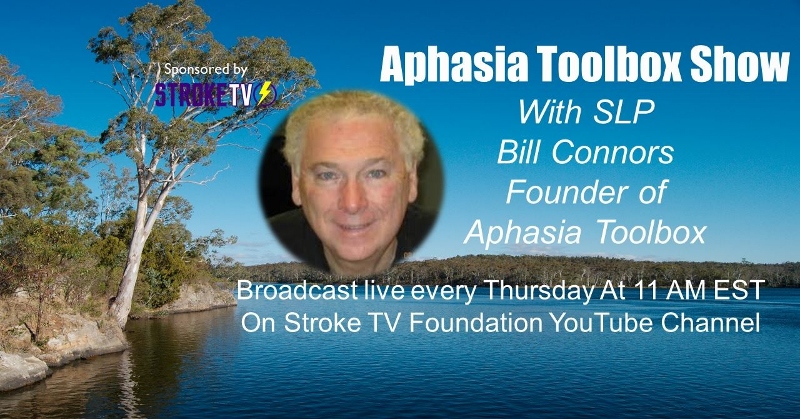
The show features host Bill Connors with his 46 years of rehab experience, producer Liana Trashnoy, and
Stroke TV
Support Directors Aaron Avila and Jerry Wald.
The goal of the
Aphasia Toolbox Show
is help people who have experienced a stroke or brain injury to maximize their recoveries. A focus on rehabilitation, whole person recovery, and the best and newest tools & treatments will dominate the shows.
Read Bill's notes about his new program in the next Section.
You can join Bill and the Aphasia Toolbox Show live using this link:
For a free consultation with the aphasia experts,
Click here
.
|
|
|
|
Join me on Thursdays on Facebook at 11 AM EST for the
live broadcast
of the Aphasia Toolbox Show.
While speech, communication and cognition with will be front stage, the whole person recovery process will always be in the forefront. This means discussions about health; sleep; hobbies; exercise, spiritual; alternative treatments, music; family, and more. While we will have invited experts and recovery-experienced guests; our emphasis will be on interacting with our audience, experts in their own right. Each show will have plenty of time for Q&A, free advice and laughter.
Scheduled topics include:
What is Whole Person Recovery?
What is aphasia and how do I best improve?
Is there a plateau for recovery?
What is the difference between aphasia and apraxia?
Can a person fully recover?
What is telepractice (rehab over the internet)?
Why is exercise so important?
What are some tools for speech and language recovery?
What is intensive treatment? How much does that cost?
What is the value in groups?
…and more
These are the recordings of the first two episodes:
January 16, 2020
January 23, 2020
|
|
|
|
EverythingSLP - Acquired Apraxia
|
The treatment of clients with acquired apraxia can be one of the most challenging undertakings for the medical SLP.
EverythingSLP
offers this flow chart
, which specifies progressive steps in addressing apraxia that affects: gestural communication; voice-phonation and articulation.
FYI
- The programs for phonatory and articulatory apraxia are in press with an estimated later 2020 publication.
Go to
EverythingSLP
to "Sign In" or "Create an Account."
|
|
|
|
It’s the number one cause of adult disability in the U.S., yet we generally don’t see the toll it takes on patients, their families and their communities. Scientific American blog, By Michael Chen, December 26, 2019
Doctors told me I'd most likely never run again, but I proved them wrong. I certainly didn’t fit the classic profile of the aging stroke victim. At the time of my brain explosion, I was 38. I’d run eight half-marathons and had a diet and exercise regimen that helped me cross those finish lines. But I also had an intense job that involved booking groups—including NBA teams—into hotels in San Francisco. That’s what I was doing at 2 a.m. on the Friday before Christmas in 2013, welcoming the Los Angeles Lakers to their hotel. I got four hours of sleep that night, then drove 90 miles to my mother’s house to drop off holiday gifts. On Sunday morning I was supposed to meet another sports team. But by that time, I was fighting for my life. Prevention Magazine, December 2019
Abstract:
Language impairment, or aphasia, is a disabling symptom that affects at least one third of individuals after stroke. Some affected individuals will spontaneously recover partial language function. Nature Reviews Neurology volume 16, pages 43–55(2020)
Hypertension is the medical term for high blood pressure, or when blood vessels cannot relax enough and create higher resistance to blood pumping through the circulatory system. So, it plays an important role in heart health. In fact, according to the Centers for Disease Control and Prevention about 70% of Americans who have chronic heart failure and 80% who have a stroke also have high blood pressure. Here’s what you need to know about how hypertension, heart disease, and stroke are related. Business Insider, January 29, 2020
|
|
|
|
|
|
|