“I am no longer accepting the things I cannot change. I am changing the things I cannot accept." - Angela Y. Davis | | | | |
(313) 305 - 0311
CAM Call Line Operating hours:
Monday through Friday, 8am - 6pm
Visit camdetroit.org for the latest information on CAM services and any upcoming closures.
| | Access to CAM services: Call CAM at (313) 305 - 0311 or go to one of the following Access Points for in-person assessments. | | |
NOAH at Central
(Formerly NOAH Project)
23 E. Adams, 2nd Floor
Detroit, MI 48226
Mon - Thurs, 9:30am - 2pm
| |  | |
Cass Community
Social Services
11850 Woodrow Wilson St
Detroit, MI 48206
Mon - Fri, 10am - 6pm
| | | |
Detroit VA
(For Veterans only)
4646 John R
[New Location] Blue Tower, 7th floor, RM A7175
Detroit, MI 48201
Mon - Fri, 8am - 4:30pm
| | Detroit CoC Competition Update | |
The Detroit Continuum of Care (CoC) is preparing for the 2025 renewal competition following new guidance from HUD. Although 2025 was initially expected to be a non-competitive year, HUD announced on July 3rd that it will release a 2025 Notice of Funding Opportunity (NOFO). This means the CoC will participate in the full competition cycle, including submission of both individual project applications and the CoC application.
The CoC competition is a competitive national funding process. HUD evaluates each CoC based on performance metrics and the strength of its application. The higher the score, the greater the potential funding awarded to our community.
Key Changes for this Year's Competition:
-
Unexpected Competition Year: Although the 2024 NOFO was a two-year notice, HUD confirmed that a full CoC competition will take place in 2025.
-
Potential for New Funding: HUD’s most recent communication suggests there may be opportunities for new project funding, particularly for street outreach and transitional housing.
-
Shortened Timeline: All renewal application materials must be submitted by 12:00 PM on July 24, 2025.
-
Streamlined Application Process: Narrative questions have been removed and the focus is on performance data from calendar year 2024.
-
Minimal Scoring Adjustments: Two new scoring elements have been added for the coordinated entry grant administered by HAND.
Watch the webinar on our YouTube channel.
| | |
General Membership Meeting
July 15 | 1:30p
| | |
Join us at today's virtual General Membership Meeting. These meetings are an opportunity for the community to receive systems-level updates, offer feedback on current initiatives and programs, and learn about the homeless service system. The next General Membership meeting will be September 16.
Register for the meeting here.
| | |
Our homeless response system, which provides critical support to people experiencing homelessness in Detroit, Hamtramck, and Highland Park, is facing a crisis. The 2024 Point-in-Time count showed a 16% increase in homelessness in Detroit, with a 35% rise in families experiencing homelessness. Chronic homelessness also surged by 26%, underscoring the need for expanded resources and policy interventions.
Read the full letter here.
| | |
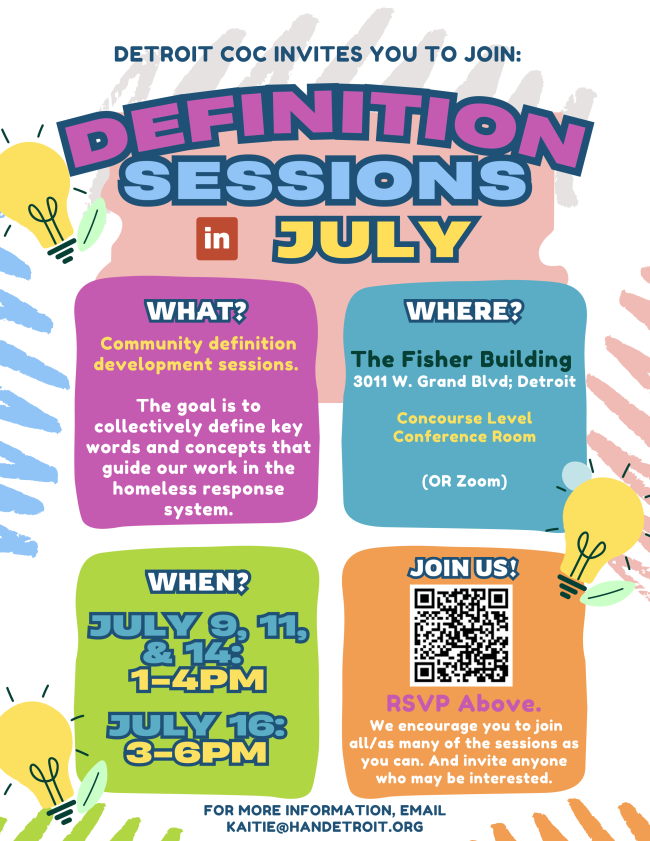
Definition Sessions in July
Last session July 16
| | |
You are invited to join our CoC series of community sessions to help us develop definitions related to our work in the homeless response system.
Our CoC has been involved in a Community of Practice (CoP) working to improve how we center People With Lived Experience of Homelessness (PWLEH) in the system. As part of this CoP, we have developed a series of goals that we want to accomplish as a community. If you're interested, you can read more about the CoP and our goals here.
The last of the 4 sessions will be offered in a hybrid format with in-person and virtual options. The in-person sessions will be held at The Fisher Building, 3011 W Grand Blvd. The virtual sessions will be held via Zoom.
Register by scanning the QR code or via this form.
| | |
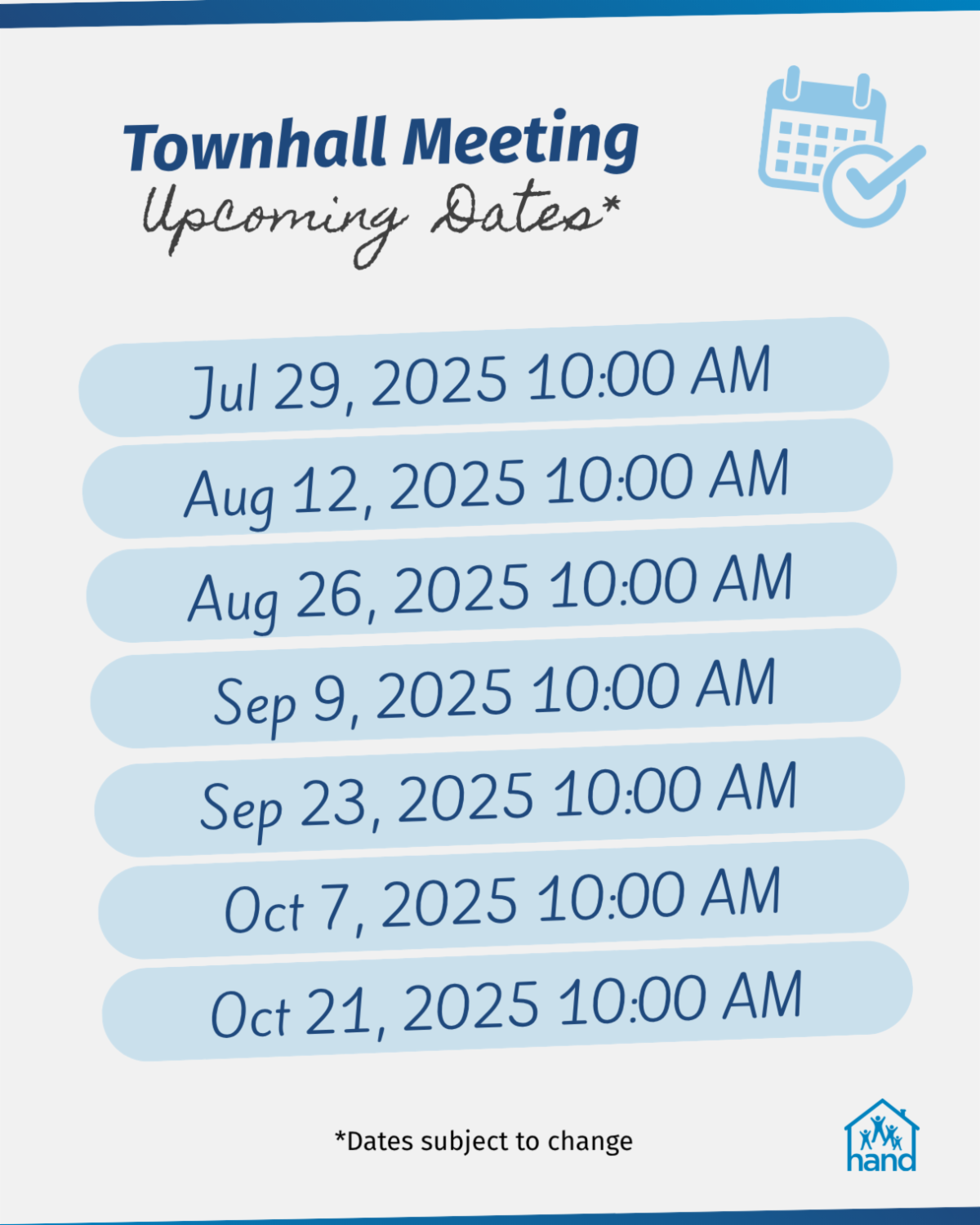
Detroit CoC Town Hall
July 29 | 10am
| | |
Join us July 29 for our next Town Hall to understand the recent changes to our federal government and their wide-ranging impact on the Detroit CoC homeless response system.
These meetings address changes to our federal, state and local landscape such as the FY2026 Federal Budget, Big Beautiful Bill, and other updates. It offers advocacy options and gives community members a chance to give input and solutions.
Register here.
These meetings are recorded and the June 15 meeting will be uploaded soon to our YouTube channel soon.
| | | LMS users have access to a wide range of trainings. The latest trainings are listed below. | | |
The Whole Person Model:
A Person-Centered Approach
July 30 | 2:00 PM
| | |
Join MCAH for a two-hour interactive webinar on The Whole Person: A Person-Centered Approach for housing and homeless service providers. This session will explore how centering the individual in our work improves service outcomes, strengthens relationships, fosters trust, and empowers the people we serve.
By the end of this webinar, participants will be able to:
- Define and explain the key principles of the person-centered approach.
- Understand why this framework is essential in supporting people experiencing homelessness.
- Identify practical, everyday strategies to implement person-centered values in their roles.
This session is ideal for anyone working in direct service, supervision, or systems-level coordination who wants to deepen their impact by putting people—not programs—at the center of their work.
Register for the training here.
CEUs Available. Contact agreen@mihomeless.org.
| | FY26 Federal Budget Update | | |
The National Low Income Housing Coalition recently released their updated analysis of the FY26 draft budget as issued by the House of Representatives Appropriations Committee:
"The U.S. House of Representatives Committee on Appropriations released their draft fiscal year (FY) 2026 Transportation, Housing and Urban Development (THUD) spending bill on July 13. The THUD spending bill provides annual funding for the vital HUD programs and services people and communities rely on for affordable, accessible housing, rental assistance, homelessness services, and community development programs.
The House’s proposal would fund HUD at $67.8 billion, a decrease of $939 million from FY25. For details, see NLIHC’s updated budget chart. While this means lower funding levels for key affordable housing programs than last year, the House’s spending bill largely rejects the severe cuts proposed by President Trump in his FY26 HUD spending request, which would have damaging impacts on the people and communities HUD programs serve."
Read the full brief here.
| | |
Big Beautiful Bill 101:
What You Need to Know About the New Law
| | |
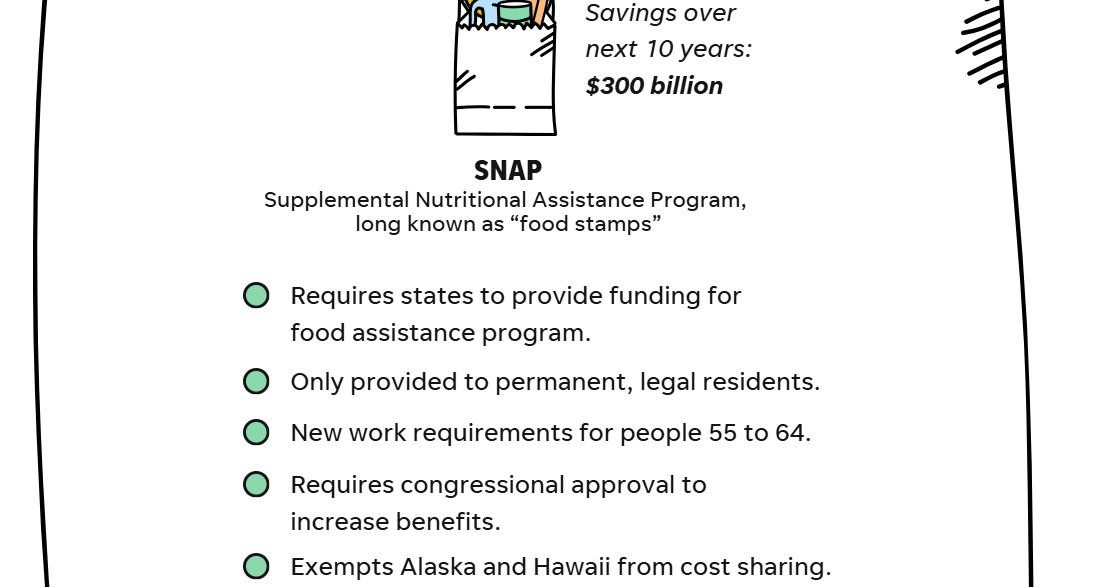
"The Penn Wharton Budget Model forecasts that the lowest-income households will be left worse off because of cuts to Medicaid and SNAP, formerly known as food stamps. Those Americans could lose $27,500 over a lifetime, while the highest-income households would gain more than $65,000."
Read the full article here.
| | | I Am a Homeless Teenager in Detroit. I’m Also an Honors Student, A School Leader, And a Poet. | | |
"With our eviction, I became one of nearly 1.4 million students in America who experience homelessness during the school year — a staggering statistic. Michigan, where I live, is home to more than 35,000 homeless students, with many of them residing in Detroit."
Read the full article on Bridge Detroit's website.
| | |
Housing-Focused Street Outreach:
Promoting Health and Safety for All
July 30 | 3pm
| | |
A comprehensive Housing-Focused Street Outreach strategy must consider the health and safety of people experiencing unsheltered homelessness, the broader community, and the dedicated staff who work with the most vulnerable populations. To achieve this, outreach teams must adopt practices that promote well-being, reduce harm, and foster safe environments for all. In this webinar, hear from communities that have successfully integrated health and safety practices into their Housing-Focused Street Outreach strategies. Communities will share lessons learned, practical approaches, and the impact of their efforts on both individuals and the wider community.
Register for the webinar here.
| | |
Understanding Contingency Management:
A Foundational Webinar for Homeless Service Providers
(Pre Recorded)
| | |
Contingency management is a psychosocial therapy that uses rewards to incentivize people to reach their substance use goals. Decades of research have shown that contingency management programs help people decrease and stop stimulant drug use. As stimulant use and stimulant involvement in fatal overdoses have both increased in recent years, having an intervention to help people decrease or stop their use has become even more important. There are currently no FDA-approved medication treatments for stimulant use disorder.
This webinar will provide attendees with a foundational understanding of contingency management and how it works to support individuals experiencing homelessness with substance use or co-occurring disorders. Attendees will hear from two programs about how they use contingency management—what has worked, what has been challenging, and how other programs might develop contingency management programs of their own.
Watch the webinar here.
| | |
2025 Data Summit: Leveling Up Your Data
July 21 - 24, 2025
| | |
Get ready to level up your game at the 5th Annual virtual Data Summit hosted by the Michigan Coalition Against Homelessness! Join them as they bring together experts from across the field to share insights, strategies, and innovative solutions for preventing and ending homelessness.
This year's theme, 'Leveling Up Your Data', promises to challenge and inspire attendees as we explore new ways to make a real impact in our communities. Don't miss out on this exciting opportunity to connect, learn, and take your data to the next level!
Register here.
| | |
Project Based Voucher Program
Waiting Lists Open
| |
The Project Based Voucher Program (PBV Program) is designed to provide low and moderate-income individuals and families with housing assistance in specific units contracted with Detroit Housing Commission (DHC). The housing assistance is provided to income-eligible applicants who are approved for tenancy at the contracted location. You apply to the PBV location waiting list of your choice. The Project Based Assistance is only available to those selected and approved from the program site waiting list.
Visit the Detroit Housing Commission's website to apply.
| | | | |
DWIHN 24-Hour Helpline
1-800-241-4949
The Detroit Wayne Integrated Health Network (DWIHN) offers 24-hour phone service for those seeking mental health support.
| |
My Safe Space Crisis Hotline
For young adults (313) 844-9136. The MCHS hotline connects youth experiencing housing and mental health crises to short-term mental health services.
| |
Corktown Health
Financial Assistance
The Housing and EFA programs provide emergency financial assistance to households experiencing utility shutoff, eviction, and first month’s rent for a new move. This assistance is designed to help clients living with HIV stay engaged or reengage in medical care.
Find out more about the program on Corktown Health's website.
| |
Detroit Health Department
Harm Reduction Wellness Stations
These Harm Reduction Wellness Stations provide free supplies to help prevent disease, reduce overdose risks, and make substance use safer. This initiative helps protect the health of Detroiters by giving residents the tools they need to stay safe.
Find more information about the stations the Detroit Department of Health's website.
| | |
Rides to Care
Whether you're pregnant, a new mom, or a caregiver, you can get free rides to doctor appointments. This new Detroit Department of Health program provides transportation for prenatal and postpartum care up to the baby's first birthday.
Rides are available
- Monday - Friday, 8 a.m. - 6 p.m.
- Saturday, 8 a.m. - 2 p.m.
- Services are not available on holidays
To schedule a ride, call (313)876-0000
For more info, visit detroitmi.gov/ridestocare
| | Detroit Affordable Housing Database | Find affordable rental housing in Detroit on Detroit Home Connect, a resource to find multi-family housing based on your income and household needs. View the current listings at the housing database website. | | | HAND has created shareable sheets that list local resources available to assist individuals with basic needs. Whether you’re looking for food assistance, medical or other needs, these sheets will help you find them. View all of our resource sheets here. | | |
I have cities, but no houses.
I have mountains, but no trees.
I have water, but no fish.
What am I?
| | | |
Do you have questions about the newsletter? Want to submit an item?
Email Kimberly Benton at kimberly@handetroit.org
| | | | |