Your Monthly News & Updates | |
|
|
There are so many ways to count a year. The universal way - from New Year's Eve to New Year's Eve, The individual way - from birthday to birthday. Or maybe you're a kid at heart and think of school years. Or maybe you have your own very personal way. For me, it is blueberry picking. As a kid my family would go off into the woods and pick blueberries and then gorge ourselves on blueberry pancakes, muffins, and pies. Even during the great drought a few years ago, when most of the blueberries had dried to nothing, we hunted and hunted until we had at least enough to make a couple of pancakes. Over the years, I have also learned that the best day to go out picking is on my mom's birthday which makes the day even all that much more special.
Of course, there isn't anything quite so Medfield as picking blueberries, is there? The Native American tribes that called this land home for thousands of years before the first European settlers arrived cared deeply for the earth. They would burn the meadows each fall to keep trees from taking hold. This meant that when the settlers first arrived, what they found were abundant fields full of tall grasses to feed their cattle, fields ready to plow, and lots of native berries. I think of this every time I walk in the field behind the former state hospital or behind Wheelock. We are so fortunate to live here!
So many of us continue to be great stewards for this place we call home. And this month, many volunteers got the privilege of sharing our lovely town with Congressman Jake Auchincloss. He was quite impressed by the high levels of historic pride and civic engagement. Thanks to an awesome and growing group of volunteers, we have been making incredible progress on sorting through the collections. If you're interested in joining in the fun, just say the word! We can always use an extra hand, and we'll be back to our usual Monday volunteer schedule after Labor Day.
Happy summer everyone!
| |
|
PeggySue Werthessen
President
P.S. If you aren't able to help at the museum, we could really use some extra hands with the new Medfield Magazine which can be done remotely. Feel free to reach out to me directly via mail.
| |
|
During August, the Museum will only be open to the general public by appointment. To submit a request, please contact David Temple who will help to coordinate a visit at a mutually agreeable time. Volunteer work will be scheduled separately through board members.
The Medfield Historical Society Museum will resume its usual first and third Saturday openings (10 a.m. to 12 p.m.) after Labor Day, plus Monday afternoon/evening volunteer opportunities.
| |
Historical Happenings Around Town | |
Legislative Reps Enjoy Town History Tour | |
|
by Chris McCue Potts
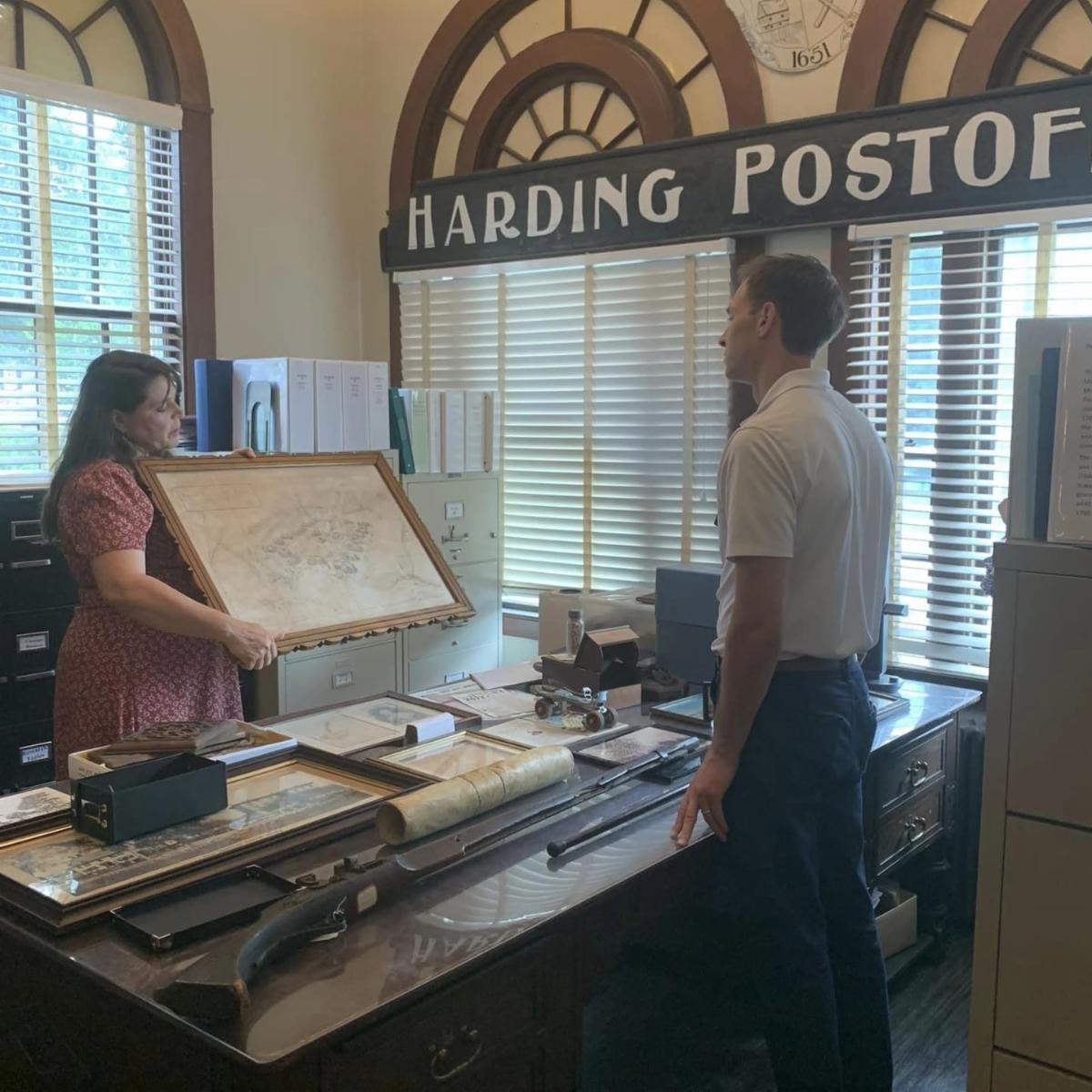
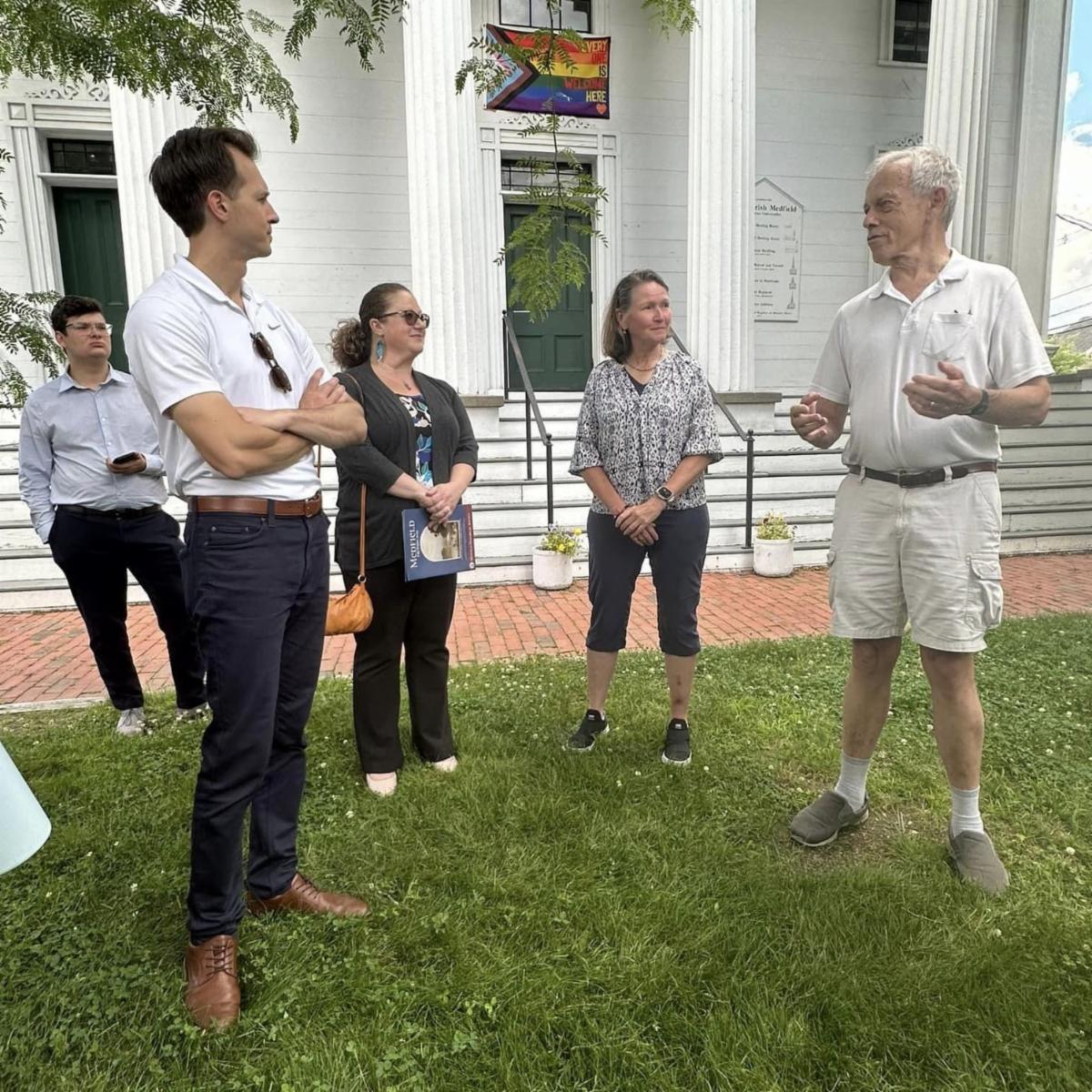
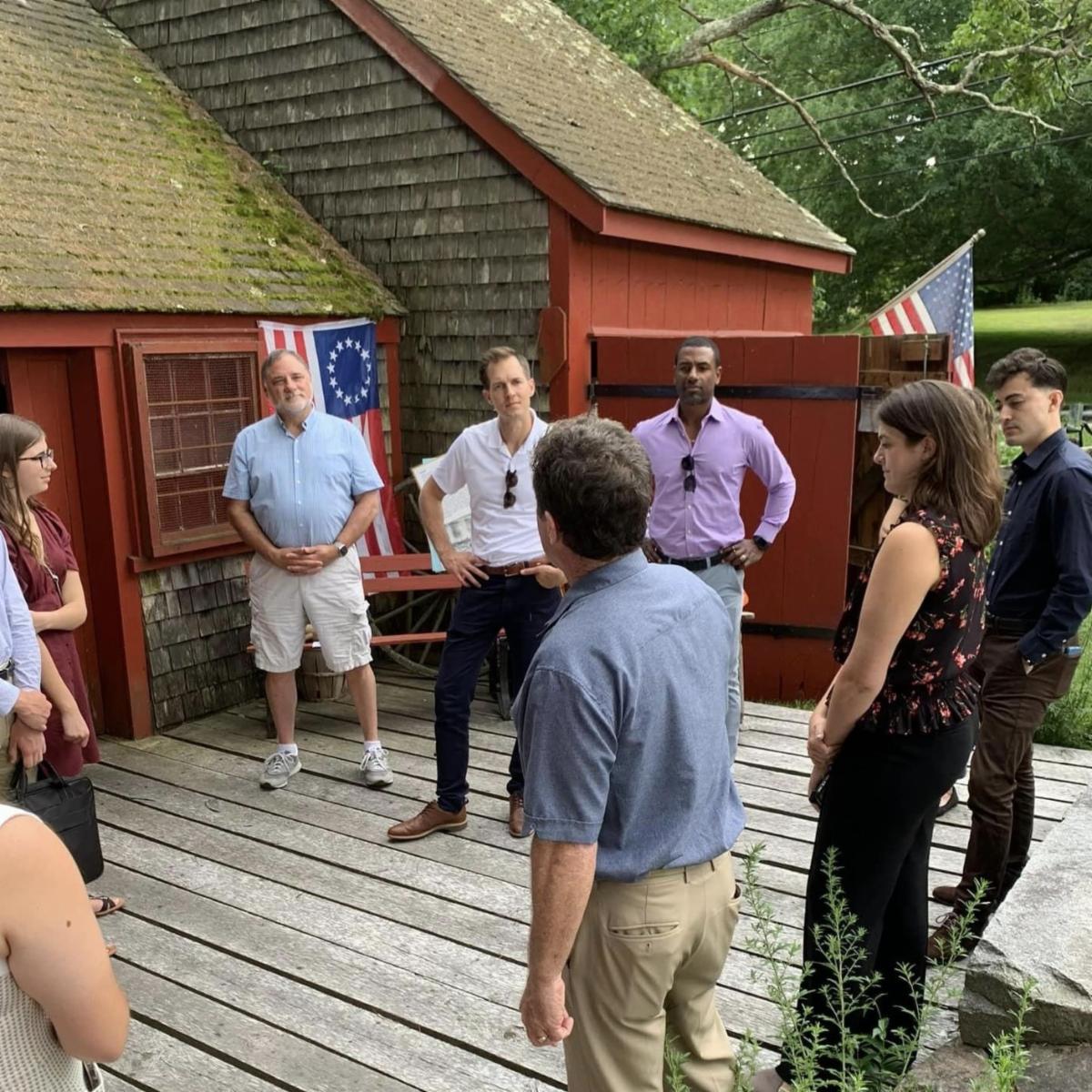
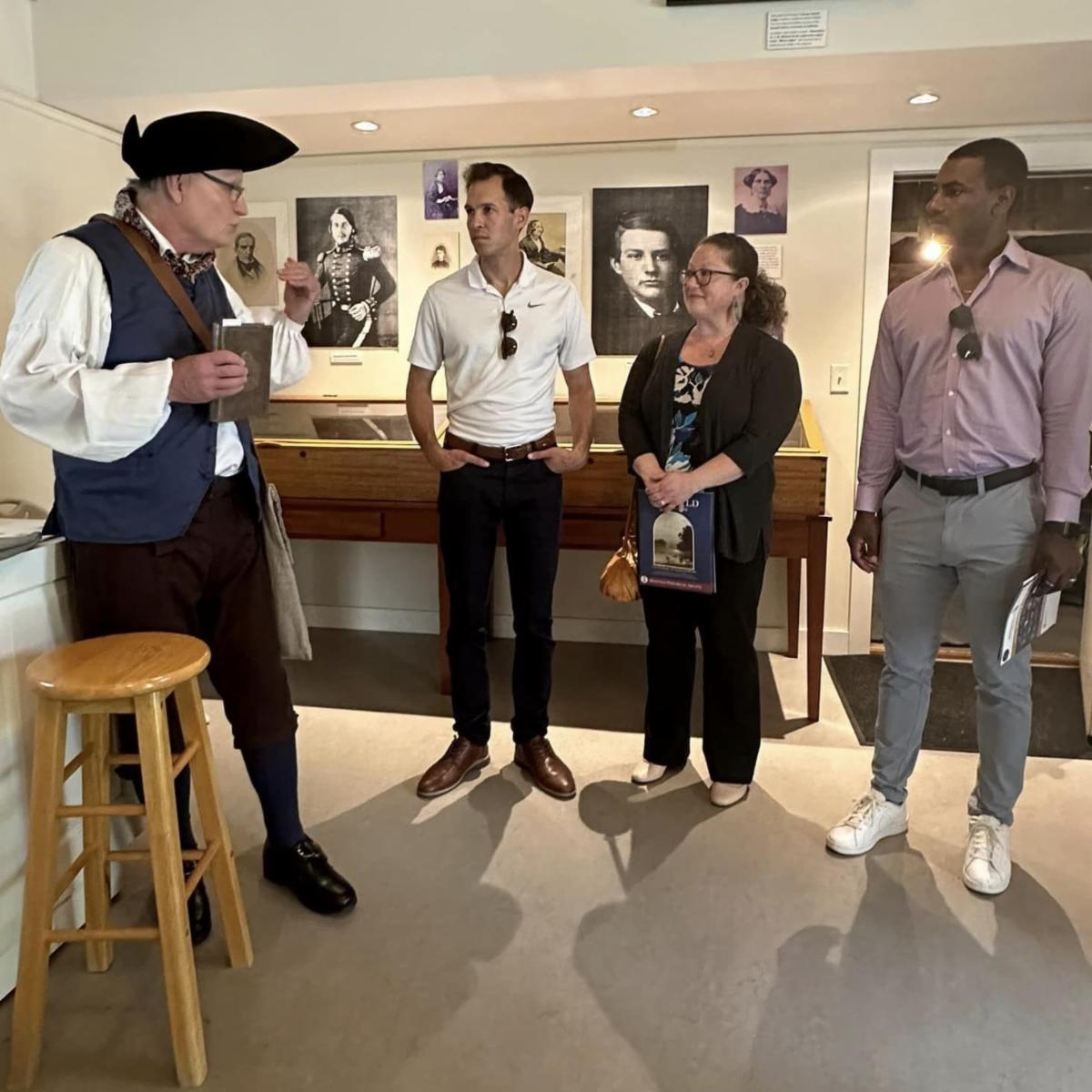
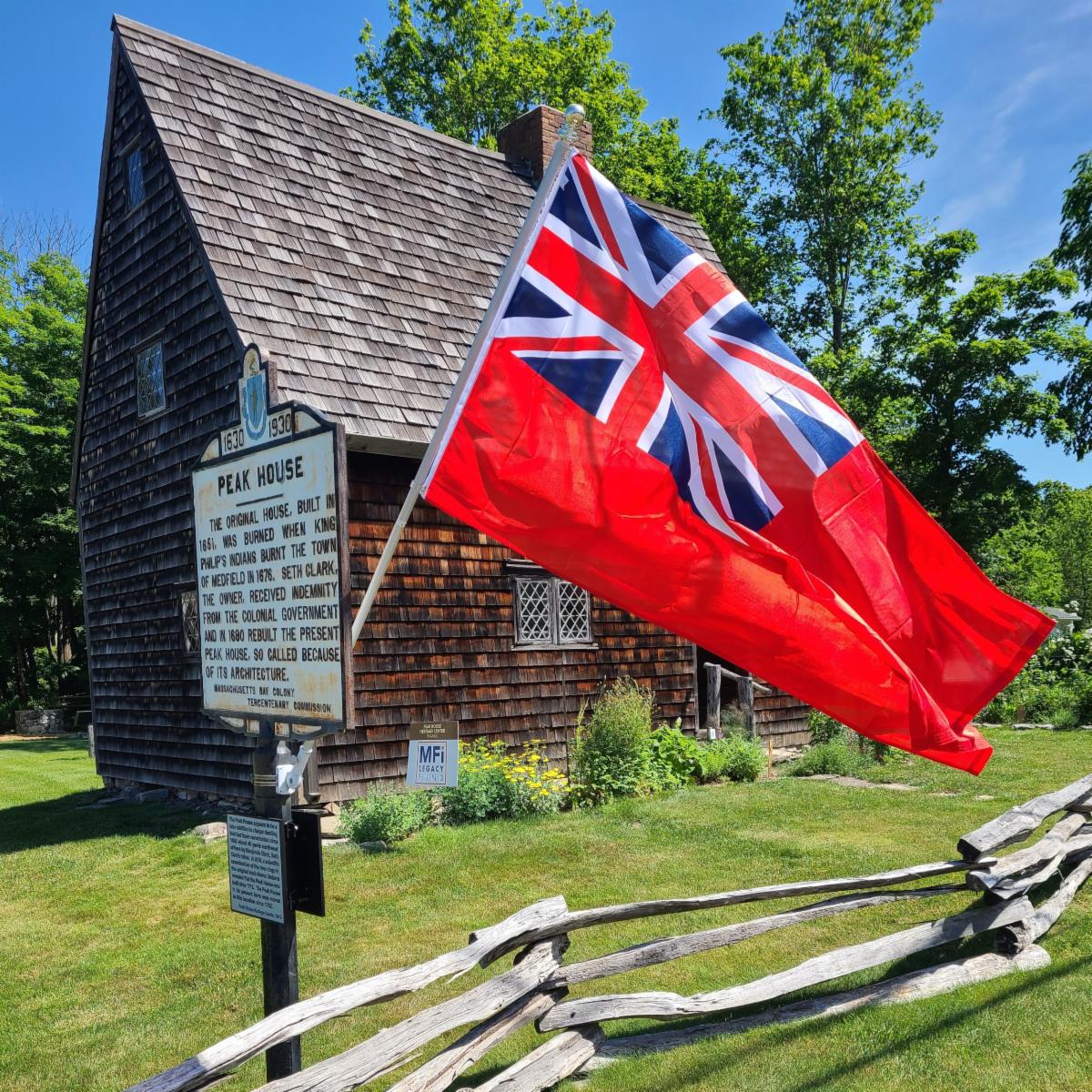
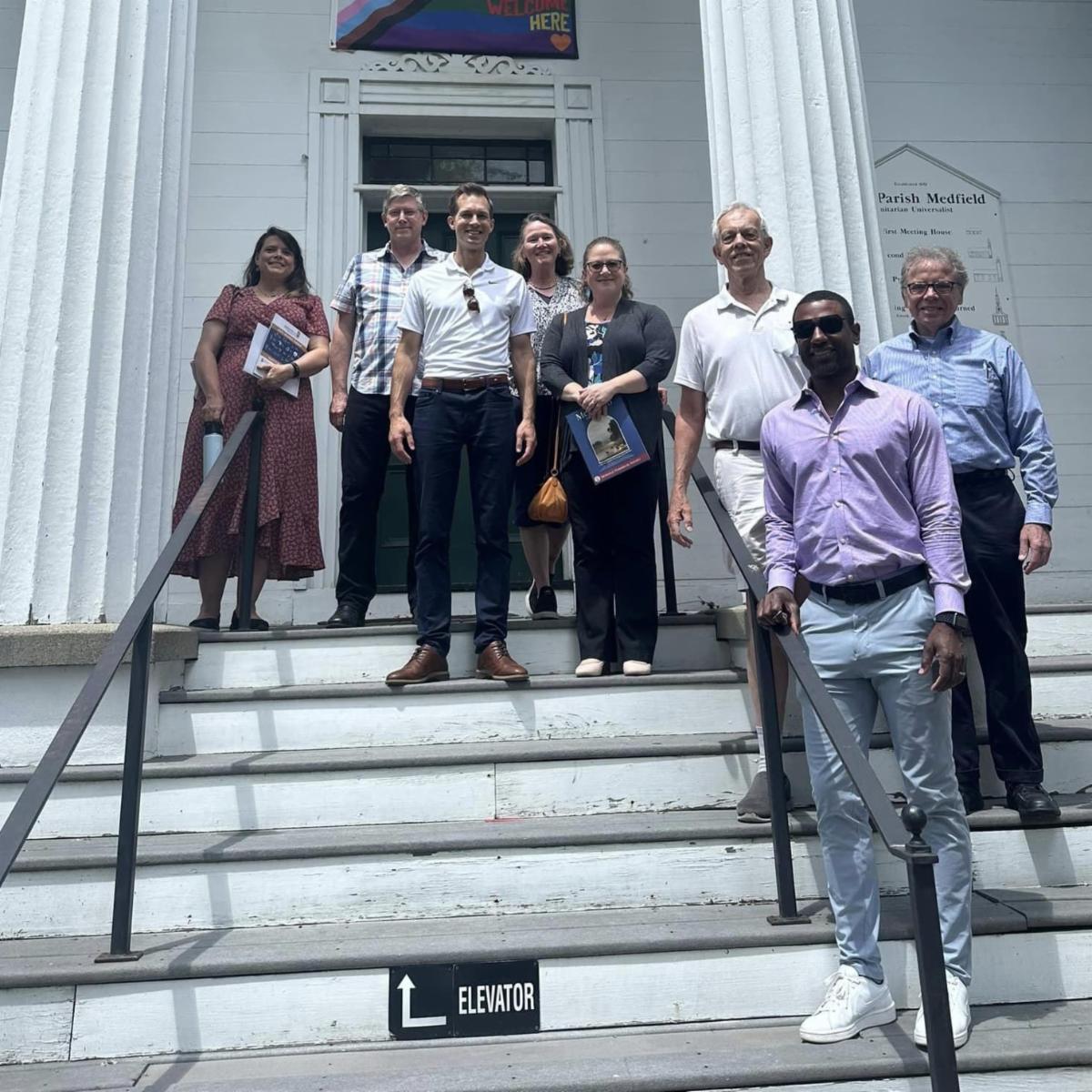
Leading up to Independence Day 2024, Medfield hosted legislators and Select Board members on July 1 for a tour of town historic sites, including Medfield Historical Society Museum, Dwight-Derby House, Kingsbury Pond Gristmill, Meetinghouse and Peak House Heritage Center.
Congressman Jake Auchincloss initiated the tour request after hearing stories about the town's history from intern Kate Anderson, a Medfield native. Joining Auchincloss for the visit were State Senator Becca Rausch, State Representative Marcus Vaughn, Select Board Chair Eileen Murphy, and Select Board member Pete Peterson. In addition to Anderson, other legislative and town staff members also enjoyed the tour.
| |
|
Medfield Historical Society President PeggySue Werthessen served as a liaison with Town Administration and other local historical organizations to establish the schedule. As a way to cover as much ground as possible within about a two-hour time frame, she allocated 15 minutes for each of the main sites, with additional information shared during brief walking stops at Medfield Public Library and Town House.
Beyond the usual historical highlights, information about the recent 3rd grade tours was shared, and Auchincloss showed an especially keen interest in the famous artists who have called Medfield home over the centuries.
As town-owned properties, the Society Museum, Dwight-Derby House and Kingsbury Pond Gristmill will soon benefit from appropriations from a $50,000 earmark obtained by Rausch. While the allocations for each site have yet to be announced, representatives from the three associated non-profit organizations expressed gratitude for any amount of funding that can help to cover capital expenses, whether a new roof, basement waterproofing, or structural repairs.
| |
The Evolution of Medfield Summers | |
|
by Chris McCue Potts
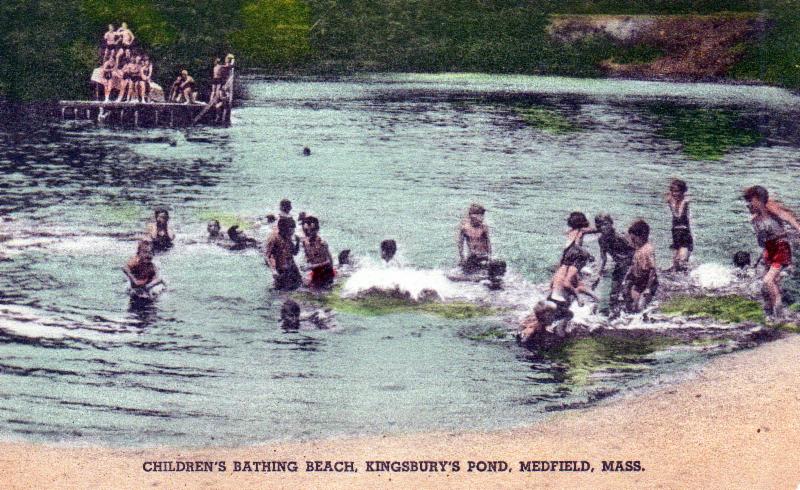
Thanks in part to its location along the Charles River and other waterways, Medfield has long been known for its abundant natural resources. It’s these very resources that attracted city dwellers to the town centuries ago.
In the late 1800s and into 1920s, Bostonians arrived to purchase large farms and convert them to summer homes and estates. Others of more modest means set up rustic summer camp tents and shacks in the Causeway-Dwight Street areas of Medfield and Millis (known as Clark’s Camps), with some of the structures still standing today.
In “History of the Town of Medfield – 1887 to 1925,” Richard DeSorgher noted that the Clark’s Camps were established in the 1880s by Joe Clark, a Civil War veteran who believed living outdoors during the summer was “the ideal existence.” After the initial tent was pitched, subsequent summers saw family members and others following suit with more tents or cottages being built. A music hall, henhouse and cook’s house were then added later. Families would reside in the camps from about June to September/October, depending on the weather.
DeSorgher pointed out that by 1908, the custom of nude swimming in the Charles River near the camps had been threatened as more and more tents and shacks were erected by summer campers. Over time, and especially after the Medfield-Millis Dwight Bridge washed out in 1936, the camps dwindled in popularity.
|  | |
|
Elsewhere in town, an especially affluent population of summer residents arrived in Medfield in the early 1890s representing high society. Large homes and estates were built, complete with landscaped lawns, fountains, fishponds and tennis courts, as chronicled by DeSorgher. The summer residencies included properties owned by a “who’s who” of prominent individuals, including Helen and J.F. McElwain, whose property at 55 Elm St. became known as “Holiday Farm” (which still exists today). J.F. McElwain was co-founder of the Thom McAn Shoe Company.
Read more >>
| |
|
by David Temple
William S. Tilden was one of Medfield’s two most important and prolific historians.
(The other is, of course, Richard DeSorgher, who grew up here, taught history and social studies here for over thirty years, published four books on Medfield history, and is still Medfield’s official town historian, though he has lived in Mashpee for almost ten years.)
Tilden (1830-1912) was a lifelong resident, music teacher, music director and organist at the Baptist church, and, in 1891, co-founder and first president of the Medfield Historical Society. He researched and wrote the 556-page History of Medfield 1651-1886, the society’s bible.
Tilden was a first-hand witness to many goings on in Medfield in the 19th century, and he wrote many short pieces as well as his magnum opus. Fortunately, Tilden had very neat and legible handwriting, and many of these pieces have been collected and transcribed and are in a loose-leaf binder at the society. It gives an often light-hearted picture of characters and events of the 19th century of our little farming village, in which the population grew from 745 in 1800…to 966 in 1850…to 1583 in 1900, not counting the 1,343 at the state hospital.
Here's a sample, written about 1880.
How the Divinity Student Preached in His Own Town
Wm. S. Tilden
Rev Pitt Clark, for many years the minister at Norton, Mass., was born in Medfield in 1763. His birthplace was on what is now Elm Street, just beyond Mill Brook. It is worthy of remark that Hannah Adams, Pitt Clark, and Eleazar Smith were born in the same neighborhood, all within eight years.
In commencing his education he studied with Hannah Adams till he was ready to enter Harvard, from which he graduated in 1790. While studying theology preparatory to his settlement at Norton, three years later, it was announced, at one time, that Pitt Clark was going to preach in the old parish church in Medfield the next Sunday. Great was the curiosity among the townsmen to hear "Pitt" preach. [They always called him by his first name here, as when he was a boy among them.]
His sister had married a young man of the town who was the acknowledged wag of the place. He it was who used to go to church on Sundays and while there was accustomed to put on an exceedingly sanctimonious expression of face, looking steadily at the seat where the boys sat. They knowing him well, could not refrain from levity; whereat he severely shook his head and the next day, meeting them, gravely reproved them for "laughing in meetin'."
When it was known that the young student was to preach, his waggish relative gave out work that he would make "Pitt" laugh in the pulpit. So when the Sunday came, he repaired to the church, and took
his seat in one of the very front pews, close to the pulpit. Then he bristled up his hair on the top of his head, and put on a countenance of great solemnity, and a semblance of great eagerness to hear. He failed to produce the effect he proposed; but the student was obliged to stand sideways in the pulpit all through this sermon, lest he should catch the eye of the mischief-maker and so his gravity be upset.
| |
People and Places of the Past | |
Stillman J. Spear: Soldier, Printer, Community Leader, State Legislator | |
|
I had a hypothesis. My hypothesis was wrong. This little story is a perfect example of how much fun it is to volunteer at the Medfield Historical Society. One line of inquiry leads to another, which leads to still another, until I am uncovering stories I never knew I needed to hear.
Old scrapbooks are fascinating precursors to Facebook, Pinterest and other forms of digital archiving. The Medfield Historical Society has a number of these hand-assembled collections of ephemera, and many will eventually be scanned for online viewing. As with every wave of technology, something is lost while something is gained. We lose the tactile and sensory aspect of connecting personally with the people who put the scrapbook together. Most scrapbooks in our collection have a unifying principle, with a family name written inside the cover, and that family’s story told through photos, clippings, and personal “scraps” that span a lifetime—sometimes, continuing for a generation or longer.
One particular scrapbook, however, has mystified me for some time. I could not figure out who put it together, or why. This massive book is about six inches thick, stuffed with printed matter of all kinds, from the period of about 1875-1895. There are colorful tickets for dances and lectures; invitations to parties; ads for ice cream; Medfield High School report cards; and notices of all kinds, including rewards offered for stolen horses; town meeting warrants; road races; spelling bees; concert programs; church suppers; appearances by the Greatest Magnetic Physician Known; reminders to be quiet in the library, and that fireworks are illegal in Medfield, and even an odd warning for people with “running ears” to “have them syringed before seeing the doctor”. How did this collection come to be?
Read more>>
| | | | |