Reviving American Manufacturing: The Surge in Reshoring Initiatives Amid Global Shifts
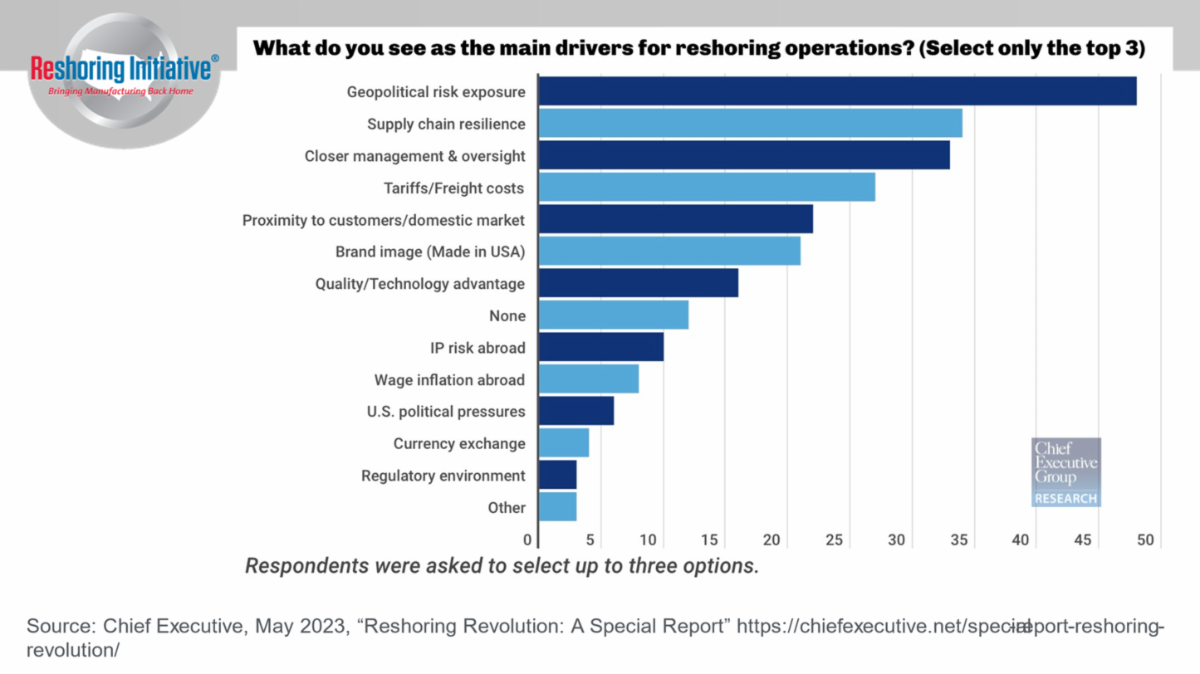
A new survey by Chief Executive and IEDC highlights a significant trend among CEOs to relocate production back to the U.S. from China, driven by the desire to mitigate geopolitical risks, enhance supply chain resilience, and reduce dependency on foreign manufacturing. The shift is fueled by challenges from the pandemic-induced supply chain disruptions, geopolitical tensions, advances in automation, and government incentives, marking a significant pivot towards domestication of supply chains amidst inflationary pressures and economic downturn concerns. The full survey, provided by the Reshoring Initiative, can be accessed here.
Negotiations on FY24 Federal Budget Continue
Appropriations leaders continued negotiations on federal fiscal year 2024 (FY24) funding for the U.S. Department of Education and other agencies. Federal funding was recently extended on a short-term basis through March 1 and March 8 of this year to allow more time for negotiations on this critical issue. Lawmakers have reportedly come to an agreement on allocations for each of the dozen spending bills that compose the federal budget, known as 302(b) allocations. This includes the Labor-HHS-ED appropriations bill, which provides funding for the Carl D. Perkins Career and Technical Education Act’s (Perkins V) state grant program along with other important federal investments in education and workforce development.
Administration Announces Nearly $200M in Grants to Expand Apprenticeships
Earlier this week, the Biden-Harris Administration announced nearly $200 million in grant funding available to expand registered apprenticeships. These funds will support career pathways and on-ramps into targeted, high-wage and high-demand occupations that will serve to provide advancement opportunities within some of the most skilled sectors. The funding includes $95 million of competitive grants through the second round of the Apprenticeship Building America Grant Program and $100 million in the second round of State Apprenticeship Expansion Formula Grants. Information can be found here.
College Cost Reduction Act Advances in the House
The House Education and the Workforce Committee approved the partisan H.R. 6951, the College Cost Reduction Act, by a vote of 22-19. The bill focuses on price transparency, college accountability for student debt repayment, and a new funding approach based on student outcomes. House Democrats released their own plan to improve access to postsecondary education as a counterproposal to the bill.
Foxx Announces She Will Not Lead Committee Next Congress
Representative Virginia Foxx (R-NC), the long-time leader for Republicans on the House Education and the Workforce Committee, has recently announced that she will not seek the leadership post in the next Congress. Chair Foxx has been the top Republican lawmaker for this committee for over a decade. Following the announcement, Reps. Wahlberg (R-MI) and Owens (R-UT) have expressed interest in succeeding in this leadership role.
Administration Announces $24M to Expand Clean Energy Workforce and Enhance Manufacturing Efficiency
The U.S. Department of Energy (DOE) announced a new $24M funding opportunity for workforce training programs with a focus on training in clean energy jobs that do not require a four-year degree. This funding, from the Bipartisan Infrastructure Law, will further expand the existing Industrial Assessment Centers (IAC) network to include more union training programs, community colleges, and trade schools. The announcement can be viewed here.
Exploring Apprenticeships: Alternatives to Traditional College Education
Education leaders in this podcast express reservations about the effectiveness of the college-for-all approach in the face of rising underemployment among graduates. In this interview, author Ryan Craig sheds light on the promising alternative of apprenticeships but highlights systemic challenges, including insufficient funding and the need for policy reforms to establish apprenticeships as a competitive post-high school option. To listen to the discussion on apprenticeships and their potential, click here.
Supporting Young Workers Through New Funding Opportunity
The U.S. Department of Labor announced an $85 million funding opportunity to improve job opportunities for young people in communities affected by violence, crime, and poverty. The grants will fund education, skills training, supportive services, and paid work experience. For more details on this initiative, visit the Department of Labor's website.
Celebrating Career and Technical Education Month
House CTE Caucus co-chairs Representatives Glenn “GT” Thompson (R-PA) and Suzanne Bonamici (D-OR) formally introduced a Congressional resolution recognizing February as CTE month. The House caucus is currently circulating this resolution for additional support. Similarly, co-chairs of the Senate CTE Caucus led by Senators Tim Kaine (D-VA), R. Michael Young (R-IN), Tammy Baldwin (D-WI), and Ted Budd (R-NC) are leading a similar resolution in the Senate. Learn more about the resolutions and how you can support them here.
Enhancing CTE for Special Populations and Underrepresented Learners
Advance CTE and ACTE launched the "Maximizing Access & Success for Special Populations and Underrepresented Learners in Career Technical Education" series. This publication shares strategies and guiding questions for each special population as defined by Perkins V, along with other key marginalized populations that have been a focus of state support. The publication includes briefs on English learners, individuals experiencing homelessness, individuals with disabilities, individuals from economically disadvantaged families, single parents, and youth with a parent in the armed forces on active duty. For more information, explore the series online.
|