|
|
This Week in Farm to School
October 28, 2021
|
|
Farm to school connects local agriculture, schools, and partners to benefit students, educators, farmers, families, and communities.
|
|
Thank You!
Thank you. Thank you for all the work you do with students, School Nutrition staff, educators and administrators, farmers, parents, local organizations, all of us... You are each appreciated as a vital member of the NC farm to school movement. We believe in the potential of this work to deeply impact the opportunities and health of students, as well as of whole communities. It is inspiring to see how your farm to school impact is creating community champions and supporting student leadership. Continue to be champions; share out your successes and learned lessons. Integrating food, agriculture, and local food systems into our educational system gathers us all together towards a resilient and vibrant future.
|
|
Tribal Food Sovereignty and Developing Native Farm to School Program
Today! October 28, 2021 // 2 - 3 pm EST
Join the First Nations Development Institute for the second episode in their First Nations’ Farm to School Webinar Series. This webinar will focus on tribal food sovereignty and developing a Native Farm to School Program. This webinar is free and open to all participants.
Strategies for Farm to School Resilient Local Food Systems
Today! October 28, 2021 // 3 - 4 pm EST
In observance of National Farm to School Month, the October School Nutrition Strategies Training Action Plans Resources (STAR) webinar will feature the USDA Office of Community Food Systems (OCFS). OCFS will promote the Farm to School Grant Program and share some current resources that are available to help Child Nutrition operators incorporate local foods in their programs. The webinar will highlight the strength and resiliency of local food systems by providing insight into how communities are responding and adapting to current challenges while having strong local food infrastructure and relationships in place. Join the webinar to also hear strategies and tips on what works best for getting meals to students and families while supporting local producers.
Using American Rescue Plan Funds and Other Federal Supports to Address State and Local Teacher and School Staff Labor Shortages
Today! October 28, 2021 // 4 - 5 pm EST
The U.S. Departments of Education and Treasury are hosting a two-part webinar series that may be of interest to School Nutrition professionals and other School Food Authority (SFA) staff. Schools and SFAs across the nation are facing challenges to filling these critical positions in schools. The purpose of these webinars is to discuss the underlying causes of these shortages and share effective practices happening at the state and local levels and how federal resources, including those under the American Rescue Plan’s Elementary and Secondary School Emergency Relief Fund (ARP ESSER) and the State and Local Fiscal Recovery Fund (SLFRF), can be used to support and sustain these efforts.
Conversations on Food Justice: Farmworkers and Agricultural Labor
Today! October 28, 2021 // 4 - 5 pm EST
Join Toxic Free NC as they wrap up the last topic in their Food Justice series. Farmworkers and other agricultural laborers, such as those working in meat processing and packing facilities, are on the frontlines of toxic pesticide exposure and other human rights violations. Farm work is one of the most dangerous professions and continues a legacy of agricultural injustice and racism in the United States. When we participate in an industrial agricultural system, we participate in the oppression of farmworkers. Join us as we hear from Araceli and Elisa, two farmworker women, and Lariza Garzón, the Executive Director of the Episcopal Farmworker Ministry as they share their experiences and ideas for creating change.
Getting Familiar With the FY 2022 Farm to School RFA
November 8, 2021 // 2:30 - 3:30 pm EST
Join the United States Department of Agriculture's Office of Community Food Systems for a presentation on the new 2022 Farm to School Grant Request for Applications! Learn what's new in this year's RFA and how your program can be considered for this new round of Farm to School Grants.
Getting Your Farm to School Grant Package Together
November 9, 2021// 2:30 - 3:30 pm EST
In this webinar, the USDA's Office of Community Food Systems Farm to School team will explore the key characteristics of a competitive Farm to School Grant application. They will review the required components and provide technical assistance on how to submit a complete application. Attendees will learn tips and tricks for writing a succinct application that clearly outlines your farm to school project.
Recorded Webinar: School Nutrition Programs and School Gardens
The School Garden Support Organization Network hosted a conversation about School Nutrition Program service and school gardens. In the recording, listen to how school gardens can be intertwined with the work of School Nutrition programs, including case studies related to School Nutrition service program funding and staffing support of school gardens!
|
|
Still Time to Participate N.C. Crunch 2021! |
|
|
|
There is still time to participate in the #NCCrunch to recognize National Farm to School Month and our #farmtoschoolheroes. Offer youth and adults with your school, early care and education center, group, organization, or family an opportunity to taste and learn about North Carolina grown fruits and vegetables.
Sign up for the 2021 N.C. Crunch to receive a free guide with tips and resources. Share how you are celebrating by using #NCCrunch and tagging @F2sCoalitionNC on Facebook. Registration here.
|
|
Farm to School Resource Hub |
|
NC Cooperative Extension Brunswick County Farm to School NC Crunch
This video, created by NC Cooperative Extension Brunswick County, celebrates the NC Crunch by crunching into a locally grown apple!
|
|
|
The School Garden Sustainability Survey
The School Garden Sustainability Survey was developed in collaboration with the University of Texas at Austin, Sprouts Healthy Communities Foundation and the School Garden Support Organization Network to collect data that will help determine why some school gardens succeed and become sustainable, while others struggle and have consistent challenges. They plan to compile data and share outcomes throughout the country to help improve school garden programs!
In Spring 2022, they will be providing each school with a synthesis of their surveys in the form of a scorecard, which will showcase areas that are strong and areas that can be improved - complete with resources, guidance and advice on how to do so. We hope you will be a part of this revolutionary research that may shift school gardens into more, and hopefully all, schools in America. This is for teachers, administrators, and staff that are working in a school that has a garden of any kind.
|
|
Growing School Gardens: Coast to Coast Virtual School Garden Tour and Activities
The School Garden Support Organization Network has invited students to go on a journey through school gardens across the country -- from the Big Island of Hawai’i to Washington, D.C. -- with Growing School Gardens! Through this virtual tour students will be meeting with other students in diverse communities to engage in hands-on learning, growing healthy food for themselves and their communities, and becoming caretakers of their local environments.
|
|
NC Commissioner Troxler: From Farms to School - Crops of NC
Join the North Carolina Commissioner of Agriculture as he reads a story about apples journey from NC orchards to NC School Nutrition programs.
|
|
|
2019 Farm to School Census
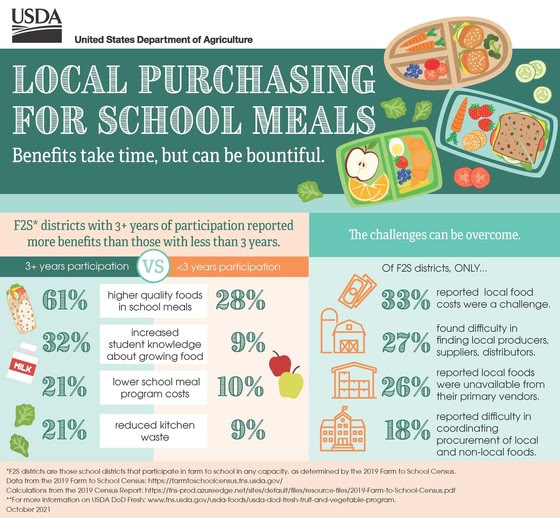
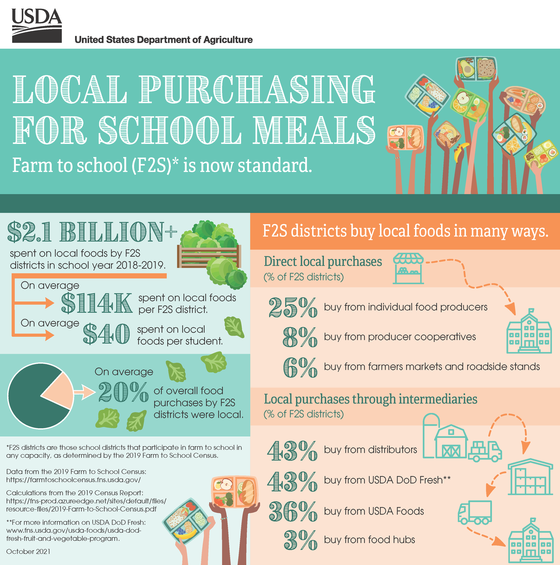
The results of the United States Department of Agriculture 2019 Farm to School Census are here! The 2019 Census is a survey that was sent to all public, private, and charter school food authorities (SFAs) that participated in the National School Lunch Program in school year 2018-19. These data include characteristics such as SFA size, eligibility rates for free and reduced-price lunch, and urbanicity, as well as information on local foods use, procurement, school gardens, expenditures, and staffing.
|
|
2022 Budding Botanist Grant
Tomorrow! Deadline: October 29, 2021
The 2022 Budding Botanist grant is now open! In partnership with the @kloraneusa Botanical Foundation, Kids Gardening will award $1,000 to eighteen high schools across the United States to support their youth garden programs.
Hardship Assistance Grants for Organic Producers
Deadline: November 5, 2021
Do you know an organic farmer, rancher, or food processor who has experienced hardship over the past year? The CCOF Foundation Bricmont Hardship Assistance Fund provides direct financial assistance to organic producers who suffer financial losses due to extreme hardship, including COVID-19 pandemic related hardships. Applications are available in English and Spanish. Award amounts range from $1,000-$2,500.
Pandemic Response and Safety Grants
Deadline: November 8, 2021
The Pandemic Response and Safety (PRS) Grant Program provides grants to food processors, distributors, farmers markets, and producers to respond to coronavirus, including for measures to protect workers against COVID-19.
EJ4Climate: Environmental Justice and Climate Resilience
Deadline: November 14, 2021
The North American Commission for Environmental Cooperation (CEC) is launching a $2 million grant program, EJ4Climate, to support environmental justice and climate resilience for underserved, vulnerable communities, and Indigenous communities across North America. This program will provide funding directly to Indigenous communities and community-based organizations to prepare for climate-related impacts.
2021 HFFI Funding
Letter of Intent Deadline: December 7, 2021
Reinvestment Fund is inviting applications for the 2021 round of the Healthy Food Financing Initiative (HFFI) Targeted Small Grants program. The 2021 HFFI round is offering at least $4 million in grant funds for food retail and food enterprises working to improve access to healthy foods in underserved areas, to create and preserve quality jobs, and to revitalize low-income communities. Funding for HFFI is provided by the United States Department of Agriculture (USDA), authorized by the Farm Bill and Reinvestment Fund, which serves as the national fund manager for the HFFI program at USDA.
2022 Youth Garden Grant
Deadline: December 17, 2021
A total of 50 programs will be awarded Youth Garden Grants in 2022. All winning programs will receive a check for $250, and materials to grow their garden program. Forty programs will receive packages worth $1,050, five programs will receive the base package plus a $1,000 tool grant from Corona Tools, and five programs will receive the base package plus two Garden Towers from Garden Tower Project! Any nonprofit organization, public or private school, or youth program in the United States or U.S. Territories planning a new garden program or expanding an established one that serves at least 15 youth between the ages of 3 and 18 is eligible to apply.
USDA Farm to School Grant Request for Application
Deadline: January 10, 2022
The United States Department of Agriculture Food and Nutrition Service (FNS) seeks to award up to $12 million this fiscal year. Eligible schools, institutions operating the Child and Adult Care Food Program and Summer Food Service Program, State and local agencies, Indian Tribal Organizations, small- to medium-sized agricultural producers or groups of small- to medium-sized agricultural producers, and non-profit organizations are eligible for Farm to School grants. Priority scoring incentives return for applicants who meet certain criteria, including new priority consideration for organizations led by Black, Indigenous, and People of Color (BIPOC) and serving BIPOC communities, and organizations located in and serving rural areas. Please see the RFA for full details.
Robert Wood Johnson Foundation’s Evidence for Action: Investigator-Initiated Research to Build a Culture of Health
Deadline: Rolling
This program funds research that expands the evidence needed to build a Culture of Health, which is broadly defined as one in which good health and well-being flourish across geographic, demographic, and social sectors; public and private decision making is guided by the goal of fostering equitable communities; and everyone has the opportunity to make choices that lead to healthy lifestyles. Proposals are accepted on a rolling basis.
|
|
The National Farm to School Network |
|
State Farm to School Policy Handbook 2002-2020
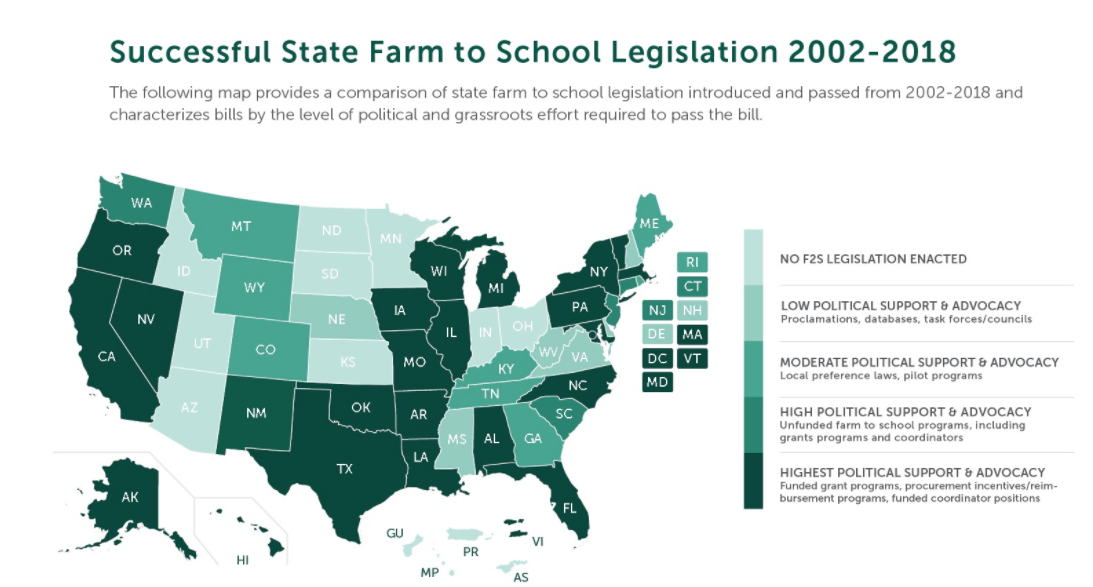
With funding from the USDA’s National Agricultural Library, the National Farm to School Network and the Center for Agriculture and Food Systems at Vermont Law School published an updated State Farm to School Policy Handbook: 2002-2020. The Handbook summarizes and analyzes all 546 farm to school bills and resolutions introduced between 2002 and 2020 from the 50 states, the District of Columbia, and U.S. territories. It enables readers to search bills by both jurisdiction and topic, and includes analysis of state policy trends, case studies, advocacy resources and more.
In addition to highlighting policies that support the three core elements of farm to school and early care and education (ECE) – local procurement, school gardens, and food and agriculture education – this edition of the Handbook also spotlights policy opportunities for supporting universal school meals, supporting BIPOC producers, and those that supported farm to school responses to COVID-19.
|
|
National School Lunch Program and School Breakfast Program
Deadline: November 2
The School Meals Programs already requires schools to procure American grown and processed food. The U.S. Department of Agriculture, Food and Nutrition Service (FNS) is seeking feedback from a broad range of stakeholders about how the Buy American provision and guidance are currently implemented, changes FNS should make to current regulations, and on how FNS can better support schools and School Nutrition authorities as they strive to purchase domestic foods and food products. The feedback FNS receives will help to inform future rule making and guidance on Buy American requirements in the school meals programs.
School Nutrition and Meal Cost Study II
Deadline: November 15
The U.S. Department of Agriculture Food and Nutrition Service (FNS) is seeking comments on its planned data collection on the cost, nutrition standards, and operations of school meals. The first study of this information (2014-2015) provided key insight into the implementation of the Healthy Hunger Free Kids Act, and this new round of data will provide further info on the current successes and challenges of school meal programs. If you are involved with these activities, please note the opportunity to give "ground truth" feedback for USDA on who they will collect data from and how. Stakeholders have until November 15 to submit comments.
|
|
Rooted Wisdom Podcast: Memories and Songs That Shape Home
This podcast episode bridges the wisdom of an Indigenous Land Steward and a Food Equity Educator to discuss the memories and songs that shape our homes. The Steward, Lilian Hill, is the Executive Director of The Native American Food Sovereignty Alliance. The Educator, Shorlette Ammons, leads the Center for Environmental Farming Systems’ committee on racial equity. What changes are we seeing in how we gather around food with our families and interact with the people who provide it? How do we more deeply understand our relationship to the earth? Learn how ancestral knowledge informs their lives, how they navigate the complexities around food access, and how colonization and slavery impact food and the path toward resilient and equitable local food systems.
A Native-led Land Trust Is Working to Empower Indigenous Youth Through Kelp Farming
The program from the nonprofit Native Conservancy is helping cultivate food sovereignty, regenerate the marine environment, and boost the local economy.
Additional Racial Equity Resources
The Center for Environmental Farming Systems (CEFS), one of our Farm to School Coalition of NC partners, has created a document of current webinars as well as resources to facilitate engagement and learning around Racial Equity, both in general and especially as it relates to food systems and education.
|
|
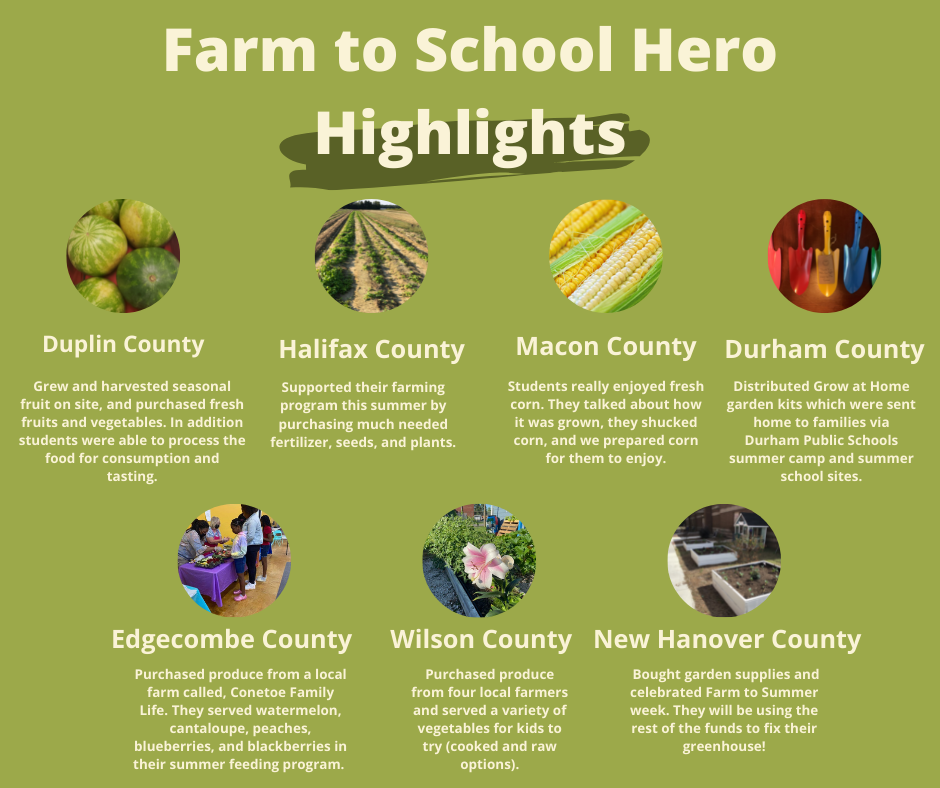
Check out some #farmtoschoolheroes we've been highlighting on our Facebook page (@F2SCoalitionNC): |
|
|
|
|
|
|