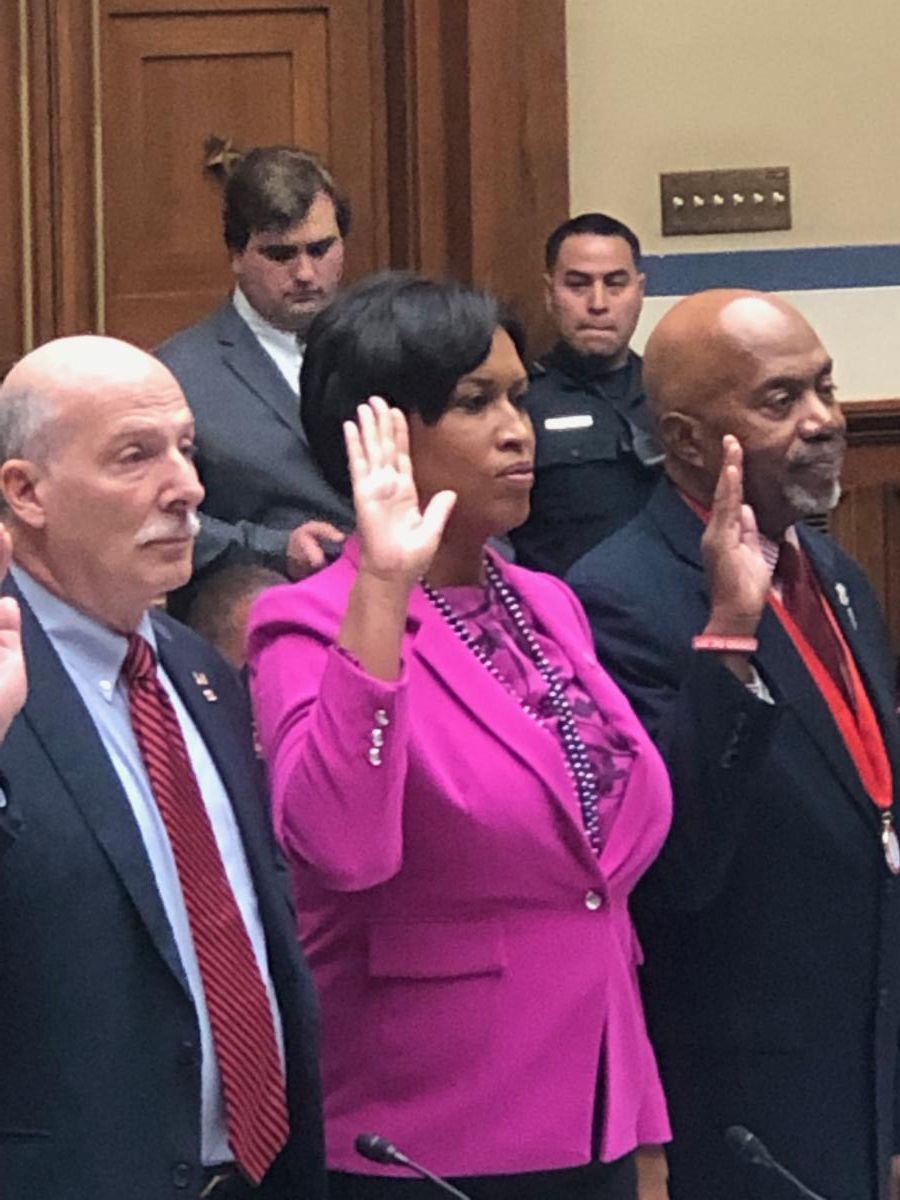
Earlier this month I testified, along with the Mayor, before Congress on Capitol Hill in support of Statehood (H.R. 51). In my testimony, I made two fundamental points: First, that the citizens of the District are United States citizens, and therefore should have the same rights as the citizens of the 50 states. Second, that naysayers come up with lots of reasons why the District should not be a state, but none of their arguments overcome the basic principle that in our country there should be no taxation without representation.
Citizens of the District Should Have the Same Rights as All U.S. Citizens
First, it is time to recognize that the citizens of the District of Columbia are citizens of the United States, with all of the responsibilities of citizenship, but they don’t have the full rights of U.S. citizenship. We send our sons and daughters to war. We pay more in federal taxes than 22 states. We pay more per capita than any state. There is nothing asked of citizens in the 50 states that is not asked of citizens in the District of Columbia. And we step up. We pay our dues. But we do not have the most important privilege of U.S. citizenship. We do not have a vote in Congress. Nor do we have sovereignty like the 50 states.
That’s all we ask: that Congress give us what it has given the citizens of 37 other states: full citizenship. Statehood. We have sought incremental gains since the 1973 Home Rule Act. But incrementalism still leaves us short. Statehood is the only way to give our citizens locally elected representatives to enact purely local laws that will not be subject to national debates over divisive social issues. It is the only way to ensure a judicial system that is representative of community values. Statehood is the easiest way to give residents a full, guaranteed, and irrevocable voice in the national legislature. Statehood means the United States citizens of the District of Columbia will have the same rights and privileges enjoyed by the United States citizens of the 50 states.
Two years ago, I had the honor of addressing the constitutional convention of Mexico City. After the Mexican Revolution, the government was organized as a federal system with 31 states. It so closely modeled its federal system after ours that its national capital – Mexico City – was a federal district. But a century later the federal government of Mexico decided the better way was to grant statehood to its federal district, its nation’s capital. It is now our time.
Throughout the world, there are only one or two national capitals where the citizens do not enjoy a vote in the national legislature; They are in autocratic countries. This is a distinction we do not want, and a stain on our democracy. We demand that Congress treat us as equals and no longer as second-class citizens.
No Argument Can Overcome the Principle That There Should Be
No Taxation Without Representation
Opponents give lots of arguments against statehood, but none of them overcome the basic principle that there should be no taxation without representation. Many Americans believe, incredibly, that the District Government is still an agency of the federal government, operating with federal dollars. Therefore, they say, we should not have statehood. They’re wrong. We are not a federal agency, 77% of our total budget is local dollars; 22.4% is federal formula spending that includes Medicaid and federal grants available to ALL states; and about 0.6%, is federal payments unique to the District.
Many opponents have argued that the District is not capable of governing itself in a fiscally responsible manner. Well, today the District’s financial status is the envy of jurisdictions around the country. Our fundamentals are solid. Our population is growing. Our revenues are growing. Our spending stays within budget year after year. Both our pension and Other Post-Employment Benefits funds are fully funded, using conservative actuarial assumptions. No other state can boast this. Our reserves soon will be equal to 60 days operating costs – a Government Finance Officers Association best practice.
Some have argued that population size is a disqualification. While we are small, population should not be disqualification for statehood. Indeed, the District’s population is greater than that of Vermont and Wyoming and given our population growth (16.7% since 2010 – the highest in the nation) it is not unrealistic to say we may surpass other states in size.
Some say that the vast amount of land owned or controlled by the federal government within the District is a disqualification. However, compared to other states, the District has the 13th lowest number of federal acres as a percentage of total land.
And then some argue that retrocession is a better alternative, and that it makes historical sense given the previous retrocession of Arlington and Alexandria to Virginia. But this is unpopular with the citizens in both the District and Maryland. You may say “so what” to the citizens of the District. But you cannot say that to the citizens of Maryland. Congress cannot force retrocession on Maryland. So, it is impractical.
Another argument is that the Constitution intended it to be this way. I disagree; I don’t believe the Founding Fathers actually intended this. We know they were mindful of Shay’s Rebellion. But there is no evidence of discussion about disenfranchising the citizens of the federal district. Rather, James Madison in Federalist #43 wrote that the citizens of the federal district “will have had their voice in the election of the government which is to exercise authority over them.” Additionally, I say this: the Constitution is a great document, but it was not perfect, as evidenced by its 27 amendments. The original method for electing the President and Vice President was flawed. The method for electing senators has changed. Civil rights has changed radically – such as the 13th amendment that abolished slavery and the 19th amendment expanding suffrage to women. Indeed, the issue before us is about civil rights – the civil rights of District citizens to full citizenship – except Congress can accomplish this by adopting H.R. 51.
Not only can each of these arguments be countered, but actually they fail to overcome the fundamental principle that there should be no taxation without representation. Not only are we not an agency of the federal government existing off its treasury, but even if we were that is not a reason to deprive 703,000 individual’s full sovereignty and representation in Congress. Not only are we small, but that is irrelevant to whether 703,000 individuals should enjoy full citizenship. Not only do we run our government well, but we run it better than other states, and they have statehood, because how well people run their government has nothing to do with whether they should be treated as United State citizens.
Self-governance is the essence of democracy and freedom. It is more sensitive to constituents. It reflects community values and priorities. Self-governance is the lifeblood of every town hall, city council, county board, and state legislature in the United States of America. The only option to gain both full voting representation and full self-governance is to adopt H.R. 51 and grant statehood to the District of Columbia.
The Council and I look forward to working with the Congress to move this bill forward so that the next time I am called to testify it will be as Speaker of the Legislative Assembly of the State of Washington, D.C.