|
MADISON, WI — May 4, 2026 — Last week, the United States Supreme Court issued a devastating 6–3 decision in Louisiana v. Callais, striking down Louisiana’s second majority Black congressional district and declaring that racially conscious redistricting under Section 2 of the Voting Rights Act is unconstitutional. This ruling erased a district that had only recently allowed Louisiana voters to elect the state’s second Black member of Congress in 2024.
Let us be clear: this decision represents a direct and dangerous blow to one of the most hard‑fought civil rights protections in American history.
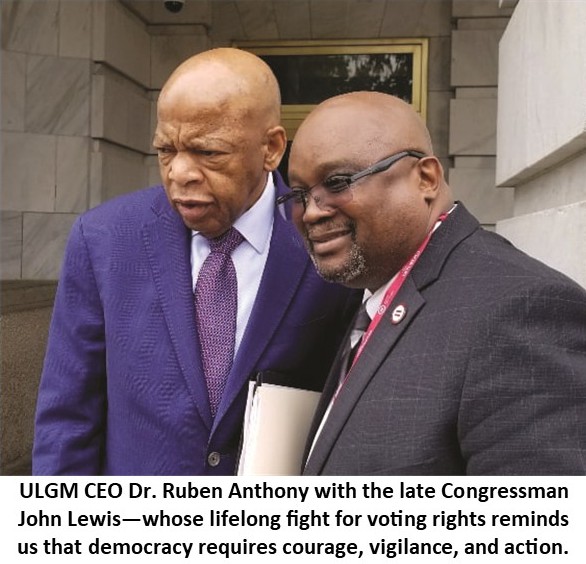
This moment calls to mind the legacy of Congressman John Lewis—who endured violence and made profound personal sacrifices so that future generations could exercise the right to vote. The Voting Rights Act exists because leaders like Lewis understood that democracy does not defend itself; it must be protected and renewed by each generation. To weaken that law dishonors the struggle and sacrifice that brought us this far.
The Voting Rights Act of 1965 was created because the promise of the 15th Amendment was deliberately denied to Black Americans for generations—through intimidation, exclusion, and systemic racism. For more than sixty years, the Act has served as a shield against those abuses and a pathway toward fair representation. Last week, the Supreme Court significantly weakened that shield.
The consequences are not hypothetical. By hollowing out Section 2 of the Voting Rights Act, the Court has opened the door—wide open—to a return of racial gerrymandering and restrictive election practices we were supposed to have left behind in 1965. Entire communities can now be carved up, diluted, or erased from the political process with impunity.
Representation matters. Districts where communities of color have a meaningful voice are more likely to elect leaders who understand their lived experiences and fight for their interests. When that representation is stripped away, real people lose power over decisions that shape their lives—from access to quality healthcare and education to economic opportunity and environmental justice. This ruling threatens to silence those voices.
Even more troubling, the Court has shifted the burden onto communities and individuals to prove intentional racial discrimination—an almost impossible standard that history tells us many states know how to conceal. This decision sends a chilling signal to legislatures that have been waiting, watching, and preparing to push the boundaries of discrimination once again.
We reject the notion that this is simply a legal or political debate. This is about race. It is about power. And it is about a fear—rooted in history—of what happens when Black Americans and communities of color are allowed equal footing and equal voice in a democracy.
Here in Wisconsin, we cannot afford complacency. Our elected leaders and community stakeholders must recommit themselves to the spirit and purpose of the Voting Rights Act. That means investing in stronger voter protections, educating our communities, and ensuring every eligible voter can participate freely and fairly.
Our Wisconsin Supreme Court must remain steadfast in defending the right of all people—especially historically marginalized communities—to choose who represents them.
I have seen what organized, principled action can accomplish. In Clark v. Wisconsin Elections Commission, I stood as a plaintiff to challenge unfair maps. We fought. We won. And if necessary, we will fight again.
This is not a moment for despair or division. It is a moment for resolve. We are in a democratic state of emergency, and the response must be peaceful, informed, and proactive. At the Urban League of Greater Madison, we will continue to educate, mobilize, and empower our community—because our democracy depends on it.
|