May 4, 2023

Top stories

■ House leaders call for release of Evan Gershkovich, Paul Whelan (Wall Street Journal) / Blinken says U.S. remains ‘intensely engaged’ in efforts to free reporter Evan Gershkovich (Wall Street Journal) 


■ Tucker Carlson floats plan to host alternative GOP debate in post-Fox future (Washington Post)


■ Fox opposes fellow journalists trying to uncover documents (Associated Press) / Fox says it settled Dominion lawsuit to 'buy peace,' as it tries to block release of more material in the case (CNN) 


■ Dow Jones to launch WSJ Radio channel on TuneIn (The Desk)


■ Hulu + live TV adds local PBS stations (Next TV) 


■ Fox television stations debuts Fox Local app (Broadcasting & Cable) 


■ Sinclair shutters five news markets: ‘We just turned off the lights for many’ (TVNewsCheck)


■ One year after removing its paywall, Quartz's traffic continues to drop (Ad Week) 


■ Vox Media’s stealthy podcast bet is gaining traction (The Hollywood Reporter) 


■ Lauren Johnston announced as executive editor of Yahoo News, U.S. (Yahoo via Editor & Publisher) 


■ Will Sommer joins The Post as a media reporter (Washington Post) 


■ Top HR executive arrested for stealing $429,000 from Fast Company publisher (Semafor)


■ Two USC journalism students covering NFL draft arrested in jersey thefts (Los Angeles Times) / USC student journalists mount a legal defense in Kansas City (USC Annenberg Media)  


■ Gray Television deploys Waymark AI-based TV commercial production platform across its national station footprint (NextTV) / An AI startup pledges to help, not replace, journalists (Fast Company)


■ Paramount restarts Simon & Schuster sale process (Axios) 


More on press freedom


■ Trump lawsuit against New York Times tossed by judge (Washington Post) 


■ Woodward, S&S will move to dismiss amended lawsuit over 'Trump Tapes' audiobook (Publisher’s Weekly) 


■ Wuhan citizen journalist who documented COVID outbreak released after three years detained (CNN) 


■ Under pressure, Iran’s journalists refuse to be silenced (VOA)

COMMUNITY

In honor of World Press Freedom Day on May 3, members of the National Press Club's Press Freedom Team have interviewed journalists in exile from around the world. We will feature their stories every day this week to shed light on press freedom issues worldwide.

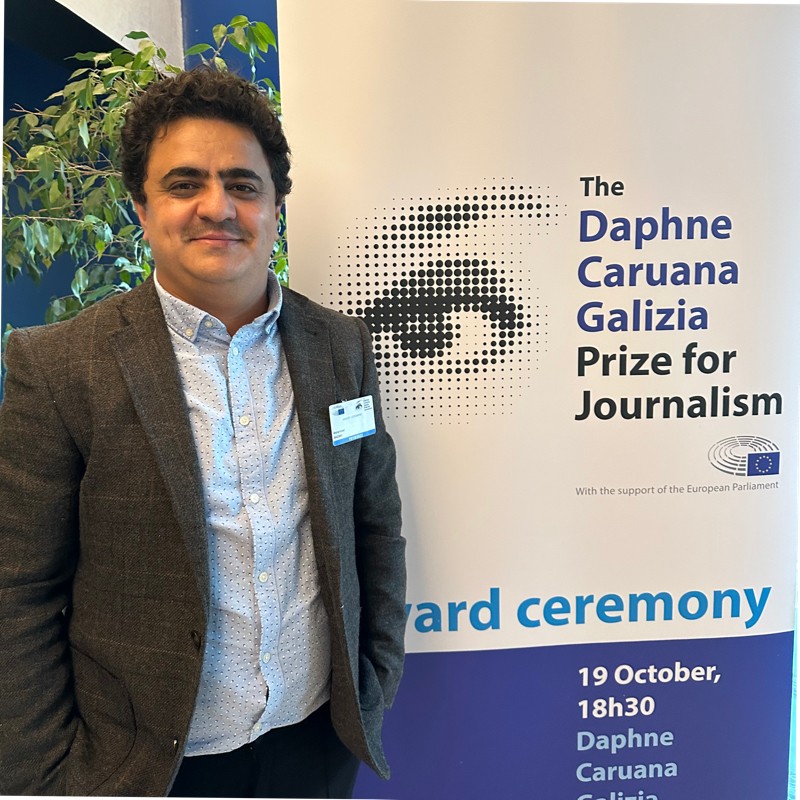
Interview with founder of Syrian Investigative Reporting for Accountability Journalism


by NPC Press Freedom Team volunteer Ahmed Omar

Ten years ago, when he had to leave his country, family, and friends behind him to start a new life, Mohammed Bassiki did not know it would be the birth of his new career as a leading investigative journalist and founder of one of the leading investigative journalism hubs in the region.


Bassiki not only pursued his career as an independent journalist after leaving Syria in 2013, he also created Syrian Investigative Reporting for Accountability Journalism — a platform designed to support independent investigative journalists reporting from/about Syria.

The National Press Club spoke with Bassiki about his career, journalism inside Syria, how journalists are managing to survive within authoritarian regimes, and the story of founding SIRAJ.


What was the first incident that made you understand the situation of the freedom of press in Syria?


Bassiki: Actually, it was a minor incident that was almost natural in Syria back then, but it was an eye-opener to me. During my first days as a journalist, one of my friends kept talking about a certain book he read and helped him in understanding many things regarding the rule of journalism. So automatically, I headed to one of the biggest bookstores in Damascus, and I asked the manager there about the book. 


When the man heard the name of the book and the author, he was frightened and stood up. He froze for a couple of minutes staring at me, took me to another closed room, and started whispering to me: “You are young and look naïve. This book is prohibited and just mentioning the name will put you in risk and may cause a lot of troubles. Be cautious; you have a bright future ahead.” 


Then he handed me a romance novel and told me: “Take this and write a review about it, this won’t get you in trouble.” At this point, I understood that this must end.


You left Syria in 2013, headed to Turkey before moving again to France in 2016, where you are still living now. When you first moved out of Syria, how did you manage to secure enough funding to live and to pursue your career as a journalist?


Bassiki: When I decided to leave Syria, I was conscious about all the obstacles that I’d face, all the risks that will face my little kid, and my bigger family inside Syria. But I was willing to pay this price just to know what does it mean to be free, to be able to represent the real and honest voices of the Syrian people. My main asset was my credibility and belief in my capabilities, so it did not take me a lot of time to be able to work again.


How did you feel when your first piece was published without any kind of censorship for the first time after leaving Syria?


Bassiki: This was one of the best feelings I witnessed in my life. There are no words that can describe it — a feeling that no one will relate except a journalist. I felt alive, and promised myself I would never give up this feeling and would never go back. It’s dangerous and risky, but my security or even life is not cheaper than the lives of those sacrificing in Syria for a better future.


Click here to read the full interview.

‘There is a generation at risk’: Exiled Russian journalist shares how he’s keeping stories alive


by NPC Press Freedom Team volunteer Zach Cohen

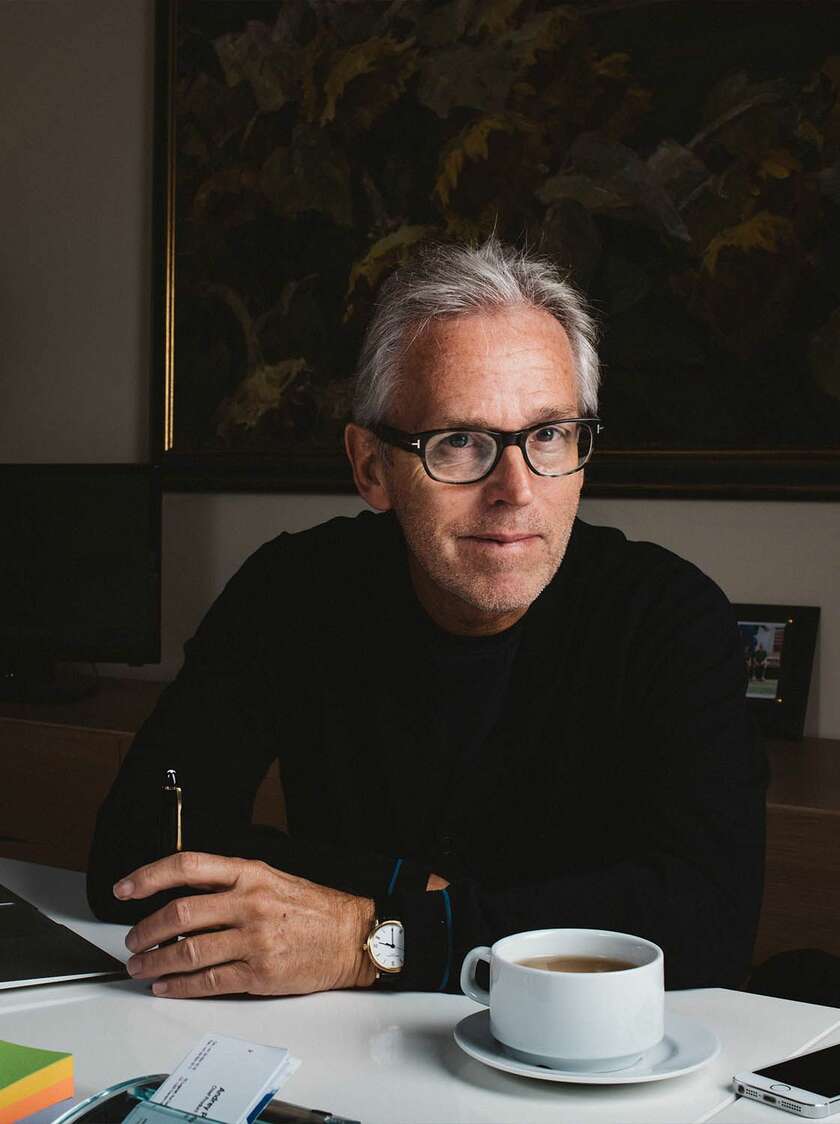
Dutch media magnate Derk Sauer, the founder of the Moscow Times and Vedomosti and CEO of RBK, fled Russia with his family and colleagues after Russian President Vladimir Putin enacted legislation that banned journalists from spreading “disinformation” — especially about the invasion of Ukraine.


“This was a dilemma that every independent platform faced in Russia,” Sauer said in an interview from his new home in Amsterdam. “We decided that we wanted to continue, and the only way to do that was to leave Russia.”


In a chaotic couple of weeks, Sauer and his team set up a new base of operations in the Netherlands, where he is a citizen. Other media organizations provided logistical support and housing as they built a new base of operations for their English- and Russian-language news.

Moscow Times reporters still reporting from inside the country do so anonymously to protect them. Their bylines don’t appear on the site, and they have to be judicious in which sources they trust. One of their reporters meets with sources in a car in a park, “just like during the Stalin days.”


“They basically went underground because they were breaking the law,” Sauer says. “But they are still there. They're still reporting.”


Sauer since then has been setting up hubs in Amsterdam, Berlin, Riga, and Prague where independent Russian journalists in exile can work. They include television and podcast studios, and they have collaborated on developing mobile applications and websites that can penetrate Russia’s digital firewall.


Sauer bemoaned the detention of Evan Gershkovich, an American journalist with the Wall Street Journal who the U.S. government and the National Press Club has said was wrongfully detained by Russia on charges of espionage.


It’s personal for Sauer: Gershkovich worked at the Moscow Times with Sauer’s son, and Gershkovich vacationed with the Sauers just weeks before his arrest.


“These made-up charges of him being a spy are completely ridiculous,” Sauer says.


But Sauer also urged American journalists not to forget about Russian journalists serving years of jail time who face even longer odds of being released.


“We all hope, of course, that Evan will be traded sooner rather than later for some spy,” Sauer says. “But these girls and guys, there’s no hope of being released early. As long as Putin is there, they will never be released.”


Russia’s independent journalists have a tall task ahead of them in combating the juggernaut of state media in Moscow. And the war in Ukraine has made that even more pronounced.


“The way the Russian population has been brainwashed is unprecedented,” Sauer says. “And it's so important that independent journalism survives. There is a generation at risk.”


Click here to read the full interview.


Today the National Press Club's Press Freedom Team and the NPC Journalism Institute hosted a discussion highlighting a few cases of exiled journalists around the world. Click here to watch the video.

CRAFT
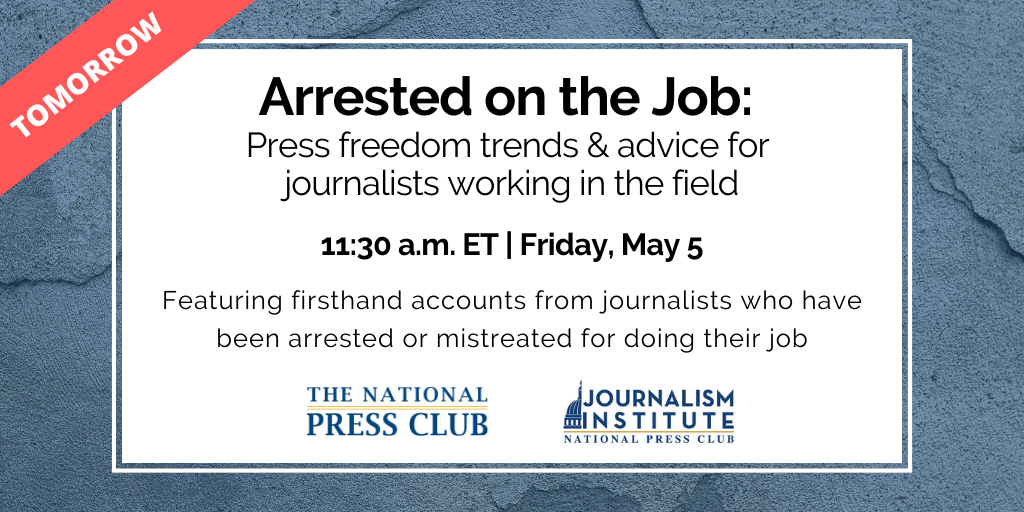
Arrested on the Job: Press freedom trends & advice for journalists working in the field. 11:30 a.m. ET on Friday, May 5. Featuring firsthand accounts from journalists who have been arrested or mistreated for doing their job.

Join us at 11:30 ET tomorrow, May 5, for a discussion about concerns for journalists working in the U.S. — an extension of important activities we are organizing around World Press Freedom Day. This virtual program, produced by the National Press Club Journalism Institute and the NPC Press Freedom Team, will feature firsthand accounts from journalists who have been arrested or mistreated for simply doing their jobs. 


Participants will gain: 


  • Knowledge of recent cases of press freedom violations within the U.S. 
  • Insight into the personal and professional impacts of facing hostility from law enforcement or sources
  • An understanding of their legal rights when faced with threats 
  • Advice on preparing for work in the field
REGISTER NOW

Meet the panel:


Matilda Bliss and Veronica Coit, two journalists with the citizen journalism publication Asheville Blade who were arrested on trespassing charges while documenting a sweep of a homeless camp in 2021. Body cam footage was just released indicating they were targets. Their case is in appeal to a jury trial.


Dion Rabouin, a Wall Street Journal reporter who was detained while doing a routine person-on-the-street interview outside of a bank in Phoenix. The mayor eventually personally apologized for Rabouin’s mistreatment.


Seth Stern, director of advocacy at Freedom of the Press Foundation, which oversees the U.S. Press Freedom Tracker.


Steve Reilly, a Washington, D.C.-based investigative reporter for The Messenger, will moderate the discussion. Reilly is a member of the National Press Club and serves on its Press Freedom Team and Board of Governors.

Resources

This newsletter is written & edited by the National Press Club Journalism Institute staff: Beth Francesco and Holly Butcher Grant. Send us your questions and suggestions for topics to cover.


Get this from a friend? Subscribe, and view the archives.


If you value this newsletter, consider supporting The Latest with a tax-deductible, recurring gift to the Institute: Even $5 a month will help fund the technology and time it takes to provide this important service.  

Facebook  Twitter  Linkedin  Youtube  

The National Press Club Journalism Institute promotes an engaged global citizenry through an independent and free press, and equips journalists with skills and standards to inform the public in ways that inspire a more representative democracy. As the non-profit affiliate of the National Press Club, the Institute powers journalism in the public interest.