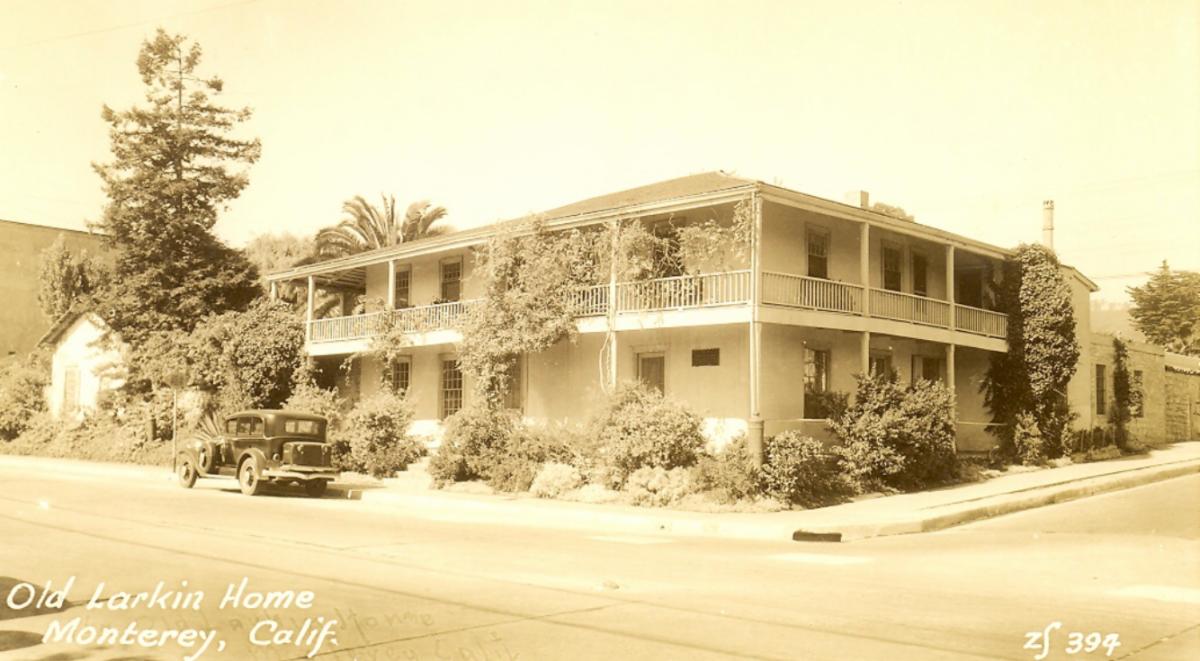
Mayo Hayes O’Donnell’s Peninsula Diary article published in the Monterey Peninsula Herald on March 8th, 1957 makes an interesting contrast to what we know about building costs today. The details for her article come from the “Larkin Papers” available for reading at the Mayo Hayes O’Donnell Library.
*******
Cost of the Larkin House
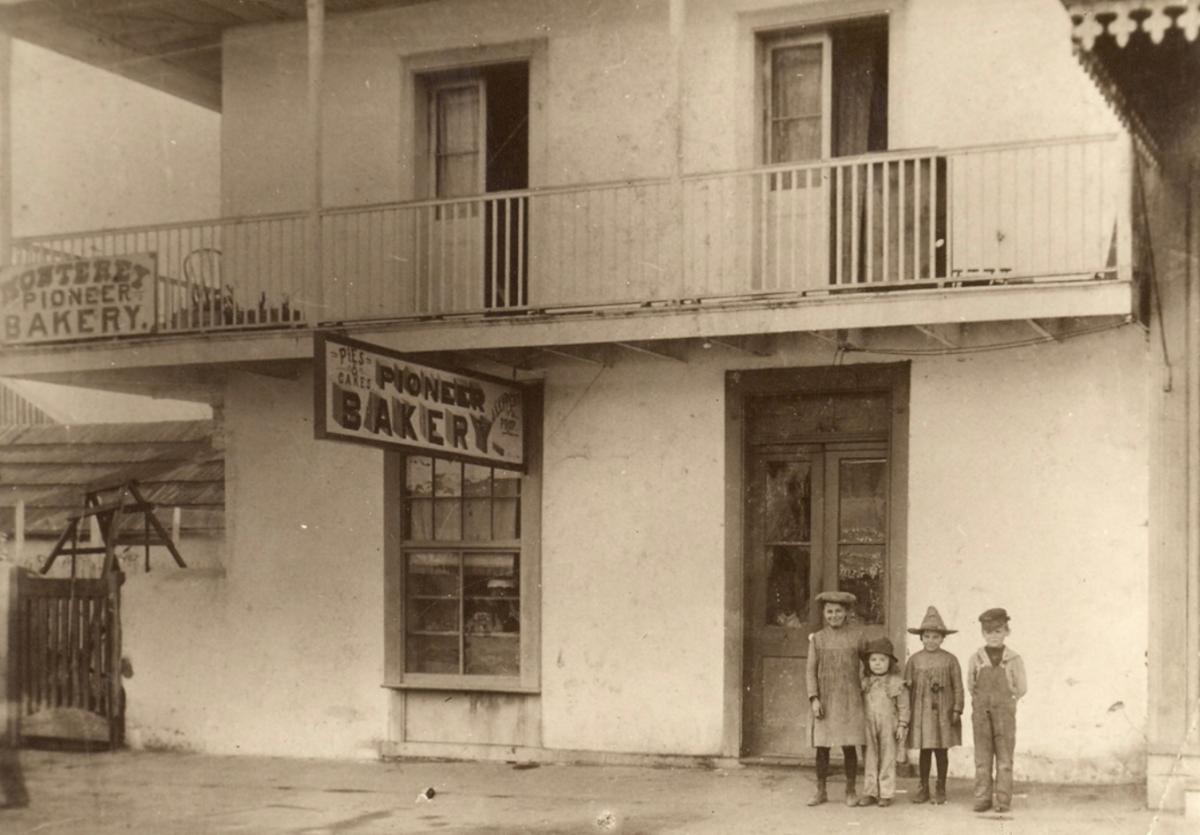
Believing that his home should also be his place of business, Larkin made not only a residence of the Larkin House, but also a store and other buildings.
His accounts - broken down to dimes - tells of the costs.
In April of 1835, he selected a building site, purchased 50 varas of land for $12.4, and paid $3.2 for the deed. Six to eight men, hired to work on the foundation for seven days, were paid $38.5. The stone cost $1.0 a load, and he used 126 loads. Other items, including the cost of an oven, purchase of lime, rent of oxen, and the cost of adobe bricks, brought the total expenditure to $222.
In his accounts, Larkin noted that during May another $5.0 was expended for work on the foundation. It was another task to prepare adobe bricks for the walls of the house and apparently, he made some of them himself, but for the most part he purchased them. He paid $6.0 for the making of the adobe molds for the bricks. He also noted that he paid another $6.0 for the repair of the hand cart which had worn out from constant use. Eleven loads of white stone (Carmel rock as it is now called) were purchased at the current price, and the laying of it cost $6.0, making the total expenditure of that month S23.4.
During June, $12.2 was spent for the repair of adobe brick because of the wet weather. $0.6 was spent for a hoe and a trowel. In July, the costs went up for Larkin recorded that he had spent $849.6, including $203.0 for the walls alone, part of which was labor. John Gorham, an Irishman who had arrived in Monterey a year before Larkin, collected $46.0 for his work as carpenter and bricklayer. Henry Hurd, recently from the United States, collected $18.0 for his work on the house. Larkin also noted that he fed and housed the workmen.
The thirteen pillars around the veranda cost Larkin $50.0, nails amounted to $0.6, ten door plates came to $30.0, six round poles cost $2.4. Larkin bought 12,000 adobe bricks for $15.0 a thousand and paid $60.0 to have them hauled to the building site. Indian labor cost him $6.7.
One month later Larkin spent $897.4, the greatest cost being the roof, it amounting to $581.0. Included in the total was also $172.0 for beams, planks, and boards. "Rum for raising the roof" amounted to $3.0. He paid $210.0 for shingles at $10.0 a thousand. Job Dye sold him $143.0 worth of shingles and William Garner, a lumberman and early English resident of California, was paid $52.0 for beams. William Mark West, another English lumberman who at various times acted as carpenter, was paid $7.5 for five planks.
Adobes for the chimney and the house cost Larkin $4.0 in October. Ten loads of stone for the oven came to $10.0. Nathan Spear, a former resident of Boston who became a merchant in Monterey, sold Larkin $15.0 worth of iron for the windows, it is presumed, for he also notes that the blacksmith was paid. $2.04 for his work on the windows.
November in Monterey must have been clear for there is no note in the account book of rain, so on the Larkin House progressed, and $642.4 was spent on the construction. Larkin noted that a deficit of $12.0 had occurred because of the loss of two crowbars. He purchased four locks for the doors of the house for $12.0, and 1,800 feet of lumber to be used on the upper floor for $90 0. Larkin paid $28.0 for slabs of wood for the kitchen, $8.0 for labor in the kitchen, $18.0 for 50 poles for a corral fence, and $16.0 to "Estevan" for digging a well, besides paying a note for $300.0 to West.
December was a rainy month, so Larkin spent only $33.0 on construction. He noted that he paid Henry Jubilee Bee, a former English sailor who made a living by guiding strangers about the country, $4.0 for work on the house. According to the records the house was being built from 1834 to 1837, and a great deal was added after the latter date.
Among the interesting expenses of the house in January was $30 for two boxes of glass for the windows. Larkin also noted that there was heavy rain at various intervals during this month making work on the residence difficult.