The American Society of Le Souvenir Français Inc.
Monthly Bulletin - Vol. III. No 2 - February 2023
|
|
George Washington's French engineers |
|
Francois Louis Teissedre de Fleury at Stony Point medal, 1779, Congress of the United States, (issuing authority), by Benjamin Duvivier, National Museum of American History, Smithsonian, Public Domain, U.S. Mint
Obverse Image: Mars (Ares) stands on the ruins of the fort at Stony Point trampling the British flag.
VIRTUTIS / ET / AUDACIAE / MONUM. / ET / PRAEMIUM / D. / DE / FLEURY / EQUITI / GALLO / PRIMO / SUPER / MURES / RESP. / AMERIC. / D. / D. / DU / VIVIER / S.,
‘A memorial and reward of valor and daring. The American Republic has bestowed (this medal) on Colonel D. de Fleury, a native of France, the first over the walls (of the enemy)."
|
|
EDITORIAL
2023 is barely two months old, and we are busy pursuing a number of projects in which your Society is participating. From the sculpture of Le Petit Prince on Fifth Avenue in Manhattan to the marker dedicated to the Duc de Lauzun at the Battle of the Hook in Gloucester, Virginia, from the renovation of the monument to La Pérouse in Maui, Hawaii, to the hommage to Louis XIV's sailor of La Belle at the Texas State Cemetery in Austin, our activities cover a wide geographical area and a long timeline spanning over 400 years.
Last month we explored several French forts in the State of New York. Before we continue to explore other French forts in future Bulletins, from the far reaches of Wisconsin all the way south to Louisiana, over a vast empire that stretched from Canada to the Gulf of Mexico, we would like to pause and turn the spotlight this month on the French engineers who worked under George Washington's command in the Continental Army, and whose contributions to American Independence are often overlooked.
Their technical expertise was unmatched, and proved crucial not just during the Revolutionary war but during the decades that followed as well. Alongside the heavy artillery, another area of expertise of the French Army, (and the topic of another future Bulletin), these engineers laid the foundations for two centuries of US military engineering excellence, which endures today. Few people know that the De Fleury Medal, the top award of the US Army Engineer Association, was named in honor of François-Louis Teissèdre de Fleury, a French Engineer in the Continental Army.
Our Society is honored and privileged to have Prof. Norman Desmarais, one of America's top experts and author of many books on the Revolutionary War, Professor Emeritus at Providence College, Rhode Island, as our Regional Delegate in New England.
In this winter month of February, Prof. Desmarais contributed to our Bulletin with a captivating article: "Valley Forge: Lieutenant Colonel Antoine-Jean-Louis Le Bègue de Presle Duportail", narrating the story of one of the most prominent of French engineers. Duportail was the founder of the Corps of Sappers and Miners which became the US Army Corps of Engineers. Also, Duportail and his three companions were the only officers to come to America with the King’s permission prior to the declaration of war.
Our association is proud to participate in the Bicentennial Committee of the triumphal tour of General Lafayette, led by the American Friends of Lafayette, as part of America250 celebrations ordained by the US Congress. In this Bulletin, we will continue to follow this most illustrious Frenchman on some of his footsteps during the month of February 1825.
Finally, as always, we will announce some upcoming events from like-minded sister organizations that are of great interest to our members and sympathizers.
We thank all of you who have recently renewed your 2023 membership, and if you haven't done so yet, please consider doing so. No contribution is too small, and your support is gratefully appreciated.
Why are we pursuing our missions? The simple answer is: because it is important that the younger generations appreciate the long history shared by America and France.
Last week, we were invited by the faculty of Manchester Regional High School in Haledon, New Jersey, to address young history students, and their keen interest was inspiring. Much more needs to be done, of course. Still, we thank all of you who share these monthly Bulletins to the educative community, and for the positive feedback we receive.
At the American Society of Le Souvenir Français, we never forget what we owe to our forebears who fought side by side for the freedom of both the United States and France. Count on us to continue honoring their deeds in the months and years to come!
Thank you as always for your remarks and suggestions.
On behalf of the Board of Directors.
Thierry Chaunu, President,
American Society of Le Souvenir Français, Inc.
|
|
A LONG TRADITION OF MILITARY EXCELLENCE |
|
Neuf-Brisach, the final fortress designed by Vauban; note how the houses support and reinforce the outer defensive walls. Photo by Luftfahrer, CC BY-SA 3.0, https://commons.wikimedia.org/w/index.php?curid=1629710
Bottom: West Point Fortifications. This plan of the complete system of defenses at West Point was copied from the original map drawn in 1780 by the Chevalier de Villefranche (1747-84), Lionel Pincus and Princess Firyal Map Division, The New York Public Library. "Plan of West Point" The New York Public Library Digital Collections. 1880 - 1899. https://digitalcollections.nypl.org/items/a2fc7450-4d05-0134-b10f-00505686a51c
|
|
WHY FRENCH ENGINEERS?
The great military engineer Vauban under the reign of Louis XIV brought the art of siege and buildings of fortresses to new heights. It is not an exaggeration to say that his teachings influenced generations of military engineers over two centuries. Vauban is legitimately considered one of history’s greatest military engineers.
Writing in 2004, historian Jānis Langins pays tribute to the impacts of Vauban and his nation on subsequent generations of engineers in peace or war:
"French military engineers of the Enlightenment left a significant legacy to military engineers and armies everywhere, as well as to modern engineering and engineering education. Indeed, France is a prime locus and the Enlightenment is a primary period in which to study the emergence of engineering as we know it today. The influence of French military engineering was felt from West Point to St. Petersburg. . . . It is no revelation that engineering is one of the most important professions of our time."
In North America, Forts such as Fort Ticonderoga (which we visited in our last Bulletin) or Fort Duquesne (in modern-day Pittsburgh, which we will visit next month), just to mention a few, were all designed with Vauban's precepts in mind. Coastal fortifications in the United States in the 19th Century are all mostly built with the same precepts by subsequent French engineers.
French engineers, trained at the École royale du génie in Mézières in the Ardennes, enjoyed a well-deserved reputation for excellence in mathematics and physics, hence their supremacy in artillery and cartography, so intertwined with engineering. Their studies took them to the field with seasoned officers, studying the art of fortifications.
Faced with the might of the professional British forces, the American Insurgents were eager to receive professional training and assistance.
To quote the Resource Study and Environmental Assessment (study/EA) for the Washington-Rochambeau Revolutionary Route:
"American officers such as Henry Knox were largely self-taught. The French were career soldiers, and their engineers and artillery officers had trained at the most advanced military and technical schools of the time."
French engineers joined in several ways.
Most were volunteers in the Continental Army (such as the famous François de Fleury, or Philippe du Coudray, Jean de Villefranche, Louis de Cambray-Digny, and Etienne de Rochefontaine).
Others were recruited with contracts: American envoys to the Court of Versailles, Silas Deane and Benjamin Franklin recruited four men: Antoine LeBègue de Presle Duportail, Jean-Baptiste Gouvion, Louis de la Radière, commissioned with ranks of colonel, major, and lieutenant colonel respectively, in February 1777, and Lt. Col. Jean-Baptiste de Laumoy. They were the only foreigners recruited at the express direction of Congress. As Royal French engineers, all four attended the School in Mézières.
Another engineer recruited by Augustin Caron de Beaumarchais, was none other than Major Pierre Charles L'Enfant, who stayed at George Washington's service after the Revolutionary War, and designed Washington D.C.
On March 11, 1779, Congress established the U.S. Army Corps of Engineers out of mostly of French personnel serving in the Continental Army.
As we will see in this Bulletin, the influence of French military engineers lasted beyond the Revolutionary War, well until the end of the 19th Century.
To quote the same National Park Service study:
"In the U.S. military in particular, French influence remained strong long after the end of the conflict. Throughout the war Americans lacked the expertise and training necessary in the technical branches of the armed forces, such as the artillery, engineering, or cartography. French volunteers provided this expertise. Training and expertise provided by French advisers and volunteers helped shape the Continental Army and its successor, the United States Army, into a skilled, professional fighting force. Even today, the U.S. Army Corps of Engineers awards the Fleury Medal for excellence in engineering, while the coat of arms and the motto of the U.S. Army Engineering School are that of the French school at Mezières: Essayons!—Let us try!”
Still in the same work, one can read, discussing the curriculum taught in US military engineering school at West Point Academy: "..Literacy in French was required so that the cadets could read Sébastien Le Prestre de Vauban’s classic Traité de fortifications and other textbooks in their original language. All these efforts represented the academy’s early commitment to inculcating Army officers into the “profession of arms.”
The contribution of these fine French military engineers to the cause of American Independence, (and not just during the successful siege at Yorktown) was immense, and often forgotten today. We will attempt to introduce a few of them, and their deeds, in this bulletin.
|
|
François-Louis Teissèdre de Fleury |
|
Stony Point State Park and the De Fleury medal.
44 Battlefield Rd, Stony Point, NY 10980
Right: Reverse of the De Fleury medal. The fort at Stony Point is visible complete with cannons and a large standard.
|
|
• Stony Point Battlefield is a historic site in Rockland County in upstate New York. By May 1779 the war had been raging for four years and both sides were eager for a conclusion. Sir Henry Clinton, Commander-In-Chief of the British forces in America, attempted to coerce General George Washington into one decisive battle to control the Hudson River. As part of his strategy, Clinton fortified Stony Point. Washington devised a plan to lead an attack on the garrison. Armed with bayonets only, the infantry captured the fort in short order, ending British control of the river.
• François-Louis Teissèdre de Fleury (1749–1799) was a French nobleman who joined the Royal Army in 1768 and later volunteered to fight in the Continental Army where he was named Captain of Engineers. In 1777 he fought at the Brandywine (where his horse was shot out from under him), was wounded at Germantown, served during the Siege of Fort Mifflin where he was wounded again. He was promoted to Lieutenant Colonel and fought in Rhode Island in August 1778.
• While leading one of the attacking columns at Stony Point in July 1779, (where he was the deputy CO of the 1st Regiment; became the highest ranking officer and acting CO of all the Revolutionary Forces in the course of the battle) Fleury won an award for being the first attacker to enter the British bastion. He led the charge followed by his men with bayonets through the British defenses to Stony Point’s summit; he was first over the enemy lines and at the flag pole, where he cut the British colors from their staff, signifying the capture of the fort (a feat Washington himself did not think possible)
• Following his exploit at Stony Point, Congress formally recognized de Fleury’s valor by awarding on October 1, 1779 a Congressional medal (struck in his honor) for his “zeal, military genius and gallantry”. He “exhibited a bright example to their brother soldiers, and merit in a particular manner the approbation and acknowledgment of the United States.”
He is one of only eleven medal recipients during the revolution and the only one earned by a foreign volunteer.
• Granted leave to return to France later that year, he returned to fight at Yorktown in October 1781. Back in the French army as a Colonel, he held commands in India and the Indian Ocean until 1790 when he returned to France, served in the Revolution army and got wounded again in 1794. He received a pension in June 1796 and died in 1799. The circumstances of his death are debated, the location of his grave is not known.
The De Fleury Medal named for Fleury, is awarded to outstanding members of the United States Army Corps of Engineers.
The "Order of the De Fleury" was established in 1779. There are four different levels of the award, which are steel, bronze, silver and gold, with gold being the most prestigious.
There are two markers at Stony Point mentioning his exploits:
• Detail excerpted from Marker:
“You are now inside the remains of the Upper Works. Within 15 minutes of each other, the two columns of American Light Infantry converged on the flanks of these fortifications. Lieutenant Colonel Francois de Fleury, a French engineer and professional soldier serving in the Continental Army, was the first man into the Upper Works, and, upon entering the Flagstaff Battery, struck the enemy colors. Later, de Fleury became the only European to receive a medal from Congress during the Revolutionary War, awarded to him for his bravery at Stony Point. “
•[Near the map on the upper left of the marker]:
“A replica of the medal awarded to de Fleury by the Continental Congress. In addition, he received $500 dollars for being the first man into the Upper Works, a sum that he divided among his men.”
|
|
Louis Le Bègue de Presle Duportail |
|
Louis Antoine Jean Le Bègue de Presle Duportail (1743-1802)
|
|
• He graduated from the Royal engineer school at Mézières in 1765.
• Captured in Charleston, South Carolina in May 1780, he was freed in a prisoner swap.
In several letters he asked to be promoted to a higher rank in order to give the necessary weight to his orders. He not only proved to be an excellent technician during the Pennsylvania campaign, but was especially noted for his sound advices as a strategist during the first councils of war in which he participated. Washington would rally to his views, and made him head of combined operations during the decisive operations carried out with Rochambeau and De Grasse until the victory at Yorktown., where he also directed the construction of siege works.
• Lafayette once called him “one of the best and most honest officers upon this continent.”
• Returning to France in October 1783, Duportail was made a Maréchal-de-Camp (Brigadier general). He served as France's minister of war during the beginning of the French Revolution, upon the recommandation of General Lafayette. Pursued by the most radical factions of the Revolution, he managed to seek refuge in America and bought a farm near Valley Forge, Pennsylvania. He lived there until 1802, when he died at sea during his return trip to France.
|
|
Philippe Tronson Du Coudray |
|
"Baron de Kalb introducing Lafayette to Silas Deane" The Miriam and Ira D. Wallach Division of Art, Prints and Photographs, The New York Public Library Digital Collections. 1778 - 1880. Public Domain
Silas Deane recruited du Coudray in a similar setting.
There are no known portraits of the unfortunate engineer. Note, several sites are mistakenly using other portraits, confusing him with other du Coudray family members.
|
|
He entered the French military and became a noted Artillery officer, writing treatises on gunpowder and metallurgy, eventually reaching the rank of Adjutant general,
• Silas Deane described him as the "first engineer" of the French military establishment, and endeavored to recruit him with the rank of major general and command of the Continental Army's artillery and engineering corps. Overzealous in his drive to recruit volunteers and gathering 200 cannons, Du Coudray annoyed the French Court which wanted to keep things quiet at the time, and was ordered to stay in his residence. Instead, Du Coudray went on and embarked for America in May 1777.
• Upon his arrival, Du Coudray faced strong jealousy from the American officers who resented foreigners being awarded superior ranks and authority. To calm the situation Du Coudray was instead appointed as "Inspector General of Ordnance and Military Manufactories" in August 1777.
• His assignments in surveying the defenses around Philadelphia, Fort Mercer (Red Bank), Fort Billingsport, Fort Mifflin, led to recommendations that were not followed, increasing the mutual recriminations and effectively slowing work.
At one point his strong temper and inability to compose with his superiors and entourage became a critical issue.
• He died prematurely in a tragic riding accident when his horse leapt from a pontoon bridge into the Schuylkill River. His spurs got tangled and he drowned under his horse. His funeral, held at St. Mary's Church in Philadelphia, was attended by many Congressional representatives. He was buried in the church yard, but the exact grave location is unknown, although a tombstone with his (barely legible) initials exists.
Coudray's death had the effect to make Duportail's position secure.
|
|
Jean Louis Ambroise de Genton, chevalier de Villefranche |
|
Marker “Revolution in the Mohawk Valley”, "French engineer Jean de Villefranche"
Fort Plain Museum, 389 Canal St, Fort Plain, NY 13339
Photo of book: French Military Engineering at Fort Plain by Norman J. Bollen
|
|
• Jean Louis Ambroise de Genton, chevalier de Villefranche was a French engineer who volunteered in the Continental Army and served under General George Washington. Because he was assigned to the Mohawk Valley, he didn’t receive the glory of serving in Yorktown, but was praised by George Washington in a letter dated December 3, 1782.
• The site of Fort Plain was chosen both for its defendable hilltop and strategic location in the valley. The fourth side of the hill formed an isthmus, which was cut across by trenches and a defensive redoubt designed by French Engineer Jean de Villefranche.
• A list of the number of men necessary to “man the works” at West Point found on British Major John André at the time of his capture by the Americans, includes a document signed “Villefranche, engineer”. Jean-Louis Ambroise de Genton, Chevalier de Villefranche, was the chief engineer at West Point starting in 1780 (New York State Archives, New York State. Papers found on British spy Major Andre ("Andre Papers", 1780. Series A4681-99, Men Necessary). Col. De la Radière also made great contributions to the works at West Point under the direction of Duportail.
• Inscription (excerpt):
“Archeological digs have confirmed the plan of the original 1779 Fort Plain. Willet expanded the fort in 1781 with a redoubt and new buildings to house as many as 600 troops. A new blockhouse designed by Major Jean de Villefranche was added in 1782 to hold 200 men. General George Washington inspected the fort on a tour of the region in 1783.”
|
|
Louis Antoine Chevalier de Cambray-Digny |
|
Louis Antoine Jean Baptiste Chevalier De Cambray-Digny
By Charles Willson Peale, from life, 1783. Courtesy, Independence Hall National Historic Park, Public Domain, via Wikimedia Commons
https://commons.wikimedia.org/wiki/File:Cambray-Digny_by_Charles_Willson_Peale.jpg
|
|
Map of Charleston, "Cambray Map", Library of Congress, Public Domain
https://commons.wikimedia.org/w/index.php?curid=54176913
|
|
• Louis Antoine Jean Baptiste de Cambray-Digny (1751–1822) was a French officer (born in Florence, Italy to French parents).
He joined the French artillery in 1770. In early 1778, he sailed to America with letters of recommendation from Benjamin Franklin to George Washington, joined the Continental Army as Colonel, and fought at the Battle of Monmouth.
He directed construction of Fort McIntosh in Pennsylvania, as a chief engineer.
He eventually took part in the Savannah Campaign, was taken prisoner in 1780 and exchanged in 1782.
Lt. Col. de Cambray-Digny was awarded a medal by the Assembly of South Carolina for his leadership in creating fortifications during the 1780 British Siege of Charleston. Cambray-Digny stands among an elite group of Revolutionary War medal recipients. His medal is one of only 15 medals awarded by the Americans during the Revolutionary War - and one of only two given to French Officers, the other one being De Fleury.
Upon his release, De Cambray-Digny requested and was granted a one-year leave, and returned to France. He retired with the rank of Brevet Colonel, and was honorably discharged on November 15, 1782.
He was a member of the Society of Cincinnati.
He participated in the French elections of 1789 at the start of the French Revolution, and managed to survive these tumultuous times. He was elected and remained mayor of the small village of Villers-aux-Érables in the Somme until his peaceful death in 1822 at the age of 71.
HOW DID ONE JOIN THE CONTINENTAL ARMY?
In the case of Cambray-Digny, it all started with a Letter of recommendation from Benjamin Franklin to George Washington:
From “Passy near Paris” on 10 Sept. 1777:
“The Bearer, M. de Cambray proposes to go to America with a View of entring into our Service. He is strongly recommended to me by the Duke de Rochefoucauld, who is not only a warm Friend to our Cause, but an excellent Judge of military Merit. I enclose his Letter, with a State of M. de Cambray’s Services which I receiv’d from another Hand, whereby it appears that he is skill’d in Engineering; and as you cannot have too much of that Science in your Army, I have the greater Confidence that you will find this Gentleman useful, I therefore take the Liberty of recommending him to your Excellency’s Protection, and of expressing my hopes that our Service will be made agreable to him” (DLC: Benjamin Franklin Papers)
Upon arriving in America, Cambray-Digny wrote a Letter to George Washington:
To George Washington from Cambray-Digny, 27 February 1778
From Cambray-Digny
On board the Ferdinand
Cape Look out [N.C.] 27th Feby 1778
My General—
I announce myself to your Excellency as a French man whose greatest desire is that of bearing his part in the just and noble cause of which you are the Protector—I am bearer of a Letter from Doctor Franklin, which I shall have the honor of delivering you when I shall have that of paying you my Court.
I arrived four days ago at Cape Look out, where the Ship Ferdinand is at Anchor—The Ship is commanded by Mr Cottineau, who judging a Land-battery necessary for the Security of his Vessel—I took charge of the execution of it—happy to find an opportunity at my first landing, of shewg my Zeal for the American Nation against the Enemies of Liberty—this work protecting the present Cargo which may be very useful, and offering at the same time an Asylum for Vessels which may be chased by the Enemy, nothing but this laudable motive could have detained me here; I consider it as a means of rendering me worthy to present myself to Your Excellency—I am an Artillery Officer, and as such desire to place myself under your Standards—After having studied the works of the greatest Generals—I am come to seek Examples under you I am with great respect General Your Excellency’s most obedt hble Servt
The Chevalier de Cambray
To which George Washington replied:
From George Washington to Cambray-Digny, 4 April 1778
To Cambray-Digny
Head Quarters [Valley Forge] 4th April 1778.
Sir.
I have received your letter of the 27th Feby informing me of your having letters from Doctor Franklin, and that you are desirous of serving in the Continental Army—it will save you unnecessary traveling and expences to apprise you that Congress alone can place you there, and consequently that your personal application to them, is the first step to be taken by you in prosecuting this business—if they should determine in your favor, it will give me pleasure to render your Situation in the Army as agreeable as possible. I am Sir Your most obedient and most humble Servt
Go: Washington
"
To think that it took weeks to write, and expect an hypothetical answer...
One can only marvel at the tenacity, patience, sincerity, fortitude, displayed by these valiant Soldiers of Freedom!
|
|
The three other recruits:
Jean-Baptiste Gouvion
Louis de la Radière
Jean Baptiste Joseph, chevalier de Laumoy
|
|
"Plan des forts, batteries et poste de West-Point, 1780" by Louis de la Radière
Wikiwand Creative Commons Attribution 2.0
|
|
• Chevalier Jean-Baptiste Gouvion (1747–1792) was one of the four French military engineers sent to America upon the request of Congress (the others being Duportail, La Radière, and de Laumoy).
He was a student-second lieutenant at the engineering school of Mézières (1769–1770).
• He entered the Continental Army on 8 July 1777 as a major. In November 1777 he was given the rank of lieutenant colonel. Along with Duportail, he planned and executed the fortifications at West Point. He also built the redoubt at Verplancks Point, in the town of Cortlandt, NY and made significant repairs at Fort Schuyler. He participated in the Siege of Yorktown under Duportail's command, was breveted a colonel in November 1781, and retired from the Continental Army in October 1783.
• Washington commended him in 1783 for "unquestionable proofs of bravery, activity, intelligence and skill" (Writings, 27, pp. 40-41).
• Gouvion returned to France and in 1783 he was given the rank of lieutenant colonel in the French army. The following year he was recognized as a Knight of Saint Louis and then in 1787 he was promoted to mestre de camp (brigadier general).
• He played a role at the start of the French Revolution. Known to Lafayette from his service in America, he was appointed major general of the Parisian National Guard in August of 1789. He was elected to the Legislative Assembly as a deputy for Paris and the following month he joined the military committee.
In April of 1792 General Gouvion resigned his position in the government to serve again in the army under Lafayette's army. He was killed by a shot from a cannon near Maubeuge in 1792.
• The name GOUVION is engraved on the north side of the Arc de Triomphe in Paris.
• Louis-Guillaume-Servais des Hayes de La Radière (1744–1779), a graduate of the French engineering school at Mézières who had attained the rank of captain in 1775, was one of the four French engineers whom the American commissioners in Paris engaged for the Continental army in February 1777.
• Brevetted a major before leaving France in March 1777, La Radière was appointed a lieutenant colonel by Congress on 8 July 1777, and he was promoted to colonel on 17 Nov. 1777. La Radière became involved in some rather acrimonious disputes with superior officers and other engineers while serving in the Hudson highlands during the latter months of 1777 and the early months of 1778.
• In August 1778 he was sent to Rhode Island to assist with Sullivan’s operations there, but he probably arrived too late to be of much use.
• La Radière died on 30 Oct. 1779, apparently at West Point.
• Jean Baptiste Joseph, chevalier de Laumoy (1750–1832) was the son of a French infantry captain. He entered the French military engineering school in 1760.
• de Laumoy was recruited to America in 1777, on 17 November was commissioned Colonel of Engineers, and joined Washington's winter camp at Valley Forge.
• On February 8, 1779, he was assigned to General Benjamin Lincoln, and on May 12, 1780, he was taken prisoner by the English after the capitulation of Charleston, and was exchanged on 26 November 1782.
• Laumoy was breveted Brigadier General on 30 September 1783, and honorably discharged from the army the following month.
• He returned to France in December 1783. On 4 July 1784 he was awarded the Order of Saint Louis. On 14 February 1789, he was second-in-command at Martinique, when the French suppressed a rebellion by the island's large African slave and ex-slave population. As one of the hated administrators, Laumoy was obliged to return to France in May 1790.
• For a while, Laumoy held a number of staff posts in the French Revolutionary Army under the marquis de Lafayette. Like Lafayette his life was endangered by the most radical elements of the Revolution, he had no choice but leave into exile, but was captured by the Austrians who treated them as anti-royalists. He managed to escape to America and lived in Philadelphia until he was removed from the émigré list. He returned to France in the summer of 1801. He fully retired in 1810, and died on 19 January 1832.
|
|
Étienne Béchet, Sieur de Rochefontaine |
|
Tomb - “Lt. Col. E.M. Bechet, Sieur de Rochefontaine”
St Paul’s Churchyard, intersection of Broadway and Vesey Street, New York, NY 10007
Photo: Thierry Chaunu (2021) © American Society of Le Souvenir Français Inc.
Inscription on the plaque:
Lt. Col. E.M. Bechet
Sieur de Rochefontaine
1755-1814
Revolutionary War Soldier
A French officer who fought for American
independence, Rochefontaine served under
the French General Rochambeau during
the Revolutionary War. He assisted in
the capture of Lord Cornwallis and later
commanded the Corps of Artillerists and
Engineers at West Point Military Academy.”
|
|
• Étienne Nicolas Marie Béchet, Sieur de Rochefontaine. (February 20, 1755 – January 30, 1814) was a French military engineer who served in the Continental Army, during the American Revolutionary War, and later as the Chief of Engineers of the United States Army Corps of Engineers. He was born in Ay, Marne France, and came to America in 1778 after failing to gain a position in the French Royal Corps of Engineers. He volunteered in General Washington's Continental Army in 1778 and was appointed captain in the Corps of Engineers. For his distinguished services at the siege of Yorktown, Rochefontaine was given the brevet rank of major by Congress, November 16, 1781.
• He returned to France in 1783 and served as an infantry officer, reaching the rank of colonel in the French Army. He came back to the United States in 1792 and anglicized his first name to Stephen. President Washington appointed him a civilian engineer to fortify the New England coast, in 1794.
• After the new Corps of Artillerists and Engineers was organized, Washington made Rochefontaine a lieutenant colonel and commandant of the new Corps on February 26, 1795. Rochefontaine started a military school at West Point in 1795, but the building and all his equipment were burned the following year. He left the Army on May 7, 1798, and lived in New York City, where he died January 30, 1814. He is buried in the Churchyard of St. Paul's Chapel in New York.
Epitaph (engraved in French on the south side of his monument):
E.M. Bechet Sire de Rochefontaine
"Dedicated himself to a military career and distinguished himself for a long time. He served in the American Campaign under the Count de Rochambeau which ended gloriously in 1782 with the capture of Lord Cornwallis. Louis XVI promoted him to Brigadier General at the Army of Saint Domingue in 1792. After the King's death, he became a Col. in the service of the United States. He retired in 1798 to enjoy a justly acquired respect and a well deserved rest among his friends.”
|
|
Major Pierre Charles L'Enfant |
|
Dedication ceremony of the Major Pierre L'Enfant marker at Arlington National Cemetery, June 14, 2022, with Denise Doring VanBuren National President, Daughters of the American Revolution. |
|
Our April 2022 Bulletin was dedicated to this great man:
• Pierre Charles L'Enfant (August 2, 1754 – June 14, 1825) was a French military engineer who designed the plans for the Capital City of the United States in 1791.
• He arrived in 1777 at the age of 23 with General Lafayette and served in the Continental Army. He was wounded at the siege of Savannah in 1779. He served in General Washington’s staff for the remainder of the war. In 1783 he became a civil architect.
• President Washington appointed L'Enfant in 1791 to plan the new "Federal City" (later named “the City of Washington”). His source of inspiration for majestic avenues and geometric patterns were the gardens of André Le Nôtre at Versailles.
• Although he died in poverty in 1825, his remains were exhumed at the instigation of the French Ambassador Jean Jusserand, and transferred to Arlington Cemetery in 1909 after lying in state at the US Capitol. In 1911, a monument was placed on top of L'Enfant's grave during a dedication ceremony presided by President Howard Taft.
What is particularly interesting given the topic of this Bulletin, are the conditions which made some engineers stay (or come back relatively quickly) in the United States. Congress passed a law in 1777 requiring all officers to pledge allegiance to Congress. By doing so, French officers were automatically granted American citizenship. When the French Revolution broke out, many of them returned to the United States as citizens.
In his book Engineers of independence: A documentary history of the Army Engineers in the American Revolution, 1775-1783, Paul Walker writes:
"Still hoping for a peacetime army and particularly concerned with getting adequately trained artillerists and engineers, Washington pressed Du portail to convince at least a few French officers to remain in America. The Chief Engineer himself preferred not to stay, but he felt sure other men might want to. However , they would require that the United States give them “an honorable, solid employment” and “show themselves to be a great respectable empire, or at least take proper measures for becoming so."
As matters stood, Duportail maintained anyone choosing to stay would clearly be making a blind choice . Congress's continued inaction tied Washington's hands. By the end of the year Duportail and Gouvion had returned to France . In late 1784 Maj. Pierre Charles L'Enfant, a Revolutionary War engineer officer who would later achieve great fame as the designer of the nation's capital, made another vain appeal for a peacetime engineer corps. Earlier L'Enfant had been led to believe that he would head the postwar engineering department , but now there was no department to command. Worse still, he had already forfeited the chance for an engineering appointment in France. In his detailed , well - reasoned memorial , L'Enfant did not advocate a European - style army for the United States , but he recognized the need for a general system of defense planned and maintained by army engineers. His preference for continental rather than state engineers and for a centralized system of fortifications was clear. He feared the states were insufficiently aware of the potential threats to their security. "It is neither the number nor extensiveness of forts that Secure a country, "L'Enfant insisted, “but their well combined Situation."
In a memoir before Congress, L'Enfant wrote:
"A neutral Power, it will be said, receives the benefit of a universal trade, has his possessions respected, as well as his colors, by all the Powers at war. This may be said of a powerful nation, but this America is not to expect; a neutral Power must be ready for war, and his trade depends on the means of protecting and making his colors respected. America, neutral without [a] navy, without troops or fortified harbors could have nothing but calamity to expect.” She cannot live free and develop in safety without “power to resent, ability to protect.”
|
|
EPILOGUE: AN ENDURING LEGACY |
|
The Corps of Engineers motto is “Essayons,” a French term which means “let us strive” or “let us try.”
Use of this term reflects French engineer contributions to America’s struggle for independence and the influence of the French Engineers on the early development of the Corps of Engineers.
Insigna U.S. Army, Public domain
|
|
Marker “Essayons – Let Us Try”
West Point Military Academy, Visitors Center
New South Post Rd, Highland Falls, NY 10928
GS: 41.373114, -73.962885
Photo: Thierry Chaunu (2022) © American Society of Le Souvenir Français, Inc.
|
|
• Inscription:
“The US Army Corps of Engineers’ motto Essayons in French for “Let us try”. It is with the same spirit that French military engineers volunteered and served in the Continental Army in the Revolutionary War. One of them was Louis Le Bègue de Presle du Portail. He arrived in America in 1777, and quickly gained Washington’s trust and respect. By 1779, he was assisting with the planning of West point and working as the senior chief engineer for the army.
Du Portail’s importance grew. By 1781, he was serving as Washington’s interpreter for his meeting with Rochambeau while the two commanders planned campaign strategy. Later that year, the generals showed their trust of du Portail by sending him to Virginia ahead of their armies to plan the siege of Yorktown, a turning point in the Revolutionary War. There, du Portail met with French Admiral François-Joseph Paul, comte de Grasse, to gain the crucial support of the navy for the attack.
Washington escorted Rochambeau on a side trip to visit the fortress at West Point during the allies’ march to Virginia in 1781."
|
|
Several of the engineers stayed, other continued to be hired from France.
We will present in future bulletins other French engineers who contributed mightily to the expansion and defense of the United States:
-
Louis de Tousard, originally an artillerist when he served in the Continental Army under Lafayette, but who served in the Corps of Artillerists and Engineers in 1795 and became the (forgotten) initiator of the Military Academy of West Point, serving as its first unofficial superintendent, and who co-founded with Irenée Dupont de Nemours the chemical giant DuPont Company,
-
Colonel Claudius Crozet, aka “The Pathfinder of the Blue Ridge”,
-
Brigadier General of engineers Simon Bernard, who designed and built many coastal forts,
-
Joseph-François Mangin, the architect of the New York City grid ...
|
|
The Valley Forge Encampment
By Prof. Norman Desmarais
|
|
George Washington and five of his officers are featured in a scenic, snowy landscape. Based on the artist Veron Fletcher’s painting, which was exhibited at the Smithsonian in February 1855, the print was drawn on stone by Edward Moran, brother of noted artist Thomas Moran |
|
Lieutenant Colonel Antoine-Jean-Louis Le Bègue de Presle Duportail arrived in America on July 5, 1777 to present his credentials to Congress. He joined the Continental Army at Whitemarsh after its defeat at Germantown and Congress appointed him brigadier general on November 17, 1777. The terrible winter of 1777-1778 was approaching and the future of the United States seemed precarious. The army already lacked clothing, food, hospital accommodations and transportation facilities. Military victories seemed more like defeats, contributing to poor morale.
General Duportail attended his first council of war on November 24, 1777. The Commander-in-Chief reported the state of affairs to the assembled generals (Armstrong, Gates, Greene, Knox, Lee, Mifflin, Scott, Sterling, Wayne, Woodford, de Kalb, Steuben, Lafayette and Duportail) and asked them to consider the question: "What measures had best be pursued in the present emergency?” He asked them to put their responses in writing and to give their opinion regarding "the expediency of an attack upon Philadelphia." Eleven of the generals were against making the attack and only four (Stirling, Wayne, Scott and Woodford) were in favor."1
|
|
Duportail's first memorial analyzed all aspects of the problem: the terrain, the report and preparation of the troops, the enemy, the motivation and level of training of the combatants, the weather conditions, possible operations etc. He deemed that an attack would result in certain defeat and risk the reversal of any preceding gains. His suggestion must have been acted upon, as Colonel John Laurens, Washington's aide-de-camp, wrote in a letter to his father, then President of Congress, on November 26th:
"
Our Commander-in-Chief wishing ardently to gratify the public expectation by making an attack upon the enemy yet preferring at the same time a loss of popularity to engaging in an enterprise which he could not justify ... went yesterday, [November 25] to view the works ... we saw redouts of a very respectable profile, faced with planks, formidably fraised, and the intervals between them closed with an abattis unusually strong. General Duportail declared that in such works with five thousand men he would bid defiance to any force that should be brought against him."2
Winter Quarters
General Washington decided on Valley Forge for winter quarters on December 12. His camp overlooked a bleak and desolate winter landscape with a beating rain driving in upon the men who had pitched tents to make themselves a little more comfortable. Heartbroken at abandoning his plan of action for 1777 and fully realizing the hardships they both endured and were to face, he wrote an address to the army with heart and mind buoyed by confidence.
Head Quarters at the Gulph,
Dec. 17. 1777—
The Commander-in-Chief with the highest satisfaction expresses his thanks to the officers and soldiers for the fortitude and patience with which they have sustained the fatigues of the campaign—Although in some instances we unfortunately failed, yet upon the whole Heaven hath smiled on our Arms and crowned them with signal success; and we may upon the best grounds conclude, that by a spirited continuance of the measures necessary for our defence we shall finally obtain the end of our warfare—Independence—Liberty and Peace—These are blessings worth contending for at every hazard—but we hazard nothing. The power of America alone, duly exerted, would have nothing to dread from the power of Britain—Yet we stand not wholly upon our ground—France yields us every aid we ask, and there are reasons to believe the period is not very distant, when she will take a more active part, by declaring war upon the British Crown. Every motive therefore, irresistibly urges us—nay commands us to a firm and manly perseverance in our opposition to our cruel oppressors—to slight difficulties, endure hardships, and contemn every danger—The General ardently wishes it were now in his power to conduct the troops to the best winter quarters—But where are these to be found? Should we retire to the interior parts of the State we should find them crowded with virtuous citizens, who, sacrificing their all, have left Philadelphia, and fled thither for protection. To their distresses humanity forbids us to add—This is not all; we should leave a vast extent of fertile country to be despoiled and ravaged by the enemy, from which they would draw vast supplies, and where many of our firm friends would be exposed to all the miseries of the most insulting and wanton depredations—A train of evils might be enumerated, but these will suffice—These considerations make it indispensably necessary for the army to take such position, as will enable it most effectually to prevent distress and to give the most extensive security, and in that position we must make ourselves the best shelter in our power—with activity and diligence Huts may be erected that will be warm and dry—In these the troops will be compact, more secure against surprises than if in a divided state, and at hand to protect the country. These cogent reasons have determined the General to take post in the neighborhood of this camp; and influenced by them he persuades himself, that the officers and soldiers, with one heart, and one mind, will resolve to surmount every difficulty, with a fortitude and patience, becoming their profession, and the sacred cause in which they are engaged. He himself will share in the hardship, and partake of every inconvenience.—
Tomorrow being the day set apart by the Honorable Congress for public Thanksgiving and Praise; and duty calling us to devoutly express our grateful acknowledgements to God for the manifold blessings he has granted us—the General directs that the army remain in its present quarters, and that the Chaplains perform divine service with their several corps and brigades—and earnestly exhorts all officers and soldiers, whose absence is not indispensably necessary, to attend with reverence the solemnities of the day.3
|
|
Fig. 2. Soldier huts. The soldiers built two thousand huts similar to these to house 20,000 men and officers. Each hut sheltered nine to twelve men. Construction was completed in a month, and the encampment became the fourth-largest city in America after Philadelphia, New York, and Boston.
Valley Forge
Valley Forge was selected and the army set up headquarters there on December 20, 1777. Before leaving the Gulph, orders were issued regarding the building of huts which the soldiers were immediately to construct for themselves. Thomas Paine, who was at Lancaster and York during the winter of 1778, wrote a letter to Benjamin Franklin regarding the encampment at Valley Forge:
I was there when the army first began to build huts; they appeared to me like a family of beavers; every one busy; some carrying logs, others mud and the rest fastening them together. The whole was raised in a few days.4
Immediately after erecting shelters for the men, the work of providing defenses began. Duportail was assigned the task of bolstering those defenses to prepare against an enemy attack because the army was encamped in a place easily accessible from the enemy's headquarters in Philadelphia. Washington expected an attack the following spring, but it never happened. This was among the most significant of all of Duportail’s services and established his reputation.
General Washington’s order book for January 15, 1778 specified that
The works marked out by the Engineers for the defense of the camp are to be erected with all possible dispatch and the Commander-in-Chief requests the favor of General Greene, Lord Sterling and the Marquis de la Fayette (General Sullivan being upon other duty) to consult with Genl. Portail on the proper means and number of men necessary to execute the works in the different Wings & second line and gives orders accordingly—and that each of them appoint proper officers to superintend and push forward the defences.5
Later, when General William Howe returned to England, he came under severe criticism for not having driven Washington from his entrenchments before his departure from Philadelphia. His excuse was that the place was naturally strong and had been so strengthened by "artificial works" that he did not judge it prudent to attempt an attack "during the severe season" and later it would have been impossible. He said: "... having good information in the spring that the enemy had strengthened his camp by additional works and being certain of moving him from thence when the campaign opened, I dropped all thought of attack."
|
|
Fig. 3. The “Duportail House” in Chesterbrook, Pennsylvania served as his headquarters at Valley Forge.
Defenses of Valley Forge
The defenses of Valley Forge were practically completed by the end of March 1778. Henry Laurens, President of Congress, wrote to a friend on April 7th: “The present newly adopted encampment Genl. Duportail assures me, is tenable against the enemy's utmost efforts by their present powers.”6
|
|
Fig. 4. The defenses of Valley Forge consisted of five redoubts (highlighted) connected by miles of trenches and earthworks designed to strengthen the natural advantages of the terrain. The redoubts were arranged in a triangle and were all visible to each other because the ground had been cleared of trees for miles around to build the huts and earthworks and for firewood. Enemy approaching the encampment could be spotted miles away. Valley Forge National Historical Park Visitors’ Brochure.
The work was accelerated because General Washington expected the enemy would attack the Continental Army in their entrenchments as soon as the good weather returned. Washington also thought that an enclosed work on a particular height ("Joy Hill" or " Mount Joy" left side of the map to the right of Valley Creek Road) might add to the army’s security. General Duportail, wrote a note, on April 13, expressing his concern that such a work would be a hindrance rather than a help, as it only allowed viewing an enemy advance on one or two sides. They could mount an attack on the other sides under cover and incapable of defense.7
|
|
Fig. 5. Valley Forge showing some of the huts protected by artillery.
The situation at Valley Forge was very tense during April 1778. The so-called "Conway Cabal" attempted to replace Washington with General Gates as Commander-in-Chief. The debate roiled in Congress during February and March and was still on everyone’s mind when news of a new menace reached camp.
After news of the surrender at Saratoga reached London, Parliament considered Lord North's Conciliatory bills and General Howe was sending out notices from Philadelphia about them. There were also reports of Commissioners from Parliament coming to restore peace. They were due to arrive shortly with full powers to grant any demand short of independence and to pardon all who would immediately lay down their arms.
Washington wrote a private letter to John Banister, a personal friend and a delegate from Virginia, a few days later, emphasizing his distress:
. . . The enemy are beginning to play a game more dangerous, than their efforts by arms . . . which threatens a fatal blow to the independence of America, and of course to her liberties. They are endeavoring to snare the people by specious allurements of peace .... Nothing short of independence, it appears to me, can possibly do. A peace on other terms would ... be a peace of war. The injuries we have received from the British ... are so great and so many, that they can never be forgotten.
He then thinks of France and his outlook brightens immediately:
. . . I think France must have ratified our independence and will declare war immediately, on finding that serious proposals of accommodation are made .... It cannot be fairly supposed that she will hesitate to declare war if she is given to understand, in a proper manner, that a reunion of the two countries may be the consequence of procrastination. An European war or European Alliance would effectually answer our purpose. . . .8
France had actually already declared war against Britain by signing the Treaty of Alliance on February 6, 1778 but the news hadn’t yet reached General Washington who proposed, on April 20, 1778, three plans and related questions for his general officers to consider for the upcoming campaign:
1. attempt to recover Philadelphia and destroy the enemy army there. What mode of execution to pursue and what force will be required against an estimated 10,000 men, exclusive of marines and seamen, whose aid may be called in? Attempt an attack by storm, by regular approaches or by blockade, and in what manner?
2. transfer the war to the north by attacking New York. Should this be done by a coup de main, with a small force, or make an attack with a large force? How large a force would be necessary in either case, estimating the number of the enemy in and around New York at 4000 men, and how to dispose of the troops to achieve the desired result, and to protect the country and secure the stores at the same time?
3. remain quiet in a secure, fortified camp, drilling and disciplining the army. What post shall be taken so as to keep the army secure, to cover the country and magazines and to be in a position to counteract any future movements of the enemy?9
Duportail’s memorial on this occasion was a very significant document as it had a profound influence in shaping Washington’s policy. It also indicated that Duportail was imbued with the American cause, during the five months he had been in the Continental Army, because he saw the cause of France in it.
When the Continental Army marched out of Valley Forge in June 1778, they met the British Army at Monmouth, New Jersey. The training they received under General Steuben during their winter encampment proved they were a respectable fighting force.
Notes
1. William Spohn Baker. Itinerary of General Washington: From June 15, 1775, to December 23, 1783. Hunterdon House, 1970. p. 106.
2. ibid.
3. General Orders. Washington, George, and Philander D Chase. The Papers of George Washington. Edited by Dorothy Twohig et al., Revolutionary War Series. University Press of Virginia, 1985. 12: 620-621.
4. Franklin, Benjamin, et al. The Papers of Benjamin Franklin. New Haven, Yale University Press, 1959. http://franklinpapers.org. May 16, 1778 26: 478.
5. Taylor, Frank H. Valley Forge: A Chronicle of American Heroism. Philadelphia: James W. Nagle, 1905. GW 13: 243.
6. Burnett, Edmund Cody, editor. Letters of Members of the Continental Congress. P. Smith, 1963. GW 14:419-420.
7. Washington, George. Op. cit. 14: 493-494.
8. Fitzpatrick, John Clement. The Writings of George Washington from the Original Manuscript Sources, 1745-1799. U.S. Govt. Printing Office, 1931). 11: 288. The Writings of George Washington: Being His Correspondence, Addresses, Messages, and Other Papers Official and Private: Selected and Published from the Original Manuscripts: With a Life of the Author, Notes, and Illustrations. Edited by Jared Sparks, American Stationers' Company, John B. Russell, 1834. 5:325
9. Washington, George. Op. cit. 14: 567.
Norman Desmarais is professor emeritus at Providence College, Providence, Rhode Island, and an active reenactor. He is a member of Le Régiment Bourbonnais, the 2nd Rhode Island Regiment and the Brigade of the American Revolution.
Professor Desmarais is the author of Guide to the American Revolutionary War series (six volumes about the war on land and seven volumes about the war at sea and overseas), as well as America’s First Ally: France in the American Revolutionary War, Washington’s Engineer: Louis Duportail and the Creation of an Army Corps, and The Road to Yorktown: The French Campaigns in the American Revolution, 1780-1783.
He is the former editor-in- chief of The Brigade Dispatch, the journal of the Brigade of the American Revolution.
He translated the Gazette Françoise, the French newspaper published in Newport, Rhode Island by the French fleet that carried the Count of Rochambeau and 6,100 French troops to America in July 1780. It is the first known service newspaper published by an expeditionary force.
Professor Desmarais served as Vice President of Le Foyer Club and the Club Richelieu (which became the Aram Pothier Club), social organizations for the preservation and promotion of the French language and culture. He serves on the Board of Directors of the Boivin Center, University of Massachusetts, Dartmouth.
He was a pioneer in the CD-ROM industry. He set up and managed the first CD-ROM network in Rhode Island and served as Senior Editor of CD-ROM World, contributing editor of Optical Information Systems, and was the founding editor and editor-in-chief of Electronic Resources Review. He is listed in Men of Achievement; International Directory of Distinguished Leadership, the Dictionary of International Biography, Who's Who of Information Technology, Outstanding People of the 20th Century, 2000 Outstanding Intellectuals of the 20th Century, and Marquis Who’s Who.
Norm was inducted into the American French Genealogical Society French-Canadian Hall of Fame in 2015, and received the Albert Nelson Marquis Lifetime Achievement Award in 2019 and 2020.
|
|
PART SEVEN OF THE SERIES
"LAFAYETTE, GUEST OF THE NATION"
If you missed the episodes from our past Bulletins...
• President James Monroe invited Lafayette, the last surviving major general of the American Revolutionary War, to tour the United States, officially to celebrate the nation's 50th anniversary but also to instill the "spirit of 1776" in the next generation of Americans at a time of great political divide. His tour drew large crowds and sparked a renewal of patriotism.
• From July 1824 to September 1825, Lafayette made a tour of all 24 States in the United States. He was received with a hero's welcome everywhere he stopped. Immense crowds, children, old veterans would come from miles away and wait hours to have a chance to see him, approach him, touch him. Many honors and monuments were presented to commemorate and memorialize the visit.
• The 24 states visited were: Alabama, Connecticut, Delaware, Georgia, Illinois, Indiana, Kentucky, Louisiana, Maine (ex-Massachusetts / North part), Maryland, Massachusetts, Mississippi, Missouri, New Hampshire, New Jersey, New York, North Carolina, Ohio, Pennsylvania, Rhode Island, South Carolina, Tennessee, Vermont, Virginia, Washington D.C.
• The main means of transportation were stagecoach, horseback, canal barge, and steamboat.
• Throughout the years 2024 and 2025 each city will celebrate this most illustrious Frenchman, ranked alongside the Founding Fathers, practically on a par with George Washington. If anyone harbors any doubt about it, one only needs to read some of the hundreds of local newspaper articles and the accounts or memoirs of contemporary witnesses accounts.
|
|
• Several of his stops are memorialized with markers and plaques, some decades-old, and an increasing number of brand new ones, thanks to the energy and enthusiasm deployed by Julien Icher, president of the LafayetteTrail.org, whose goal is to dedicate all 175 markers by 2024.
• These new markers from the LafayetteTrail.org are all made in the same distinctive blue and red cast metal and signed by the William C. Pomeroy Foundation which is generously funding this gigantic project.
• The American Society of Le Souvenir Français Inc. is honored to partner with these two like-minded organizations, as well as all other American patriotic associations and volunteers who are participating in these celebrations, under the umbrella of America250.
|
|
As we started with the August 2022 Bulletin, we will narrate every month some of the most salient episodes of this remarkable journey of the corresponding month 199 years ago, while keeping you abreast of the many celebrations planned by the local committees of the American Friends of Lafayette in 2024 and in 2025.
For this series we will also borrow from the testimonies of a privileged close witness, Auguste Levasseur, Lafayette’s personal secretary, who traveled along with the Marquis and his son, George Washington Lafayette, and who published his extensive daily journal: “Lafayette en Amérique 1824-1825, ou Journal d'un voyage aux Etats-Unis" (Published by the Librairie Baudoin, Paris, in 1829), as well as other well-documented sources, such as Samuel Lorenzo Knapp. “Memoirs of General Lafayette : with an Account of His Visit to America and His Reception By the People of the United States; From His Arrival, August 15th, to the Celebration at Yorktown, October 19th, 1824”(Published in November, 1824)
|
|
-
February 23, 1825 – Sets off on the southern leg of his tour Because the route from Richmond to Raleigh was by carriage over poor roads, the traveling party was obliged to take the sandy "Lower Road" by Suffolk and Halifax.
- February 25—Interviewed by Poulson's Advertiser, a Philadelphia newspaper, recalls his wound at Brandywine
- February 26 — Overnight stop at the Indian Queen Inn in Murfreesboro, North Carolina
- February 27 – Traveled to Northampton Court House (present-day Jackson, North Carolina) where he met the official North Carolina greeting party and stayed at Eagle Tavern in Halifax, North Carolina
-
February 28 – Traveled through Enfield, North Carolina, with a brief stop at the home of Joseph Branch and across the Tar River at the falls and spent the night at Col. Allen Rogers' Tavern at Rogers Crossroads in eastern Wake County, North Carolina
|
|
Lafayette at Suffolk, Virginia |
|
Marker, Lafayette’s tour, Suffolk, VA
February 25, 1825
Suffolk Visitor Center, 610 E Market St, Charlottesville, VA 22902
Photo: Lafayette Trail
|
|
• “Having arrived at the town he [Lafayette] was received with military honors by that fine martial corps, the “Suffolk Columbians,” commanded by Capt. Charlton, and escorted to the Court House, where he received the congratulations of the authorities of the place, of the citizens, and of a large concourse of respectable individuals who had eagerly pressed into town from the circumjacent county, to greet his arrival.” American and Commercial Daily Advertiser, dated March 2, 1825
• Inscription:
“On Feb 25, 1825, general
Lafayette was the guest of
honor as he dined at the
courthouse before leaving
Suffolk the next day.”
William G. Pomeroy foundation 2020
|
|
Lafayette in Murfreesboro, North Carolina
|
|
Markers, Lafayette’s visit, Murfreesboro, NC
February 26, 1825
586 W Broad St, Murfreesboro, NC 27855
Photo : North Carolina Highway Historical Marker Program
|
|
• “...the whipping and swearing of our drivers, all was insufficient to stimulate our horses, which, sunk in the mud to their knees, appeared to have taken root, refusing to make the least exertion to draw us out of this sad situation, in which we remained about an hour. At length we arrived and were very amply compensated by the cordial hospitality of the inhabitants of Murfreesborough, who neglected nothing to prove to General Lafayette that the citizens of North Carolina were not less sincerely attached to him than those of the other states.” (Auguste Levasseur. “Lafayette in America in 1824 and 1825, Vol. II. p. 74.)
• Inscription of historic Marker A-65 (on Main & 3rd Street) :
“On his American tour
Lafayette spent night
of Feb. 26, 1825, at
Indian Queen Inn which
stood two blocks north”
• Inscription of 2019 marker:
•“Indian Queen inn
marquis de Lafayette stayed
overnight in Murfreesboro
said to have missed ball here in
his honor when carriage got stuck in the mud nearby”
North Carolina Folklife Institute & William G. Pomeroy foundation 2019
|
|
Lafayette in Jackson, North Carolina |
|
Mural Lafayette & Marker, Lafayette’s tour, Jackson, NC
February 27, 1825
119 W Jefferson St, Jackson, NC 27845
Mural: Image Capture July 2022 (c) Google 2022
Bottom: Photo marker: Lafayette Trail
|
|
• On February 27, 1825, Lafayette reunited with Col. William Polk, an old friend from the Revolutionary War, in Jackson, North Carolina. He was received and addressed inside the county courthouse by the first North Carolina Supreme Court Chief Justice, John Louis Taylor.
• The town board passed a resolution in 2020 to name the small pocket park as “Lafayette Park,” and the Northampton County Museum is currently developing a permanent exhibit about the Revolutionary War general. There is also a mural, painted by local artist Napoleon Hill, featuring General Lafayette and the NC welcoming delegation. That is located across the street on the side of the Embassy Café.
• Inscription:
“On February 27, 1825,
Lafayette was received at
County Courthouse by NC
Justice John Taylor, reunited
with friend col. WM Polk.”
William G. Pomeroy foundation 2020
|
|
Lafayette in Enfield, North Carolina |
|
Marker, Lafayette’s tour, Enfield, NC
February 28, 1825
404 Sherrod Heights, Enfield, NC 27823
|
|
• On February 28, 1825, General Lafayette made a 30 minute stop at attorney Joseph Branch’s house while on his way to Raleigh and Fayetteville.
• “The Cellar” is a historic home. It was listed on the National Register of Historic Places in 1979. Major Joseph Branch’s son, Lawrence O’Bryan Branch, aged 5 when Lafayette stopped at the house, became a Confederate Brigadier General, killed at the battle of Antietam.
• Inscription:
“On February 28, 1825,
general Lafayette was
entertained here in Joseph
Branch’s home on his way
to Raleigh and Fayetteville.”
William G. Pomeroy foundation 2020
|
|
WE WILL CONTINUE TO TRAVEL WITH LAFAYETTE
OVER THE NEXT 7 MONTHS!...
|
|
PAST MONTHLY BULLETINS
OUR GOAL: turn the spotlight on a famous, or less famous, episode or historical figure during the long shared history between France and the United States, with illustrations and anecdotes.
You can have access to all our past Monthly Bulletin
since February 2021 by visiting our website:
You can click on the photos throughout our bulletins and also on the links indicated in blue for more information and direct access to sources.
|
|
Next month we will turn our attention back to the series on French forts in the 17th and 18th century in the Midwest. |
|
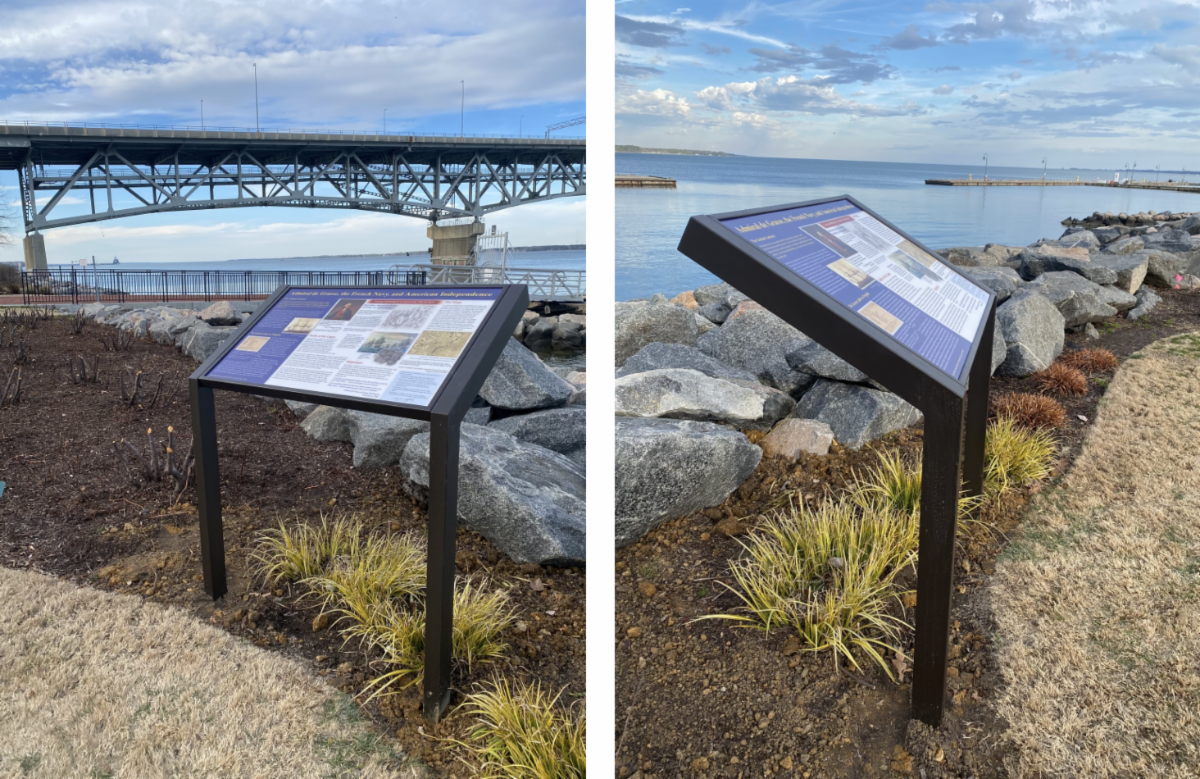
INSTALLATION OF OUR MARKER
"ADMIRAL DE GRASSE, THE FRENCH NAVY,
AND AMERICAN INDEPENDENCE"
IN YORKTOWN
As you may recall, the dedication of our marker took place on October 18, 2022 on Riverwalk in Yorktown, in the presence of Admiral Frédéric de Rupilly.
However, the metal frame had been damaged during transportation. We are grateful to the National Park Service for their help in reordering a new one to the manufacturer. We also thank profusely the authorities of York County, who recently installed the new marker in its final place, for their patience and cooperation.
We are very proud of this magnificent marker, signed by your Society!
|
|
Photos: courtesy of Katie Meis, York County Economic and Tourism Development Office
Riverwalk, Yorktown, VA 23690
The Marker Committee Members consisted of:
Nicole Yancey, Regional Delegate of the Souvenir Français, and former Honorary Consul of France in Virginia • Rear Admiral Hilaire Ducellier • Rear Admiral Frédéric de Rupilly • Colonel Aymeric Tardieu de Maleyssie • Lt Colonel Alain Abad • Lt Colonel Mathieu Brulais • Dr. Robert A. Selig, Ph.D., historian, author of the text of the interpretive panel • Thierry Chaunu • Johnny Carawan, National Park Service.
|
|
In Memoriam: Battle of Rhode Island Association Director Burt Quist
It is with great sadness that the Battle of Rhode Island Association and the Butts Hill Fort Restoration Committee announce the passing of Director Colonel Burton C. Quist, USMC (Ret.). He passed with his family at his side after a brief battle with cancer on January 25, 2023. In addition to being a founding Director of the Battle of Rhode Island Association (BoRIA) and an active member of the Butts Hill Fort Restoration Committee (BHFRC), Burt was a Board Member of the Rhode Island Society of the Sons of the Revolution and the Rhode Island Chairman for the Washington-Rochambeau Revolutionary Route Association.
Burt’s contributions to the BoRIA were many and significant. With his ability to work with people, he recruited several volunteers to the BoRIA Board and BHFRC. Recognizing that achieving our mission required “getting the story out”, he became Director of Public Affairs and began outreach through the media and multiple events. His “Coffee and Donuts at the Fort” event brought recognition that BoRIA had begun. Finally, with his senior leader military background, Burt was able to engage and enlist several local, state and national American Revolution heritage organizations, forging partnerships, and garnering funding and mutual support for BoRIA’s multiple restoration and preservation efforts.
Burt was commissioned in the Marine Corps in 1969 and retired from active service in 1996. Among his deployments as an infantry officer, he served in Vietnam and Guantanamo Bay, commanded 1st Battalion 1st Marines, and commanded Joint Task Force Provide Promise (Forward) during the Yugoslav Wars. He was a graduate of the Marine Corps Amphibious Warfare School and the Naval War College and taught at the Marine Corps Command and Staff College. Following instructor duty at the Naval War College, he retired from the Corps in Newport, Rhode Island. He established lifelong friendships during his 27-year career and his family enjoyed multiple assignments on both coasts and in Norway. After his military career, Burt worked in business development for another 20 years. Having been stationed in the Newport area, he constantly desired to return to Aquidneck Island for retirement. He and Cathy moved back to Middletown in 2009, where he eventually retired from Northrup Grumman in 2016.
In retirement, Burt conducted tours of Newport for the Newport Historical Society, worked as a tour guide at Fort Adams, and pursued his passion for the restoration of Butts Hill Fort in Portsmouth. He always enjoyed using his love of history to contribute to the local community on Aquidneck Island. He would often find any opportunity to ensure a conversation somehow ended up with a discussion on Rhode Island’s Revolutionary War history. He also traveled frequently to see his sons and grandchildren and visit friends and family around the country and the world, including those in Norway, Croatia, and Chile.
Burt was a good friend to many and had a dry sense of humor. He loved studying history and educating the community about the restoration efforts at Butts Hill Fort. His friendship, dedication, and contributions will be sorely missed.
Donations in Colonel Quist’s memory may be made to the Battle of Rhode Island Association (BoRIA) by mail to PO Box 626 Portsmouth, RI 02871 or at www.battleofrhodeisland.org.
|
|
An announcement: Lecture Conference
"The History of the French in New York"
|
|
If you can't attend the conference, you can listen to it on Facebook Live or after the event on the Consulate's YouTube channel. |
|
FROM OUR FRIENDS AT THE LAFAYETTE TRAIL! |
|
The Lafayette Trail, Inc. is pleased to announce the upcoming dedication of a new Lafayette Trail historic marker in Buras-Triumph, Plaquemines Parish, Louisiana on Tuesday, March 7, 2023, at 2 pm CT. This will be our first event in the Pelican State.
The marker dedication ceremony will take place at Fort Jackson, located at 220 Herbert Harvey Drive, Buras-Triumph, LA. Parking will be available on-site.
The ceremony is expected to last approximately 45 minutes. Attendees are encouraged to remain on-site at the conclusion of the event and socialize with other participants!
If you are in the area and able to attend the unveiling, please consider doing so! This event will provide a unique opportunity to celebrate the strong historical attachment of Louisiana to France and the very vibrant legacy that Lafayette has left in the state.
|
|
ANNOUNCEMENT FROM
THE NATIONAL ARTS CLUB
INVITATION TO A RECEPTION FOR
MARCEL MARCEAU'S FRIENDS AND ADMIRERS
March 20, 2023
|
|
You are cordially invited to a reception
for Marcel Marceau’s
friends and admirers
on March 20, 2023 at 6.30 pm
The National Arts Club (NAC) hosts
"Marcel Marceau: Master of Mime",
a special exhibit ( March 9 - April 28, 2023)
celebrating the legendary mime on his 100th birthday.
The exhibition features photographs by Ben Martin, a Time photographer who produced them in close collaboration with the famed pantomime artist. A revised edition of the 1978 photographic portrait of the artist will be released in March 2023 to coincide with the exhibit. His widow Anne Sicco will be in attendance representing the Marceau family.
There is no charge for the reception, and the exhibit is open to the public.
The cost of the dinner is $90, payable by cash or check.
For more information please call: Francis Dubois at 917 880 2274
|
|
ANNOUNCEMENT FROM
Paris Post 1 American Legion
and
the Society of Honor Guard, Tomb of Unknown Soldier
|
|
Paris Post 1 Legion Sergeant-at-Arms Michele Crosley, with her mother, President of Paris Post 1's Auxiliary Ginette Crosley at the American Cemetery in Suresnes. |
|
• In 1845 in Lyon, France, Claude Ducher organized the first international exhibition ever dedicated to the queen of flowers: the rose. That same year, he created his rose nursery that would one day be internationally recognized.
• In 1921, after World War I, Claude Ducher attended, and supplied the white roses for the choosing of the Unknown Soldier ceremony which took place in Châlons-en-Champagne (at the time known as Châlons-sur-Marne).
• After the Unknown Soldier was chosen, the body was transported under guard by Legionnaires of Paris Post 1 to the port city of Le Havre. On October 25, 1921 from the port in Le Havre, the Navy cruiser USS Olympia left for the USA, with not only a full crew, but also with a Marine detachment unit whose duty was to guard the Unknown Soldier until they all safely arrived in Washington, D.C. The Unknown Soldier was then laid to eternal rest in Arlington National Cemetery in Virginia.
• Continuing the family tradition, Florence and Fabien Ducher created the Never Forget rose in 2021 in partnership with the Society of the Honor Guard for the Centennial of the Unknown Soldier.
This same rose is now available (in root form) for shipping in Europe (USA is this spring/summer).
|
|
A message from Chuck Schwam,
Chief Operating Officer
The American Friends of Lafayette
VIRGINIA LAFAYETTE DAY
March 14th, 2023
Start time: 10:00am
|
|
On February 24, 2015 the Virginia Assembly passed House Joint Resolution No. 797 “Designating March 14, in 2015 and in each succeeding year, as a Day of Honor for the Marquis de Lafayette in Virginia.”
Now, eight years later, I am pleased to announce our eighth annual "LAFAYETTE DAY" !!!
Once again, we start at the Virginia State House and will have a few short walks the rest of the day. Pay parking lots and decks are nearby on 8th & Grace Streets and 7th & Marshall Streets. PLEASE NOTE: The itinerary below is all within walking distance. You will only need to park your car once.
We expect many dignitaries in attendance.
The itinerary for March 14th, 2023 is:
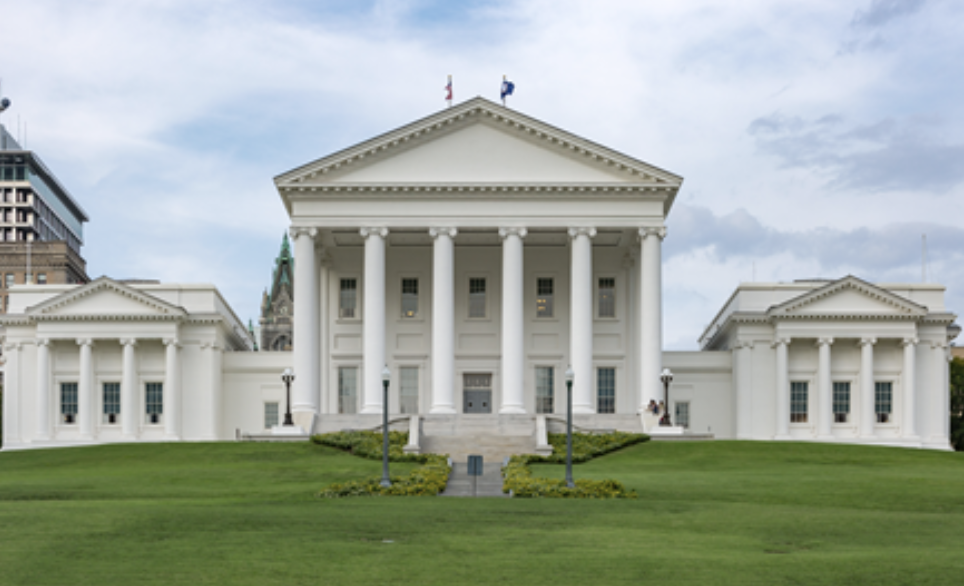
- 10:00am: We will start with the Lafayette Day ceremony in the Rotunda of the Virginia State House (1000 Bank St. Richmond, VA 23219). The Virginia Statehouse houses the oldest elected legislative body in North America. We will conduct a wreath laying ceremony in front of Houdon’s Lafayette bust (see below) and Washington's statue in the Capitol Rotunda. This is a FREE EVENT. We will then....
- ...have a private tour of the Capitol Statehouse. This is a not-to-be missed tour (even if you've done it before). This is a FREE EVENT. We will then walk over to….
- ...the Governor's Mansion where will be given a private tour here as well. This is an exciting opportunity to see the Virginia's Executive Mansion, home to Virginia's governors since 1813, and the oldest governor's residence in the country still used for its original purpose....and a place that Lafayette visited. My hope is that we will be able to see the "Lafayette Bedroom" where Lafayette was nearly 200 years ago. This is a FREE EVENT. We will then walk over to….
-
...a group luncheon within walking distance of the statehouse (Meriwether's). This lunch was a HUGE hit in year's past as the chef flexes his culinary muscles with a delicious and authentic French four-course meal, (Mushroom Soup, Salad Nicoise, Coq au Vin, Creme Brulee) ($35pp to be collected at the door).
I need to provide all venues with the number of people expected.
Thank you and vive Lafayette !!!
Chuck Schwam
AMERICAN FRIENDS OF LAFAYETTE
CHIEF OPERATING OFFICER
NATIONAL BICENTENNIAL COMMITTEE CHAIR
240.676.5010
|
|
OUR MISSIONS:
• To preserve the memory of the French soldiers, sailors and airmen who gave their lives for freedom, and who are buried in the United States.
• To honor French Citizens who did great deeds in the United States, or with a strong connection with the United States,
• To promote the appreciation for French culture and heritage in the United States, and the ideals that unite our two nations, in order to pass the torch of memory to younger generations.
• To strengthen the long-standing traditional bonds of friendship between the American and French peoples, and to this end: erect or maintain memorials and monuments and encourage historical research, public presentations and publications in the media.
We are looking to complete our geographic coverage with Regional Delegates for the SouthWest in cities such as Austin, or Houston, and Louisiana, in cities such as New Orleans or Baton Rouge.
The American Society of Le Souvenir Français, Inc. is an independent American corporation, apolitical, established in 1993 in NY, with 501 (c) 3 non-profit status.
|
|
Sadly, Amazon announced the end of its program as of February 20, 2023 and we will no longer benefit from eligible purchases from Amazon members who enrolled in that program.
|
|
Help us implement several historic commemorative projects celebrating the 245-year-old Franco-American friendship and alliance! |
|
The American Society of Le Souvenir Français, Inc. is a registered NY State non-profit corporation and has full IRS tax exempt 501(c)3 status. All donations are tax deductible.
Copyright © 2023 The American Society of Le Souvenir Français, Inc.
All Rights Reserved
Merci de nous contacter si vous souhaitez recevoir ce bulletin dans sa version traduite en français.
Contact: Thierry Chaunu, President
697 Third Avenue #341 New York, NY 10017
|
|
|
|
|
|
|