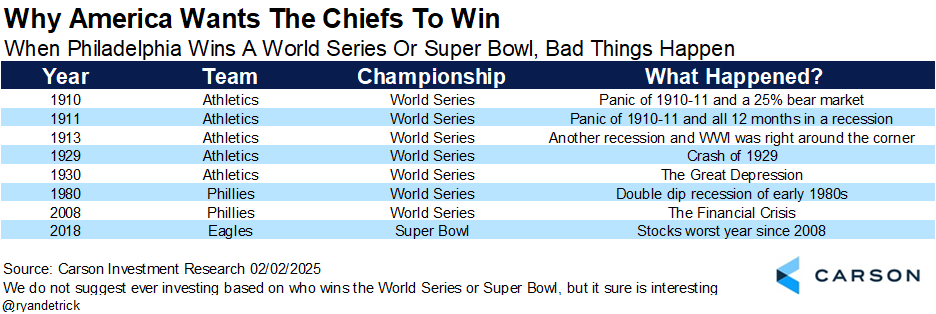
When Philadelphia wins, we lose.


The Eagles won the Super Bowl on February 9th, and the S&P 500 opened at 6,066 the next day. The S&P 500 fell below 5,000 over the next two months.


Economists and Wall Street are not blaming Philly, but are citing trade concerns. The global tariff battle has hit stocks hard all over the world. A pullback on some of the announced tariffs prompted one of the largest rallies on Wall Street ever on Wednesday. The market gave back a chunk of those gains on Thursday.


The main question: Is now a good opportunity to buy?

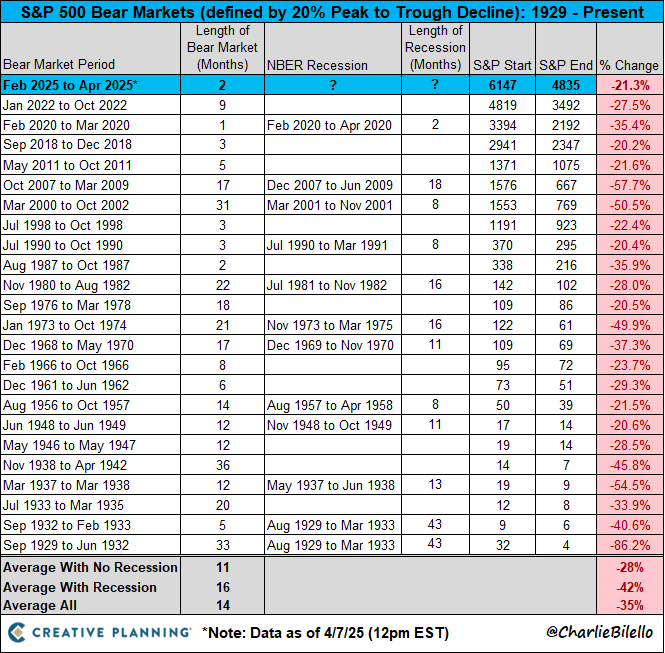
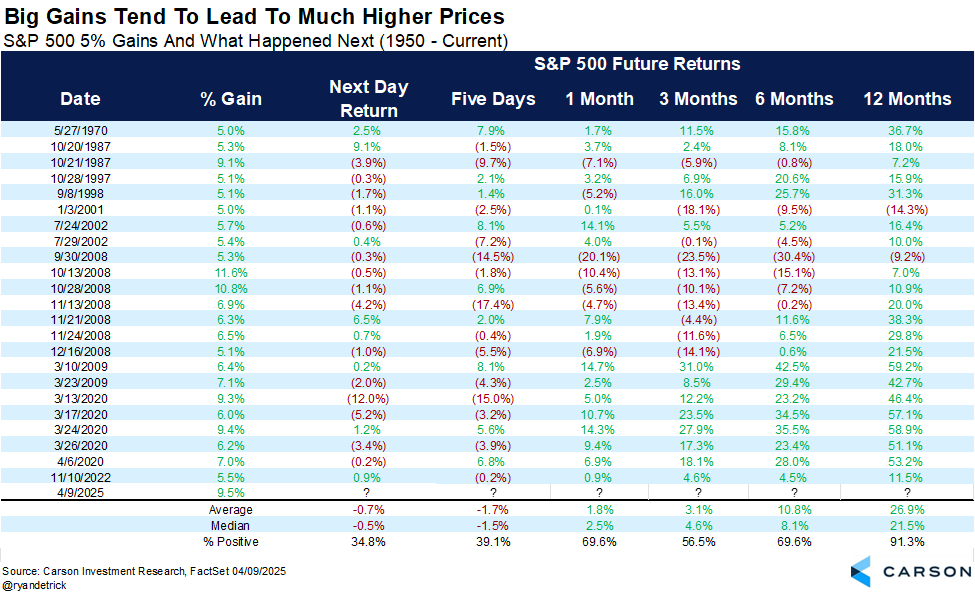
The chart above gives us a history of bear markets (when the S&P 500 falls more than 20% it's called a bear market).


It highlights how challenging timing a market bottom is with stocks.


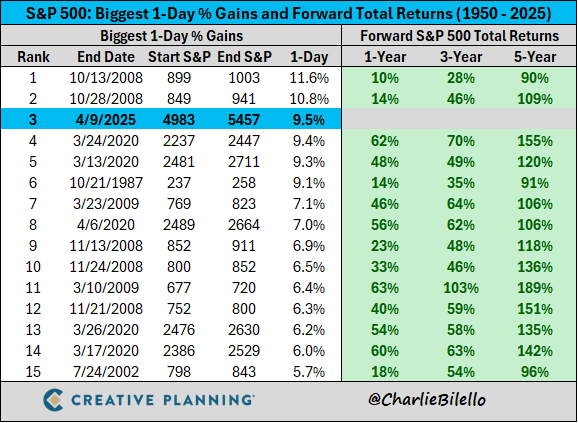
In early 2020, stocks crated. Then, on March 13, 2020, the S&P 500 had one of its best days ever, rallying more than 9% as stimulus measures started to be announced in Washington.


If you bought during that rally, you ended up feeling like a sucker soon after. The S&P 500 closed at 2,711 on the 13th. The index would then drop 20% before bottoming.


In the 2022 bear market, the S&P 500 fell to about 4,000 in the late spring. The index then rallied to nearly 4,500 in July with people saying this was the rally to jump into! The S&P would then decline roughly 22% before bottoming in October at 3492.


The best percentage gain for the S&P 500 since 1932 was October 13, 2008, when the index jumped 11.6%. The index then plummeted more than 30% over the next several months before bottoming in March 2009.


Case closed, don't own or buy stocks right now....

Or... it's a generational buying opportunity!


If you look out one, three, or five years, massive market declines were unbelievable times to dive into stocks.


The March 24, 2020, and March 23, 2009, days in this chart were two rallies off of bear market bottoms.


If you sit on the sidelines, you could miss the beginning of the next great bull market run.


The answer to "should I buy stocks right now" comes down to time.


If you are saving money out into the future, history tells us now is a terrific moment to invest in stocks. If you want to save for retirement and do not plan on retiring in the next few years, look at the chart above.


As far as timing the bottom, the best way to do that is through consistent savings.


If you were saving through your retirement plan in October 2022, you bought at the lows. The same applies with March 2020 and December 2018.

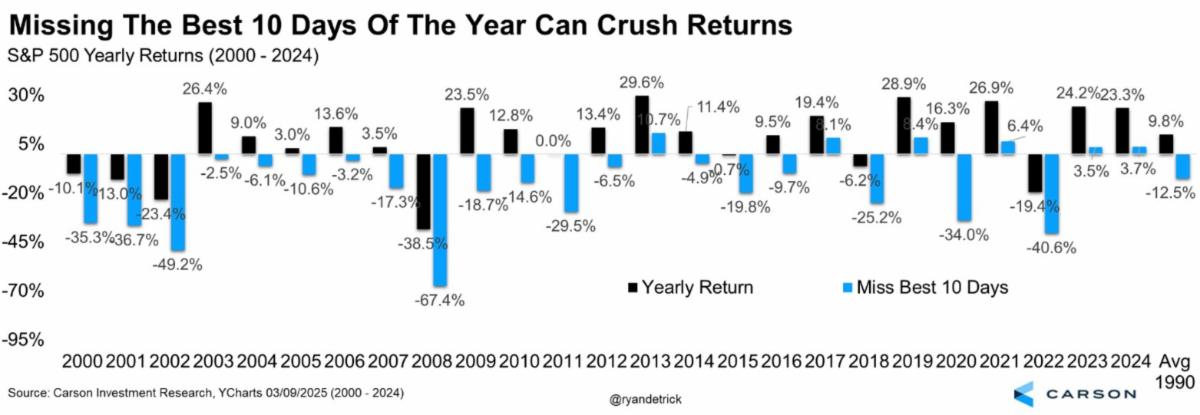
Another important tidbit for investing during downturns is to stay in the game.


I know many of you have heard me say, "I'm more scared about missing out than I am of a 10% downturn." The reason for that mindset is the chart above.


If you sell or stay on the sidelines with excess cash and miss those big rallies, it will have an unfortunate impact on your long term returns.


If the market sell off gets worse, we will have future savings and can rebalance the portfolios to buy into those drops. If the market rallies while you sit on the sidelines, there is no going back in time to get those gains.

There will be moves made in your accounts as the volatility continues.


It will vary from person to person because of the differences in risk level. A person who is retired will have moves made that are much different than a person in their 30's who is in those prime working years.


I do not try to time the bottom for reasons stated above, my preference is to analyze levels and make moves from there.


If the S&P 500 is down 25%, it would take a 33.3% recovery to get back to those all-time highs. If it takes three years for the index to rebound, that would be about an 11% annualized return.


When I analyze other assets, such as US government bonds or high-yield savings accounts, those interest rates are around 4%.


I like my chances of the S&P 500 beating those other assets over a long period of time.


A retired person does not have the same time horizon as me. I can't tell my dad to go be an Uber driver until the stock market recovers. His portfolio reflects that with a lower stock allocation than me.


I know seeing the numbers go down is frustrating. If you have questions or concerns, don't hesitate to reach out.


I will be reaching out to all of you in the coming weeks to discuss your accounts individually.