7/9/24

corn field and blue sky

Topics Included

Are Poor fermentations Degrading Silage Amino Acids?

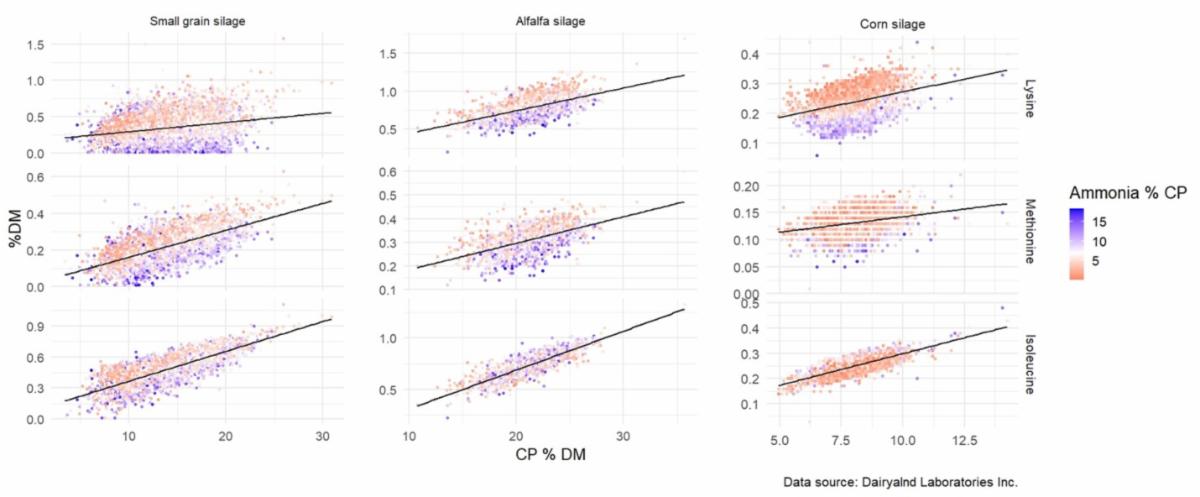
Over the first year of including amino acids in NIR packages for silages, we’ve observed these trends:

  • Silages with high ammonia (or soluble protein) consistently contain lower amino acid levels
  • Some amino acids are impacted more than others

What might be causing these trends?

It looks like amino acids are being deaminated due to poor or extended fermentation during ensiling. As bacteria and fungi break down proteins, deamination results in ammonia production (raising ammonia while lowering amino acids). Clostridium species are especially known for their proteolytic and deaminating activities.  


But why are some amino acids being degraded more than others? Lysine has a unique structure with a side chain amino group, which could make it more susceptible to deamination. Methionine and cysteine are unique in that they contain a sulfur atom, which can cause them to be targeted preferentially by bacteria and fungi.  In contrast, isoleucine, leucine, and valine are branch chain amino acids with more hydrophobic side chains, which could make them less susceptible to microbial attack. 


How much does this matter?

In this example diet, moving the silages’ amino acids and ammonia from a standard deviation on one side of average to the other changed CNCPS predictions of MP allowable milk 2 lbs, MP supply 44 grams, lysine supply 5 grams, and methionine supply 1 gram. 

Feed

lbs/day

Corn silage

15

Alfalfa silage

15

HMSC

10

Protein/mineral mix

10

Total

50

Parameter

1 SD High

1 SD Low

Difference

ME allowable milk

83.2

83.1

0.1

MP allowable milk

83.6

81.5

2.1

MP Supply (g)

2518.8

2474.7

44.1

Lys (g)

171.7

166.4

5.3

Met (g)

54.0

52.7

1.3

His (g)

74.8

71.9

2.9

Within this “normal range” of silage qualities the magnitude of impact isn’t severe, but silage quality is not evenly distributed, and the long tail of poorer fermentations can get ugly. How much MP is truly being lost in those small grain silages where ammonia runs over 30% of CP and lysine approaches 0? or those butyric haylages where ammonia averages 20% of CP?


NIR measurements of lysine, methionine, histidine, leucine, and isoleucine are included in Dairyland’s CNCPS and NASEM Complete packages for all forages and several non-forage ingredients. Combined with XML imports, these impacts of fermentation quality on amino acid concentrations are accounted for in most formulation software by default. 

Printable PDF

What's New

Updated Feed and Forage Summaries are now available

  • Updates include improved searchability and graphical distributions of key nutrients

Silage hygiene tests available including:

  • Clostridium perfringens
  • Enterobacteriaceae
  • Coliform/E. Coli

Enhanced NIR Offerings for Commodities

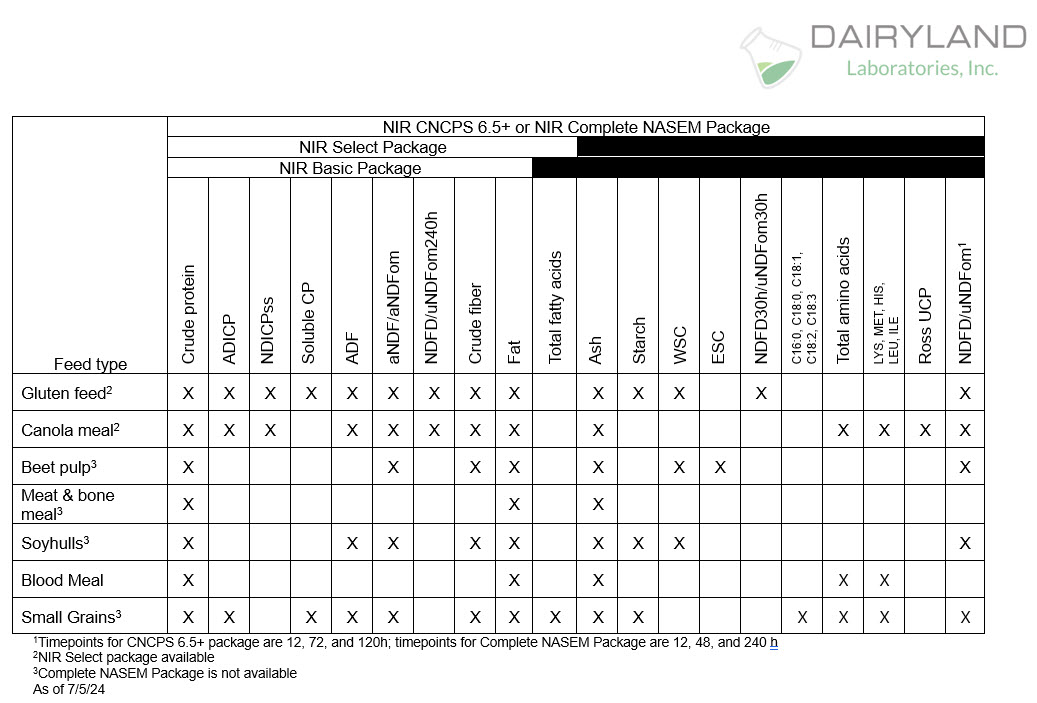
  • The list of feed types and nutrients we can measure by NIR is continuously expanded as we look to quantify variation that is most valuable for diet formulation. Here’s a complete list of commodity feed types, and nutrients offered in NIR packages today, with many new parameters released in the last year.

World Forage Superbowl Deadlines

Entries are now being accepted for the 2024 World Forage Analysis Superbowl. Corn silage entries must be received by July 10, 2024. All other entries must be received by August 22, 2024. The form is available on both the World Dairy Expo and Dairyland Labs websites.


Please read the rules regarding haylage and baleage samples needing to show signs of fermentation. Many samples have been disqualified simply due to not following these rules.


Please write as neatly as possible and provide an email address if available. This helps ensure you receive your results and contest information as efficiently and accurately as possible.


Remember the networking and educational opportunities surrounding the Superbowl. Learning successful growing and harvesting methods from fellow contestants can potentially help your operation long term.


Thank you for your time and interest in the World Forage Analysis Superbowl. We look forward to seeing your submittals throughout the year. Questions regarding sample analysis for the World Forage Superbowl should be sent to Doug Harland, Dairyland Labs – Lab Manager De Pere and a member of the World Forage Analysis Superbowl Committee.

Pricing Update

New pricing will go into effect August 1st, 2024. Most packages will see price increases in the range of 3-5%. This update will help ensure that we can provide the timely and reliable analysis you expect from Dairyland Laboratories. A complete updated price list is available. Please contact us with any questions you may have.   

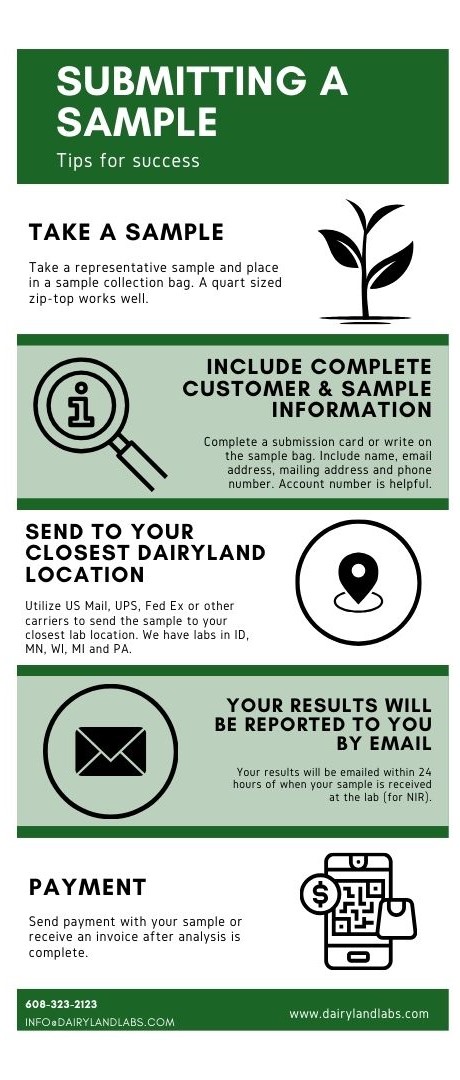
Printable Guide to Submitting a Sample

Here's your quick guide to submitting a sample to Dairyland. Have more questions? Feel free to contact us at any time.

If someone sent you this newsletter, or you found it via social media, and want to subscribe, please use the link below.

Subscribe to Dairyland Newsletters

Dairyland Laboratories, Inc. | 608-323-2123| Email

Facebook  Instagram  LinkedIn  YouTube